Which Credit Card to Pay Off First and Save More
You're staring at three cards, three due dates, and one monthly budget that can't stretch any farther. One card has the ugly rate, one has the tiny balance, and one is sitting close to the edge of your comfort zone. The question of which credit card to pay off first isn't just about math anymore, because the wrong order can cost more in interest, while the wrong first move can also stall your progress or let an account slip into delinquency.
The pressure is real because credit card debt is expensive right now. The CFPB reported that U.S. credit card debt exceeded $1.2 trillion at the end of 2024, average APRs reached 25.2% for general purpose cards and 31.3% for private label cards, and consumers were assessed $160 billion in interest charges in 2024 CFPB Consumer Credit Card Market Report, 2025. In plain English, whichever balance you leave alone the longest can get expensive fast.
Debt Help U is an educational resource, not a lender, and its calculators are built to help people compare payoff timing, interest, and order of attack without handing over personal details. The right answer usually comes from three lenses, interest cost, motivation, and delinquency risk. That's the framework here, and it's the one that keeps people from choosing a strategy that looks smart on paper but falls apart in real life.
Table of Contents
- Introduction Which Card Should You Tackle First
- How Snowball Avalanche and Hybrid Actually Work
- Avalanche vs Snowball vs Hybrid Compared Directly
- What the Numbers Look Like With Real Card Examples
- When Interest Math Is Not the Only Priority
- How to Choose and Put Your Plan Into Action
- Situational Recommendations for Different Households
Introduction Which Card Should You Tackle First
A common setup looks like this. One person has a 29% APR card with a balance that keeps growing, a second card with a much smaller balance, and a third card with a promotional rate that's about to end. Another person has the opposite problem, several manageable balances but one account that's close to being missed, which makes the order of repayment matter in a different way.
That's why there is no single universal winner. The most efficient choice is usually the highest-APR card, but the most practical choice can be the smallest balance or the most urgent account if cash flow is shaky. The core mistake is treating every household like it has the same problem.
The three lenses are simple. Avalanche is about saving the most interest. Snowball is about getting a quick win and staying engaged. A hybrid approach is about protecting yourself from promo expirations, late fees, and penalty APRs while still making progress on cost.
Practical rule: if the balance is stable, prioritize the costliest APR. If motivation is shaky, a visible win may keep the plan alive long enough to matter.
That's the basic decision tree, and it works better than guessing. The sections below show how each method works, when each one fits, and how to turn the choice into a payment plan that gets used.
How Snowball Avalanche and Hybrid Actually Work
All three methods start the same way. Pay the minimum payment on every card, then send every extra dollar to one target card. The difference is simple, it is the order of that extra payment.
Avalanche
Avalanche sends the extra money to the highest APR first. That is the math-first choice because it attacks the balance charging the most expensive interest. Fidelity describes avalanche as the payoff method that cuts total interest most effectively when card rates differ Fidelity.
Snowball
Snowball sends the extra money to the smallest balance first. That card disappears sooner, which gives people a visible win and makes the plan easier to stick with. Behavioral research summarized in a later payoff review found that smallest-to-largest ordering made clients about 14% more likely to eliminate debt after one year and 43% more likely after four years, even though it can cost more interest on paper JMU honors review.
Hybrid
A hybrid rule fits households with mixed risk. Use avalanche or snowball as the default, then override it for a card leaving a 0% promo or a card that is close to delinquency. The CFPB says minimum-payment calculations must assume the post-promotional rate when a promotional purchase APR ends, so an expiring promo can turn costly fast CFPB regulation 1026.51.

The rule does not change the minimums. Every card still gets its required payment until the balance is gone.
That is the practical advantage. One household may need the cheapest path, another needs a quick win, and a third needs to stop a promo reset or late-fee spiral before it spreads. A good plan gives every extra dollar a clear job.
Avalanche vs Snowball vs Hybrid Compared Directly
The cleanest comparison is not “which one is better” in the abstract. It's “which one solves the problem this household has.” If the problem is cost, avalanche usually wins. If the problem is follow-through, snowball often wins. If the problem includes a promo ending soon or a delinquency risk, hybrid is the safer framework.
| Criteria | Avalanche | Snowball | Hybrid |
|---|---|---|---|
| Main goal | Lowest interest cost | Fast momentum | Balance cost, motivation, and urgency |
| Extra payment target | Highest APR | Smallest balance | Highest APR unless promo expiry or risk changes the order |
| Best fit | High-rate debt, disciplined budget | People who need quick wins | Households with mixed risk, promo dates, or stress |
| Weak spot | Slower emotional payoff | Can cost more interest | Requires more judgment |
Avalanche is the strongest answer when the numbers are the priority. It lines up with the classic math of debt repayment, and it gets more valuable as the APR spread between cards gets wider. That's why it's the default recommendation for people who can stay consistent.
Snowball is the better behavioral tool. A small card gone quickly can create momentum that a spreadsheet never will. That does not make it mathematically superior. It makes it more usable for people who keep quitting halfway through.
Hybrid is the smartest answer when reality is messy. A card leaving a promo should jump the line because the cost can change sharply once the temporary rate ends, and a card near delinquency may need attention even if it is not the highest APR. That is the part most generic explainers skip.
For a deeper breakdown of how these methods compare in practice, see Debt Help U's debt snowball vs avalanche guide.
Avalanche saves the most interest when the APR spread is meaningful and the budget is stable.
Snowball improves follow-through when a quick win is the difference between sticking with the plan and abandoning it.
The right choice is usually obvious once the goal is named clearly. If the goal is minimum cost, pay the highest APR first. If the goal is sticking with a plan, pay the smallest balance first. If the goal includes avoiding a costly transition or a missed payment, override both with the urgent account.
What the Numbers Look Like With Real Card Examples
Start with a simple household case. Card A has a $3,200 balance at 22% APR, Card B has a $700 balance at 17% APR, and Card C has a $1,500 balance at 29% APR. Add $50 per month beyond minimums, and the payoff order changes the outcome in a real way.
Run those cards through the Debt Help U calculator and avalanche produces $1,969 in total interest, while snowball produces $2,129 Debt Help U snowball vs. avalanche calculator. Both methods clear the debt in 36 months, and avalanche costs $160 less in interest. That spread is why the highest-APR card usually goes first when the budget is steady.
Why the high-APR card often comes first
The high-APR balance is the one that grows fastest if you leave it alone. Carrying expensive revolving debt while making only minimum payments is a bad trade when cash flow is tight. The CFPB's credit card market reporting shows how common costly balances still are, which is exactly why the most expensive card deserves attention early CFPB Consumer Credit Card Market Report, 2025.
The small-balance card still matters. If the person paying the debt is worn down, a fast win can keep the plan alive. In that case, the cheapest card to eliminate first can make more sense behaviorally, even when it is not the lowest-cost option.
How to test the numbers privately
Use the Debt Help U debt payoff planner to compare both approaches against your own balances and extra payment amount Debt Help U debt payoff planner. A quick calculator run shows payoff date and total interest without guesswork.
That check matters because two cards can look similar on a statement and still produce very different results once APR and extra payments are included. The point is to see the tradeoff before sending the first extra dollar.
When Interest Math Is Not the Only Priority
A payoff plan should start with the card that can do the most damage next. If a 0% promo is ending soon, a payment is overdue, or one balance is sitting close to a limit, that card moves to the front even if it is not the most expensive on paper.
That is the triage rule. Protect against a rate jump first, protect against a credit hit second, then use interest math to fine-tune the rest. Expiring promo terms can change what you owe and how the minimum payment works, so a card with a deadline deserves early attention.
The urgency checklist
- Promo ending soon: move this card up if the rate will rise after the promotion ends.
- Late-payment risk: put the card with the highest chance of a missed payment or fee at the front.
- Utilization stress: if one account is crowded near its limit and causing credit worry, reduce that balance sooner.
- Stable accounts: keep these in the normal avalanche or snowball order.
The New York Fed has said credit-card delinquency remains high but mostly stable since 2024, while broader consumer stress measures have moved in different directions NY Fed Liberty Street Economics. That is a clear sign that some households need a missed-payment prevention plan, not just a plan that minimizes interest. The right first card is sometimes the one that keeps the whole budget from cracking.
A simple household rule works well here. If a card is close to delinquency, protect the account first. If a promo is about to end, pay that balance before the higher rate hits. If the cards are stable, go back to avalanche or snowball and let the numbers decide.
Interest savings still matter. They just do not outrank a looming fee, a penalty rate, or a credit hit that can make recovery harder.
How to Choose and Put Your Plan Into Action
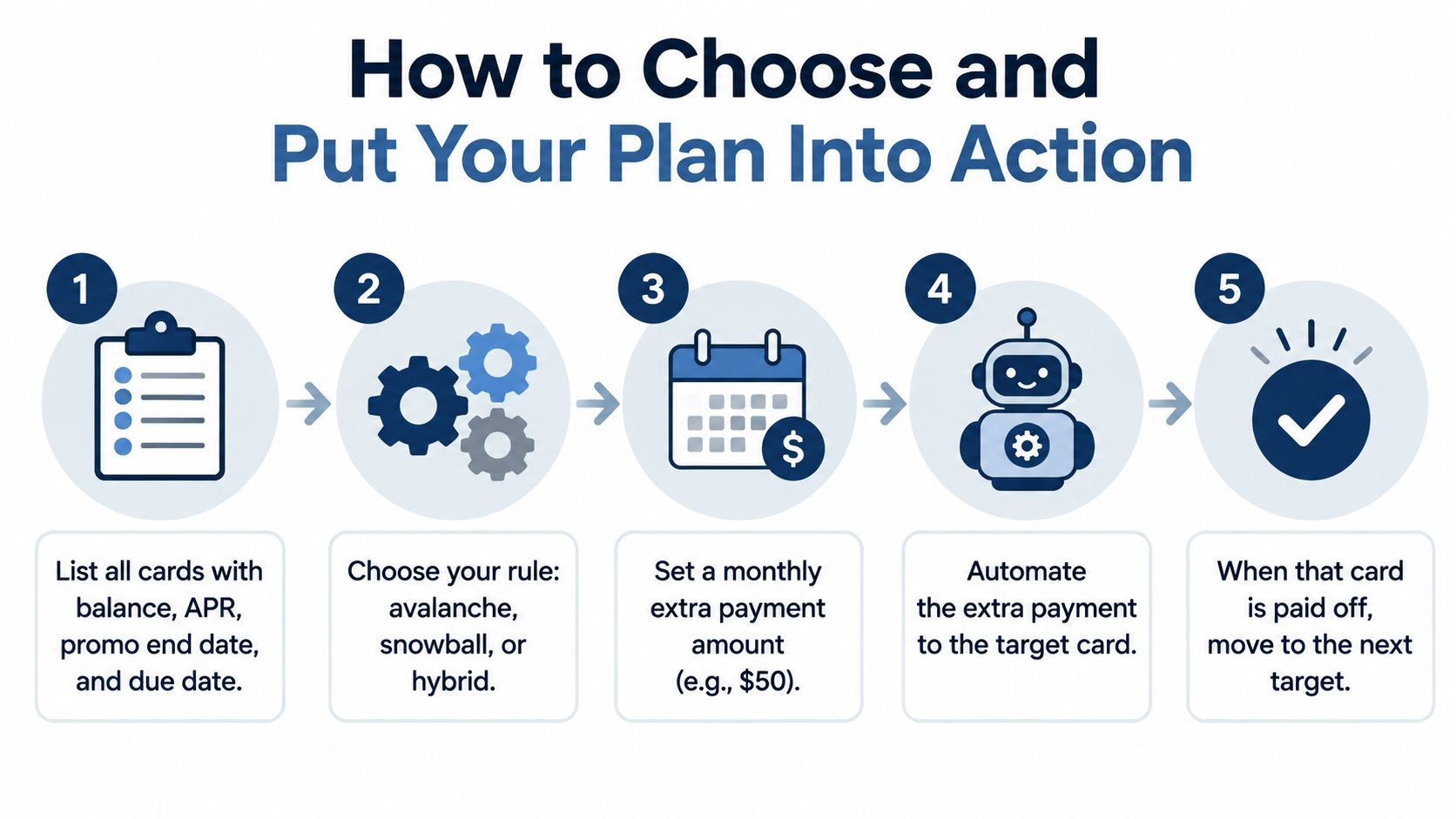
A payoff plan gets real only when it's written down with actual numbers. Start with every card, then list balance, APR, promo end date, and due date. That is the whole input set needed to decide which credit card to pay off first without guessing.
Then pick the rule. If the cards are stable, choose avalanche. If the household needs morale boosts, choose snowball. If one card has a promo ending or a delinquency risk, let that card jump the line even if it breaks the default order.
The next move is mechanical. Set a fixed extra amount, even if it's small, and automate it to the target card. Debt Help U's calculator tools include a debt payoff planner that can show how that extra payment changes the timeline before any money moves Debt Help U debt payoff calculator.
A simple execution list
- List the cards. Include the balance, APR, due date, and any promo deadline.
- Pick the target. Choose the highest APR, smallest balance, or urgent account.
- Lock the extra payment. Use one monthly amount and keep it consistent.
- Automate the transfer. Set the extra payment to go to the chosen card.
- Roll the freed-up payment. When one card is gone, add that payment to the next target.
If cash flow feels too tight to do any of this comfortably, a broader affordability check matters. Debt Help U also offers a DTI calculator and a six-question assessment to help users gauge whether repayment, consolidation, or another option makes more sense. That's useful because the right payoff order doesn't fix a budget that's already breaking.
The important part is to stop treating the minimum payment as the plan. The minimum is just the floor. The extra payment is what changes the outcome.
Situational Recommendations for Different Households
A tight budget with a little room for consistency should usually start with snowball if quick wins are the only thing keeping the plan alive. A household with a wider APR spread and steady cash flow should go straight to avalanche because that is where the interest savings live. If a promo is ending soon, that card should move ahead of the pure APR ranking.
If utilization stress is the problem, the card closest to the limit may deserve first attention even if another account has a higher rate. If delinquency risk is already on the table, the account most likely to miss a payment should be the first rescue target. That's not a soft recommendation. It's a practical one.
People can also switch methods without failing. A snowball plan can become avalanche once the first two cards are gone and the confidence is there. An avalanche plan can become hybrid if a promo starts to expire or a household expense spikes.
Use the payoff date and total interest projections as a reality check after the first setup. If the plan is not moving, the issue is usually not the math, it's the structure. Debt Help U publishes plain-language guides, and it can provide an optional referral only when asked, with U.S. availability varying by state.
If the goal is to stop guessing and start paying the right card first, use Debt Help U to compare payoff order, interest, and timeline before sending the next extra payment. The calculators can help show whether avalanche, snowball, or a hybrid triage plan fits the cards on the table right now.
Related guides
- Debt snowball vs. avalanche: which one finishes faster Avalanche always pays less interest. The gap is smaller than the argument about it suggests. Run both on your own balances and see what it is worth.
- How to get out of credit card debt without a loan Borrowing your way out is the advice everyone gives first. Here is what works when you do not want more debt.
- How long will it take to pay off my credit card debt? Your minimum payment shrinks every month. Following it down is what turns a five-year balance into a thirty-five-year one.