How to Figure Finance Charge on Credit Cards Fast
A credit card statement can show a balance that looks familiar, yet the finance charge still feels surprising. The reason is simple: the issuer usually doesn't wait until the statement date to calculate borrowing costs. The balance can affect interest day by day, and the timing of payments, new purchases, and certain fees can change the result.
Learning how to figure finance charge means separating three ideas: the APR, the daily periodic rate, and the dollar finance charge. Once those pieces are clear, the calculation becomes a practical balance exercise rather than a mysterious line on a statement.
Table of Contents
- What a Finance Charge Really Means for Your Card
- Gather What You Need Before You Calculate
- How to Figure Finance Charge With Average Daily Balance
- Why Payment Timing and Fees Change Your Result
- Estimate Total Cost When You Pay Minimum or Add Extra
- Quick Check and Next Steps to Stay Accurate
What a Finance Charge Really Means for Your Card
Suppose a cardholder carries a balance into a billing cycle and pays part of it before the statement closes. The issuer doesn't necessarily apply one monthly percentage to the final statement balance. Instead, the issuer may use the balance recorded across the billing cycle, apply the applicable rate, and include qualifying credit-related charges.
Under Regulation Z's finance-charge definition, a finance charge is the dollar cost of consumer credit. It includes a charge imposed directly or indirectly on the consumer as a condition of receiving credit. This is broader than interest alone.
APR and finance charge are related, but they aren't the same thing. APR expresses the borrowing cost as an annualized rate. The finance charge expresses the resulting cost in dollars for the relevant transaction, balance, or billing period. For open-end credit, issuers disclose both the periodic rate and the annualized APR, helping consumers compare accounts. For closed-end credit, the APR framework also connects the finance charge with the unpaid balance through an actuarial method.
The practical distinction: APR tells a cardholder how the rate is expressed. The finance charge tells that cardholder how many dollars the credit cost.
That distinction matters when a cardholder compares two offers. A lower stated rate may not tell the entire story if one account also applies transaction charges or other credit-related fees. Federal disclosure rules were designed to standardize borrowing-cost information so consumers could shop more transparently, and that disclosure structure remains central to U.S. consumer credit pricing.
For a credit card, the most useful mindset is to treat the finance charge as a daily accrual, not a month-end percentage. The next step is collecting the exact inputs before doing any multiplication.
Gather What You Need Before You Calculate
A correct calculation starts with the account terms, not a guessed monthly rate. The cardholder should gather the following information from the latest statement, card agreement, and transaction history.
- APR by balance type: Check whether purchases, cash advances, and balance transfers have different APRs. The applicable rate depends on the type of balance being calculated.
- Billing-cycle length: Record the cycle's opening and closing dates. The number of days affects the result.
- Daily periodic-rate rule: Many calculations use APR divided by 365, although some issuers use 360. The card agreement controls the method.
- Daily ending balances: List the balance for each day, including payments, new purchases, credits, and other changes.
- Qualifying fees: Look for cash-advance fees, balance-transfer fees, or other charges that may be included in the finance-charge calculation.
- Payment dates: A payment made early in the cycle affects more daily balances than the same payment made near the end.
The Federal Reserve's Regulation Z guidance explains why the nominal APR may not tell the whole story. A billing cycle can have a historical or effective APR that differs from the nominal APR when charges such as cash-advance or balance-transfer fees enter the finance-charge calculation.
The statement may show a finance-charge line, but that line is a result to verify, not always enough information to recreate the calculation. A transaction list helps identify when the balance changed and whether a fee was added.
A spreadsheet can make the daily list easier to manage. The key is consistency. If a payment posted on one date but was scheduled on another, the posted date and the issuer's terms may determine when the balance changed for calculation purposes.
How to Figure Finance Charge With Average Daily Balance
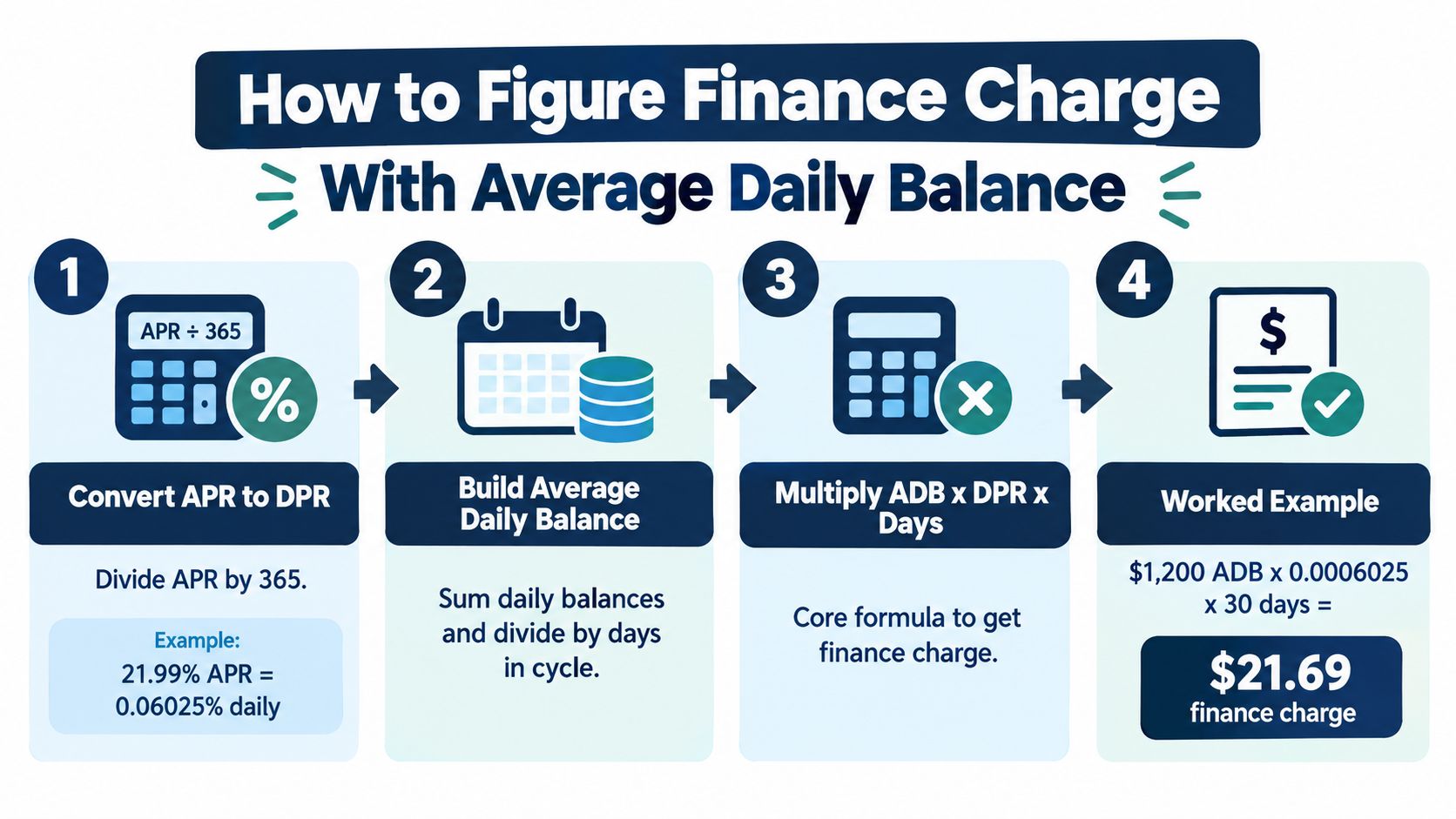
The common credit-card formula is:
Average daily balance × daily periodic rate × days in the billing cycle = finance charge
The Chase explanation of daily periodic rates describes the standard process of identifying the APR, converting it to a daily rate, calculating the average daily balance, and multiplying the results by the cycle length.
Step 1 Convert APR to a daily rate
Take the APR and divide it by 365 when the issuer uses a 365-day method. For a 24% APR, the daily periodic rate is about 0.06575%, or 0.0006575 as a decimal. The decimal form is the one used in the multiplication.
The rate applies to the balance held over each day. That is why the timing of a payment matters, even when the payment amount stays the same.
Step 2 Build the average daily balance
List each day's ending balance. Add those daily balances together, then divide the total by the number of days in the cycle.
A simplified example uses a $1,200 average daily balance, a 24% APR, and a 30-day billing cycle:
- Daily periodic rate: 24% ÷ 365 = about 0.0006575.
- Average daily balance: $1,200.
- Cycle length: 30 days.
- Finance charge: $1,200 × 0.0006575 × 30 = about $23.67.
The result is an estimate based on the stated inputs. The account agreement may use a different divisor, include fees, or apply separate rules to different balance types.
Step 3 Account for payment timing
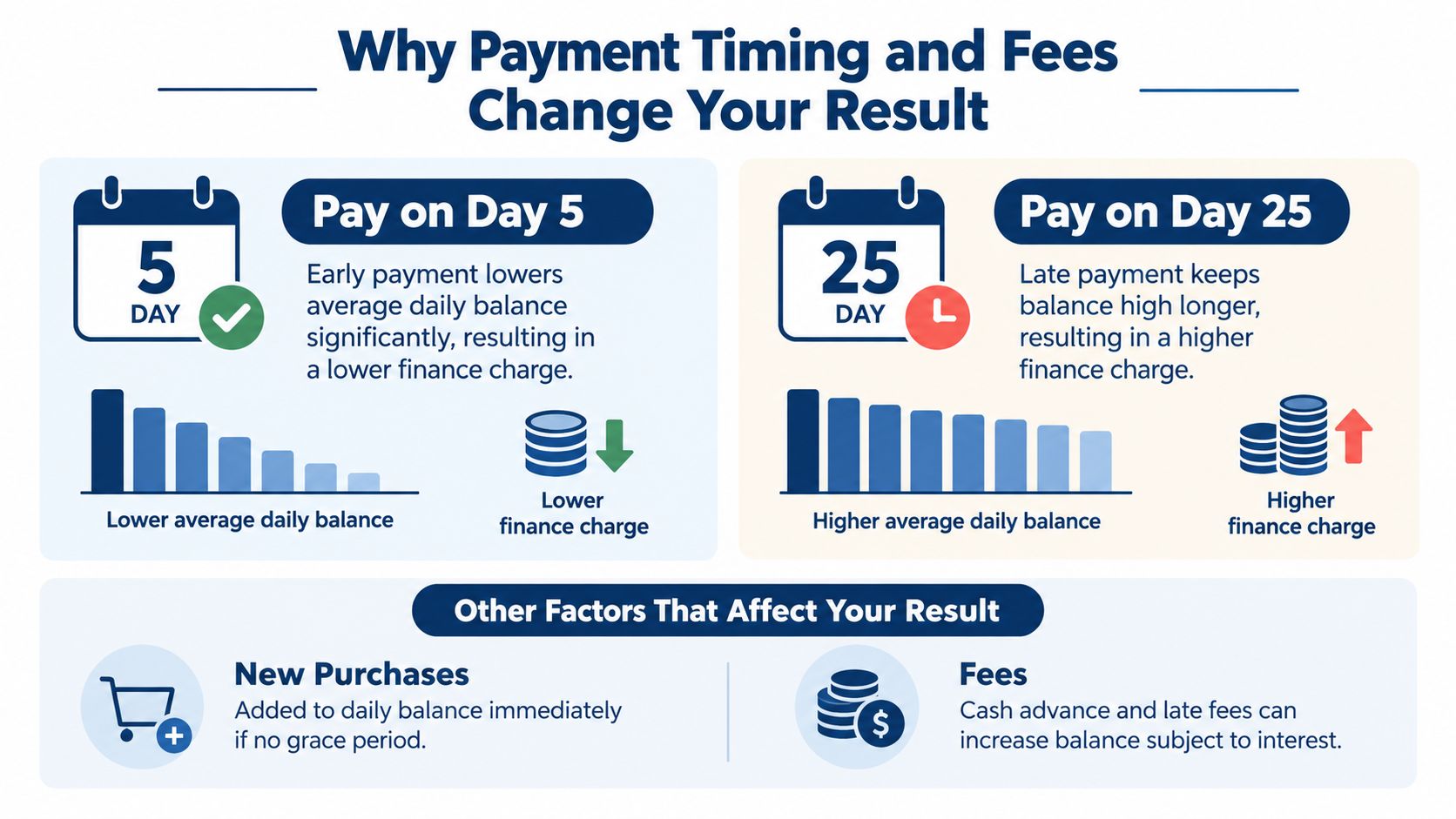
Consider a cardholder who starts with a balance and makes a meaningful payment during the cycle. A payment on day five lowers the balance for most of the remaining cycle. The same payment on day 25 leaves the original balance in place for much longer, so the average daily balance will usually be higher.
A quick two-period illustration makes the weighting clear. If a balance is $1,200 for the first five days and $700 for the remaining 25 days, the average daily balance is:
(($1,200 × 5) + ($700 × 25)) ÷ 30 = about $783.33
The calculation doesn't treat the payment as if it happened at month-end. It gives the lower balance more weight because it lasted longer.
For readers who want to test different balances and payment dates, the credit card interest calculator can provide a structured estimate. A manual calculation remains useful because it shows exactly why the result changes.
Payment timing is the largest practical error source. A month-end balance shortcut can miss the days when a payment, purchase, or fee changed the amount subject to daily accrual.
Why Payment Timing and Fees Change Your Result
Two cardholders can have the same APR and different finance charges because their balances followed different paths. The rate is only one input. The balance held on each day determines how much of that rate has something to act on.
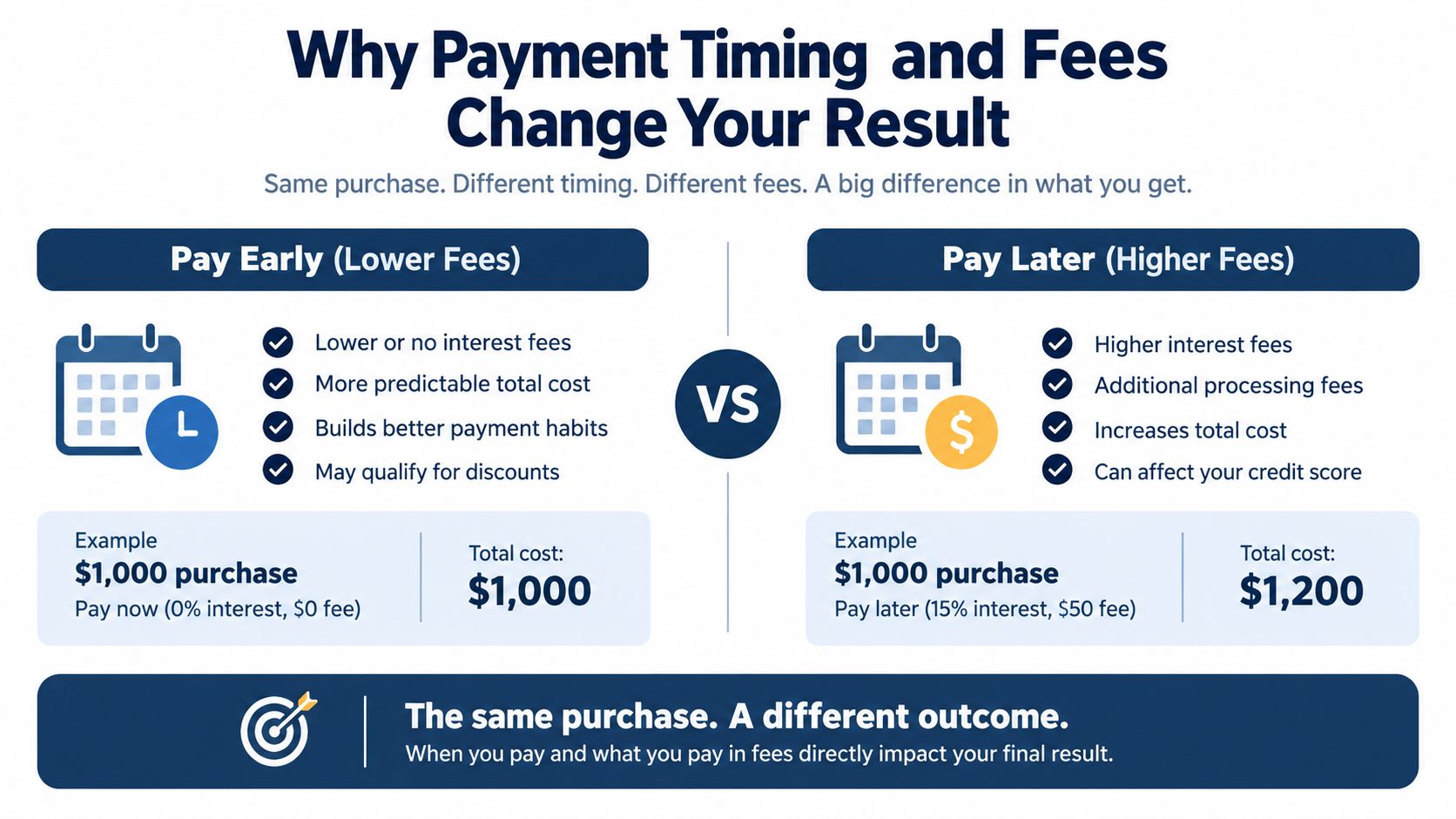
Consider a $1,000 purchase. If a payment reduces the balance on day five, the lower balance applies across most of the remaining cycle. If the payment posts on day 25, the higher balance remains in place for much longer. The early payment generally produces a lower average daily balance, while the later payment generally produces a higher one.
A simple timeline helps explain the difference:
| Payment timing | Balance pattern | Likely calculation effect |
|---|---|---|
| Early in the cycle | High balance for fewer days, lower balance for more days | Lower average daily balance |
| Late in the cycle | High balance for more days, lower balance for fewer days | Higher average daily balance |
New purchases can also change the result. If a purchase enters the daily balance and doesn't receive a grace-period treatment, it can affect the amount used in the calculation from the applicable posting date.
Fees require another check. Under the federal guidance cited earlier, transaction charges and other credit-related fees can form part of the finance charge. A cash-advance fee or balance-transfer fee may therefore raise the cycle's all-in borrowing cost beyond the interest produced by the balance alone.
A lower finance charge estimate can be wrong if it leaves out a fee that belongs in the account's finance-charge calculation.
The statement's transaction section should be reviewed alongside the rate disclosures. A cardholder comparing the expected finance charge with the statement should check three dates first: the payment posting date, the purchase posting date, and the date any fee was added.
Estimate Total Cost When You Pay Minimum or Add Extra
One month's finance charge answers only a narrow question. A cardholder carrying a balance also needs to know how the payment choice changes the balance for future cycles.
Minimum payments are often structured as the greater of a flat amount or a percentage of the balance. The CFPB's 2025 Consumer Credit Card Market Report describes this type of minimum-payment structure for U.S. cards, using the example of a minimum payment set at the greater of accrued interest plus 1% of the balance or $35. That kind of formula illustrates why minimum-payment rules can alter the speed of repayment and the total finance charge over time.
A minimum-only plan may reduce the balance slowly, especially when new purchases continue. Adding a fixed amount changes the balance used in later daily calculations, and an early extra payment can also reduce the current cycle's weighted balance.
The comparison below is intentionally qualitative. Exact payoff time and total finance charge require the current balance, APR, minimum-payment rule, fees, new purchases, and payment dates.
| Payment Strategy | Estimated Payoff Time | Total Finance Charge | When This Fits Best |
|---|---|---|---|
| Minimum payment only | Longer and dependent on the issuer's formula and changing balance | Higher when the balance remains outstanding longer | A temporary cash-flow constraint |
| Minimum payment plus a fixed extra amount | Shorter when the extra amount is sustained | Lower when the balance falls faster | A cardholder who can commit extra room in the monthly budget |
| Early payment plus extra amount | Often more efficient than waiting until the due date, subject to account terms | Potentially lower because the daily balance falls sooner | A cardholder paid before the statement or due date |
The minimum payment calculator can help test a minimum-only scenario against an added monthly amount. The result is an estimate, not a promise, because issuer rules and future account activity can change the schedule.
The most useful comparison isn't merely “minimum” versus “extra.” It is minimum at the usual payment date versus minimum plus extra paid as early as practical. That comparison captures both payment size and payment timing.
Quick Check and Next Steps to Stay Accurate
A manual estimate becomes more useful when it can be checked against the actual statement. The following routine keeps the review focused:
- Confirm the APR: Match the balance type with the rate used in the calculation.
- Confirm the divisor: Check whether the account uses 365 or another method.
- Rebuild the daily balance: Include posted payments, purchases, credits, and applicable fees.
- Check the cycle length: Use the actual opening and closing dates.
- Compare the result: Review the statement's finance-charge line and investigate any meaningful difference.
A mismatch doesn't automatically mean the issuer made an error. The account may use separate rates, a different daily-rate convention, a grace-period rule, or a fee treatment that wasn't included in the first estimate. The card agreement and statement disclosures should resolve the uncertainty.
For a longer-term view, the debt payoff calculator can help organize balances and repayment assumptions. Debt Help U provides free, no-login calculators that estimate repayment timelines and interest scenarios, with inputs kept in the browser during calculator use.
The central habit is straightforward: record what happened each day, not only what appears on the statement date. A payment made earlier can lower the balance used across more days, while a fee or new purchase can raise it. That daily perspective makes the next finance-charge estimate easier to check and makes payoff choices easier to compare.

For the next billing cycle, save the statement, mark every payment posting date, record new transactions, and calculate the average daily balance before the statement arrives. Then compare the estimate with the finance-charge line and adjust the following payment plan based on what the numbers show.
Debt Help U offers plain-language guides and private, no-login calculators for estimating credit-card interest, minimum-payment timelines, and payoff strategies. Visit Debt Help U to test the next billing cycle's numbers and compare repayment options before sharing personal contact information.
Related guides
- How long will it take to pay off my credit card debt? Your minimum payment shrinks every month. Following it down is what turns a five-year balance into a thirty-five-year one.
- How to get out of credit card debt without a loan Borrowing your way out is the advice everyone gives first. Here is what works when you do not want more debt.
- Debt settlement vs. consolidation vs. bankruptcy Four paths out of unmanageable debt, what each one costs, and what each one breaks. Real numbers on a $30,000 balance, not a pitch for any of them.