Payment in Full Letter: How to Write One That Works
You've made the last payment on a debt that's been hanging over your head, and now you want proof. Not a vague email, not a verbal promise from a collector, but a written record that says the account is closed and the balance is zero. That's exactly where a payment in full letter matters.
A common mistake is treating it like a magic spell. It isn't. It's one control point in a payoff or settlement workflow, and it only works if the balance is already resolved, the wording is precise, and the paper trail is tight. Used the right way, it helps protect the payoff you already made. Used the wrong way, it just creates confusion.
Table of Contents
- When You Actually Need a Payment in Full Letter
- Paid in Full Versus Settlement Offer Versus Balance Confirmation
- What to Put in the Letter Step by Step
- A Ready to Use Template You Can Adapt
- Setting the Right Offer Before You Send Money
- Sending the Letter and Keeping Your Paper Trail
- Putting It All Together Without Overpromising
When You Actually Need a Payment in Full Letter
The letter matters at the moment the money is no longer theoretical. That can be the day a cashier's check is handed over, a wire clears, or a settlement payment posts to an account that's been dragging on for months. At that point, the goal is simple, put the debt in writing, identify the account, and ask the creditor to confirm the balance is zero.
A payment in full letter is not a negotiation tool. It is not a payoff statement, and it is not a request to settle for less. It is a written confirmation request after the money has moved, so there's no room later for a collector to claim the payment was partial or misapplied.
Practical rule: if the payment has already cleared, the letter should document the closure, not re-open the deal.
That distinction matters because paid accounts can still stay on a credit file under reporting rules, even when the balance is zero. Paid collections are normally updated to show a paid status rather than deleted, and most negative information can stay on a credit report for seven years, which is why the letter is useful as evidence even when the tradeline doesn't vanish immediately. FICO reports that collections reported as paid in full are disregarded by FICO Score 9 and the FICO Score 10 suite, so the value of the letter depends on the scoring model and the debt type. How collections affect your FICO Score
The other reason the letter exists is documentation for future disputes. A creditor or collector may later argue about the status of the account, especially if the payment went through a settlement path or the balance had been contested. Keep the letter with the final statement, the receipt, and any written acknowledgment, as those records help show the account was closed.
If the account is old, the debt may also sit near other legal issues, including collection timing. The statute of limitations question is separate from the letter itself, but it often sits in the background of payoff decisions, so it's worth checking the rules before sending money through this statute-of-limitations guide.
The three situations that justify sending one are straightforward. First, paying off an open account on good terms. Second, closing a charged-off balance after a settlement payment has cleared. Third, satisfying a final judgment or collection balance with a lump sum.
Paid in Full Versus Settlement Offer Versus Balance Confirmation
These three letters look similar on paper, but they do very different jobs. Mixing them up is how people lose negotiating power or send money before they have protection.
A payment in full letter goes out after payment. It asks for confirmation that the debt is satisfied and the balance is zero. A settlement offer letter goes out before payment. It proposes a reduced lump sum and should trigger written acceptance before any money leaves the account. A balance-confirmation request goes in the opposite direction. It asks the creditor to state what it believes is owed, usually because the number is disputed, stale, or tied to old records.
| Three Creditor Letters Compared | Sent Before or After Payment | What Creditor Must Return | Biggest Risk if Misused |
|---|---|---|---|
| Payment in Full Letter | After payment clears | Written confirmation of zero balance or paid status | Treating it like a negotiation letter instead of documentation |
| Settlement Offer Letter | Before payment | Written acceptance stating the offer closes the debt | Paying before acceptance and losing the full-satisfaction protection |
| Balance-Confirmation Request | Before payment, usually before dispute work | Statement of the creditor's claimed balance | Sending money when the amount is still uncertain |
The choice is usually obvious once the goal is named. If the money already moved, use the paid-in-full letter. If the money has not moved and a reduced lump sum is being proposed, use the settlement offer. If the number itself is in question, ask for balance confirmation first.
If the creditor is still deciding whether to accept a reduced amount, the reader is not ready for a payment-in-full letter yet.
That simple rule keeps the process from getting sloppy. It also lines up with broader guidance on debt-resolution choices, including the tradeoffs between settlement, consolidation, and bankruptcy, which are laid out in this comparison guide.
What to Put in the Letter Step by Step
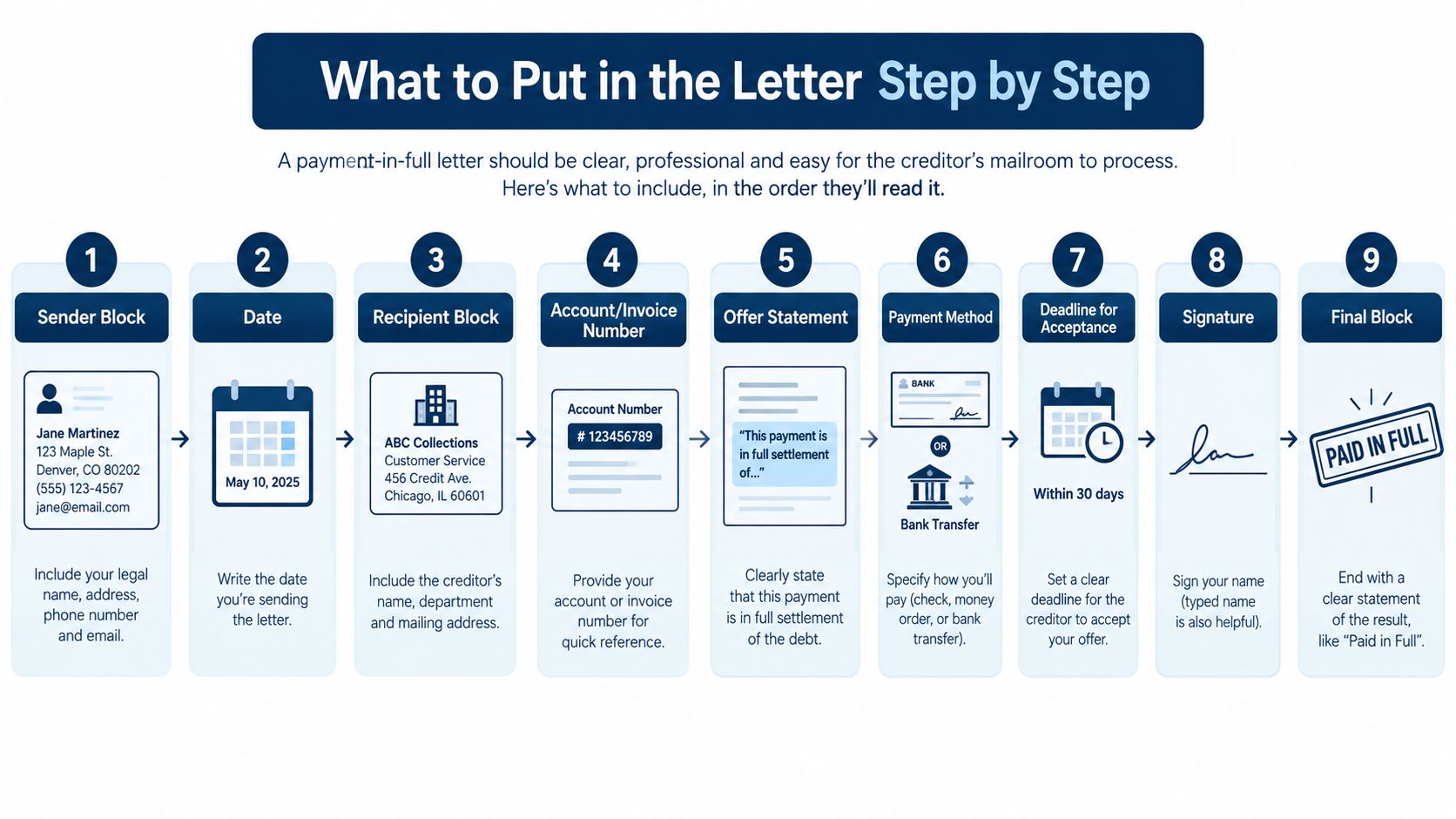
The mailroom reads the sender block first, not the story behind the debt. That means the letter should start with the full legal name, current mailing address, phone number, and email address. If those details are missing, the creditor has no clean way to match the paper to the account holder.
Start with identity and account details
After the date, list the creditor's correct legal entity name and the payment-processing address. Do not guess at the collections branch if the payoff department handles closures. Then identify the account number and the original creditor, because those two items are what anchor the file.
Practical rule: send the letter to the office that handles payoff or settlement postings, not just the address printed on a collections notice.
Next, state the payment method, the amount, and the date it cleared. The sentence should say plainly that the payment constitutes payment in full of the named account. That is the core line, and it should not be buried inside polite filler or mixed with explanations about hardship.
Make the request short and exact
The request block should ask for three things. Mark the balance zero. Return written confirmation that the account is paid in full. Stop any further interest or fee accrual tied to that balance, if anything is still being added behind the scenes.
A short closing paragraph is enough. Sign the letter, then give the creditor a defined number of business days to respond. The tone should stay neutral and factual. Apologies, arguments, and emotional detail only dilute the record.
Here's the order that usually works best:
- Sender block, full contact information.
- Date.
- Creditor legal name and address.
- Account identifiers, account number and original creditor.
- Payment statement, amount, method, and clearance date.
- Confirmation request, zero balance and written acknowledgment.
- Signature and response window.
That sequence matches how a creditor's records team processes it. The letter is there to document, not to debate.
A Ready to Use Template You Can Adapt
A usable template should be plain enough to copy, but sharp enough to hold up later. The line that matters most is the one stating that acceptance, or the payment itself if the debt has already been paid, constitutes full and final satisfaction of the account. That language is where careless wording causes the most trouble.
Template
[Your full legal name]
[Your mailing address]
[City, state, ZIP]
[Phone number]
[Email address]
[Date]
[Creditor legal name]
[Payment processing address]
[City, state, ZIP]
Re: Account number [account number], original creditor [original creditor name]
Dear [Creditor name]:
This letter confirms that payment in the amount of [amount] was made on [date cleared] by [method of payment] for the above-referenced account. This payment is tendered as full and final satisfaction of the account.
Please update your records to show a zero balance and send written confirmation that the account has been paid in full. If any balance, interest, or fee has continued to accrue, please correct your records accordingly.
Sincerely,
[Your signature]
[Your printed name]
The required elements are the date, the creditor's correct name and address, the account number, the payment amount, the payment method, and the statement that the payment is in full and final satisfaction. The request for written paid-in-full confirmation also belongs in every version.
Optional details can help, but they're not required. A case or file number can be useful. A phone number for receipt acknowledgment can help the payment team find the record faster. A short factual recap of the debt can be added if the account has been transferred multiple times.
What should be skipped is just as important. No apologies. No life story. No admissions of hardship that invite a collector to reframe the payment as something less than final.
The weakest version of the key sentence says, “this resolves the account.” That's too soft. The stronger version says, “acceptance constitutes payment in full and complete satisfaction of the above-referenced account.” That is the line that closes the door.
For a routine payoff with no discount, keep the amount equal to the full balance and leave the settlement language out of the body. For an accepted settlement, keep the same structure but make sure the amount line matches the written acceptance and the satisfaction clause clearly says the reduced payment closes the entire account.
Setting the Right Offer Before You Send Money
A weak offer ruins a good letter. The biggest mistake is mailing a check for less than the full balance before the creditor has agreed in writing to accept that amount as full satisfaction. Under accord-and-satisfaction principles, that can leave the rest of the debt alive and enforceable if the wording is sloppy or the acceptance isn't clear.
The number should be built, not guessed. Start with the last statement and separate principal, interest, and fees. Check the statute of limitations on the debt in the relevant state. Then look at where the account sits, original creditor, third-party collector, or junk-debt buyer, because each one reacts differently to a reduced lump sum. The older and less documented the account, the more room there usually is to negotiate.
A practical way to think about it is pro-rata fairness. If the debtor has a fixed lump sum and multiple unsecured accounts, the offer should be sized so each creditor can see the same basic logic across the file. Guidance on full-and-final settlement offers recommends dividing the available lump sum by total unsecured debt and using that ratio to set each offer, then attaching an income-and-expenditure budget where relevant. It also warns that payment should not be sent until written acceptance is in hand. Full and final settlement offer guidance
| Offer Size by Debt Situation | Typical offer as % of balance | Reason |
|---|---|---|
| Older, disputed, or heavily aged balance | Lower end of a settlement range | Collection risk is weaker and documentation may be thinner |
| Balance nearing a limitations window | Mid-range settlement level | The creditor still wants recovery, but enforcement leverage may be changing |
| Recent, well-documented balance with original creditor | Closer to full payoff | Acceptance is less likely at a steep discount |
| Structured payoff instead of discount | Full balance over time | The debt is still strong enough that a discount is a harder sell |
A worked example keeps the math honest. A $4,000 balance with a limitations window that is nearing its close might justify a settlement offer in the middle of the range, while a recent debt owed to the original creditor usually calls for a much tighter offer or a structured payoff instead of a discount. The point is not to chase the biggest haircut. The point is to send an amount that matches the risk and the paper trail.
That same logic also matters when collection pressure is high. A wage-garnishment concern can change how aggressively a creditor will negotiate, which is why this garnishment guide belongs in the background before any check is mailed.
Sending the Letter and Keeping Your Paper Trail
The delivery method is part of the protection. A beautifully written letter that disappears into the wrong mailbox is still a lost letter.
Certified mail with return receipt requested should be the default for anything that closes an account or settles a balance. USPS Priority Mail with signature confirmation is a solid backup. A tracked commercial courier can work too, especially when a creditor has a tight internal deadline for processing payoff mail. Registered mail is usually overkill for this kind of consumer debt paper trail. An emailed copy is fine as a backup, but it should never be the only delivery method if the account matters.
Keep the original signed letter, the check or money order number, the receipt, the tracking number, the return receipt card once it comes back, and any portal or email confirmation. Put everything in one payoff folder, physical or scanned. When a collector later claims the file was incomplete, that folder is what answers the question.
A clean paper trail beats a phone call every time.
The post-payment checkup matters just as much. Around 30 to 45 days after the payment posts, confirm that the creditor cashed the instrument, request a written zero-balance or paid-in-full confirmation on creditor letterhead, and review all three credit reports for the correct status update. If the account was settled for less than the balance, the reporting should show the account as paid or settled, not magically rewritten into something more favorable unless that was separately agreed. If the record is wrong, follow up in writing and keep a copy.
The late collector or data furnisher usually corrects the record only after the paper trail forces the issue. That is why the file matters more than the phone conversation that came before it.
Putting It All Together Without Overpromising
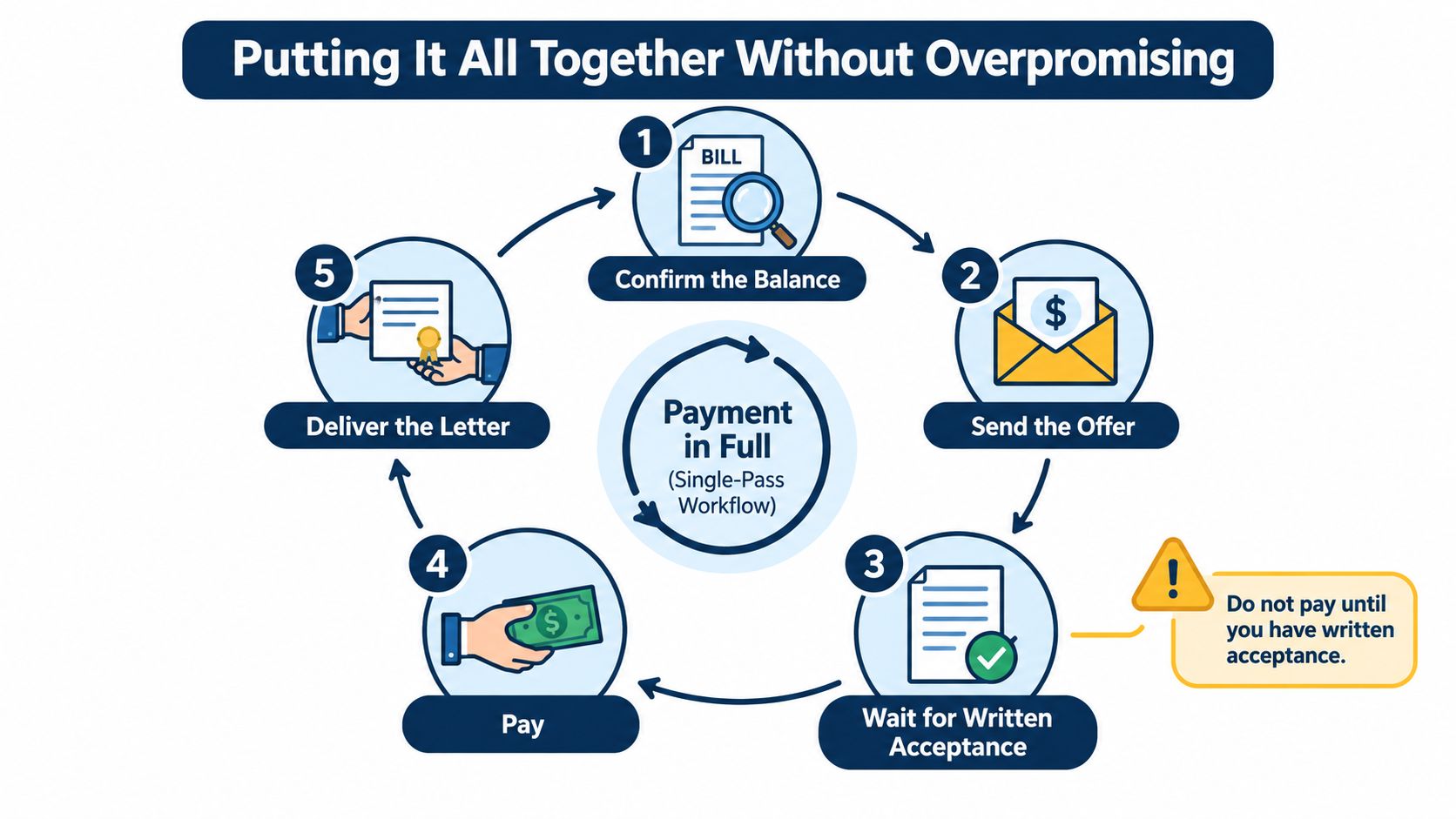
The sequence is simple when it's done right. Confirm the balance. Send the offer if a settlement is needed. Wait for written acceptance. Pay. Then send the payment in full letter to lock in the record. Do not pay until written acceptance is in hand unless the full balance is being satisfied on purpose.
What the letter can do is document payoff, support disputes, and help clean up account status after the fact. What it cannot do is force deletion from a credit report, wipe out a valid court judgment, or stop a collector who already has a separate legal basis to act. It is evidence, not a magic eraser.
Warning: do not pay until there is written acceptance.
The habits that make it hold up later are basic. Keep the signed acknowledgment and final statement in one folder. Note the date the account should report as paid. Check the next two bureau reports for accuracy. Those three habits are what turn a payoff into a record that can survive a later dispute.
Debt Help U offers plain-language guides and tools for people who are comparing payoff, settlement, and other unsecured-debt options. If this kind of paperwork is on the table, visit Debt Help U for practical guidance that helps you organize the payoff process and avoid expensive mistakes.
Related guides
- Your rights when a debt collector calls What collectors can do, what they cannot, and the two letters that change the conversation. Your rights under federal law, in plain language.
- Is debt settlement a scam? How to tell a real company from a predator Federal law already bans the most common predatory practice. Knowing that one rule screens out most bad actors in a single question.
- Statute of limitations on debt, and the trap that restarts it Old debt eventually becomes unsuable. One small payment can restart the clock and undo that. How long your state gives you, and what resets it.