Snowball Debt Payoff Calculator: How It Works
You're staring at three or four balances, the minimum payments keep shifting, and every statement feels like it asks for a decision you didn't plan to make. A snowball debt payoff calculator turns that pile of uncertainty into a real payoff order, a projected end date, and a sense of what the plan will cost.
For a lot of households, that matters right now. Revolving consumer credit stood at about $1.35 trillion in June 2026 (Federal Reserve G.19). That is roughly 7% of total household debt, but it carries far higher interest than mortgages, auto loans, or student debt, which is exactly why payoff order matters so much. The New York Fed tracks credit card delinquency alongside those balances (New York Fed Household Debt and Credit Report).
That's why the calculator is useful before anyone picks a repayment method by instinct. Snowball means paying the smallest balance first while making minimum payments on everything else, then rolling the freed-up payment into the next debt. The calculator shows whether that motivational approach gives a timeline a household can live with, or whether the cost of that order is too high.
Table of Contents
- Why a Snowball Debt Payoff Calculator Matters Right Now
- Required Inputs for Accurate Payoff Projections
- Understanding Your Calculator Output and Timeline
- Snowball Versus Avalanche Interest Cost Comparison
- When Rising Minimum Payments Change the Strategy
- Running Your Payoff Plan on Debt Help U
- Connecting Calculator Results to Debt Relief Options
- Your Action Plan After Running the Numbers
- Frequently Asked Questions About Snowball Calculators
Why a Snowball Debt Payoff Calculator Matters Right Now
A common first step is less about math than relief. Someone opens a card statement, sees a balance they can't erase quickly, then looks at a second card, a car payment, maybe a student loan, and realizes the problem isn't one debt, it's the order of all the debts.
A snowball debt payoff calculator gives that person a concrete answer instead of a vague promise. It maps balances into a sequence, then converts that sequence into a projected debt-free date and total interest, so the plan stops being a guess. That matters because a plan with no timeline feels endless, and endless plans are the ones people abandon.
The snowball idea itself is easy to understand. Pay the smallest balance first, keep minimums current everywhere else, then move the freed payment to the next balance. The emotional value comes from closing accounts sooner, but the calculator shows the trade-off in plain numbers.
Practical rule: a payoff method is easier to follow when the user can see the next account disappearing soon enough to stay engaged.
The current credit card environment makes that visibility more important. The combination of widespread card use, large balances, and rising delinquency means households are not just looking for motivation, they're looking for a plan that fits real cash flow. A calculator can turn that stress into a decision point, which balance first, which payment amount, and whether the snowball order still makes sense once minimums are added back into the picture.
Required Inputs for Accurate Payoff Projections
A good projection starts with good inputs. If one balance is off by a little, the result changes a little. If an APR is wrong, the timeline and interest estimate can drift enough to make the output less useful.
Start with the balance, APR, and minimum payment
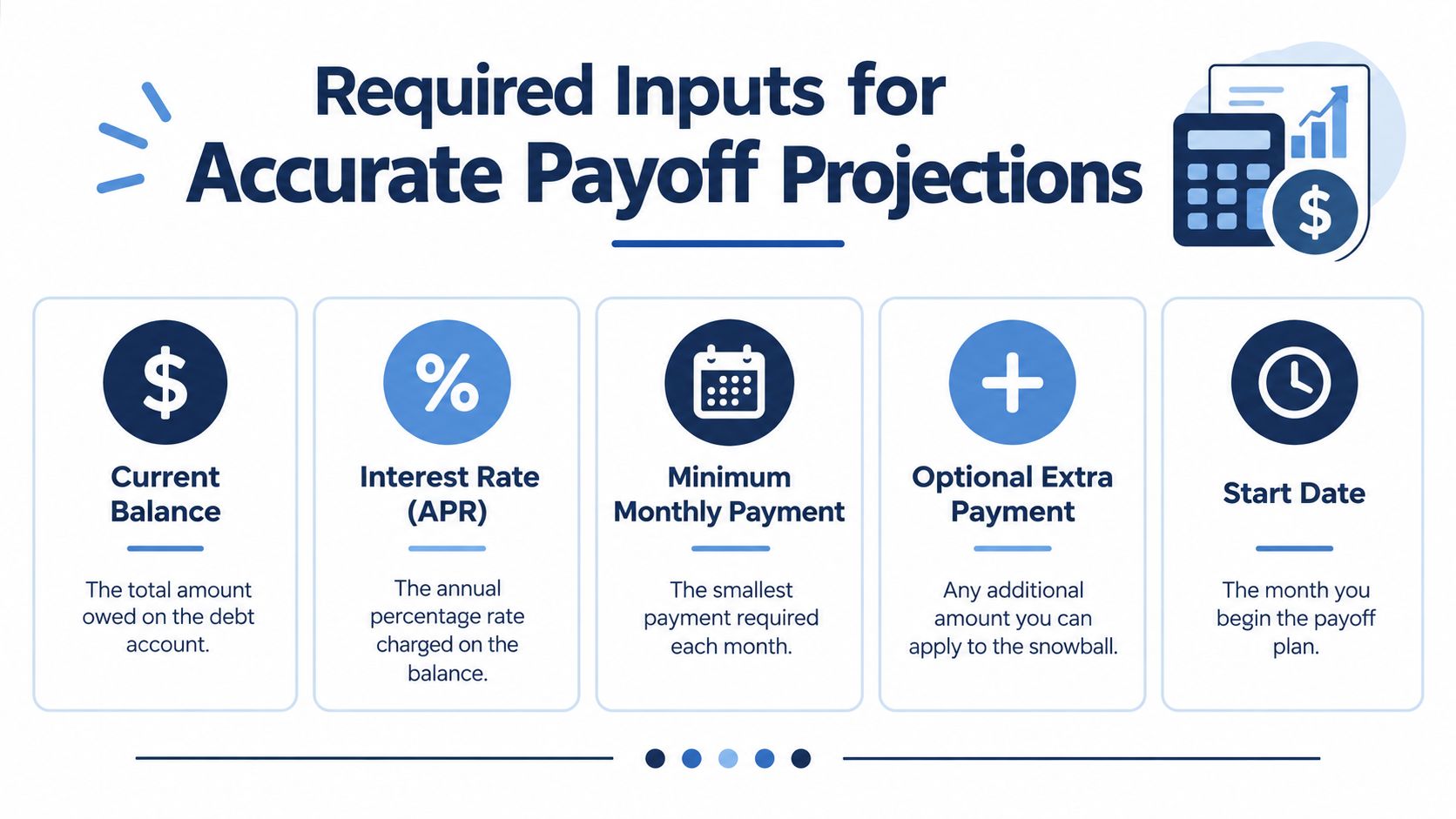
Every account needs three core details, current balance, APR, and minimum monthly payment. The balance usually comes from the latest statement or online account page, while the APR is often listed near the payment summary or account terms. Minimum payments can be fixed amounts or formula-based, so the statement matters more than memory.
The extra monthly payment is the number that changes the plan the most. That's the amount above the required minimums that gets sent toward the snowball target, and it determines whether the payoff date is months away or years away. A calculator can only project what the household can commit, not what it hopes to commit after a good month.
Use the start date and keep the estimate honest
The start date matters because the calculator needs a point of reference. Even if the payoff amount stays the same, the month the user begins affects the month they finish.
A slightly rough balance estimate won't ruin the plan if the APR and minimum payment are correct. A slightly rough APR, on the other hand, can distort total interest much more because the interest calculation compounds over time. If one number deserves a careful check, it's the rate.
Best habit: gather every statement first, then run the calculator once with clean numbers instead of revising the plan three times.
A quick checklist helps:
- Current Balance: the exact amount owed on each account.
- Interest Rate: the APR for each debt, not just a vague estimate.
- Minimum Payment: the required monthly payment right now.
- Extra Payment: the amount available beyond the minimums.
- Start Date: the month the payoff plan begins.
That's enough to produce a first-pass projection that's useful.
Understanding Your Calculator Output and Timeline
Once the numbers go in, the output usually looks simple on the surface and confusing underneath. The most useful response is to read each result as a separate question, not as one giant verdict on the plan.
Read the debt-free date first
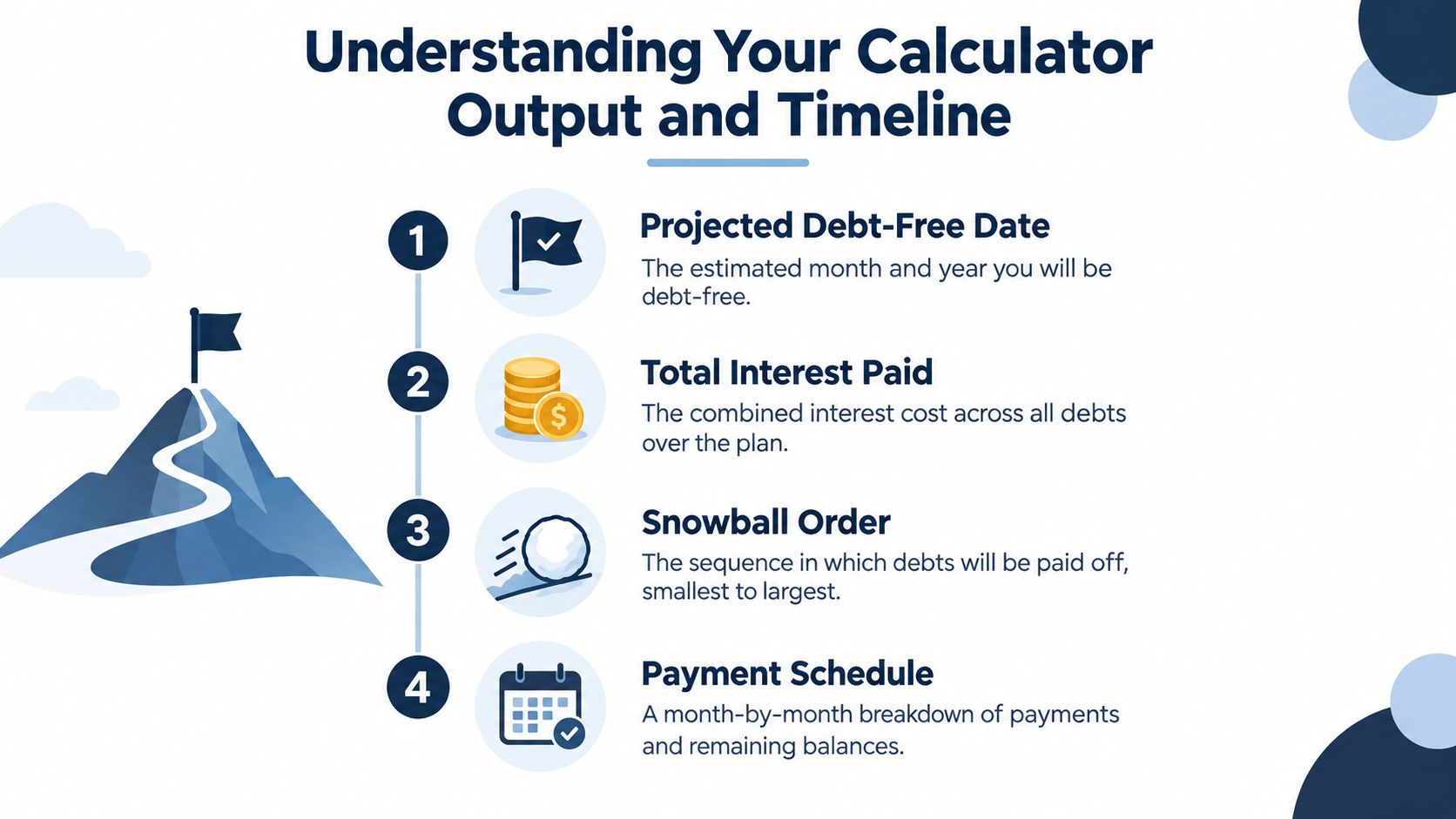
The projected debt-free date is the anchor number. It's the estimated month and year when the last balance reaches zero if payments stay on track. For many users, that date is more motivating than the interest total because it turns a painful obligation into a finish line.
The total interest paid is the cost of the path, not just the balances. It helps answer a simple question, how much does this repayment order cost over time? That matters especially when the household is comparing a snowball order against another strategy and wants to know what the emotional speed is buying.
Use the payment schedule to spot pressure points
The month-by-month schedule shows when each balance disappears. That's where the snowball starts to feel real, because every closed account frees up mental space and one payment to roll forward. The schedule also shows the months when nothing dramatic happens yet, which can help prevent disappointment early in the plan.
A cumulative payment total is the broadest number in the output. It shows how much money goes out across the entire payoff path. When that figure looks larger than expected, it usually means the plan needs either a bigger extra payment or a different repayment order.
If the calculator offers both snowball and avalanche views, compare them side by side with this debt snowball versus avalanche guide. The point isn't to chase the shortest label on the screen. It's to decide whether the emotional payoff of faster account closures is worth the cost of carrying more interest for longer.
A timeline is useful only if the household can actually keep the payment pattern alive month after month.
Snowball Versus Avalanche Interest Cost Comparison
A debt plan can look tidy on paper and still feel messy in real life. Snowball pays the smallest balance first. Avalanche pays the highest-rate balance first. The better choice depends on whether the household needs faster motivation or lower total interest.
| Metric | Snowball Method | Avalanche Method |
|---|---|---|
| Order | Smallest balance first | Highest interest rate first |
| Main benefit | Faster early wins | Lower interest cost |
| Main drawback | Usually more interest | Smaller emotional wins early |
| Best fit | People who need momentum | People who can stay patient |
The trade-off is easy to test with this snowball vs avalanche cost calculator. A 2023 study in the Southern Economic Journal estimated that, compared with an interest-minimizing repayment order, the average household pays an extra 1.8% to 4.3% in interest with snowball, and the paper also estimated a national aggregate wealth transfer to lenders of about $46.2 billion to $53.9 billion (Southern Economic Journal study). The same paper reported an average increase in interest costs of 2.34% across bootstrapped samples, with 90% of estimates between 1.93% and 2.78%.
That price is the point of the comparison. Snowball can cost more, but it may keep a household engaged when early closed accounts matter more than squeezing out the last dollar of interest. Avalanche is usually the cleaner mathematical choice when the borrower can stay steady without needing those quick wins.
The practical question is whether the extra interest is worth the behavior benefit. A family juggling rent, a car payment, and credit cards may value the morale boost of faster account closures if it helps them keep paying every month. A borrower with stable cash flow and strong discipline can usually favor avalanche and keep more money from going to lenders.
When Rising Minimum Payments Change the Strategy
A lot of snowball advice assumes the minimum payment stays stable and the extra payment remains available. That assumption breaks fast when bills are crowded and cash flow is thin.
Recent survey evidence shows households often protect housing first, then auto loans, credit cards, and student loans, which means the best snowball order may be constrained by rent, mortgage, and car-payment risk rather than by balance size alone. That matters because missing a housing or transportation payment can do more damage than delaying a debt snowball by a month.
Why minimums can crowd out the snowball
The danger is simple. A household sets aside an extra amount for debt payoff, then one card's minimum rises and absorbs part of that cushion. The snowball still exists on paper, but the money that was supposed to accelerate progress gets pulled back into survival spending.
Industry data points in the same direction. FICO reported that the share of active bankcard accounts making minimum payments rose from 5.3% to 10.4% by December 2025, and Bank of America said the share of consumers making only minimum credit-card payments has increased over the past two years (FICO benchmark trends). The CFPB also reported that among general-purpose cards, the share paying only minimums reached 15% in 2024, and for private-label cards it reached 20%, up from 13% and 17% respectively in its previous report (CFPB consumer credit card market report).
When minimums rise, the snowball can stall even if the budget looked workable a few months earlier.
When a hybrid plan makes more sense
A pure smallest-balance rule is not always the best plan under stress. If housing and auto payments need protection first, the calculator should be treated as a flexible tool, not a rigid command. In that situation, a hybrid approach can make more sense, for example by keeping the snowball structure but sending extra money to the most expensive or most urgent account temporarily.
That choice is not about giving up on the method. It's about keeping the household stable enough to keep paying at all. A plan that protects essentials and keeps the lights on is more useful than a perfect strategy that collapses after one hard month.
Running Your Payoff Plan on Debt Help U
The cleanest way to use a calculator is to enter the facts once, then test a couple of different extra-payment amounts before deciding on the plan. A realistic example helps. Suppose a household has three credit cards, each with a different balance and APR, and wants to know which order produces the most manageable payoff path.

Enter each card the same way
Start with the current balance, APR, and minimum payment for each card. Then add the extra monthly amount the budget can support without cutting into essentials. If the balances are entered correctly, the calculator can sort them into a snowball order and show when each one should disappear.
The next move is to change only the extra payment and watch the timeline move. That's often the most revealing part of the process, because a modest increase can change the payoff date more than people expect. The point is to see whether the budget can support a meaningful payment now, not a perfect one later.
Compare order, not just amount
A strong calculator also lets the user compare snowball and avalanche ordering without rebuilding the whole plan. That comparison is useful because the payment total may stay similar while the interest cost changes. When the numbers are close, motivation style usually becomes the deciding factor.
For a broader planning view, the Debt Payoff calculator can help users test whether the balances and payment assumptions feel realistic before they settle on a final order. The output should feel understandable, not mysterious. If the result only makes sense after several revisions, the inputs probably need another pass.
The privacy side matters too. A useful payoff calculator doesn't need a login, and it shouldn't force a phone number before showing the result. People dealing with debt usually want clarity first.
Connecting Calculator Results to Debt Relief Options
Sometimes the calculator does its job too well. It shows a payoff date that feels unworkable, a total interest burden that keeps climbing, or a monthly payment that leaves too little room for essentials. That result is not failure. It's a signal that self-managed repayment may not be the only realistic option.
When the numbers point past self-payoff
A plan that stretches too far into the future can become a grind instead of a plan. If the debt-free date feels distant, or the payment required to get there squeezes out housing, transportation, or basic living costs, the household may need to compare other paths. Consolidation can simplify payments, settlement can reduce what gets repaid in some cases, and bankruptcy can create a legal reset when the burden is too high.
Those options carry their own trade-offs. Consolidation can reduce complexity but may not solve spending habits. Settlement can bring sharper credit consequences and uncertain outcomes. Bankruptcy has the strongest legal effects, but it's also the most serious step and should be understood with care.
Use the calculator as a decision screen
The value of the calculator is that it gives a starting point for that conversation. It shows what happens if the household stays on the current track, then makes it easier to ask whether a different route makes more sense. That's especially useful when balances are not just expensive, but stressful enough to affect day-to-day stability.
A smart next step is to compare self-payoff with formal relief options only after the payoff projection is clear. That way the decision isn't driven by panic. It's driven by a timeline, a payment level, and a realistic look at what the household can sustain.
Your Action Plan After Running the Numbers
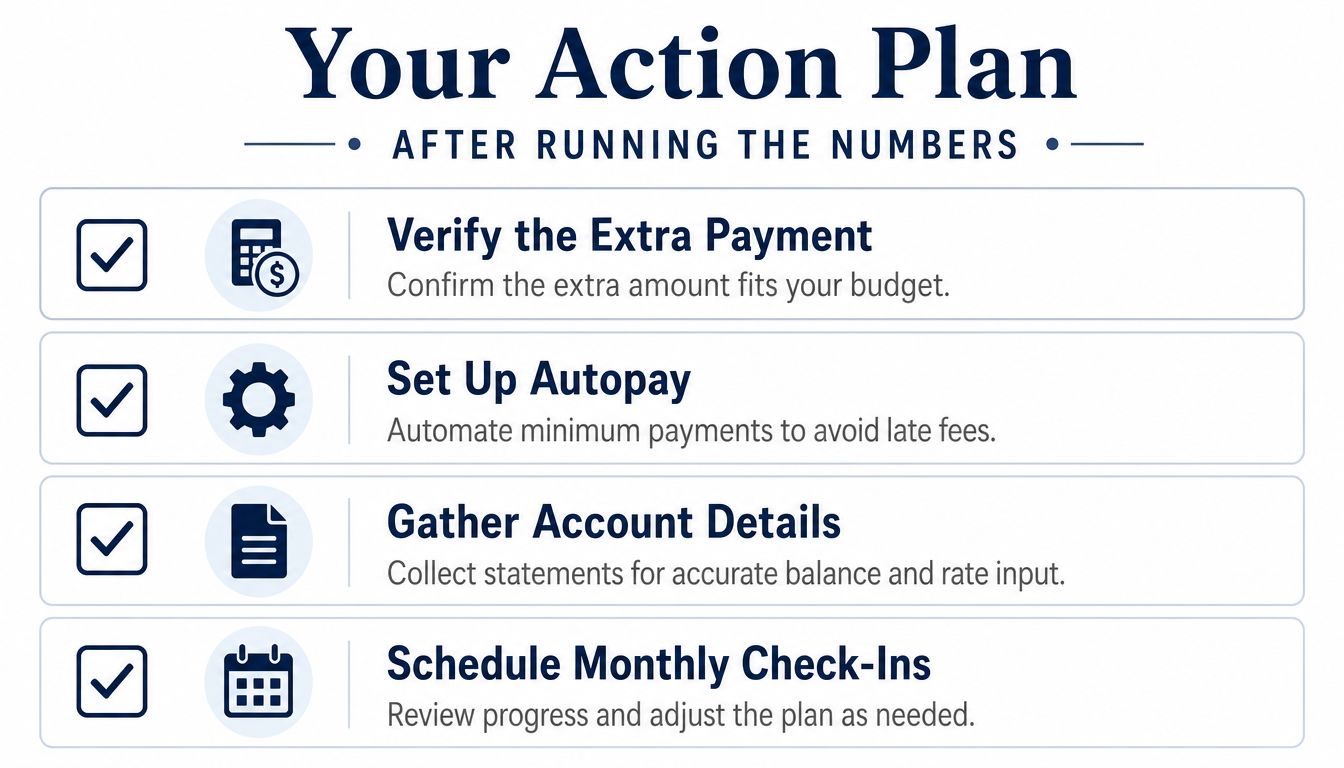
The first check is whether the extra payment is realistic for at least a few months. If it only works in a good month, the plan is too fragile. If it fits the budget after essentials are covered, it's ready to test.
Turn the output into a routine
Set up autopay for the minimums so late fees don't interrupt the plan. Then direct the extra payment to the chosen target card and keep that rule steady until the balance is gone. Once one account closes, roll that payment into the next target instead of letting it disappear into spending.
A simple monthly check-in keeps the plan honest. Review the balances, confirm the extra payment still fits, and rerun the calculator if income or interest rates changed. If an unexpected expense hits, preserve the minimums first, then rework the extra payment after the emergency passes.
Use milestones instead of willpower
The first paid-off balance matters because it proves the system works. That early win is the part many households need to stay engaged, especially when the last few months on a small balance feel slow. After that, each closed account should trigger a fresh look at the next target and the next extra-payment amount.
A debt plan doesn't need perfect conditions. It needs a payment structure that can survive normal life, then adapt when life changes.
Frequently Asked Questions About Snowball Calculators
Should installment loans like a car payment be included? They can be, but only if the borrower can protect the essential payment first. A snowball calculator is most useful when it reflects the actual bill list, not just revolving accounts.
What about a card with a promotional zero-percent APR period? That card still belongs in the plan, but the calculator should treat the promo end date carefully if the user wants a realistic projection. If the promotional window changes the amount of interest charged, the repayment order may need another look.
What happens if rates change mid-plan? The payoff date and interest total change too, because the projection is built on current terms. Re-run the calculator after the change so the new timeline reflects the new rate.
Does closing a paid-off card hurt credit? Credit effects are individual and depend on the full profile, so the decision should be weighed carefully. The calculator's job is to show the debt side of the picture, not to promise a score outcome.
Is the calculator private? The tool is designed for browser-based use, so inputs stay local during the calculation process and no account creation should be required. That makes it easier to test scenarios before sharing details with anyone else.
Debt Help U gives consumers a private way to compare payoff timelines, interest costs, and repayment order before they make a big decision. If the numbers have gotten harder to read than the statements themselves, visit Debt Help U to test your balances, compare your options, and get a clearer view of what comes next.
Related guides
- Debt snowball vs. avalanche: which one finishes faster Avalanche always pays less interest. The gap is smaller than the argument about it suggests. Run both on your own balances and see what it is worth.
- How to get out of credit card debt without a loan Borrowing your way out is the advice everyone gives first. Here is what works when you do not want more debt.
- How long will it take to pay off my credit card debt? Your minimum payment shrinks every month. Following it down is what turns a five-year balance into a thirty-five-year one.