What Is a Credit Line: Your 2026 Guide to Understanding
A credit offer arrives in the mail, or a bank app displays an available balance that seems to provide a helpful cushion. Then an unexpected bill appears, and the borrower faces a difficult question: what is a credit line, and how much will using it really cost?
The answer matters because a credit line can support short-term cash flow, but it can also keep debt available long after the original expense has been forgotten. Understanding the limit, balance, interest, repayment rules, and credit-score effects gives borrowers more control over each decision.
Table of Contents
- What Is a Credit Line
- How Credit Lines Work in Practice
- Revolving vs Non-Revolving Credit Explained
- Your Credit Line and Your Credit Score
- Using Your Credit Line Wisely
- Key Takeaways for Your Financial Health
What Is a Credit Line
A credit line is a reusable borrowing facility with a preset maximum. A lender approves access up to that limit, and the borrower draws only what's needed. After repayment, some or all of the available borrowing capacity returns, allowing the borrower to use the facility again without submitting a new application.
A simple analogy is a financial reservoir. The lender builds the reservoir's maximum size, the borrower draws water when needed, and repayments refill the available space. The reservoir isn't free money, though. Any amount taken out becomes a balance that may generate interest and require regular payments.
Credit cards are the most familiar example. A borrower may have a credit limit, spend part of it, repay the balance, and then use the restored capacity again. Other examples include certain personal lines of credit, business lines, and home equity lines of credit. The exact terms differ, but the central structure remains the same: borrow, repay, and potentially borrow again.
The Federal Reserve classifies this structure as revolving consumer credit. Its G.19 consumer credit release explains that revolving credit allows borrowing up to a prearranged limit and repayment in one or more installments. Credit cards make up most of that category. As of June 2026, revolving consumer credit stood at about $1.35 trillion. Separately, the CFPB reported that the total credit line available on existing accounts reached a historic $5.7 trillion in 2024 (CFPB consumer credit card market report).
Practical rule: A credit line should be treated as borrowed capacity, not as income.
That distinction helps a person with debt avoid a common mistake. Seeing available credit can create the feeling that an expense is affordable, even when the monthly budget cannot support repayment. The limit describes what a lender may permit, not what a household can safely borrow.
How Credit Lines Work in Practice
A credit line behaves like a refillable financial pitcher. The credit limit is the pitcher's full capacity. The outstanding balance is the amount already poured out and still owed. Available credit is the empty space remaining.
Suppose a lender approves a credit line with a fixed limit. The borrower draws funds for an expense, and the outstanding balance rises. Available credit falls by the amount drawn. When the borrower makes a payment, the balance declines and available credit generally increases again, subject to the account's posting rules and any restrictions.
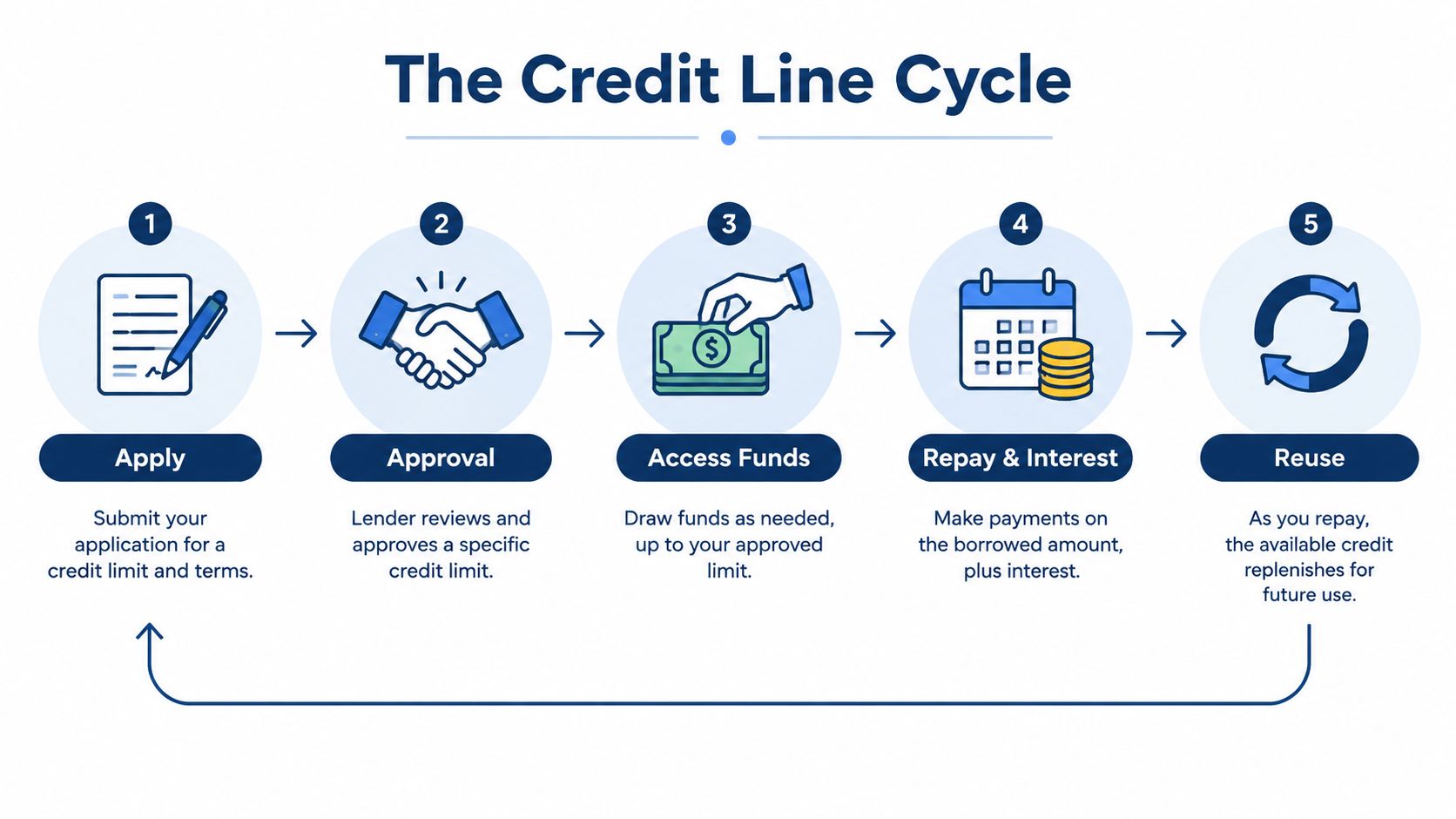
The basic borrowing cycle
- Approval: The lender reviews the application and sets a limit, interest rate, fees, and repayment terms.
- Drawing funds: The borrower uses part of the limit. A credit card purchase, transfer, or cash withdrawal may count as a draw, depending on the product.
- Interest assessment: Interest generally applies to the outstanding balance, not to unused capacity. The credit-line explanation from Broadview Federal Credit Union describes this reusable structure and explains why draw timing and repayment speed influence total cost.
- Repayment: The borrower makes at least the required payment. Paying more reduces the balance faster and restores available capacity sooner.
- Reuse: Once capacity becomes available again, the borrower may draw from the line without reapplying, as long as the account remains open and the lender allows further use.
This cycle makes a credit line flexible, but flexibility can hide the cost of repeated borrowing. A borrower who repays an amount and immediately draws it again may see available credit return without making meaningful progress toward becoming debt-free.
For a card balance, a borrower can use a credit card interest calculator to estimate how payments and interest affect the payoff timeline. The calculation becomes more useful when it reflects the actual balance, annual percentage rate, and planned monthly payment rather than relying on the minimum payment alone.
Revolving vs Non-Revolving Credit Explained
People often use “credit line” as if every facility works the same way. The most important distinction concerns whether the borrower can reuse the account after making payments.
Revolving credit stays open for repeated borrowing within an approved limit. Credit cards and HELOCs are common examples. A borrower can use available capacity, repay it, and potentially draw again. The balance and available credit move in opposite directions as transactions and payments post.
A non-revolving facility generally provides a set amount for a defined purpose or period and then follows a repayment schedule without restoring reusable borrowing capacity. Personal loans, mortgages, and auto loans are common examples of non-revolving borrowing, although product terms can vary.
The comparison below highlights the practical difference.
| Feature | Revolving Credit Line | Non-Revolving Credit Line |
|---|---|---|
| Access | Borrower draws as needed within an approved limit | Borrower generally receives a defined amount |
| Reuse | Payments can restore available capacity | Repayment usually doesn't create a reusable balance |
| Common products | Credit cards and HELOCs | Personal loans, mortgages, and auto loans |
| Payment pattern | Payment can depend on the balance and product terms | Regular payments usually follow a fixed schedule |
| Interest exposure | Interest generally applies to the amount outstanding | Interest applies to the loan balance under its repayment terms |
| Main risk | Repeated borrowing can keep the balance active | A fixed obligation can strain the budget even when the funds aren't fully needed |
Why the distinction matters for debt repayment
A non-revolving loan can create structure because the borrower receives funds and follows a defined payoff path. A revolving line can offer more control over timing, but it also leaves the door open for new borrowing.
That difference becomes especially important during consolidation. Moving a credit card balance to another reusable facility may change the interest rate or payment terms, but it doesn't automatically reduce the debt. If the original card remains open and spending continues, the household can end up with both the new balance and fresh card debt.
Borrowers should read the agreement carefully. Some accounts have a draw period, a later repayment phase, variable rates, or lender rights that differ from standard credit-card terms. The label matters less than the contract's rules for access, interest, minimum payments, and account closure.
Your Credit Line and Your Credit Score
A credit line affects a credit score partly through credit utilization, the share of available revolving credit currently being used. The basic calculation is:
Outstanding balance ÷ credit limit = utilization ratio
For example, a balance of $500 on a $1,000 limit uses half of that line. The same $500 balance on a $5,000 limit uses a much smaller share. The debt amount hasn't changed, but the account appears less heavily used relative to its available capacity.
Why utilization creates pressure
High utilization can signal that a borrower depends heavily on revolving credit. It can also make debt repayment harder because interest continues to accrue while the balance remains high. A lower limit can make the ratio rise even when the borrower hasn't made a new purchase.
A new credit line can therefore produce a temporary appearance of relief without solving the underlying cash-flow problem. The borrower may transfer debt, gain unused capacity, and then continue spending. The account balance can return quickly, while the original spending pattern remains unchanged.
Philadelphia Fed data shows that among active large-bank card accounts, the 75th percentile of utilization was 50.47% in Q1 2026, meaning a quarter of active accounts were using at least half their available line (Federal Reserve Bank of Philadelphia data via FRED). That figure shows why consolidation decisions require more than comparing advertised rates. A borrower already using a large share of available capacity needs a payoff plan and spending controls, not another place to carry a balance on its own.
High utilization isn't only a score concern. It can reduce financial breathing room because more of each monthly payment goes toward maintaining existing debt.
Households evaluating affordability should also review their debt-to-income ratio guide. Utilization describes the relationship between revolving balances and limits, while debt-to-income compares required debt payments with income. Together, they give a clearer view of both credit standing and monthly pressure.
Using Your Credit Line Wisely
A credit line works best when the borrower decides the repayment source before drawing funds. A planned expense with a clear payoff schedule is easier to manage than an open-ended balance used for recurring shortfalls.
The first safeguard is to separate available credit from available cash flow. A lender may approve a limit that exceeds what the household can repay comfortably. Borrowers should set their own spending ceiling based on income, essential expenses, savings needs, and existing payments.
Four habits that reduce avoidable risk
- Track the balance after every draw: A running balance makes repeated borrowing visible before it becomes difficult to unwind.
- Pay more than the required minimum when possible: Minimum payments preserve account access, but they can leave principal outstanding for much longer under the account's terms.
- Check variable-rate language: A variable rate can raise the required payment or increase the cost of carrying the same balance.
- Keep a repayment purpose: A line used for a defined need should have a written target balance and payment amount.
Cash advances and other special transactions may have different pricing or fees from ordinary purchases. Borrowers should check the agreement before using the line for cash, transfers, or business expenses. A low introductory rate also deserves careful review because the later rate and repayment rules determine the longer-term cost.
Lenders may also reduce, reprice, or terminate a credit line under the account agreement. A revolving line charges interest on drawn funds, requires a minimum monthly repayment, and can be ended subject to the notice terms in your agreement. If a lender lowers the limit while the balance stays the same, utilization can rise and the borrower may lose access to an expected emergency reserve.
Debt repayment requires a method that matches the household's behavior. A borrower comparing the debt snowball and debt avalanche methods can choose whether to prioritize a quick psychological win or the balance with the highest interest cost. Either method becomes harder if the credit line continues funding new purchases.
Key Takeaways for Your Financial Health
A credit line is reusable borrowing capacity, not a permanent income supplement. The borrower draws funds, owes the amount used, pays any applicable interest and fees, and may regain access as payments restore available credit.
Three principles deserve attention:
- The limit isn't a budget: A lender's approval reflects underwriting, not a guarantee that the household can repay the full amount safely.
- Utilization matters: A high balance relative to the limit can affect credit standing and leave less room for unexpected costs.
- Repayment must come first: A line used without a payoff plan can keep revolving debt active, even when a consolidation offer appears cheaper.
A credit line can be useful when the borrower understands the terms, limits new spending, monitors the balance, and pays consistently. It becomes dangerous when available capacity encourages spending that the monthly budget cannot support.
Debt Help U offers no-login calculators and plain-language guides that help consumers estimate payoff timing, compare payment strategies, review debt-to-income context, and understand options for unsecured debt. Visit Debt Help U to calculate the cost of a current balance and identify a repayment approach before drawing from another credit line.
Related guides
- How long will it take to pay off my credit card debt? Your minimum payment shrinks every month. Following it down is what turns a five-year balance into a thirty-five-year one.
- How to get out of credit card debt without a loan Borrowing your way out is the advice everyone gives first. Here is what works when you do not want more debt.
- Debt settlement vs. consolidation vs. bankruptcy Four paths out of unmanageable debt, what each one costs, and what each one breaks. Real numbers on a $30,000 balance, not a pitch for any of them.