Debt Consolidation vs Chapter 7: A Clear Cost Comparison
A borrower with maxed-out cards, rising minimums, and late payments often starts with the option that feels least permanent. Debt consolidation sounds responsible because it promises one payment and a lower rate. Chapter 7 feels more severe. But the practical question isn't which choice sounds better. It's whether a lender will still approve the borrower, and whether the borrower can realistically repay the debt after approval.
The comparison below puts cost, eligibility, timeline, and credit consequences side by side. The answer depends on the household's numbers, assets, and cash flow, but the central distinction is simple: consolidation keeps the debt alive, while Chapter 7 may legally discharge qualifying unsecured balances.
Table of Contents
- Debt Consolidation and Chapter 7: What Borrowers Consider First
- What Debt Consolidation and Chapter 7 Actually Do
- Cost of Repaying Versus Cost of Discharging
- Eligibility and the Means Test
- When Consolidation Gets Declined and Chapter 7 Still Works
- Timeline From Filing to Freedom
- Matching the Right Option to Your Situation
Debt Consolidation and Chapter 7: What Borrowers Consider First
A borrower with maxed-out cards, rising minimums, and recent late payments may want the option that feels less permanent. Debt consolidation looks like a conventional repayment plan, while Chapter 7 carries court involvement and a lasting credit record. The practical fork comes earlier: can the borrower still qualify for a loan with terms that create real savings?
Consolidation does not erase principal. It replaces several balances with one new loan, leaving the borrower responsible for the underlying debt under different terms. The loan helps only if its rate, fees, and payment fit the borrower's budget better than the existing accounts.
Chapter 7 uses a different process. The filer submits financial information to the bankruptcy court, and a trustee reviews assets and qualifying debts. Non-exempt property may be sold, while eligible unsecured debts can be discharged through the case. The U.S. Courts' Chapter 7 explanation outlines the formal process and its consequences.
| Question | Debt consolidation | Chapter 7 |
|---|---|---|
| What happens to principal? | The balance is refinanced, not erased | Qualifying unsecured debt may be discharged |
| Who controls approval? | A private lender or program provider | The bankruptcy court and applicable eligibility rules |
| What happens to payments? | One new payment continues through the loan term | Qualifying discharged balances no longer require repayment |
| What is the main gate? | Credit, income, debt-to-income ratio, and underwriting | Means test, debt type, assets, and legal eligibility |
| Main financial trade-off | Continued repayment, interest, and possible fees | Legal costs, asset exposure, and a lasting credit record |
Practical rule: Choose consolidation only when the borrower qualifies for materially better terms and can keep making the new payment.
Approval must be tested before comparing advertised rates. Recent late payments, high credit utilization, and little income left after necessities can lead to a denial. Approval can also produce an APR that barely improves the situation once interest and fees are included.
Chapter 7 has its own eligibility rules, but they address whether repayment is realistic under the filer's income and circumstances. That difference frames the decision: consolidation can preserve the borrower's existing repayment path while extending the obligation, whereas Chapter 7 may discharge qualifying unsecured debt through a court case. Cost, eligibility, and time must be evaluated together.
What Debt Consolidation and Chapter 7 Actually Do
Debt consolidation is a repayment strategy. A borrower takes a new loan to pay existing unsecured accounts, then sends one monthly payment to the new lender. The borrower may gain a single due date, a fixed payment, and a different APR, but the principal remains outstanding. A debt-management plan can also combine payments administratively, although it isn't the same as borrowing through a consolidation loan.
The structure changes, not the obligation. The borrower still owes the balance, and the new loan can include interest and origination charges. A lender may also use a hard inquiry, which can cause a temporary score reduction, and borrowers with weaker credit can receive rates that fail to create meaningful savings.
Chapter 7 is a legal proceeding. The filer submits financial information to the bankruptcy court. A trustee examines assets and debts, applies exemption rules, and may liquidate non-exempt property. At the end of the case, qualifying unsecured obligations can be discharged, ending the legal duty to repay those particular debts.
The difference in one balance sheet
| Category | Debt consolidation | Chapter 7 |
|---|---|---|
| Principal | Remains owed | Qualifying unsecured principal may be eliminated |
| Monthly obligation | Replaced with a new scheduled payment | Discharged qualifying debts no longer carry the same payment obligation |
| Contract status | The new loan remains a private contract | The discharge changes the legal enforceability of qualifying debts |
| Approval | Depends on lender underwriting | Depends on bankruptcy eligibility and case review |
| Asset risk | The loan itself doesn't liquidate property | Non-exempt property can be exposed to trustee action |
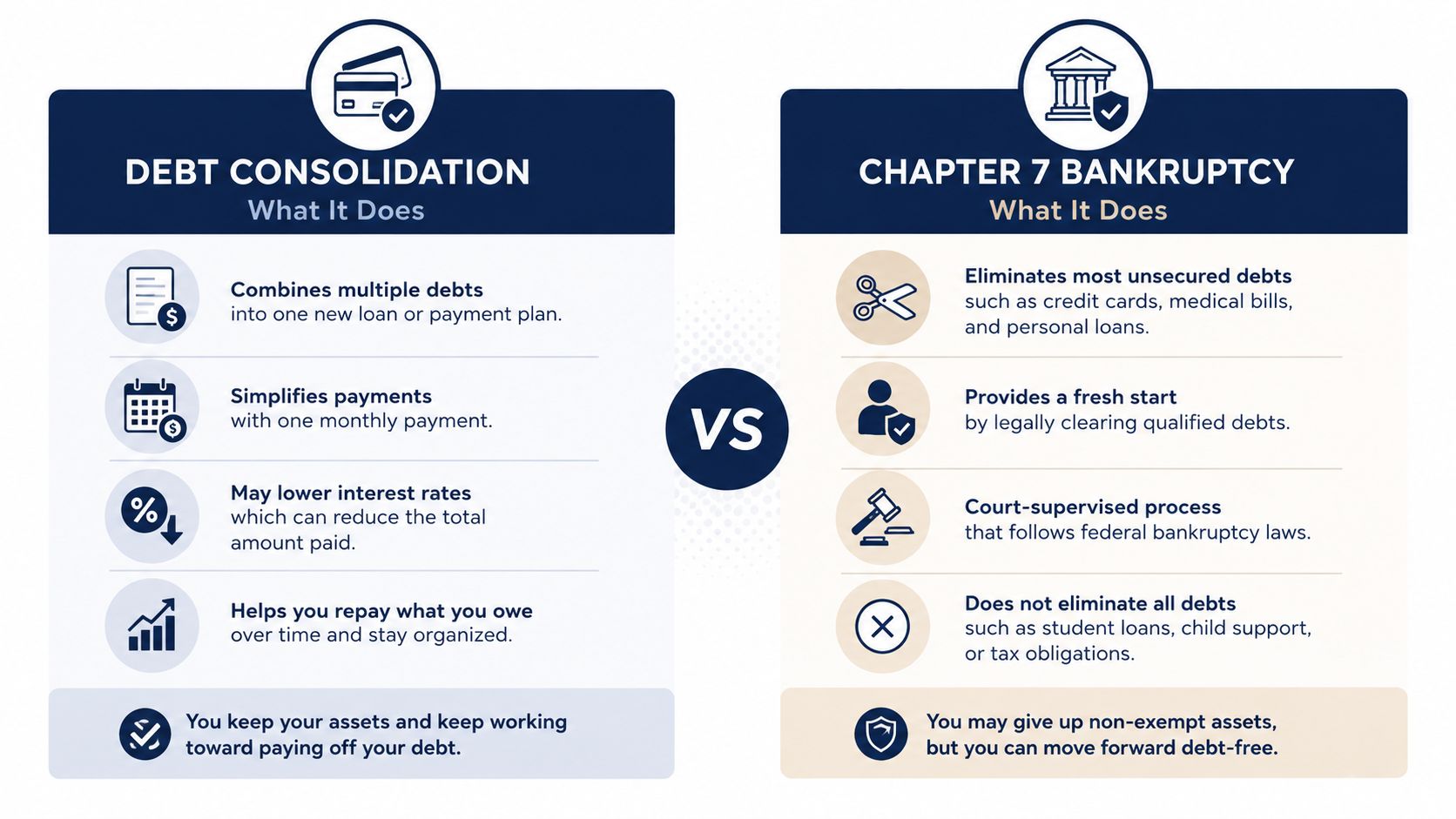
These options solve different problems. Consolidation addresses payment structure and interest cost when a borrower can qualify and maintain repayment. Chapter 7 addresses insolvent or unmanageable unsecured debt through a court-supervised discharge, subject to eligibility, exemptions, and non-dischargeable debt rules.
That distinction matters because a lower monthly payment can hide a larger total repayment obligation. A discharge can create a cleaner balance sheet, but it carries legal and credit consequences that a refinancing transaction doesn't.
Cost of Repaying Versus Cost of Discharging
A borrower with a $25,000 credit-card balance faces two very different price tags. A consolidation loan at 11% with a 5% origination fee costs $34,244, while a loan at 12% with no fee costs $33,367, based on the supplied comparison. The lower advertised rate is more expensive in that example because the fee increases the borrowing cost.
A separate five-year example uses $25,000 at 12% with a 5% fee and produces $35,035 in total repayment, including $10,035 in interest and fees. The origination charge comes out of the loan proceeds, so the borrower may receive less cash than the stated loan amount while still owing the full contractual balance. Discover's APR explanation explains why fees can make the loan cost more than its nominal interest rate suggests.
| Line Item | Debt Consolidation Loan, 60 mo | Chapter 7 Bankruptcy |
|---|---|---|
| Working debt | $25,000 | $25,000 |
| Interest and fees | $10,035 in the supplied 12% example | Qualifying debt can be discharged rather than repaid |
| Filing or origination cost | 5% origination fee in the example | $338 court filing fee in the supplied comparison |
| Repayment obligation | Continues through the loan term | Ends for qualifying discharged unsecured debt |
| Credit consequence | Requires continued positive repayment | Bankruptcy record can remain for up to 10 years from filing |
| Other exposure | Approval and payment risk | Non-exempt property may be exposed to the trustee |
The supplied comparison lists a $338 federal bankruptcy filing fee, along with administrative and trustee charges and attorney fees. Those added costs vary by case and provider, so no borrower should treat them as a fixed total. Compare the full cost of repaying the balance with the cost of discharging it, including legal expense, possible asset exposure, and credit consequences.
The financial calculation is only one part of the decision. Chapter 7 can leave a credit-report record for up to 10 years from the filing date, and the supplied comparison identifies an eight-year bar before another Chapter 7 discharge.
Bankruptcy can be cheaper in pure dollars, but the borrower pays with eligibility rules, asset review, and a credit record that lasts far longer than the court case.
Consolidation is the better repayment tool when the borrower qualifies for a materially lower APR, has stable surplus income, and will stop using the old cards. It is a poor choice when fees and interest consume the projected savings or when the new payment remains unaffordable.
The practical fork is qualification. A borrower who cannot obtain a loan on terms that reduce total cost should not force a refinancing plan just to avoid considering bankruptcy. Use this guide to evaluate whether a consolidation loan is worth it before accepting an offer.
Eligibility and the Means Test
Chapter 7 eligibility begins with the means test. The first screen compares the filer's average monthly household income during the prior six months with the applicable state median. For a one-person Texas household, the median-income figure for cases filed on or after 15 July 2026 is $66,837 annually, or about $5,570 monthly, according to the median family income figures published by the U.S. Trustee Program. Those figures are revised through the year, so check the current table before relying on them.
A Texas borrower earning $58,000 annually would fall below that first median-income screen in the example. That doesn't automatically guarantee a discharge, because the case still requires accurate financial disclosures, debt classification, asset analysis, and review of the applicable legal rules. But income below the first threshold can prevent the initial presumption that the filer has enough ability to repay.
How the two approval systems differ
A consolidation lender evaluates the borrower as a credit risk. The lender reviews the credit score, recent payment history, revolving utilization, income stability, and debt-to-income ratio. The lender's central question is whether the borrower is likely to repay the new loan under its underwriting model.
Chapter 7 asks a different question: does the household's financial position fit the legal test for liquidation and discharge? A filer can be denied a consolidation loan precisely because the credit profile shows distress, while that same distress can support the argument that repayment is not feasible under Chapter 7 rules.
| Gate | Chapter 7 Means Test | Consolidation Loan |
|---|---|---|
| Primary signal | Household income compared with state median | Creditworthiness and repayment risk |
| Financial review | Prior six months of average income, allowed expenses, debts, and assets | Credit report, income, existing obligations, and lender criteria |
| Decision-maker | Bankruptcy court process and trustee review | Private lender |
| Possible result | Proceed with Chapter 7, face further review, or consider another chapter | Approval, high-cost offer, or denial |
| Core risk | Presumption of abuse or asset exposure | Payment remains unaffordable despite refinancing |
Borrowers should not treat the means test as a simple income calculator. The bankruptcy means-test calculator can help organize the information, but a qualified bankruptcy professional must assess the complete filing picture.
The practical recommendation is direct: check the lender's likely offer and the bankruptcy eligibility picture before signing anything. A borrower who qualifies only for a high-rate loan hasn't solved the debt problem. A borrower who passes an income screen still needs to understand exemptions and which debts Chapter 7 can discharge.
When Consolidation Gets Declined and Chapter 7 Still Works
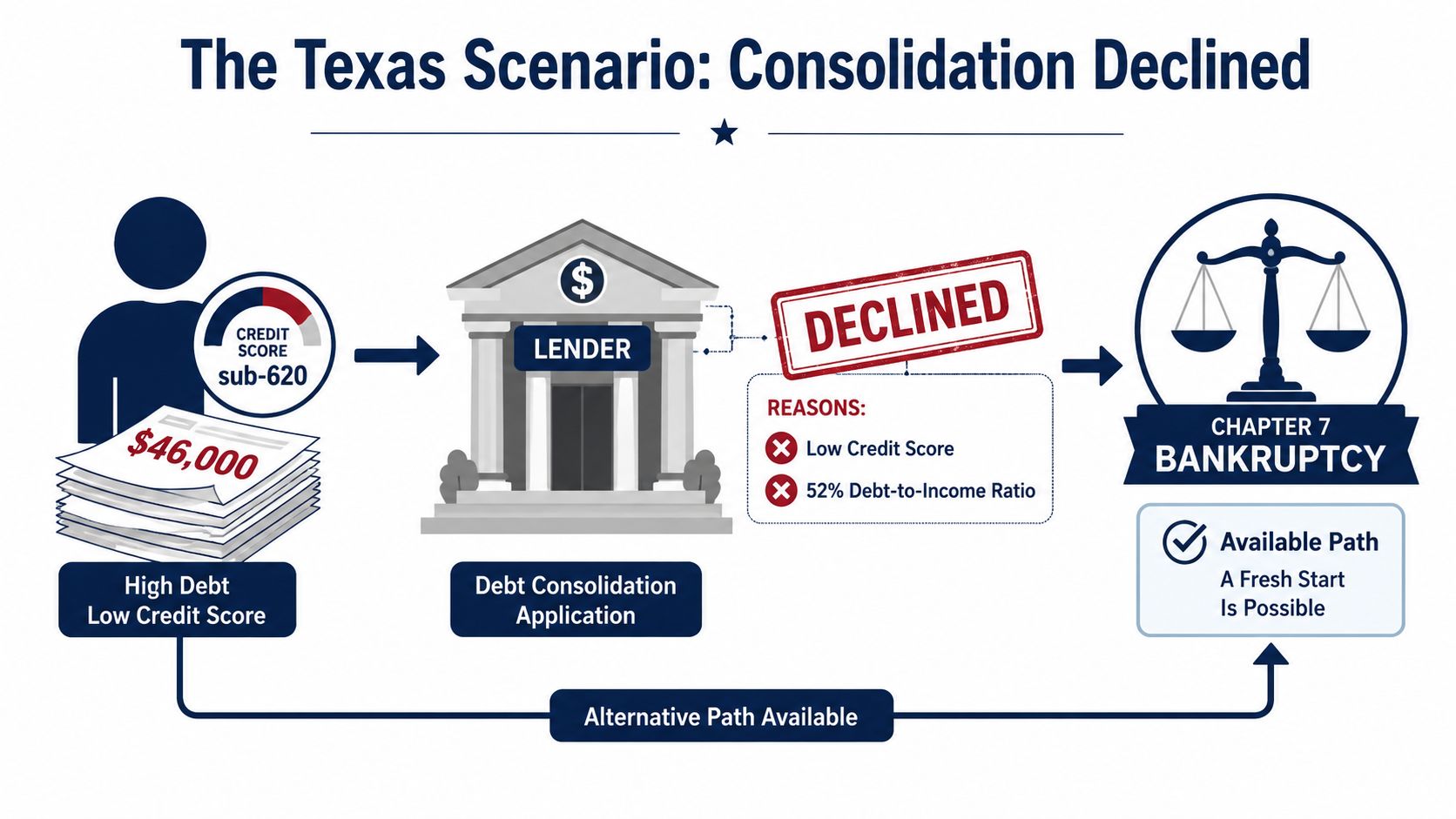
Consider a modeled Texas household with $46,000 of credit-card and medical debt. The borrower applies for a 60-month consolidation loan and receives a denial tied to a sub-620 credit score and a 52% debt-to-income ratio. Recent late payments and maxed utilization make the application look risky, and the lender's hard inquiry adds another short-term credit event.
The denial is not surprising. The borrower is asking a private company to lend more money after demonstrating difficulty servicing the existing accounts. The same missed payments that created the debt crisis can also undermine the underwriting decision.
The fork after the denial
The household then examines Chapter 7. The income example uses one person in Texas with $30,000 earned during the prior six months, which annualizes to $60,000. That sits below the supplied $66,837 Texas one-person median-income figure for 2026, so the borrower can proceed to the next legal analysis rather than being screened out at the initial income comparison.
This modeled scenario is not a client case and isn't a prediction of a court result. It demonstrates the decision fork: consolidation needs a lender's approval, while Chapter 7 uses statutory eligibility rules and a court process. The borrower still needs a complete means-test review, accurate schedules, and an assessment of assets and dischargeable debts.
A denial doesn't automatically make bankruptcy the right answer. Some borrowers can stabilize income, negotiate directly, or use a structured repayment plan. But when balances are large, utilization is high, minimums keep rising, and no lender offers affordable terms, continuing to shop for consolidation can waste time while interest continues accumulating.
A declined consolidation application is information. It shows that the private-credit route may be closed, not that the borrower has no relief options.
Chapter 7 also isn't a shortcut around every obligation. Certain debts may not qualify for discharge, and non-exempt assets can create consequences. Borrowers comparing Chapter 7 and Chapter 13 bankruptcy should examine whether a repayment chapter better protects important property or addresses debts that Chapter 7 won't eliminate.
Timeline From Filing to Freedom
Consolidation and Chapter 7 put borrowers on different clocks. A consolidation loan ends with the final payment, so the borrower trades immediate restructuring for years of scheduled repayment. Chapter 7 uses a court process to address qualifying unsecured debts on a much shorter timeline.
A borrower might select a 60-month loan and make fixed payments for five years. In the supplied comparison, extending that loan to 84 months costs $9,268 more, even though the longer term can lower the required monthly payment. That lower payment may ease monthly cash flow, but it also prolongs the obligation and raises the total cost.
Chapter 7 follows a different schedule. The supplied timeline places the meeting of creditors 21 to 40 days after filing, with discharge typically coming 60 to 90 days after that. In the stated example, filing to discharge takes roughly four to six months. Case complexity, missing information, or failure to complete required steps can change the actual timing.
| Milestone | Consolidation Loan | Chapter 7 Bankruptcy |
|---|---|---|
| Starting point | Application, underwriting, and loan funding | Petition and schedules filed with the court |
| Early process | Existing balances are paid through the new loan | Trustee review and meeting of creditors |
| Main obligation | Fixed monthly payments continue | Required filing steps and financial-management requirements |
| End point | Debt closes after the final payment | Discharge ends qualifying unsecured obligations |
| Typical time frame in supplied examples | 60 months, with longer terms reaching 84 months | Roughly four to six months from filing to discharge |
The credit consequences differ as well. Consolidation can preserve the borrower's current profile if every payment stays current, although the application creates a new inquiry and the repayment period remains lengthy. Chapter 7 can resolve qualifying unsecured debt sooner, but the bankruptcy record may remain for up to 10 years from filing.
Time is part of the price. Consolidation demands years of payments and interest. Chapter 7 involves a shorter legal process, followed by a long-lasting credit record and possible consequences for non-exempt assets. Choose the loan only when its rate, fees, and monthly payment fit a budget that can hold for the entire term. Choose Chapter 7 when prolonged repayment is unrealistic and the borrower qualifies after reviewing assets, exemptions, and dischargeable debts.
Matching the Right Option to Your Situation
The strongest decision framework uses three variables: balance size, credit profile, and income margin. No single factor decides the case, but the combination reveals whether consolidation is realistic or merely attractive in theory.
A borrower with a smaller unsecured balance, strong credit, and dependable income has a better chance of receiving a rate that makes refinancing useful. A borrower with damaged credit and little monthly surplus faces the opposite problem. The lender may decline the application, or the offered APR may be high enough to erase the savings.
| Balance Range | Credit Profile | Income vs. State Median | Recommended Path | Key Condition |
|---|---|---|---|---|
| Smaller unsecured balance | Strong, established credit | Stable income with repayment room | Consider consolidation first | New APR and fees must beat current carrying cost |
| Mid-range balance | Strong credit | Adequate repayment margin | Consolidation may fit | Written budget must support every payment |
| Mid-range balance | Damaged credit | Means-test eligibility may support Chapter 7 | Compare Chapter 7 seriously | Review dischargeability and property exposure |
| Larger unsecured balance | Damaged credit | Little room above or below the applicable median | Chapter 7 often deserves priority | Confirm eligibility, exemptions, and non-exempt assets |
| Any balance | Any profile | Payment already fails in normal months | Avoid reflexive refinancing | A new loan cannot repair a persistent cash-flow deficit |
Consolidation should be chosen only when the new payment fits a written budget with a 10% buffer, and the APR is below the existing debt's cost after fees. The supplied rate data gives useful context: the average APR on credit-card accounts assessed interest was 22.15% in the second quarter of 2026, compared with an average 24-month personal-loan rate of 11.86%, a difference of about 10.29 percentage points, according to the Federal Reserve's G.19 consumer credit release. That gap can create savings, but only for borrowers who qualify for the lower rate.
Chapter 7 should be evaluated when repayment is structurally impossible, especially after denials, repeated delinquencies, or unaffordable minimums. The borrower must confirm that non-exempt property exposure is manageable and accept the eight-year repeat-filing bar described in the supplied comparison. The credit record can remain for up to 10 years, so the decision requires more than a monthly-payment comparison.
The best option is the one that clears its gate and solves the actual problem. A loan that cannot be approved is not an option, and a bankruptcy filing that ignores assets or non-dischargeable debts is not a complete plan.
Debt Help U offers free, no-login calculators and plain-language guides to compare payoff costs, debt-to-income context, consolidation, settlement, and bankruptcy. Visit Debt Help U to compare the numbers privately before deciding whether a lender conversation or a bankruptcy consultation makes sense.
Related guides
- Chapter 7 vs. Chapter 13 bankruptcy: which one applies to you One wipes qualifying debt in a few months. The other reorganizes it over three to five years. Your income and what you own decide which is even available.
- Debt settlement vs. consolidation vs. bankruptcy Four paths out of unmanageable debt, what each one costs, and what each one breaks. Real numbers on a $30,000 balance, not a pitch for any of them.
- Is a debt consolidation loan worth it? Sometimes it saves thousands. Sometimes it costs more than doing nothing at all. The rate and the term decide, and one of them is where people get caught.