Extra Payment Calculator Credit Card: Cut Debt Faster
A $5,000 credit-card balance at about 22.15% APR can take 19 years and 3 months to repay with minimum payments alone, producing $8,159 in interest, according to an independent calculation summarized by TheStreet. That example changes the question. The issue isn't whether an extra payment helps. It's how much extra payment changes the payoff curve, and when another option may make more sense.
An extra payment calculator for a credit card turns that question into a comparison. A borrower enters the balance, APR, minimum-payment terms, and an added amount such as $50, $100, or $200 per month. The result shows how the payment changes the payoff date and total interest, while a more complete analysis also considers consolidation, settlement, or a lower APR.
Table of Contents
- Why Extra Payments Matter More Than Most Borrowers Realize
- How a Credit Card Payoff Calculator Works
- Using the Debt Help U Extra Payment Simulator
- Worked Example on a $3,000 Balance at 22% APR
- Comparing $50, $100, and $200 Extra Payments
- Lump Sums Versus Steady Monthly Extras
- Which Input to Move First for the Biggest Impact
- Snowball, Avalanche, and When to Compare Other Options
- Reading the Numbers and Building a Personal Plan
- Quick Reference Table for Common Scenarios
Why Extra Payments Matter More Than Most Borrowers Realize
U.S. revolving consumer credit reached about $1.34 trillion by March 2026, while the average APR on credit-card accounts that incurred interest was 21.52% in the first quarter of 2026, according to the Federal Reserve's G.19 consumer credit data. At that rate, interest doesn't wait for a borrower's budget to improve. It posts against the balance each billing cycle, and the next charge is calculated on whatever principal remains.
The minimum payment creates the trap. Issuers commonly calculate minimums as a small percentage of the balance or apply a flat minimum, such as $25 to $35, depending on the account terms, as described by SavvyMoney. On a $3,000 balance at 22% APR, a common formula of interest plus 1% of the balance produces a first payment near $85. About $55 of that is interest, so roughly $30 reaches principal. At a high APR, that payment may reduce principal slowly because interest takes a large share first.
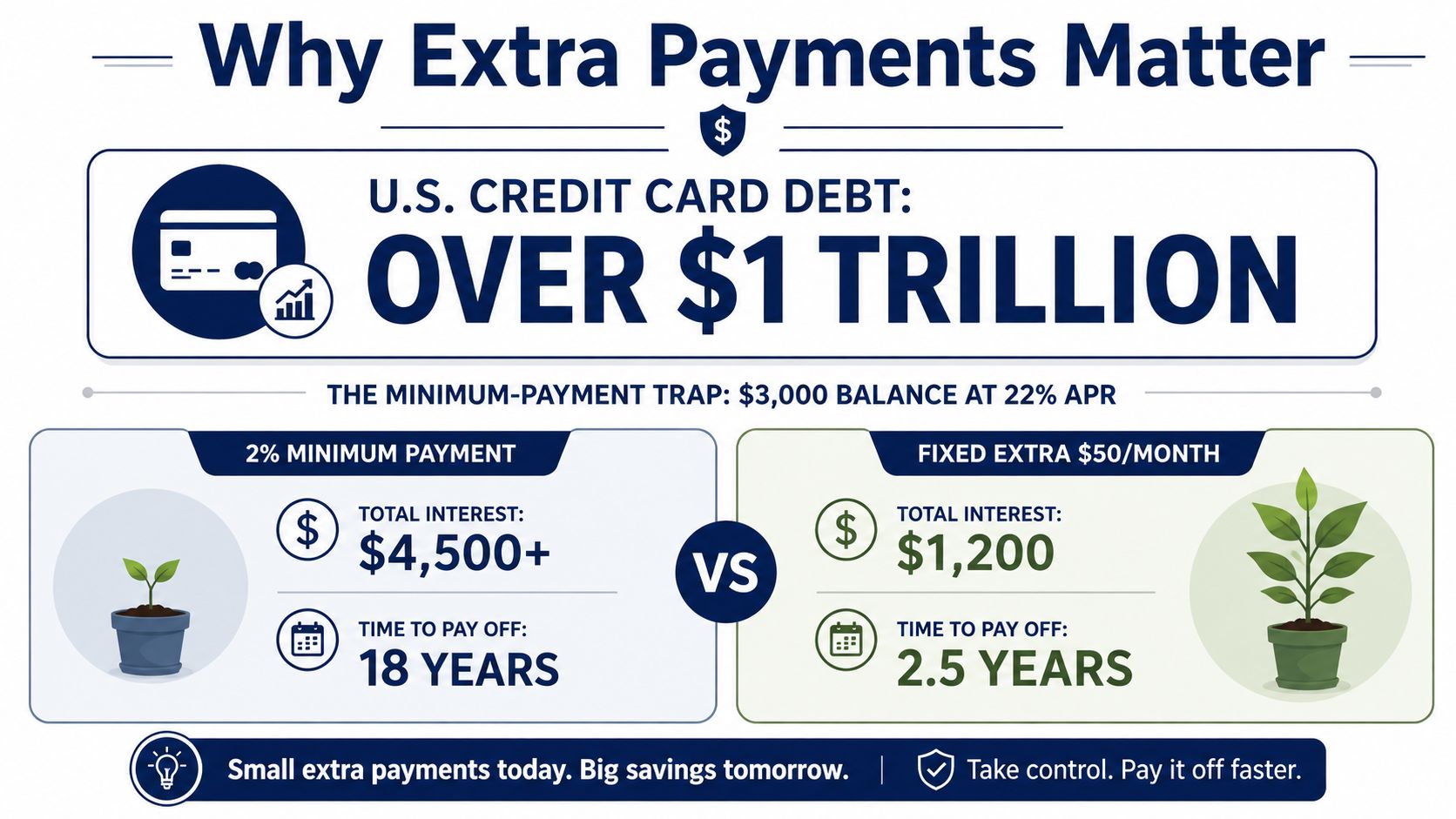
A fixed extra amount attacks principal earlier. Every dollar paid above the required minimum leaves less balance for future interest, so the benefit repeats in later billing cycles. The Federal Reserve's credit-card repayment rules require excess payments to be allocated first to the highest-interest balance, which matters when an account carries different balance categories.
Practical rule: A minimum payment protects the account from becoming delinquent. An extra payment changes the debt's trajectory.
That's why borrowers often begin with $50 per month, then test $100 and $200. The first amount can feel manageable, while the larger scenarios reveal what a tighter budget might buy in time and interest. The calculator makes that trade-off visible without requiring a balance transfer, a new loan, or a rate negotiation.
How a Credit Card Payoff Calculator Works
A credit-card payoff calculator is a month-by-month projection, not a simple division problem. It applies interest to the revolving balance, subtracts the payment, and repeats the cycle until the projected balance reaches zero. The Ultimate Finance Calculator describes a common method: divide the APR by twelve to estimate monthly interest, then treat the payment left after interest as principal reduction.
The result is an estimate. Daily-balance calculations, fees, new charges, and an issuer's account rules can make a statement differ from the projection. The CFPB's credit-card repayment guidance also explains why payment allocation and account terms matter when evaluating a payoff plan.
The inputs that shape the result
A calculator uses four core inputs:
- Current balance: The amount owed at the start. A larger balance gives interest more principal to act on.
- APR: The annual percentage rate. Many models use APR divided by twelve for a monthly rate, while an issuer may calculate interest from daily balances.
- Minimum-payment rule: The required baseline, which may be a percentage, a flat floor, or a combination of interest, fees, and a percentage of the balance.
- Extra monthly payment: The amount added above the required minimum. This is usually the input a borrower can change immediately.
Bankrate's credit-card payoff calculator lets users enter a payment to estimate the months required, or enter a target payoff period to estimate the needed payment.
The outputs worth recording
| Input | What It Controls | Output Affected |
|---|---|---|
| Current balance | Starting principal | Payoff time and interest |
| APR | Monthly interest charge | Total interest and payment needed |
| Minimum-payment rule | Required baseline payment | Minimum-only timeline |
| Extra monthly payment | Principal reduction speed | Months saved and interest saved |
| Target payoff period | Required monthly commitment | Suggested payment amount |
| Payment timing | When principal falls | Future interest accumulation |
Record payoff time, total interest, and total repayment cost. Total repayment cost combines the starting balance with projected interest and any modeled charges.
A useful way to read the model is to compare the same balance under different extra payments. Enter the baseline, then test $50, $100, and $200 without changing the APR or minimum-payment rule. The comparison shows the payoff months and interest saved for each budget choice.
Early payments usually have more reach because they reduce principal before later interest calculations. A $50 extra payment can lower the balance used in many future cycles, while a $200 payment lowers it faster. The calculator therefore shows more than a payoff date. It helps identify the point where an additional dollar produces a smaller practical gain than a lower APR, consolidation, or another debt option.
Using the Debt Help U Extra Payment Simulator
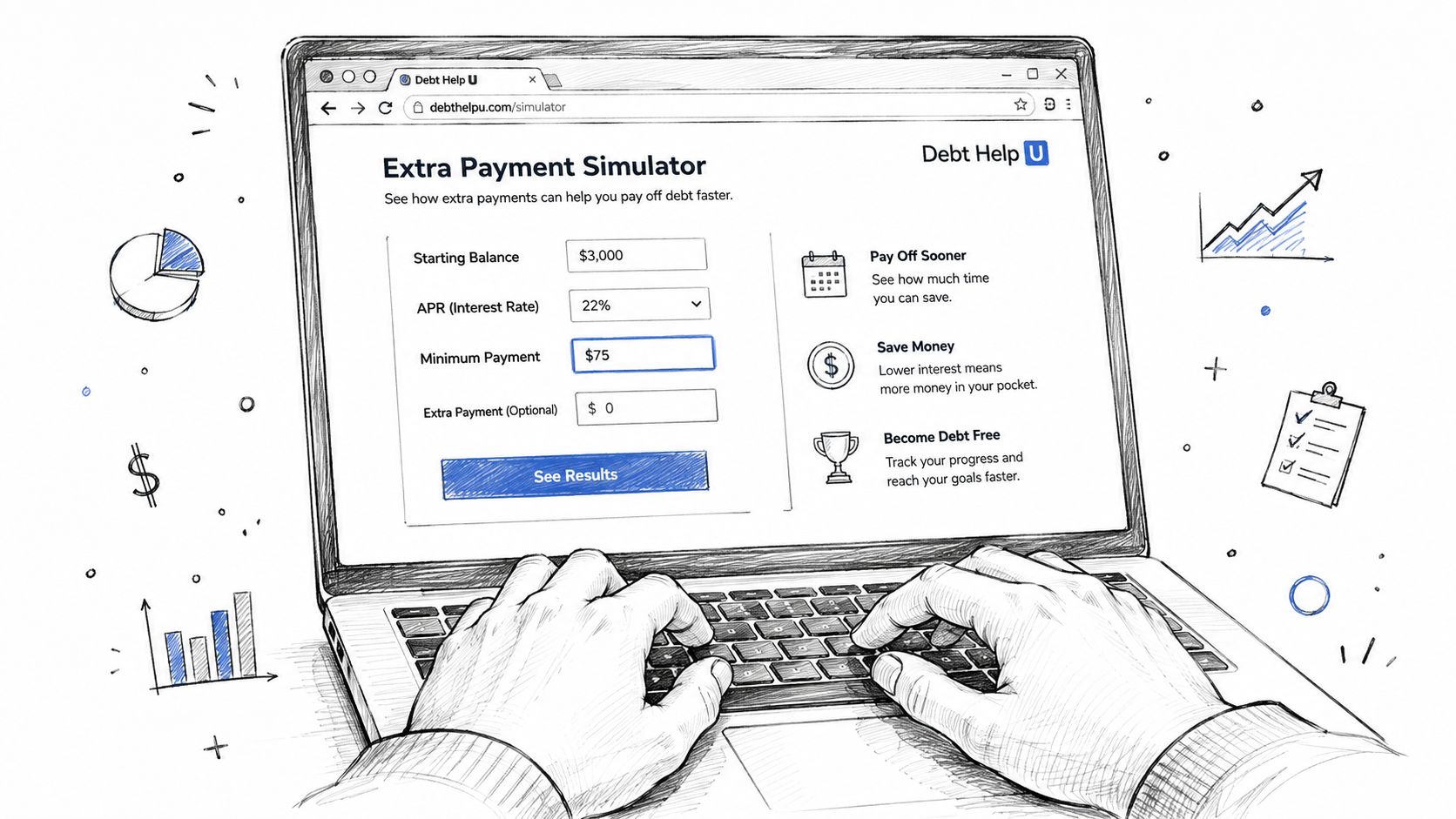
A first-time user can approach an extra payment simulator like a statement review. The starting example uses a $3,000 balance, a 22% APR, and the card issuer's minimum-payment rule, set at interest plus 1% of the balance, with a $25 floor. The added payment begins at $50, the amount many borrowers test first.
The user enters the balance, selects the APR, and confirms the minimum-payment setting. Then the user enters $50 in the extra-payment field or moves the extra-payment slider until the displayed amount reaches $50. The screen should be read as a comparison, not as a promise from the card issuer. The projected payoff months should fall, the interest total should shrink, and the interest-saved indicator should show the difference from the selected baseline.
What to do with the controls
The slider is useful because it lets the user test several affordable commitments without rebuilding the scenario. After recording the $50 result, the user can change the extra amount to $100 and then $200, keeping every other input unchanged. The compare control helps place those scenarios side by side, while an export control can preserve the results for budgeting or later review.
The simulator can also be paired with a credit-card debt payoff calculator when more than one balance is involved. For a single card, three numbers deserve a written record:
- Payoff time: The projected number of months or the projected payoff date.
- Total interest: The cost of carrying the balance under that payment plan.
- Interest saved: The difference between the selected extra-payment scenario and the baseline.
The same process works with $100 and $200. The important discipline is changing one variable at a time, so the reader knows whether the improvement came from the added payment, a lower APR, or a different minimum-payment assumption.
Worked Example on a $3,000 Balance at 22% APR
Consider a cardholder with a $3,000 balance at 22% APR who pays only the minimum, calculated as interest plus 1% of the balance with a $25 floor. The first payment is roughly $85, but the minimum falls as the balance declines. Minimum-only repayment takes about 15 years and costs roughly $4,433 in interest.
Adding $50 per month changes the schedule substantially. The projected payoff falls to about 3 years and 8 months, with roughly $1,198 in interest. The difference is about 11 years and 4 months sooner, and approximately $3,235 less interest.
| Scenario | Monthly Payment | Payoff Time | Total Interest Paid | Time Saved vs Minimum | Interest Saved vs Minimum |
|---|---|---|---|---|---|
| Minimum only | About $85 initially, then recalculated | About 15 years | About $4,433 | Baseline | Baseline |
| Minimum plus $50 | Minimum plus $50 | About 3 years 8 months | About $1,198 | About 11 years 4 months | About $3,235 |
The calculator arrives at those outputs by applying the monthly rate to the outstanding balance, subtracting the interest charge from the payment, and carrying the remaining principal into the next cycle. As the balance falls, the interest charge falls too. The schedule therefore accelerates as more of each payment reaches principal.
The result isn't a guarantee of the exact statement outcome. Issuers may calculate interest using daily balances, and new purchases, fees, promotional balances, or missed payments can change the schedule. The projection works best as a controlled comparison under fixed assumptions.
The larger illustration uses $6,000 at 23% APR. A $150 monthly payment takes 77 months and produces $5,498 in interest, while a $200 payment takes 46 months and produces $3,014 in interest, according to the supplied repayment comparison. The additional $50 therefore saves close to $2,500 and removes 31 months from the modeled schedule.
Comparing $50, $100, and $200 Extra Payments
On a $3,000 balance at 22% APR, changing the extra payment from $50 to $100 or $200 changes both the payoff date and the interest cost. The calculator's table makes the trade-off visible, so you can compare a faster payoff with a payment your budget can sustain.
| Extra Monthly Payment Amount | Total Monthly Payment | Months to Payoff | Total Interest Paid | Interest Saved | Months Saved vs Minimum |
|---|---|---|---|---|---|
| $0 | Minimum only | About 180 months | About $4,433 | Baseline | Baseline |
| $50 | Minimum plus $50 | About 44 months | About $1,198 | About $3,235 | About 136 months |
| $100 | Minimum plus $100 | About 26 months | About $710 | About $3,723 | About 154 months |
| $200 | Minimum plus $200 | About 14 months | About $401 | About $4,033 | About 166 months |
The jump from minimum-only payments to an extra $50 produces the largest first improvement. Raising the extra amount to $100 removes more time and interest. Raising it again to $200 still helps, but the schedule has already become much shorter, so the added monthly strain buys a smaller time reduction.
The modeled figures assume no new purchases, missed payments, or unexpected fees. Your issuer may calculate interest from daily balances, and payment timing can affect the result. Treat the table like a controlled experiment: change one input, then compare the outcome under the same assumptions.
Find the payment breakpoint
The lowest payment is not automatically the best payment. An extra $50 may be sensible if it fits every month. An extra $100 can be better if it remains reliable. An extra $200 may save more interest, yet become a poor choice if the higher bill causes new card charges or missed payments.
Run all three scenarios, then ask what happens outside the calculator. If a different APR, consolidation loan, or settlement option could reduce the cost more than another extra-payment increase, compare that alternative before committing to the largest number. The useful breakpoint is the point where the next extra dollar no longer improves your overall financial position.
For a larger balance, the same comparison can reveal a different trade-off without repeating the earlier payoff example. Test $50, $100, and $200 as separate additions to your current minimum payment. A $50 increase may be manageable today, while $200 may shorten the schedule more but leave too little cash for essentials. The best setting is the highest amount you can maintain without borrowing again elsewhere.
Use the simulator to compare payoff speed, interest savings, and monthly pressure together. A single payoff date cannot show that trade-off.
Lump Sums Versus Steady Monthly Extras
A one-time refund or bonus feels powerful because the payment is visible immediately. Yet the comparison must account for when principal leaves the balance, not just the size of the payment. On the $3,000 balance at 22% APR, the supplied scenario compares a $1,200 lump sum in month one with $100 extra each month for 12 months.
The answer depends on what the payment does after the cash runs out. Hold the total payment at $185 a month and the lump-sum plan finishes in about 11 months with roughly $201 in interest. The same $185 a month with no lump sum takes about 20 months and roughly $593 in interest. Front-loading saves about 9 months and $392 under that assumption.
The advantage disappears if the payment drops back to the minimum once the extra cash is gone. Both plans then run past ten years and cost about the same interest, since a minimum calculated from the balance shrinks as the balance shrinks. A lump sum earns its reputation only when the monthly payment stays put afterward.
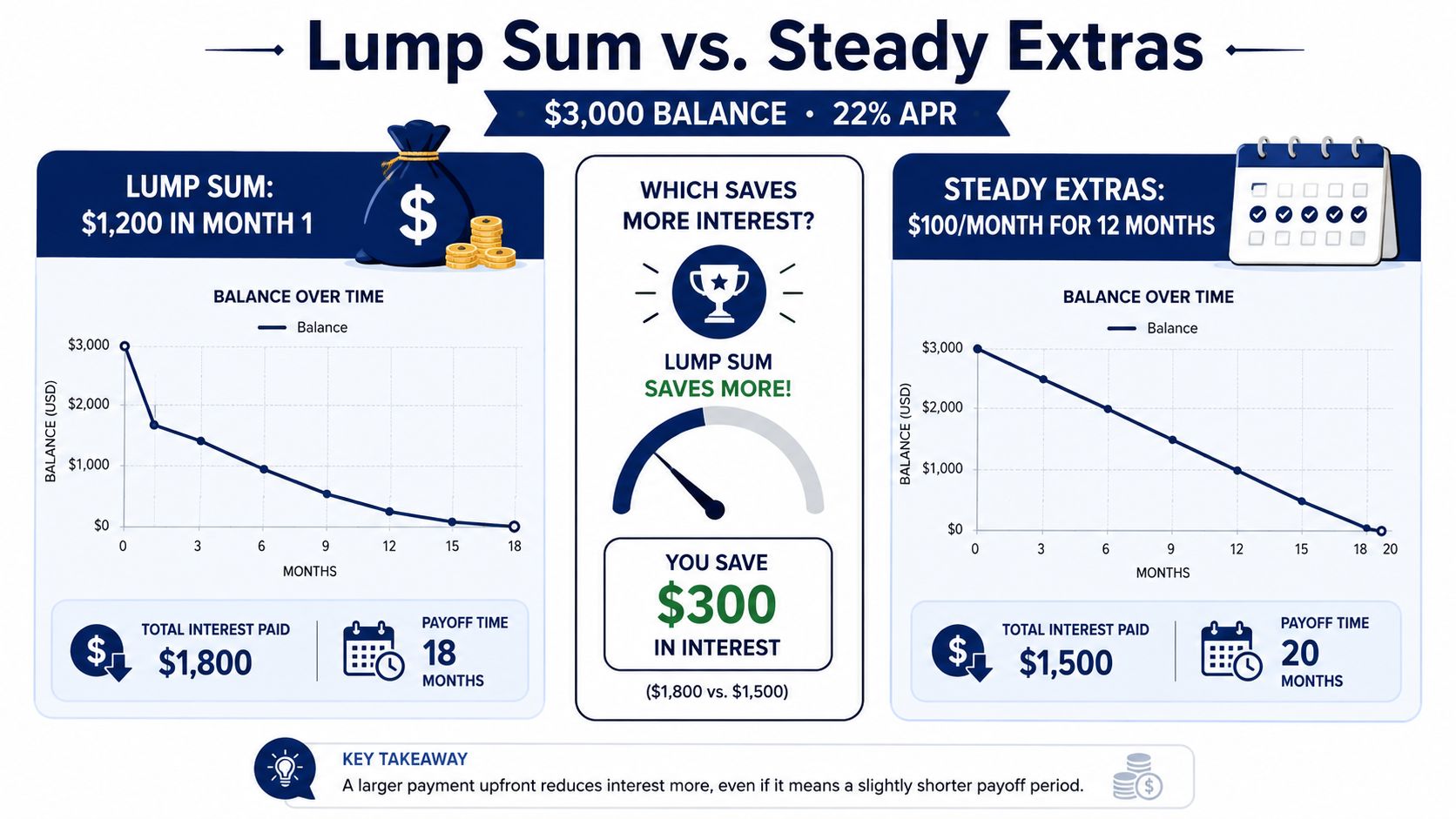
The reason is timing. A dollar paid in month three removes principal before many later interest calculations. The same dollar held until month thirty leaves a larger balance in place for more cycles. Sum Money's extra-payment calculator explanation describes this type of simulation by varying the added monthly payment and comparing the resulting payoff schedules.
A practical hybrid
A borrower with cash available can model a front-loaded plan:
- Apply the usable lump sum early: This reduces the balance before another cycle of interest.
- Keep a sustainable monthly extra: A recurring amount prevents the plan from stopping after the one-time payment.
- Test the cash reserve separately: Debt reduction shouldn't leave the household unable to handle an unexpected expense, because new card charges can undo the modeled savings.
The content-owner comparison also highlights a common behavior pattern. People often model a $500 to $2,000 annual lump sum, then overestimate its effect relative to steady monthly payments. The exact winner depends on timing and total dollars, so the calculator should compare both schedules rather than rely on intuition.
The central lesson is front-loading paired with a steady payment. If a lump sum is available and doesn't create a new cash shortfall, paying it earlier gives each dollar more time to prevent interest, as long as the monthly payment doesn't fall afterward. If the money isn't available yet, regular extras keep the principal moving down while the borrower waits.
Which Input to Move First for the Biggest Impact
An extra-payment simulator usually gives borrowers four dials: balance, APR, minimum payment, and extra payment. A clean sensitivity test changes one dial at a time and records the payoff time and total interest. That prevents a lower projected cost from being mistaken for the effect of an extra payment when the actual change came from a lower rate.
| Variable Changed | New Value | Months to Payoff | Total Interest Paid |
|---|---|---|---|
| Extra payment | Increase from baseline | Recalculate | Recalculate |
| APR | Lower than baseline | Recalculate | Recalculate |
| Balance | Lower than baseline | Recalculate | Recalculate |
| Minimum payment | Fixed higher payment | Recalculate | Recalculate |
The extra-payment slider is usually the first control users move because it represents an action available without opening a new account. APR has greater mathematical weight, but a borrower can't change a known rate by entering a smaller number. A lower APR normally requires a product change, such as a balance transfer or consolidation loan, and approval isn't guaranteed.
Decision order: Test the extra payment first, then model a lower balance, then test whether a lower APR changes the answer enough to justify a new product.
A $25 increase can be worth testing even when $200 isn't realistic. The minimum-payment calculator helps establish the required-payment baseline, while an extra-payment model shows what happens when the borrower keeps paying above that floor.
APR should still be tested when a real offer exists. The comparison needs to include fees, promotional expiration, qualification requirements, and the risk of adding new charges. A lower rate can beat a modest extra payment, but only if the replacement product's full cost and repayment period work in the borrower's favor.
Snowball, Avalanche, and When to Compare Other Options
With multiple cards, the payment amount is only part of the decision. The snowball method directs extra money to the smallest balance first, while the avalanche method targets the highest APR first. Snowball creates a visible early win. Avalanche generally prioritizes the balance producing the greatest interest cost.
Consider two cards, one with a $1,800 balance at 19% APR and another with a $4,200 balance at 26% APR. At a combined budget of $250 per month, snowball clears the smaller card in about 13 months, while avalanche saves about $394 in interest over the full payoff. The choice is therefore behavioral as well as mathematical. A borrower who needs a quick closed account may value snowball momentum, while a borrower focused on total cost may prefer avalanche.
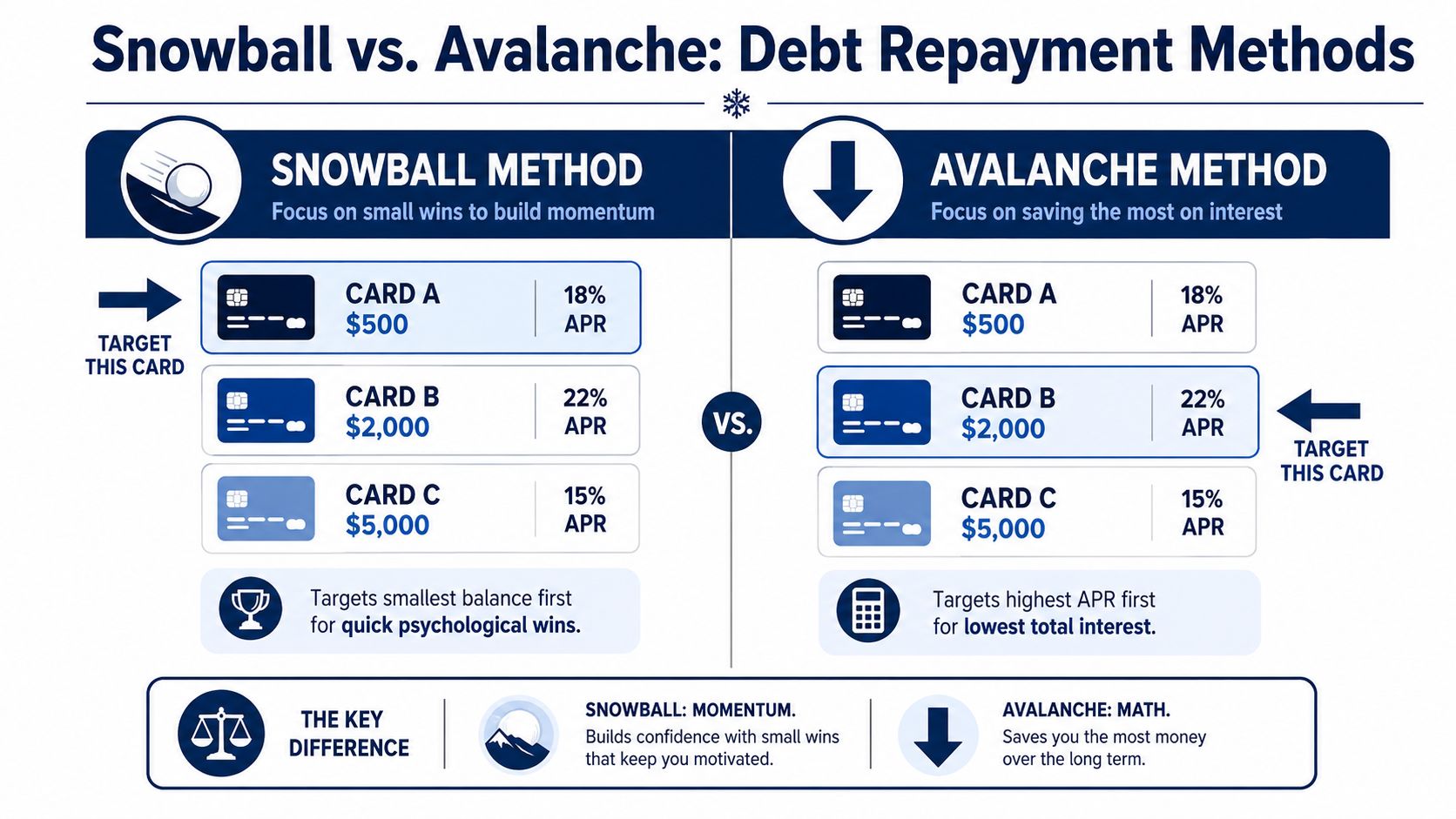
The snowball versus avalanche guide can help organize the priority decision. Either method requires minimum payments on the other cards and a consistent redirection of the freed payment after one balance closes.
The breakpoint beyond extra payments
An extra payment isn't automatically the smartest move in every situation. A borrower should compare it with realistic alternatives:
- Balance transfer: Model a promotional rate of 0% for 18 months, then include any transfer cost and the rate after the promotion.
- Debt settlement: Model an offer at 50% of the balance, while accounting for credit damage, possible balance growth, creditor discretion, and the repayment timeline.
- Consolidation loan: Test a replacement loan at 12% APR, including origination charges and the required term.
These are scenario assumptions, not universal offers or expected outcomes. The break-even point appears when the alternative's total cost and timeline become better than the steady extra-payment plan, after fees and risks are included.
A borrower who can comfortably maintain the plan may favor self-directed repayment. Someone facing rising minimums, delinquency risk, or an income shortfall needs a broader comparison before committing to a payment that the budget can't sustain.
Reading the Numbers and Building a Personal Plan
A payoff calculator becomes useful when it supports a decision, not just a payoff date. Use three checkpoints to turn the result into a plan you can repeat.
First, mark the month when the balance drops below 30% of the original amount. This milestone helps you review progress and see how interest charges change as the principal gets smaller. It is a planning reference, not a universal credit-score rule.
Next, compare the plan's projected interest with the savings from raising the extra payment by $25. For example, if you entered an extra $50, test $75. Adopt the higher amount only if the projected savings exceed any fee or other cost required to free that cash. A payment increase that forces new borrowing elsewhere does not reduce the overall cost.
Set a calendar review for 90 days after the new payment starts. Enter the actual balance, confirm the current APR, and check whether the issuer changed its minimum-payment calculation. Save the calculator result beside the statement so the projected path and actual path are easy to compare.
Use the calculator as a dashboard, not a one-time verdict.
The $3,000 at 22% projection assumes stable inputs, including the payment amount, APR, fees, and absence of new charges. A different payment, purchase, fee, or rate can change the result. Credit-card disclosures from the Consumer Financial Protection Bureau explain why statement terms deserve a fresh check when account conditions change.
Keep the personal plan simple: record the baseline, choose the highest sustainable extra payment, avoid new charges where possible, and review the schedule on the calendar date. If the actual balance falls more slowly than projected, test $50, $100, or $200 extra payments, then compare the result with a lower-APR option or professional debt guidance. The best payment is the one that reduces debt without making the budget fail.
Quick Reference Table for Common Scenarios
The table below is a lookup aid for comparing extra-payment levels. It uses the supplied worked examples for the $3,000 at 22% APR and $6,000 at 23% APR scenarios. The other rows are useful placeholders for comparison, but a borrower should run the exact statement terms rather than treat them as personalized projections.
| Balance | APR | No Extra | +$50/mo | +$100/mo | +$200/mo |
|---|---|---|---|---|---|
| $1,000 | 19.99% | Run exact terms | Run exact terms | Run exact terms | Run exact terms |
| $3,000 | 22% | About 180 months, about $4,433 interest | About 44 months, about $1,198 interest | About 26 months, about $710 interest | About 14 months, about $401 interest |
| $6,000 | 23% | Run exact terms | Run exact terms | Run exact terms | $200 payment, 46 months, $3,014 interest |
| $10,000 | 24.99% | Run exact terms | Run exact terms | Run exact terms | Run exact terms |
For the $6,000 balance, the supplied comparison also shows a $150 monthly payment taking 77 months with $5,498 in interest. That result demonstrates why the gap between $150 and $200 can be large at a higher balance, but it doesn't supply every $50, $100, or minimum-only result needed to complete the row without inventing data.
The table assumes a fixed APR, no new charges, and minimums recalculated as the balance falls where the underlying example specifies that approach. Actual statements may use daily-balance calculations, fees, promotional rates, or separate balance categories. The Federal Reserve disclosure framework explains why statement-based repayment estimates and simple calculators can differ.
The next step is specific: run the balance, APR, minimum rule, and $50 extra payment through a calculator, record payoff time and total interest, then repeat at $100 and $200. Debt Help U offers free, no-login calculators and plain-language comparisons for extra payments, minimum payments, snowball and avalanche plans, consolidation, settlement, and bankruptcy. Visit Debt Help U to compare the numbers privately before deciding which repayment path fits the budget.
Made with the Outrank tool
Related guides
- How long will it take to pay off my credit card debt? Your minimum payment shrinks every month. Following it down is what turns a five-year balance into a thirty-five-year one.
- How to get out of credit card debt without a loan Borrowing your way out is the advice everyone gives first. Here is what works when you do not want more debt.
- Debt settlement vs. consolidation vs. bankruptcy Four paths out of unmanageable debt, what each one costs, and what each one breaks. Real numbers on a $30,000 balance, not a pitch for any of them.