Maxed Out Credit Card: What It Costs and What to Do
You swipe your card for gas, groceries, or an emergency repair, then check the app and feel your stomach drop. The balance is sitting right at the limit, maybe even a little over, and the only thing left to do is make the minimum payment and hope next month is better. That's the trap with a maxed out credit card, it doesn't just feel bad, it keeps costing you while you stand still.
The problem is not only the balance. A card that's at or near its limit is usually sitting at close to 100% utilization, which is far above typical usage, and that alone can drag down credit scores and squeeze household cash flow. The danger is that minimum payments often don't break the cycle, they just keep the account alive while interest keeps running and the balance stays stuck.
Table of Contents
- What a Maxed Out Credit Card Really Means
- The Three Costs That Hit You Immediately
- Immediate Steps to Stop the Bleeding
- Repayment Strategies That Actually Work
- Why Minimum Payments Keep You Trapped
- When You Need Credit for Emergencies
- Choosing Your Path Forward
What a Maxed Out Credit Card Really Means
A maxed out card means the balance is sitting at or near the credit limit, so the utilization ratio is close to 100%. In a major U.S. benchmark from the Federal Reserve Bank of Philadelphia, the 90th percentile of active large-bank card balances was 94.97% of the credit limit in Q4 2025, while the median was only 8.84% in the same period. That gap shows how far a maxed-out account sits from ordinary borrowing behavior (Federal Reserve Bank of Philadelphia data via FRED).
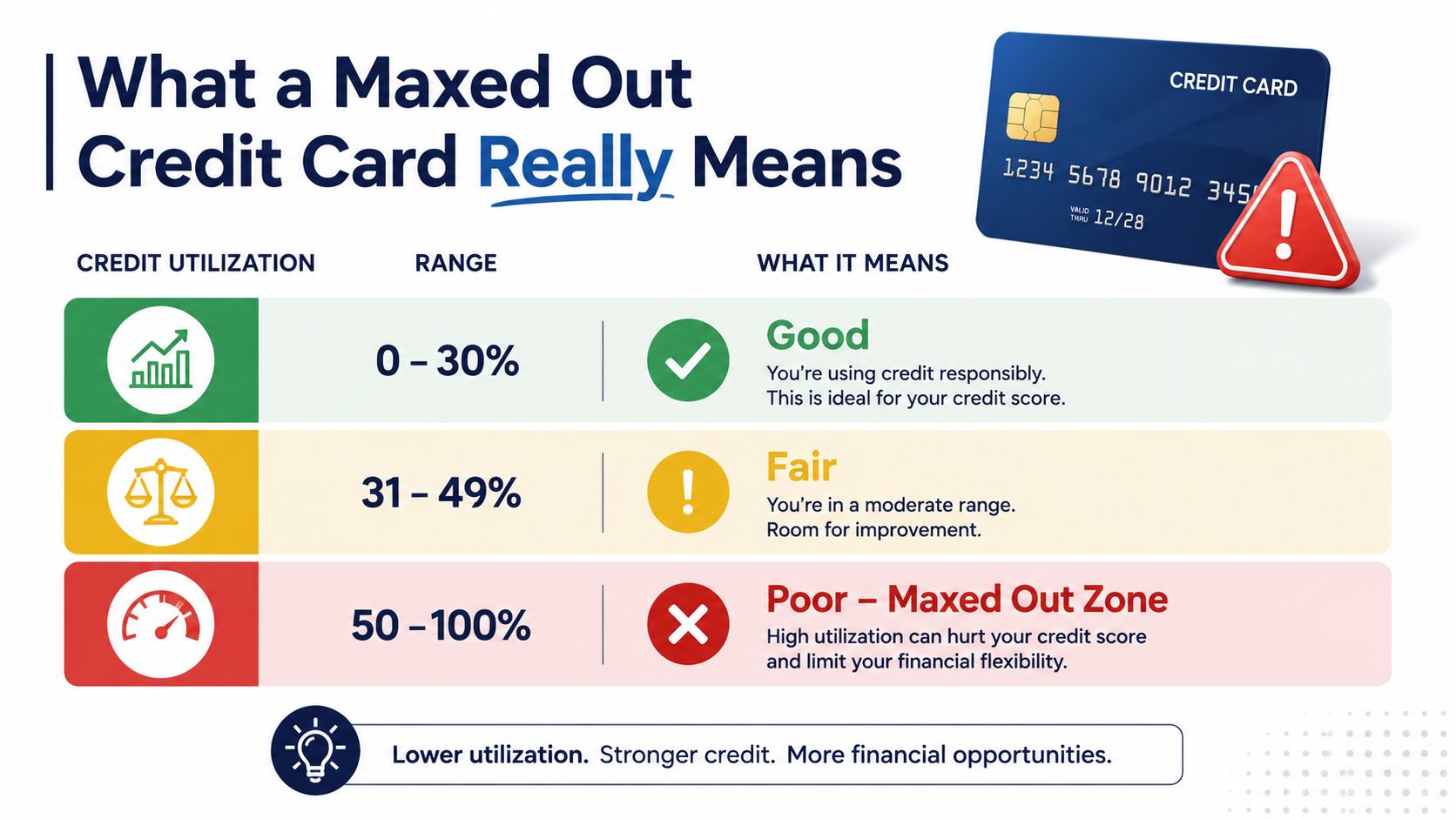
Credit scoring also looks at per-card utilization, not just your total debt. One card at the limit can hurt even if another account still has room. Experian says revolving utilization can affect about 20% to 30% of a credit score depending on the model, which is why a single maxed-out account can pull the number down quickly (Experian).
A card at the limit is a warning sign, not something to manage forever.
The broader market makes that clear. CFPB market data shows utilization rising steadily as credit scores fall, with deep subprime cardholders averaging above 80% in every year measured while superprime stayed under 10% (CFPB consumer credit card market report). A maxed-out card sits far above either level and leaves very little room to absorb interest, fees, or an unexpected charge. That is why “carrying a balance” and “maxed out” are not the same thing. One leaves room to recover. The other keeps you stuck right at the edge.
The Three Costs That Hit You Immediately
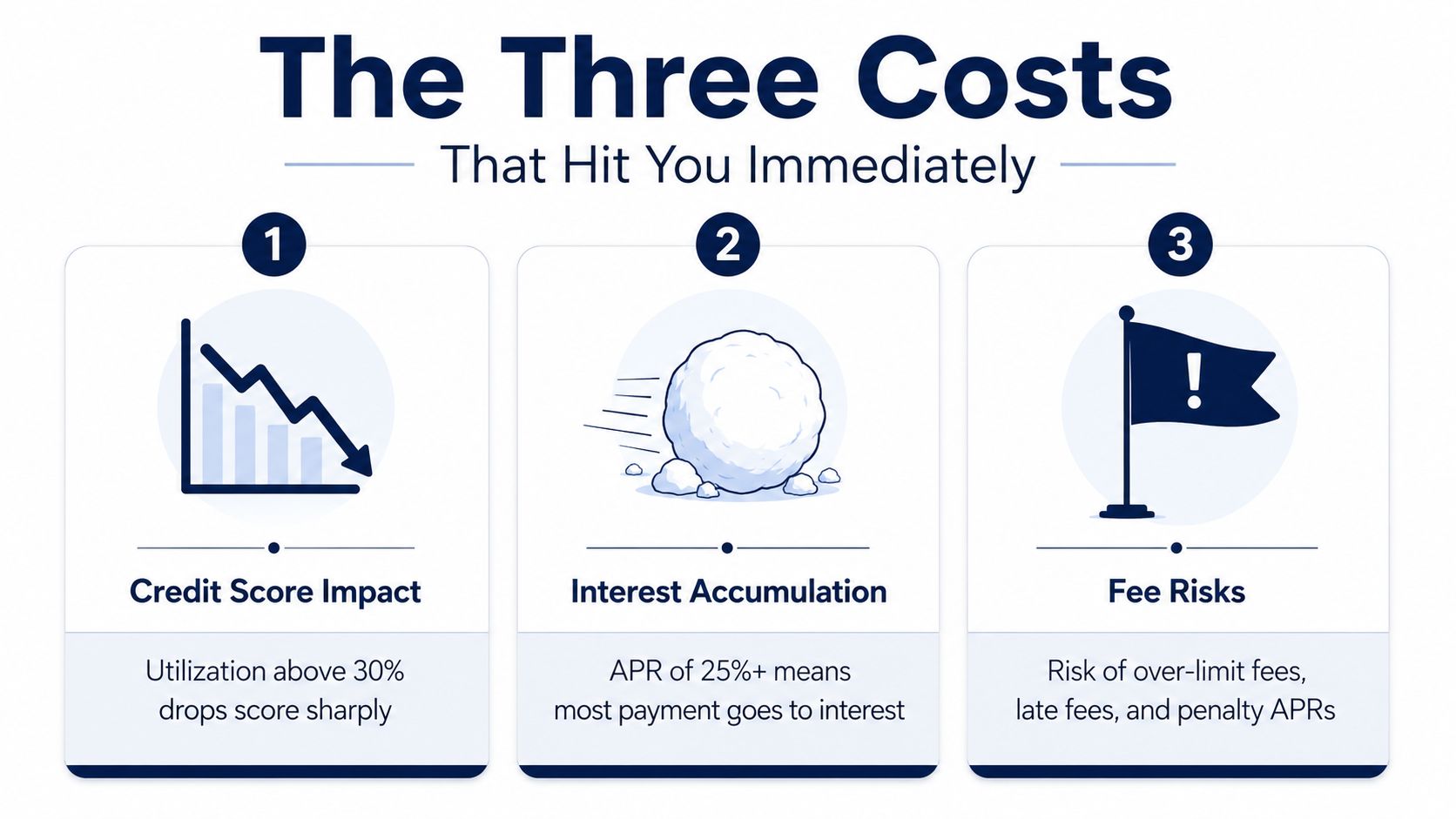
A maxed-out card hits in three places at once, and none of them wait politely. Your score takes a hit, your interest bill keeps growing, and your payment structure starts working against you. That combination turns one bad month into a long grind.
Credit score damage comes first
Utilization is one of the biggest scoring factors, so a card sitting near its limit can drag your score down fast. If the statement closes with a high balance, the bureaus see that number, even if you paid on time. That is why a maxed-out card can hurt you before the next billing cycle even starts.
Interest keeps charging while you tread water
The trap is that the balance does not stand still. Minimum payments are usually too small to make meaningful progress, and most of each payment gets swallowed by interest while the principal barely moves. Use a credit card interest calculator and you will see the problem clearly, the debt can stay alive for far longer than people expect even if no new charges are added.
Fees and account stress can stack on top
Once a card is pinned at the limit, any new charge can be declined, which creates a second problem, less room for an emergency. The broader market shows how common heavy card debt has become. Federal Reserve data show revolving consumer credit, most of which is card debt, reached about $1.32 trillion by late 2025, an all-time high, and the CFPB said average cardholder debt reached $5,288 at year-end 2022, up 24% from 2021 (Federal Reserve, CFPB consumer credit card market report). High balances make fee trouble and payment stress more likely, especially when a household is already stretched.
For score suppression that lasts, see Experian. The message is simple, a maxed-out card does not just cost you today. It keeps charging, keeps your score pinned, and keeps the debt timeline longer than your minimum payment plan admits.
Immediate Steps to Stop the Bleeding
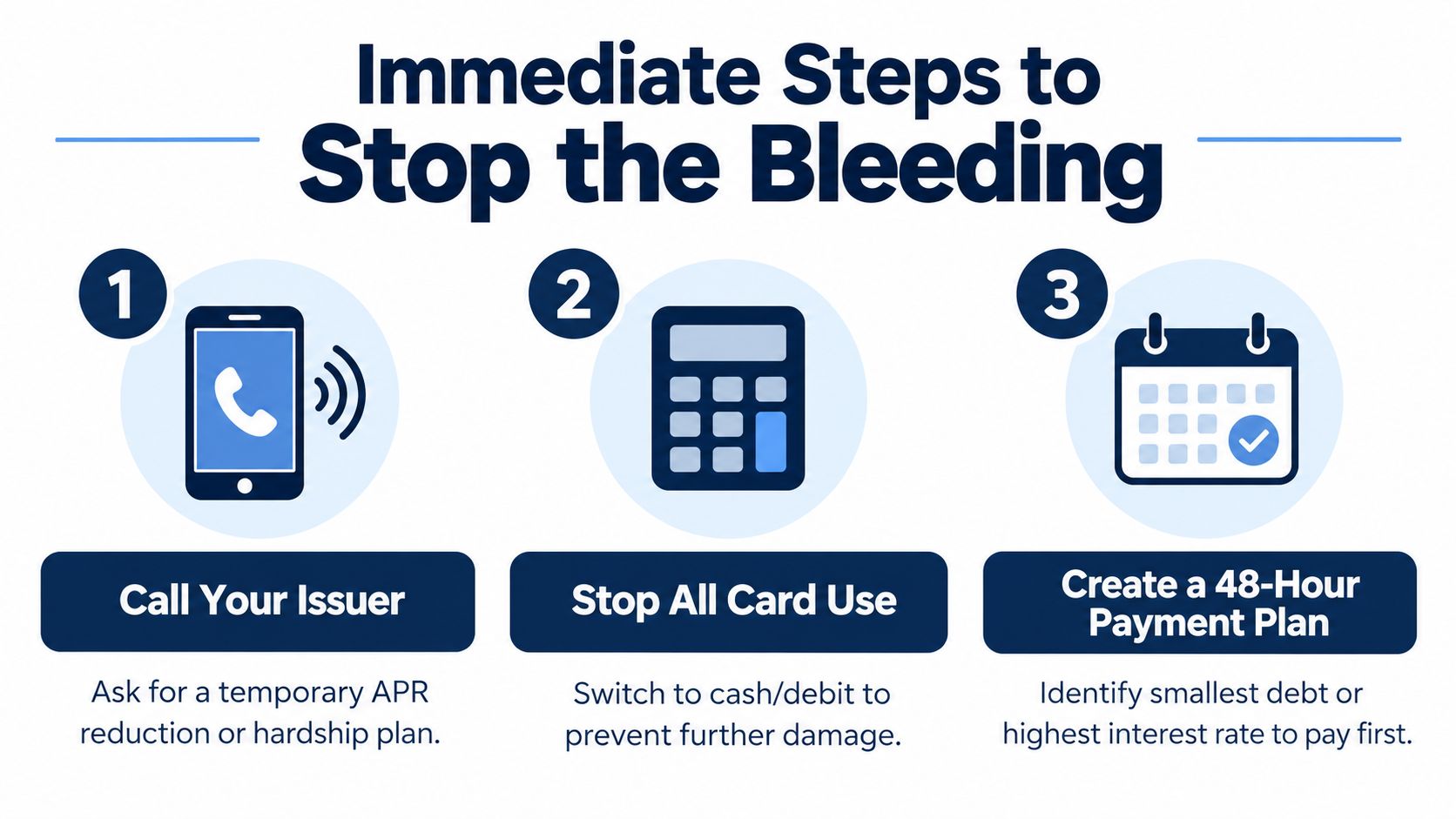
The first move is simple, stop putting new charges on the card. New spending keeps the utilization ratio pinned and makes every payment less effective. If the card is still being used for routine purchases, the balance will keep outrunning the cleanup effort.
Call the issuer before the account gets worse
A creditor is not going to fix the problem for free, but hardship options can buy breathing room. A temporary APR reduction, fee relief, or a modified payment plan can matter more than people expect when the balance is already pinned high. The point is not to argue your way out of debt, it's to keep the account current while making the math less brutal.
Make one strategic payment now
Even a small payment beats waiting for the “right” moment. The reason is timing, a payment made before the statement closes can lower the balance that gets reported to the bureaus, while a payment after the statement cuts off does nothing for that cycle. Check the closing date, then aim the payment there.
Use a limit increase carefully
A credit-limit increase can lower utilization if the issuer approves it, but it can backfire if the request triggers a hard inquiry or if spending rises with the new limit. It also does nothing if the balance remains unchanged. The safer move is to treat a higher limit as a possible side effect, not a plan.
Do not confuse available credit with actual progress. A card looks better when the balance falls, not when the ceiling rises.
The fastest checklist is short. Stop new charges today, contact the issuer this week, and schedule the first payment before the next statement closes. That order beats almost every emotional response people make when they first realize the card is maxed out.
Repayment Strategies That Actually Work
The best repayment plan is the one that lowers the balance fast enough to matter and fits the household budget without collapsing it. That means comparing methods by what they do, not by how clever they sound. Snowball, avalanche, and balance transfers all serve different purposes.
| Repayment Strategy Comparison | Monthly Payment | Payoff Timeline | Total Interest Paid |
|---|---|---|---|
| Minimum-only approach | Lowest required amount | Longest, often years of slow progress | Highest |
| Debt snowball | Minimums on all cards, extra on smallest balance | Faster early wins | Lower than minimum-only |
| Debt avalanche | Minimums on all cards, extra on highest-rate balance | Usually the most cost-efficient path | Lowest among self-pay methods |
| Balance transfer | New payment on transferred balance | Depends on promo period and payoff speed | Can be reduced if the balance is cleared during the intro window |
The debt snowball approach works best for people who need momentum. Paying off the smallest balance first creates visible progress, and that psychological win can keep a plan alive when frustration would otherwise kill it. The debt avalanche method is the sharper financial tool because it targets the highest-interest balance first, which cuts the long-run cost.
Use the debt snowball vs avalanche guide to choose based on discipline, not ego.
Small extra payments matter more than people think
The most dangerous myth is that only a large lump sum changes the picture. Extra principal, even when it's modest, reduces the balance that future interest is calculated on and can improve utilization before the next reporting cycle. That is why a small monthly bump can beat years of passive minimums.
Balance transfers fit a narrower situation. They make sense when the borrower can qualify, stop adding new charges, and pay down enough during the promotional window to justify the transfer fee. If those conditions are not in place, the transfer just delays the pain.
Why Minimum Payments Keep You Trapped
Minimum payments are built to keep the account current, not to clear the balance. On a maxed-out card, that means you can look stable while the debt barely shrinks. The payment covers the month, but it does not free up room fast enough to matter.
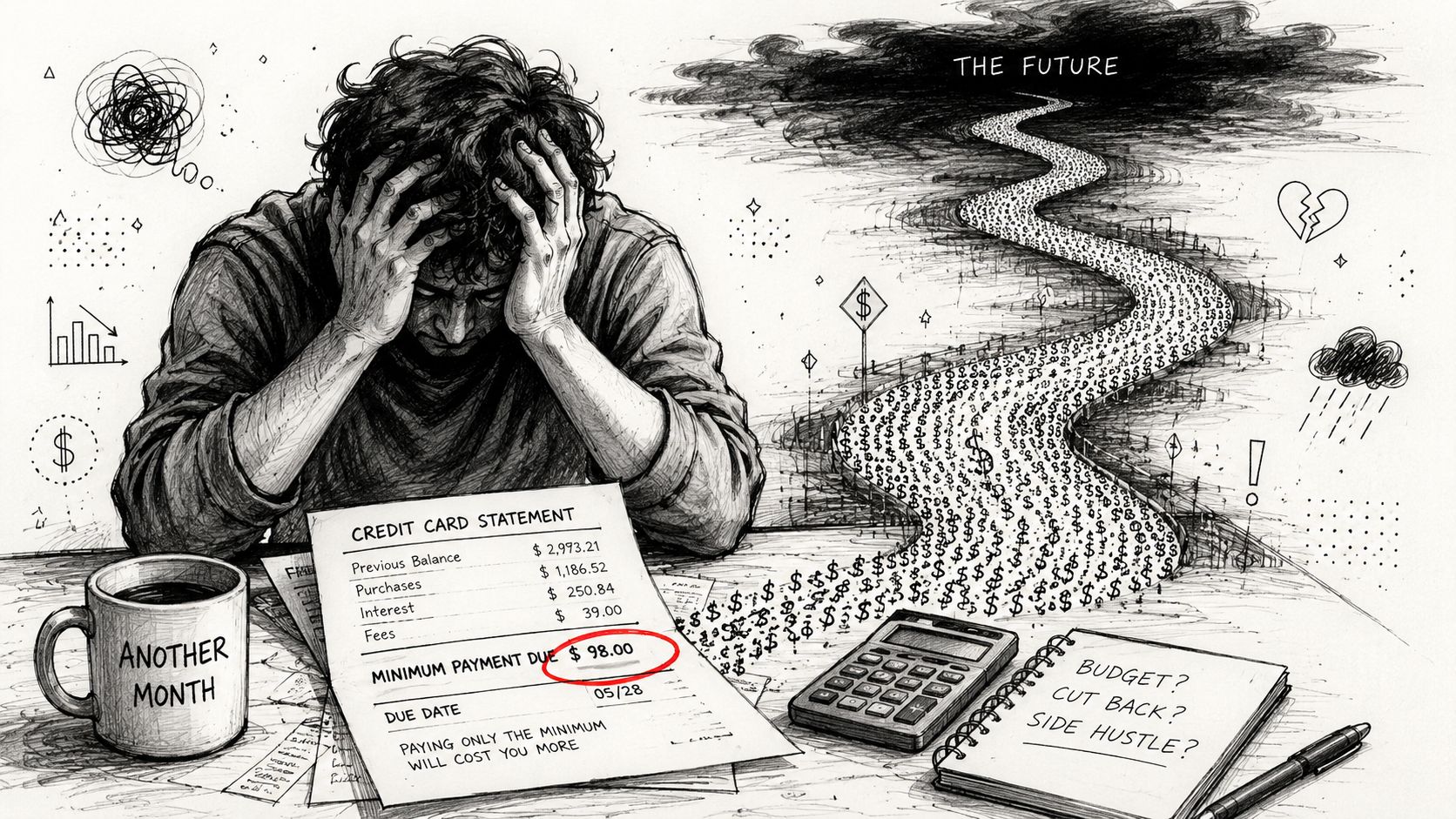
The scale is plain. The CFPB reported that the average minimum payment due on a revolving general purpose account reached $129 in 2024, and that about 15% of general purpose cardholders paid only that minimum, the highest share since at least 2015 (CFPB consumer credit card market report). That combination explains the trap, more people are revolving debt, and the payment floor is getting harder to outrun.
Minimum-only is a slow leak, not a fix
Paying only the minimum lets interest eat a large share of each payment. The balance can stick around even when no new spending happens, because too little of the payment reaches principal. That is how people stay stuck for months or years, depending on the rate and the size of the debt.
What matters is the timeline
The useful question is not whether the minimum can be covered this month. It is how long that payment pattern keeps the debt alive. That timeline is the part most content skips, and it is where the true cost shows up.
Use the minimum payment calculator to see the payoff date and total interest before you tell yourself the minimum is harmless.
When You Need Credit for Emergencies
A maxed-out card creates a second problem that gets ignored too often, there may be no room left when a real emergency shows up. That matters because people do not only carry debt, they also need backup credit when the car breaks, the fridge dies, or a medical bill lands. If the card is already full, the safety net is gone.
That is the trap, not just the score hit, but the fact that many households still expect to use cards that have no room left.
Resilience matters as much as payoff speed
Consolidation can help when the goal is one fixed payment and more breathing room. Settlement can lower the amount repaid but usually comes with major credit damage and less predictability. Bankruptcy can clear the runway for a fresh start, but it is a serious legal step with long-term consequences. Each path changes future credit access differently, so the right choice depends on whether the household needs monthly relief, score recovery, or emergency flexibility.
If another emergency would force the card back to the limit, the plan is too fragile. A repayment path that ignores resilience just sets up the same crisis later.
Choosing Your Path Forward
The decision comes down to one question, can the household reasonably pay the debt down without blowing up the rest of the budget? If yes, self-repayment with a snowball or avalanche plan is the cleanest route. If no, the next step is comparing consolidation, settlement, and bankruptcy based on cash flow, credit goals, and how much room is needed for future emergencies.
A simple filter works well. Stable income and a manageable total balance point toward self-repayment. Multiple cards with crushing minimums point toward consolidation. No realistic path to repay in full points toward settlement review or a bankruptcy consultation, especially if the account is already pushing the household toward repeated re-maxing.
Decision rule: pick the option that lowers the monthly burden without forcing a second debt spiral.
What matters most is not pride, it's speed and durability. The best choice is the one that stops the balance from growing, restores some monthly breathing room, and gives a real timeline out of the trap.
Debt Help U gives consumers a private way to compare payoff timelines, interest costs, and debt-relief options without handing over contact details first. If a maxed out credit card is draining cash flow and blocking emergency flexibility, visit Debt Help U to check the numbers and see which path fits the situation before the next statement closes.
Related guides
- How long will it take to pay off my credit card debt? Your minimum payment shrinks every month. Following it down is what turns a five-year balance into a thirty-five-year one.
- How to get out of credit card debt without a loan Borrowing your way out is the advice everyone gives first. Here is what works when you do not want more debt.
- Debt settlement vs. consolidation vs. bankruptcy Four paths out of unmanageable debt, what each one costs, and what each one breaks. Real numbers on a $30,000 balance, not a pitch for any of them.