What Is Financial Hardship and How to Prove It
Financial hardship is a payment-capacity problem: in 2025, 16% of U.S. adults didn't pay all their bills in full, while 28% either missed a bill or had difficulty paying one. It happens when a person can't meet current or upcoming obligations despite a willingness to pay, often after illness, job loss, reduced hours, or another reasonable cause.
A worker whose hours were cut may still be trying to keep every account current. Rent and groceries come first, but minimum payments now take more than the remaining income. The problem isn't a lack of concern or responsibility. The monthly numbers no longer fit together.
That distinction matters. Feeling anxious about money can happen even when every payment is manageable. Financial hardship begins when the household's available cash can't cover its obligations, or when paying one essential bill means falling behind on another. The definition can help a person explain the situation to a lender, creditor, counselor, or legal professional.
The sections below define hardship in practical terms, identify common triggers, compare relief paths, and show which documents can support an application. The aim is a clear answer to what is financial hardship, followed by an evidence-based way to decide what should happen next.
Table of Contents
- Introduction to Financial Hardship
- Understanding What Financial Hardship Really Means
- Common Triggers and Qualifying Criteria
- How Hardship Affects Your Debt Relief Options
- Documents That Prove Financial Hardship
- Special Situations and Debt After Death
- Next Steps and Resources for Moving Forward
Introduction to Financial Hardship
A reduced paycheck can turn an ordinary budget into a crisis quickly. A household may have enough income for housing, food, utilities, and transportation, but not enough left for credit card minimums, medical bills, or a personal loan payment. The account statements show missed payments, while the household's bank balance shows that paying everything was impossible.
The working definition is simple: financial hardship is the inability to meet current or upcoming obligations despite willingness to pay, usually because of illness, unemployment, reduced income, or another reasonable cause. Banking guidance uses a similar payment-capacity approach, treating hardship as an inability to discharge obligations when a revised arrangement might restore the borrower's ability to pay. The Australian Banking Association's financial difficulty guideline provides that formal framing.
A hardship claim therefore needs more than a statement such as “money is tight.” It should show what changed, what the household earns now, what it must pay, and why the current arrangement no longer works.
Practical rule: A strong hardship explanation connects a specific cause to a specific payment problem.
A person facing a temporary medical bill may need a short pause or reduced payment. A household with income that remains below essential expenses may need a more lasting debt strategy. A borrower struggling only with student-loan payments may need a debt-specific review rather than a broad solution for every account.
Understanding the definition is the first step. The right relief path depends on the trigger, the type of debt, the household's payment capacity, and the documents available to support the explanation.
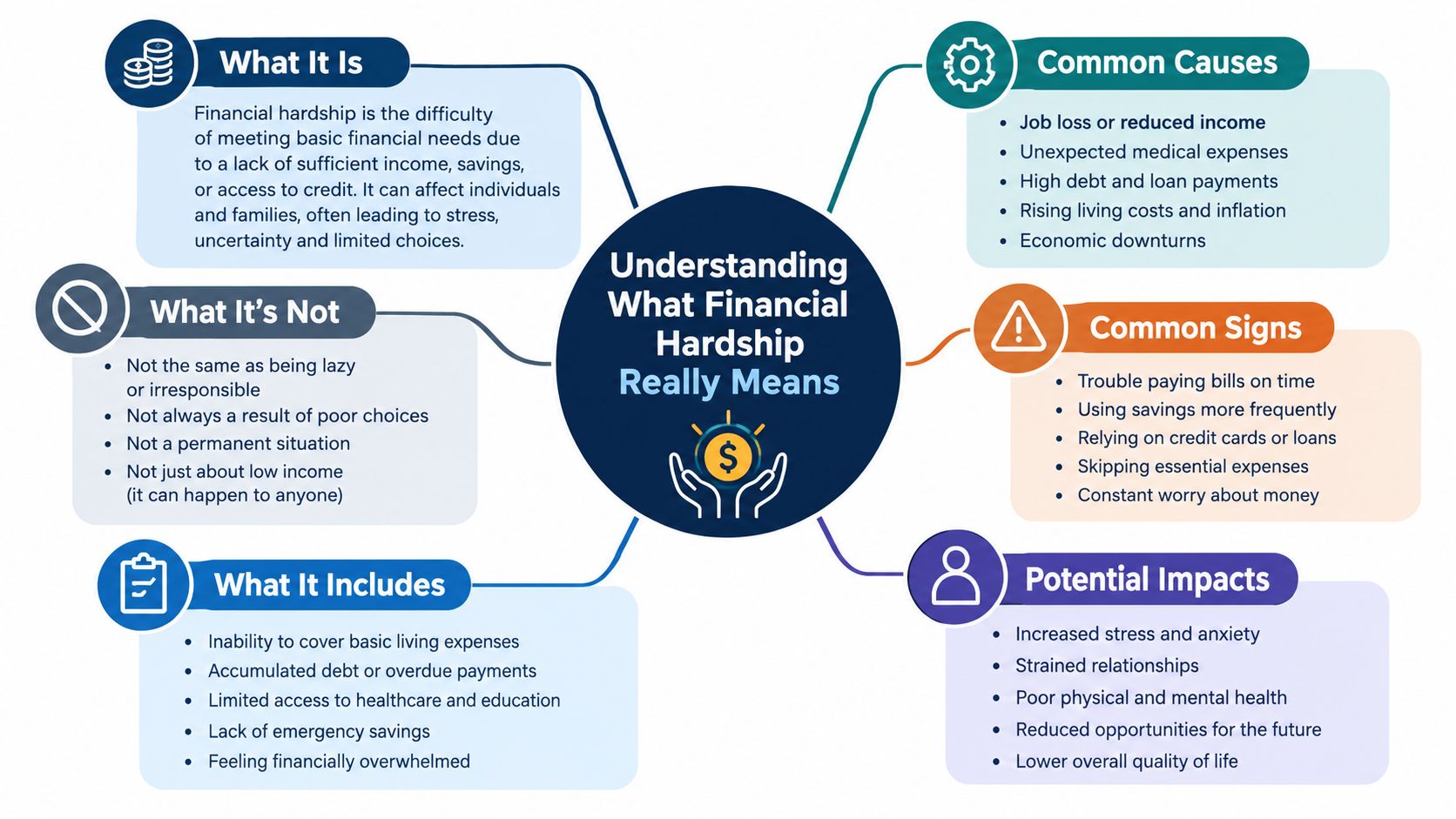
Understanding What Financial Hardship Really Means
A household budget works like a bridge. Income provides the bridge's carrying capacity, while rent, food, utilities, insurance, transportation, and debt payments create the load. If the load rises above the available capacity, something gives. The household may skip a payment, borrow for essentials, delay medical care, or use one credit account to cover another.
That analogy separates hardship from ordinary financial discomfort. A person may dislike carrying debt and still be able to make every payment. A person experiencing hardship has a practical shortfall. The issue is whether the available money can support the required obligations now or in the near future.
A payment-capacity test
Lenders and consumer-support programs often look for four connected facts:
- A reasonable cause: Illness, unemployment, reduced hours, or another circumstance affected the household.
- A current or upcoming obligation: The problem concerns a bill, payment, or necessary expense that the household can't meet.
- A willingness to pay: The borrower isn't just refusing to pay. The existing arrangement has become unrealistic.
- A possible adjustment: A revised payment, temporary pause, or other arrangement could improve the household's ability to keep paying.
That framework doesn't guarantee approval. Each creditor or program applies its own eligibility rules. It does give the reader a practical way to describe the problem without relying on vague language.
How researchers measure hardship
Researchers don't rely only on whether someone says they feel stressed. They examine missed payments, difficulty covering necessities, debt repayment problems, and the ability to handle unexpected costs. In the Federal Reserve's 2025 household economic well-being report, 16% of adults said they hadn't paid all bills in full during the prior month, and 28% said they had either missed a bill or struggled to pay one.
The second figure means more than one in four adults experienced short-term payment strain. It doesn't mean every person in that group has the same cause or needs the same solution. It does show why hardship is better understood as a measurable problem with recurring obligations, not as a feeling.
A reader speaking with a creditor can use the same logic: explain the cause, show the income change, list the necessary expenses, and identify the payment that no longer fits. That turns “financial stress” into a documented payment-capacity problem.
Common Triggers and Qualifying Criteria
Hardship often starts with an event that changes the budget. A job loss can remove income altogether. Reduced hours can leave employment intact while making minimum payments unaffordable. Illness can combine lost wages with medical bills, and divorce or separation can divide household income before expenses fall.
Other triggers include the death of a spouse, an unexpected repair, and an urgent household expense. A person may also face a debt-specific problem, such as a student-loan payment that became unaffordable even though other bills remain current.
Three forms of financial distress
A one-off shock is a sudden cost that disrupts an otherwise workable budget. A major vehicle repair can force a household to choose between transportation and debt payments. A temporary creditor program or short forbearance period may fit if the income problem is brief and the regular budget can recover.
A chronic cash-flow gap is different. If income remains below essential expenses month after month, postponing a payment may only move the problem forward. The household may need a broader review of spending, income, debt terms, and available formal options.
Debt-specific distress affects one category more than others. Student loans, medical bills, rent arrears, credit cards, and secured loans can have different rules and remedies. The Federal Reserve found that 41% of student-loan borrowers who were recently required to make payments had payment difficulties, and 76% of those borrowers with repayment trouble had an affordability problem, such as income below expenses, an unexpected expense, or an unexpected income drop, according to its 2025 credit report. The figures illustrate why the label “hardship” isn't enough by itself. The debt type and the cause shape the available response.

The numbers used to assess risk
Some debt analysts use ratios to see how much income goes toward debt service. The debt service-to-income ratio, or DSI, compares annual debt payments with annual income. The Bank for International Settlements' discussion of household debt indicators explains that high DSI can leave households vulnerable if income falls or interest costs rise, and notes that several countries use DSI above 30% to 40% as a risk threshold.
A ratio isn't a universal approval rule. A household with high housing costs may struggle at a lower debt ratio, while another household may manage a higher ratio temporarily. The calculation still helps a borrower prepare:
- Add required monthly debt payments.
- Compare that total with gross or net income, using the definition requested by the program.
- List essential expenses separately, because debt capacity depends on what remains after necessities.
- Identify whether the problem is temporary, persistent, or limited to one debt type.
Programs may also review payment history, assets, bank statements, and the reason for the hardship. A clear ratio gives structure, but the full budget explains the lived reality behind it.
How Hardship Affects Your Debt Relief Options
Hardship can open a conversation, but it doesn't make every option suitable. A temporary payment pause may help a household recover from a short interruption. It may do little for a household whose income has been below expenses for a long period.
The table below compares the main paths. Terms vary by creditor, state, contract, and personal circumstances, so the comparison is a screening tool rather than a recommendation.
| Option | Best Fit | Typical Timeline | Credit Impact | Key Trade-offs |
|---|---|---|---|---|
| Forbearance | A temporary income interruption or short-term shock | Usually temporary, based on the creditor's agreement | A formal arrangement may affect reporting, depending on the creditor and terms | Payments may be postponed rather than forgiven, and interest may continue |
| Creditor hardship program | A borrower who can resume a manageable payment after an adjustment | Often temporary or reviewed periodically | Reporting and account restrictions vary by creditor | The program may reduce payments or interest, but it may close or restrict an account |
| Debt settlement | Serious unsecured-debt distress where negotiated payoffs are being considered | 24 to 48 months is the timeline described in the credit card payment options guide | Missed payments and settled accounts can damage credit | Balances may grow, creditors may refuse an offer, fees may apply, and forgiven debt can create tax questions |
| Bankruptcy | A severe, broad debt problem requiring a formal legal process | Depends on the bankruptcy chapter and court process | Bankruptcy has a serious, lasting effect on credit records | Legal costs, filing requirements, public records, asset risks, and long-term financial consequences require professional advice |
Matching the option to the hardship
Forbearance can fit a one-off disruption when the borrower expects income to return. The borrower should ask whether interest continues, whether late fees are waived, how payments are reported, and whether the missed amount becomes due later.
A creditor hardship program may be more useful when the borrower can pay something but not the contracted amount. The account might receive a reduced rate, lower payment, or temporary accommodation. The agreement should be obtained in writing before the borrower assumes that a phone conversation changed the contract.
Debt settlement involves negotiating reduced payoffs on eligible debts. It can carry meaningful risks, including credit damage, possible balance growth, creditor discretion, and fees. It doesn't guarantee that every creditor will settle or that the final cost will be lower.
Bankruptcy is the formal legal route. It may address a broad debt burden, but it also brings serious legal and credit consequences. A qualified bankruptcy attorney can explain eligibility, exemptions, and the consequences for the household's property and debts.
The most affordable-looking monthly payment isn't automatically the least expensive option. The full comparison includes fees, interest, credit reporting, legal consequences, and the time needed to finish.
Documents That Prove Financial Hardship
A creditor can't evaluate a payment-capacity problem from a general statement alone. A complete packet links the event to the financial result. It should show what changed, when it changed, and why the existing payment is no longer affordable.
Organize proof around the trigger
For lost income, gather a termination letter, unemployment documentation when available, recent pay stubs, and records showing reduced hours or pay. The purpose is to establish the change in earnings rather than merely report that work has become difficult.
For medical hardship, collect provider statements, billing notices, insurance explanations, and records of related income loss. A medical bill by itself may show a cost, but the household budget shows whether that cost caused the missed payment.
For separation or the death of a spouse, relevant records may include legal documents, changed income information, account statements, and evidence of new household obligations. The precise documents depend on the creditor and the account.
Show the monthly shortfall
Bank statements can reveal when income arrives, which essential payments leave the account, and where the balance falls short. A monthly budget should list income, housing, utilities, food, transportation, insurance, medical expenses, and every debt obligation. The list doesn't need to look polished. It needs to be complete and consistent with the supporting records.
A hardship letter adds context. The guide to writing a hardship letter can help organize the explanation, but the strongest letter remains specific to the household.
A useful letter should include:
- Dates: State when the job loss, illness, separation, death, or expense occurred.
- Amounts: Identify the income reduction, new bill, or payment shortfall.
- Cause: Explain the event without exaggeration or irrelevant detail.
- Current capacity: State what the household can realistically pay after essential expenses.
- Requested adjustment: Ask for a particular review, such as a reduced payment, temporary pause, or alternative arrangement.
“Financial stress has made payment difficult” is weaker than “Reduced hours began in a stated month, income fell, and the remaining income no longer covers essential costs plus the contracted payment.” The second version gives the reviewer something that can be checked.
Documents should be labeled by account and date, with sensitive information shared only through a secure channel. The borrower should keep copies of every submission and every written response.
Special Situations and Debt After Death
Debt after a death creates confusion because family relationships don't automatically determine legal responsibility. There is no single national answer about who owes a deceased person's debt. The answer depends on the state, the account structure, and whether the survivor was a joint account holder, co-signer, authorized user, or covered by another legal exception.
A person's debt generally doesn't disappear at death. It's usually paid from the deceased person's estate, which may include property, bank accounts, and other assets. Survivors can become personally responsible in certain circumstances, including when they were a joint account holder or co-signer.
Account status matters
A joint account holder generally shares responsibility under the account agreement. An authorized user is different. The Consumer Financial Protection Bureau states that an authorized user on a deceased person's credit card is generally not responsible for the balance merely because the person was allowed to use the card. That distinction appears in the CFPB guidance for survivors dealing with debt collectors.
The estate's representative should notify creditors and ask for instructions about the account. A family member shouldn't promise personal payment before confirming the account structure and applicable law. Debt collectors also must follow rules governing communications with survivors and estate representatives.
State law can change the result. The CFPB identifies nine community property states: Alaska, if a special agreement is signed, Arizona, California, Idaho, Louisiana, Nevada, New Mexico, Texas, Washington, and Wisconsin. The CFPB explanation of debt after death notes that community property rules can affect responsibility.
Before paying a deceased relative's account, confirm the survivor's legal role and the state's rules.
The surviving household's own hardship should be assessed separately. A death may reduce income, increase expenses, or create estate costs, but inherited-payment confusion and personal debt distress aren't the same issue. An estate attorney or consumer-law professional can review the account documents when responsibility is disputed.
Next Steps and Resources for Moving Forward
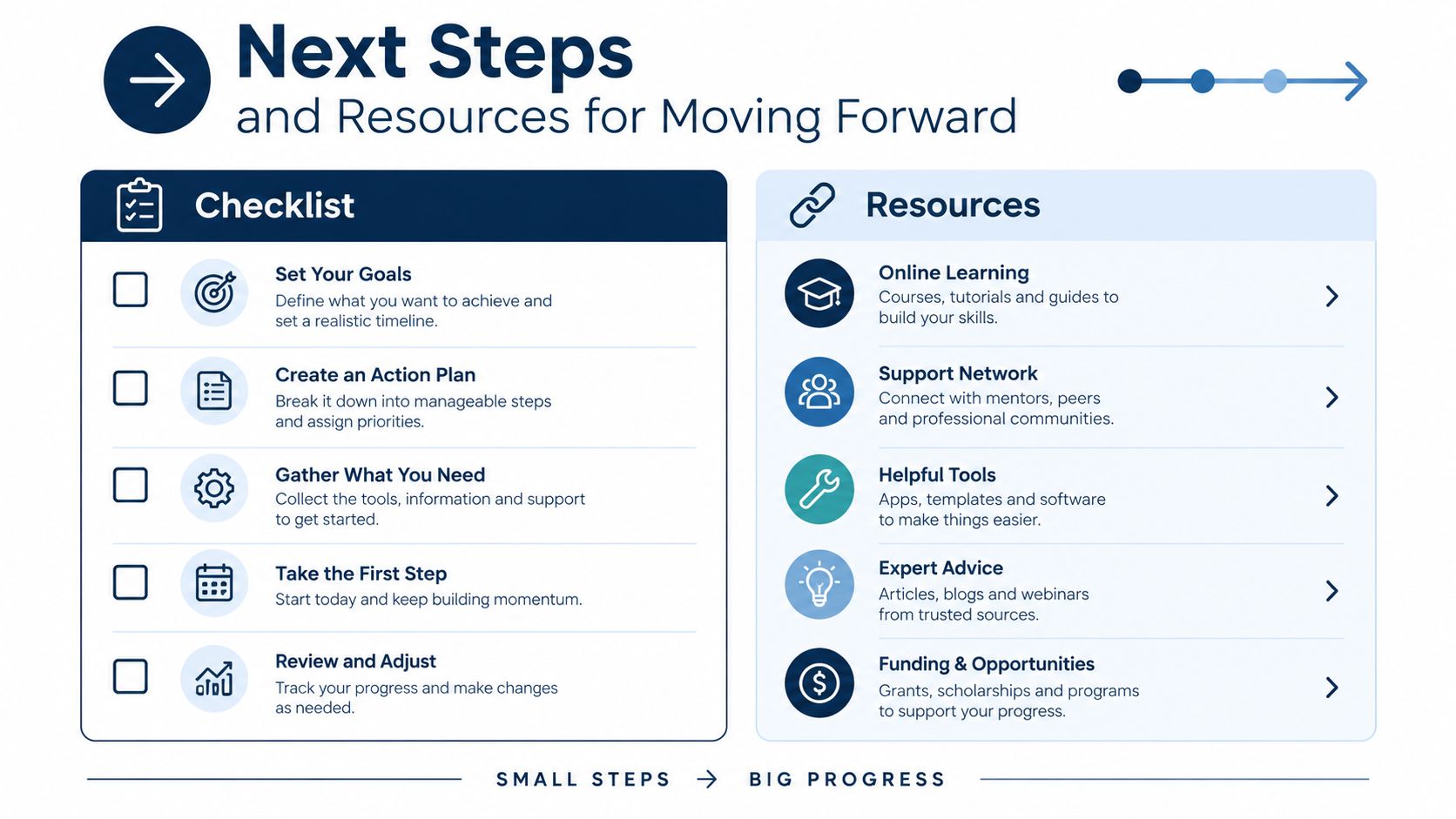
Financial hardship becomes easier to address when the household turns a general worry into a sequence of decisions. The process doesn't require a perfect budget on the first attempt. It requires enough accurate information to distinguish a temporary shock from a continuing inability to pay.
Start with the household's numbers
First, list monthly income and every required obligation. Calculate the household's debt service-to-income picture, then compare the amount left after essential expenses with the total debt payments. A deficit indicates that the current arrangement isn't sustainable without a change in income, expenses, terms, or debt structure.
Second, classify the hardship:
- Temporary shock: A short interruption or unexpected bill may point toward creditor assistance or forbearance.
- Chronic gap: Persistent income below essential expenses calls for a broader affordability review.
- Debt-specific distress: One category, such as student loans or medical debt, may need a specialized program.
- Broad unsecured-debt problem: Multiple unaffordable accounts may justify comparing settlement, consolidation, and bankruptcy with qualified guidance.
Third, assemble the documentation packet before making calls. Include income records, proof of the triggering event, bank statements, the monthly budget, account statements, and a focused hardship letter. A complete packet helps the reviewer understand the problem without repeated requests for basic information.
Model options privately
Free tools can help a household test possible paths before sharing contact details. A minimum-payment calculator can estimate a payoff date and total interest from a balance and APR. An extra-payment simulator can show how a fixed additional payment changes the repayment path. A debt-to-income calculator can provide an affordability reference, while a debt assessment questionnaire can organize debt type, payment status, hardship, state, and monthly capacity.
A private, no-login resource such as Debt Help U's debt relief guide can help a reader compare repayment strategies and formal relief options before contacting a provider. Any referral should be treated separately from education, and no tool can guarantee approval or a particular outcome.
Ask focused questions
When contacting a creditor or professional, a household should ask:
- Does the account qualify for a hardship review?
- What documents are required?
- Will interest, fees, or credit reporting change?
- What happens when a temporary arrangement ends?
- Is the agreement available in writing?
- Which state-law rules affect the account?
Financial hardship isn't a moral failing. It's a payment-capacity problem caused by circumstances and numbers. The appropriate next step depends on the cause, the debt type, the available evidence, and the state where the household lives.
Debt Help U offers free, no-login calculators and plain-language comparisons for repayment strategies, settlement, consolidation, and bankruptcy, with an optional introduction to a third-party program when requested. A household can begin by reviewing its payment capacity and debt options privately at Debt Help U.
Related guides
- Debt settlement vs. consolidation vs. bankruptcy Four paths out of unmanageable debt, what each one costs, and what each one breaks. Real numbers on a $30,000 balance, not a pitch for any of them.
- How long will it take to pay off my credit card debt? Your minimum payment shrinks every month. Following it down is what turns a five-year balance into a thirty-five-year one.
- Debt snowball vs. avalanche: which one finishes faster Avalanche always pays less interest. The gap is smaller than the argument about it suggests. Run both on your own balances and see what it is worth.