Minimum Monthly Payment Calculator Guide
You make the payment every month, check the app, and the balance barely moves. The due date gets met, the late fees stay away, but the number at the top of the statement feels stuck in place. That gap between paying on time and getting free is exactly where a minimum monthly payment calculator earns its keep.
The confusion usually starts because the statement shows a number that feels manageable. What it doesn't show at a glance is how much of that payment is only keeping the account current, how much is going to interest, and how long the balance can linger if nothing changes. A calculator turns that hidden pattern into something visible, which is often the moment the repayment problem stops feeling vague and starts looking solvable.
Table of Contents
- Why Your Credit Card Balance Never Seems to Shrink
- The Purpose of Payoff Transparency Tools
- How Issuers Calculate Your Minimum Due
- Using the Debt Help U Calculator
- Interpreting Your Payoff Date and Total Interest
- Comparing Minimum Payments to Alternative Strategies
- Hidden Variables That Distort Calculator Results
- Quick Reference Guide and Next Steps
Why Your Credit Card Balance Never Seems to Shrink
A cardholder can make every minimum payment for months and still feel like the balance is glued in place. That happens because the payment is usually built to satisfy the account, not to erase the debt quickly. The result is a plan that can look affordable in the short run while stretching repayment over a long period.
The balance moves, but not much
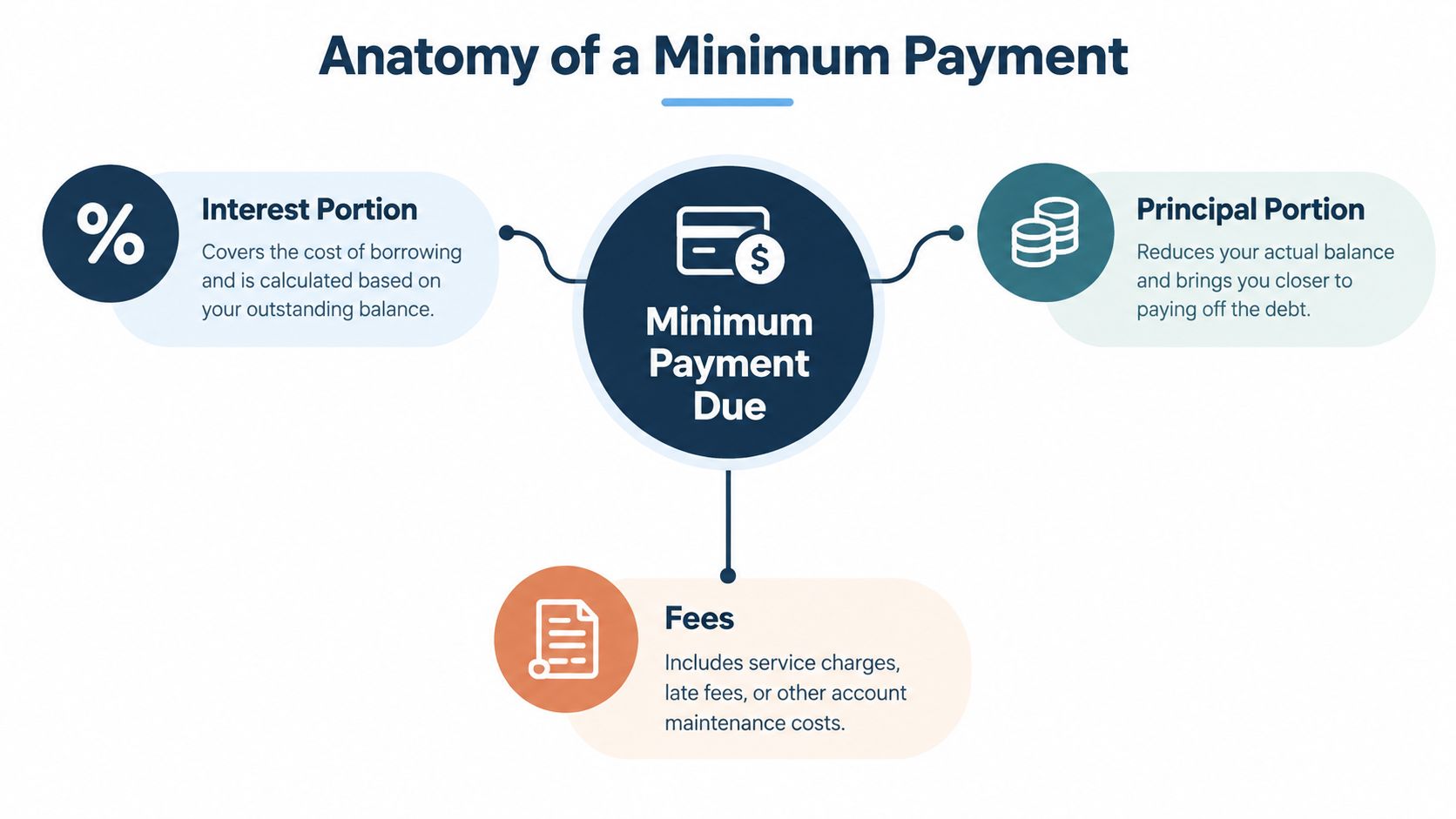
The key problem is amortization. Each statement cycle, part of the payment goes to interest and fees, and only the remainder hits principal. When the principal portion is tiny, the balance falls slowly even though the account stays in good standing.
That's why a minimum monthly payment calculator is more than a convenience tool. It shows the difference between “I paid something” and “I'm making real progress.” For many people, that distinction changes the entire plan.
Practical rule: If a payment keeps the account current but doesn't create a clear path to payoff, the statement is giving a cash-flow signal, not a victory lap.
Why the statement minimum can feel deceptive
Minimum due amounts are often designed to be small enough to fit a tight budget. That can be useful for avoiding missed payments, but it also means the borrower may spend a long time carrying the balance. The longer the balance remains, the more interest can accumulate.
The calculator helps a reader ask a better question than “Can this month's payment be covered?” It asks, “What does this payment do to the debt over time?” That change in perspective matters because credit card debt is not only a monthly expense, it's a timeline problem.
The emotional shift is important too. Once the payoff date appears on screen, the debt stops feeling like an endless fog. It becomes a sequence of months, interest charges, and choices. That's the first step toward treating the balance as a math problem with a real end date instead of a vague worry.
The Purpose of Payoff Transparency Tools
Credit card transparency didn't become mainstream by accident. In the United States, the Credit CARD Act of 2009 pushed statements to show how long repayment would take if only minimum payments were made, along with the total principal-and-interest cost and the payment needed to eliminate the balance in 36 months. The same milestone also required a warning that making only minimum payments increases both interest paid and the time needed to repay the debt, which helped normalize payoff calculators that estimate dates and total cost under different payment patterns. That historical shift is part of why modern tools focus on time and total interest, not just the due date. Regulation Z, 12 CFR 1026.7(b)(12) repayment disclosures
Why the 36-month benchmark matters
The 36-month benchmark gives consumers a simple way to judge whether a payment plan is aggressive enough to reduce the debt in a reasonable period. It doesn't mean every balance should be gone in exactly three years, but it does give a practical reference point. If a payment setup stretches far beyond that, the borrower can see that the current approach is mostly maintenance.
That matters because minimum-payment plans often look harmless when they're judged only by the monthly due. Once the long-term cost appears, the picture changes. The borrower can compare the “small monthly payment” against the true price of keeping the debt alive.
Why calculators exist in the first place
A calculator translates statement language into a repayment timeline. Instead of asking users to mentally reconstruct how interest and principal interact, it shows the likely payoff path directly. That's especially useful when someone is weighing whether to keep paying the minimum, add extra cash, or consider a broader debt strategy.
A useful calculator doesn't flatter the borrower. It gives a clean projection and lets the numbers speak for themselves.
This is also why transparency tools feel so different from a simple bill summary. A bill tells the user what's due now. A payoff tool shows what that choice does over time. Those are not the same thing, and treating them as if they are can keep a household stuck in the same repayment cycle for years.
How Issuers Calculate Your Minimum Due
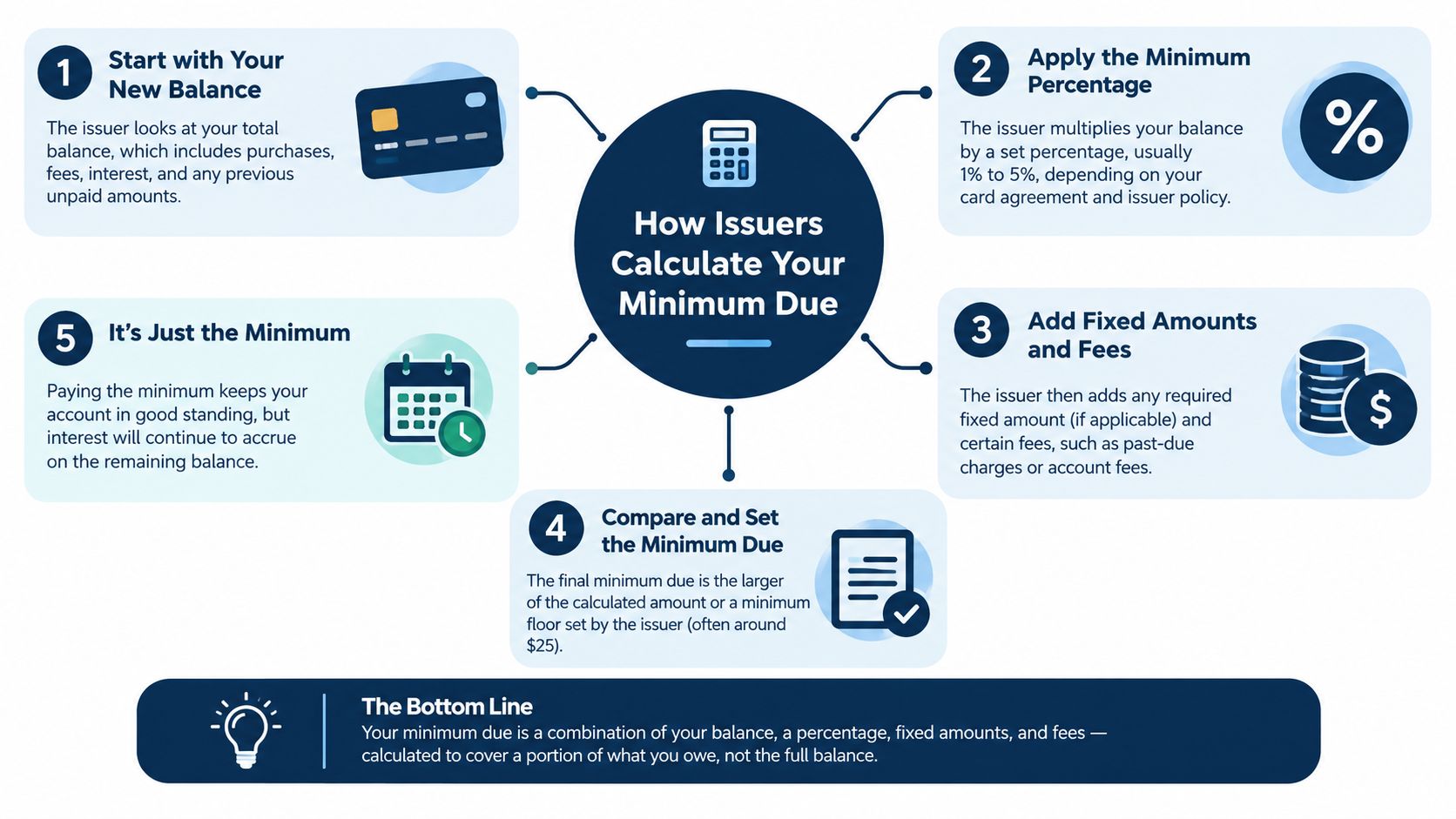
Credit card minimums are usually built from a few moving parts. Industry explanations describe the formula as a small percentage of the balance, plus interest and fees, with a dollar floor so very small balances still trigger a payment. Common summaries place that percentage in the rough range of 1% to 4% of the outstanding amount, with floors such as $25 or $35 for smaller balances. In the United Kingdom, the Financial Conduct Authority requires the minimum repayment to cover at least interest, fees, and charges plus 1% of the amount outstanding, and some contractual examples use the higher of £5 or that formula. How credit card minimum payment is calculated
The basic formula in plain language
Think of the issuer's formula like a three-part bill.
- Interest and fees come first. Those charges have to be covered or the payment formula can understate what the account really needs.
- A small slice of principal is added. That is the part that reduces the balance.
- A floor may override the math. If the percentage comes out too low, the issuer can still require a fixed amount.
That structure explains why minimum payments don't behave like ordinary installment loans. The payment can stay small even when the balance is large, and the small principal slice may barely dent the debt after the interest portion is accounted for.
Why floors change the result
A dollar floor can be helpful on a tiny balance because it can wipe out the remaining amount faster. On a larger balance, the floor matters less because the percentage formula usually produces a higher number. That difference is one reason two people with similar cards can see very different minimums on their statements.
Industry summaries also describe typical minimums as roughly 2% to 4% of balance under the flat-percentage method, with floors such as $25 or $35, depending on the issuer and product. How credit card minimum payments are calculated That spread matters because a small shift in the formula can change the payment enough to affect a payoff projection.
Why the calculator needs APR and balance together
A minimum payment isn't just about the balance. APR changes how much interest gets added before the next payment cycle. That's why the same payment can behave very differently on two cards with different rates. The calculator has to include both pieces or it risks giving a projection that looks tidy but doesn't match real-world debt growth.
Using the Debt Help U Calculator
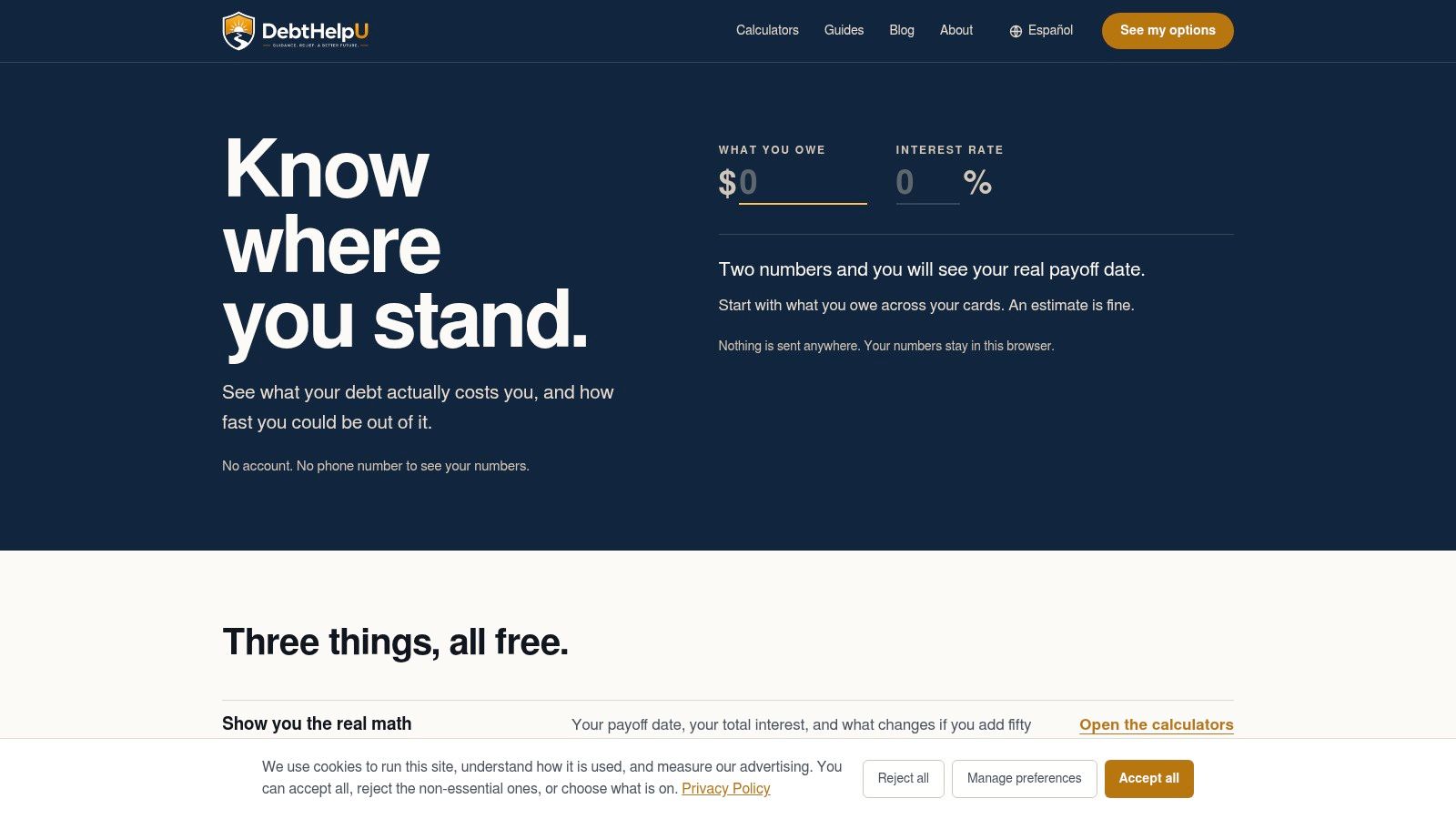
Debt Help U offers a minimum payment calculator that estimates payoff date and total interest from the current balance and APR. The tool works without an account or phone number, and the site states that inputs stay in the browser during calculator use. That privacy setup matters for someone who wants a quick projection before deciding whether to share information anywhere else. Debt Help U minimum payment calculator
What to gather before starting
The two most useful numbers usually sit on the credit card statement. One is the current balance, and the other is the APR. If the statement also shows a minimum due, that number helps the borrower compare the issuer's formula with the calculator's projection.
A few people get stuck because they're looking for a special “calculator input” section on the statement. There usually isn't one. The needed figures are already there, just under different labels.
How to read the result on screen
The output typically tells the borrower how long repayment could take at the current minimum and how much interest may accumulate over that period. Those two numbers answer different questions. The payoff date answers “when,” while total interest answers “at what cost.”
The practical value comes from comparison. If the result looks uncomfortably long, the borrower can test whether a higher payment changes the picture. If the timeline is already manageable, the calculator still helps confirm that the current plan is at least pointing in the right direction.
Why privacy changes the experience
A no-login calculator lowers the friction that keeps people from checking their options. It also gives the user room to test a few scenarios without handing over contact details first. For anyone uneasy about talking to a provider before understanding the debt, that matters.
The point isn't to produce a perfect prediction. The point is to get a fast read on the debt's shape. Once the balance, APR, and minimum due are visible together, the repayment decision gets much clearer.
Interpreting Your Payoff Date and Total Interest
A payoff date isn't just a calendar result. It's a warning label or a relief signal, depending on how far out it lands. If the date looks far away, the card is probably functioning more like a long-term cash-flow drag than a short bridge, especially when the current payment barely reduces principal.
Read the payoff date as a stress test
The question is whether the timeline fits the household's budget without creating strain elsewhere. A short, realistic payoff window can mean the minimum strategy is temporary and manageable. A stretched-out timeline suggests the borrower may be surviving month to month rather than reducing debt in a durable way.
That distinction matters because the same minimum payment can mean two very different things. For one person, it's a brief holding pattern before a raise or bonus. For another, it's a sign that the budget can't absorb the balance any faster.
Total interest tells the other half of the story
The total interest figure reveals how expensive the debt becomes if the borrower keeps following the same path. Bankrate reported that 47% of American cardholders were carrying a balance as of December 2025, while the average credit card balance was about $6,523 and minimum-payment payoff at 19% APR could take 170 months with $6,491 in interest. Credit card debt report Those figures show why total interest can be the more useful number for judging whether the minimum plan is a temporary tactic or a warning sign.
If the projected interest feels disproportionate to the original balance, the debt is not behaving like a short-term inconvenience.
Use the result as a decision filter
A borrower who sees a modest timeline may decide to stay with the minimum while focusing on other priorities. A borrower who sees a long timeline and a heavy interest burden may need a stronger response. That could mean extra payments, a different repayment strategy, or a broader debt-relief review.
The Debt Help U credit card interest calculator can help with that comparison because it focuses on the cost side of the equation. Credit card interest calculator When the projection looks harsh, the borrower doesn't need to panic. The point is to treat the output as a diagnostic, not as a sentence.
Comparing Minimum Payments to Alternative Strategies
A minimum payment is the baseline, not the finish line. Once the projection is visible, the next question is whether a small change in payment behavior can produce a noticeably better outcome. In many households, the answer is yes, and the gap between “minimum only” and “slightly more than minimum” can be the difference between endless revolving debt and a plan with traction.
Side by side comparison
| Strategy | Timeline Impact | Interest Cost | Credit Impact |
|---|---|---|---|
| Minimum payment only | Usually the slowest path | Usually the highest cost over time | Keeps the account current if paid on time |
| Minimum plus extra payment | Shortens the payoff path | Lowers total interest compared with minimum only | Can help reduce utilization over time |
| Consolidation | Can simplify the repayment path | Depends on new terms and fees | May affect accounts differently |
| Settlement | Can reduce the amount paid, but timelines vary | Can lower paid principal, but terms are case-specific | Can have a significant credit impact |
| Bankruptcy | Restructures or discharges certain debts through legal process | Depends on chapter and case outcome | Can have major credit consequences |
Why small extras matter so much
The minimum payment formula is built to preserve the account. Extra principal changes the math. Even a modest add-on can reduce the amount on which future interest is charged, which is why a repayment simulator is so useful when someone wants to test whether a small monthly increase is worth it.
For readers comparing broader approaches, the debt snowball and debt avalanche methods create different psychological and mathematical paths. Snowball vs avalanche guide The right choice depends on whether the borrower needs motivation from quick wins or wants to direct extra payments toward the costliest balance first.
When the minimum result suggests a bigger problem
A minimum payment projection becomes more concerning when the timeline remains long even after the borrower is stable enough to consider more than the floor amount. That can point to serious cash-flow strain or to a debt load that needs a formal strategy instead of a waiting game. In those cases, the calculator stops being a simple budgeting tool and starts acting like an early warning system.
Hidden Variables That Distort Calculator Results
A calculator is only as honest as the assumptions behind it. If the model holds the APR steady and assumes the borrower keeps paying on time, the result can be useful. If real-life terms change, the projection can drift away from what the statement eventually shows.
What the calculator may not know
Late fees can change the minimum due. A penalty APR can make interest accumulate faster. Statement-cycle quirks can also affect which charges land in which billing period, which means the payment burden may not match the neat version a basic calculator displays.
Those details matter because many card agreements don't behave like a clean textbook example. The issuer's formula can shift the number that appears on the statement, and a missed payment can make the debt more expensive than the original projection assumed. That's why the calculator should be treated as a planning guide, not a guarantee.
Why card terms matter more than people expect
Two balances that look similar can repay differently if the issuer's rules differ. A percentage-based minimum with a floor behaves differently from a formula that adds fees in a new cycle. Even a small change in the rate or the floor can alter the payoff path enough to matter for someone living close to the edge.
Reality check: A projection built on current terms is useful. A projection built on current terms plus a future late fee is not a promise, it's a stress scenario.
How to use the projection responsibly
The safest way to read the result is to ask whether the current pattern is stable. If the user pays on time every month and the rate stays the same, the estimate is usually a decent planning tool. If the user has already missed payments, expects fee changes, or is considering settlement or bankruptcy, the calculator should be treated as a starting point for comparison rather than a final answer.
That approach keeps the user from overtrusting a clean-looking number. Credit card debt rarely stays perfectly still, so the projection should be read as a baseline that can change if the account changes.
Quick Reference Guide and Next Steps
Quick ways to judge the result
- Check the minimum due formula: Look for the balance, interest charges, and any fees that might be built into the payment.
- Read the payoff date first: A far-off date usually means the minimum is preserving the balance more than reducing it.
- Compare total interest to the original balance: A large interest figure is a sign the debt is expensive to carry.
- Test one extra payment scenario: A small change in monthly payment can reveal whether the current plan is holding the debt back.
- Match the result to the budget: If the numbers feel tight, the issue may be cash-flow stress rather than simple budgeting discipline.
Where other tools fit
Debt Help U also provides tools and guides for comparing repayment paths, including a debt payoff planner, a debt-to-income calculator, and side-by-side explanations of consolidation, settlement, and bankruptcy. Those resources make more sense after the minimum payment result shows whether the current plan is realistic or just barely survivable. The minimum monthly payment calculator is the first read, not the whole diagnosis.
A simple decision rule
If the result looks manageable and temporary, the borrower can keep monitoring the balance and consider small extra payments. If the result looks stretched, expensive, or unstable, it's time to compare alternatives before the debt has more room to grow.
A good next step is to review the card statement, run the projection again with current terms, and decide whether the minimum is a bridge or a warning sign.
Debt Help U gives consumers free, no-login calculators and plain-language debt guides that show how balance, APR, and payment size affect payoff time and total interest. If the minimum due on a credit card feels manageable but the balance still isn't moving, visit Debt Help U to compare repayment scenarios and see what the numbers are really saying.
Related guides
- How long will it take to pay off my credit card debt? Your minimum payment shrinks every month. Following it down is what turns a five-year balance into a thirty-five-year one.
- How to get out of credit card debt without a loan Borrowing your way out is the advice everyone gives first. Here is what works when you do not want more debt.
- Debt settlement vs. consolidation vs. bankruptcy Four paths out of unmanageable debt, what each one costs, and what each one breaks. Real numbers on a $30,000 balance, not a pitch for any of them.