What Is Minimum Payment Due on Credit Card
The minimum payment due is the smallest amount required by the statement deadline to keep a credit card account current, and it's often calculated as a small percentage of the balance plus interest and fees or a fixed dollar floor. In the United States, common issuer floors now range from $15 to $50, with $40 the most common floor reported in 2025, while UK examples often use about 2% to 3% plus charges or a floor amount.
A familiar moment follows: a statement arrives, the balance looks uncomfortable, and the minimum due seems manageable. Paying that amount can protect the account from becoming late, but it doesn't mean the debt is being paid off efficiently. The number is a billing threshold, not a personalized recommendation for a healthy repayment plan.
Table of Contents
- Understanding the Minimum Payment Due
- How Issuers Calculate Your Minimum Payment
- The True Cost of Paying Only the Minimum
- Comparing Minimum Payments to Extra Payments
- Credit Card Debt and Minimums After Death
- Strategies to Escape the Minimum Payment Trap
- Taking Control with Private Debt Calculators
Understanding the Minimum Payment Due
A statement arrives after an expensive month. The balance looks alarming, yet the minimum payment due seems manageable. Paying that amount by the deadline can keep the account current, but it may do little to reduce the debt. The figure is a billing requirement, not a personalized repayment plan.
The minimum due is the smallest payment the card issuer requires by the due date. It appears with the statement balance, due date, interest charges, and other account details. Paying less than this amount can result in late fees and other account problems. Paying on time generally protects the account's payment status.
Credit cards are revolving accounts, so the issuer does not require the entire balance immediately. Instead, unpaid debt can carry into the next billing cycle under the card's interest terms. The minimum payment keeps the account in good standing while the remaining balance continues to accrue borrowing costs.
Practical rule: The minimum due protects your payment status. It does not make the debt affordable over time.
A low required payment can provide needed breathing room during a month with medical bills, reduced income, or an unexpected repair. The hidden reason it can feel like a moving target is the issuer's floor amount. A percentage-based calculation may produce a small figure, but the card can require a fixed minimum instead. As the balance changes, the percentage result can move above or below that floor.
That distinction creates two separate outcomes:
- Keeping the account current: The required amount reaches the issuer by the deadline.
- Reducing the balance: The payment covers interest and fees while meaningfully lowering principal.
- Paying off the account: The full balance is eliminated under the card's terms.
U.S. standardized disclosures show how long repayment could take with minimum payments only and identify the monthly payment that would repay the balance in 36 months. The CFPB's regulation on minimum-payment disclosures explains why that statement figure reflects the specific account, including its balance and applicable terms, rather than a universal rule.
How Issuers Calculate Your Minimum Payment
Issuers typically use a hybrid formula. The calculation may start with a percentage of the statement balance, then add interest, fees, and past-due amounts, or compare that result with a fixed minimum floor. The exact language appears in the cardholder agreement, so two cards with similar balances can produce different minimum payments.
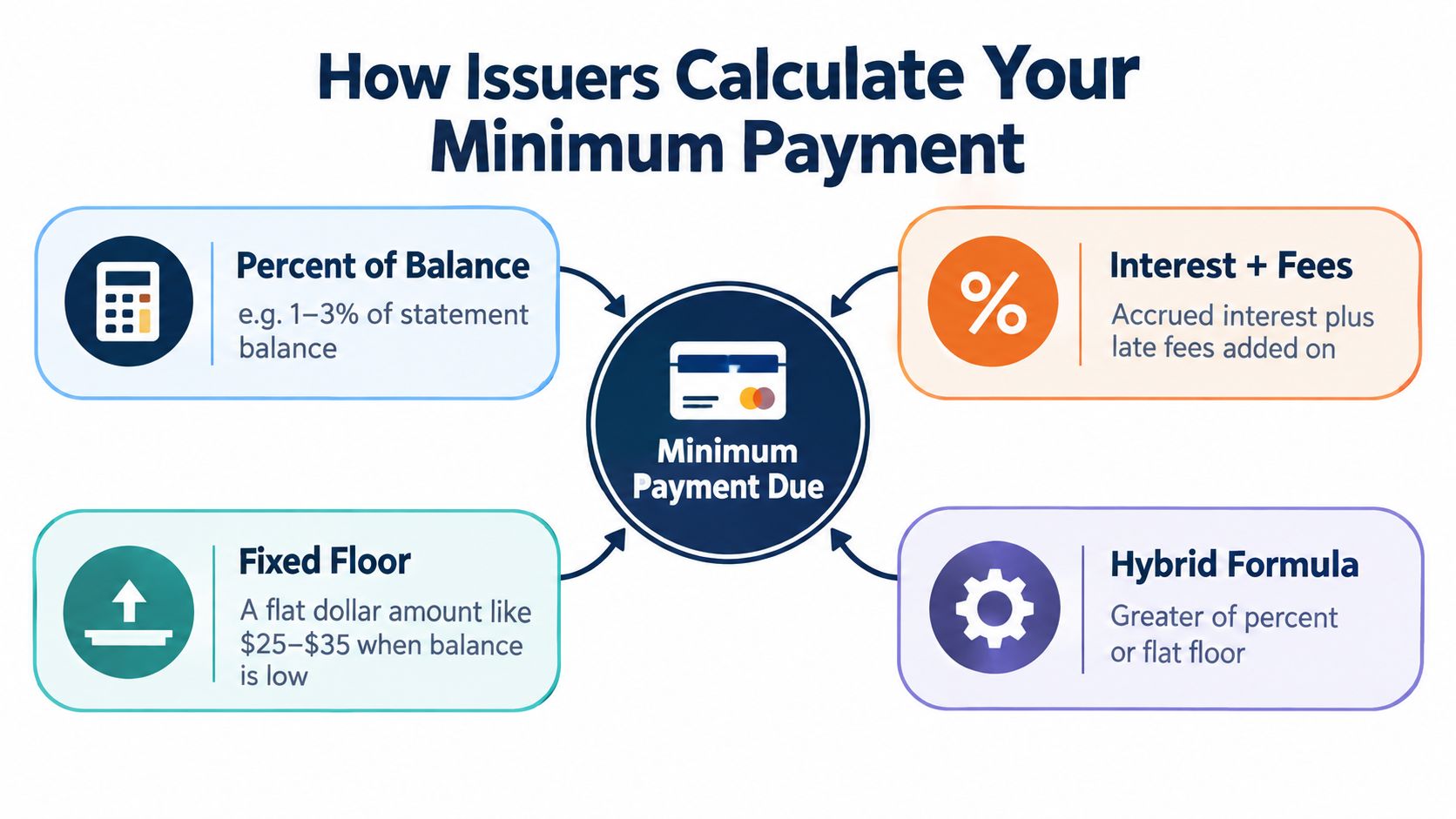
The most common U.S. approach identified in the CFPB's 2025 credit card market report uses 1% of the balance plus finance charges, fees, and past-due amounts. The report also found that the most common fixed floor was $40, compared with $25 in 2015, and that published floors ranged from $15 to $50. All issuers reviewed used a percentage-of-statement-balance method with costs added separately.
The main parts of the calculation
A statement can reflect several components:
- Balance-based amount. The issuer applies a stated percentage to the statement balance or principal.
- Interest or finance charge. Accrued borrowing costs may be added to the required amount.
- Fees and past-due sums. Charges and unpaid amounts can make the minimum rise.
- Fixed floor. If the formula produces a small number, the issuer may require a stated minimum dollar amount instead.
The floor explains why a small balance can create a minimum that seems disproportionately high. A percentage calculation might produce a modest result, but the card agreement can require the higher flat amount. The floor also explains why one issuer's minimum may differ sharply from another's even when balances are close.
UK lenders use similar building blocks, although their formulas differ. HSBC's explanation of minimum payments describes a common approach of about 2% of the monthly balance, with interest or other charges considered. Bank of Scotland gives an example using 2.5% of the statement balance plus interest and fees or £5, whichever is higher, while Nationwide describes a formula involving late fees and interest plus 1% of the remaining statement balance or £25, whichever is greater.
A statement reader can reverse-engineer the number by comparing the current balance, interest charge, fees, past-due amount, and the card agreement's floor. For a plain-language explanation of the interest component, the guide to figuring out a finance charge can help clarify why interest may be included before principal falls.
The True Cost of Paying Only the Minimum
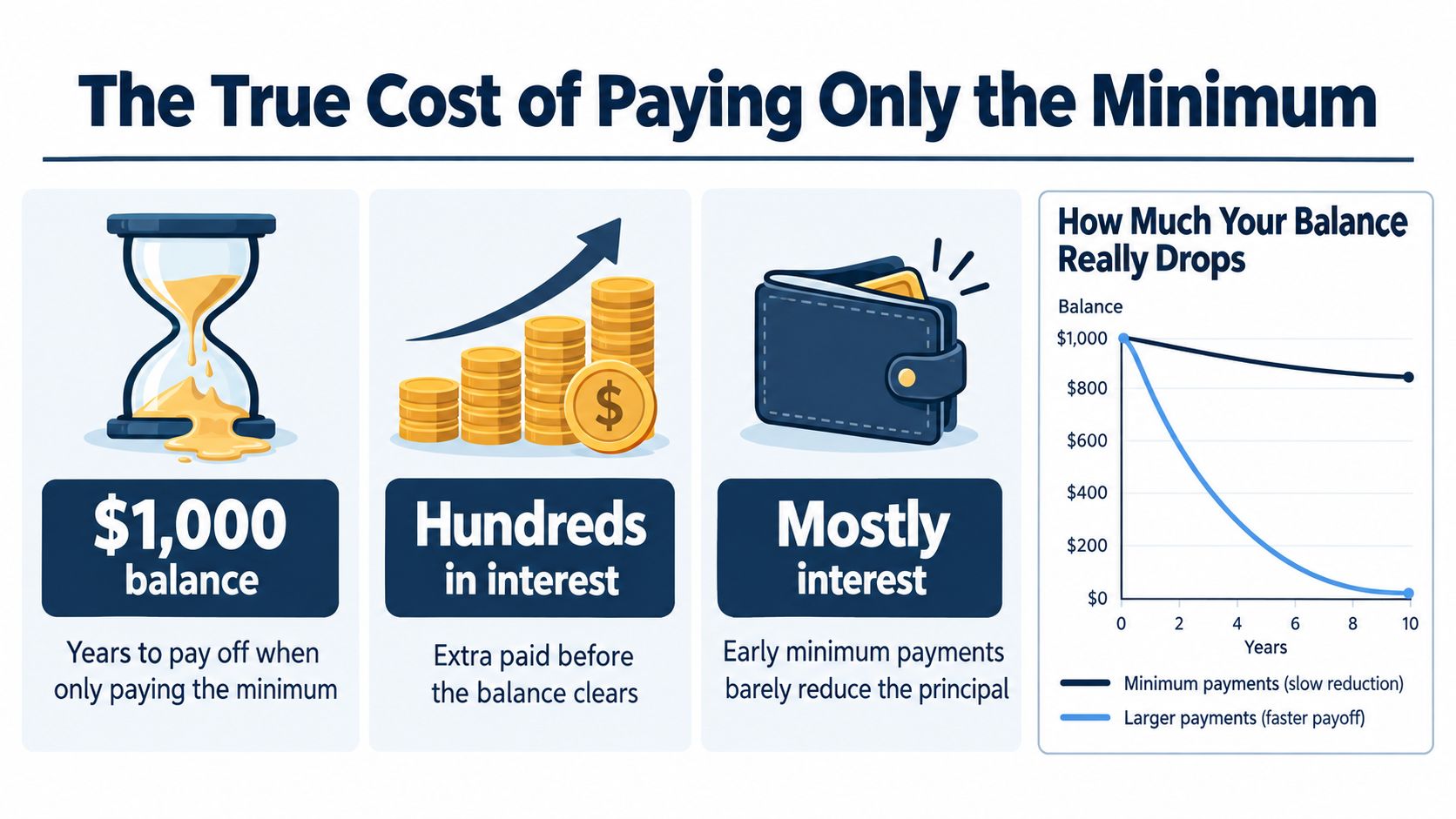
A cardholder may have enough cash to cover this month's minimum, yet still face a balance that barely moves. The hidden mechanism is the relationship between the required payment and the monthly finance charge. If the minimum sits only slightly above that charge, a small remainder reaches principal, especially at a high APR.
The Bankrate explanation of credit card minimum payments helps explain why the effect is nonlinear. Interest is taken from the payment first, like a toll collected before the balance can shrink. The smaller the principal reduction, the more balance remains for the next cycle's finance charge. Fees and past-due amounts can add to the amount owed and make recovery harder.
Why the timeline stretches
Paying only the minimum can create a repeating cycle:
- High APR: A larger share of each payment goes to the finance charge.
- Slow principal reduction: Less money lowers the balance.
- Persistent interest: The remaining balance continues generating charges.
- Extended repayment: The account takes longer to clear and costs more to carry.
The minimum due answers one narrow question: what must be paid to keep the account current? It does not show what payment would clear the balance at a reasonable total cost.
As noted in the disclosure rules above, the key cost mechanism is how much of each minimum payment is absorbed by the finance charge before principal is reduced. The estimate reflects the card's actual formula, applicable APRs, fees, and the balance at the billing-cycle closing date, rather than a simple percentage applied in isolation.
A payment can be affordable today and still be expensive over the life of the balance.
Paying the minimum still matters when funds are limited because it can help prevent delinquency. Treat it as a short-term holding position, not a repayment plan. A consistent extra amount sends more money toward principal, shortening the period during which interest applies.
Comparing Minimum Payments to Extra Payments
A payoff comparison needs the balance, APR, minimum-payment formula, fees, and payment timing. Without those details, an exact payoff month or interest total would be misleading. The clearest lesson is how the required payment relates to the monthly finance charge.
Consider a statement where the minimum is only slightly higher than the finance charge. Interest absorbs most of the payment, so only a small amount reaches principal. A fixed extra payment changes that result. Once the finance charge is covered, the additional money reduces the balance directly.
The credit card payment options guide helps borrowers compare repayment approaches instead of treating the statement minimum as the only available choice.
Payoff Timeline Comparison
| Payment Strategy | Estimated Payoff Time | Total Interest Paid |
|---|---|---|
| Minimum payment only | Can be very long, depending on balance, APR, fees, and issuer formula | Higher because interest continues while the balance remains |
| Minimum plus a fixed extra amount | Shorter than minimum-only repayment when new charges stop | Lower because principal falls sooner |
| Fixed payment above the minimum | More predictable, subject to the card's APR and terms | Lower than minimum-only repayment when the payment reduces principal consistently |
Your statement can reveal whether the payment is producing real progress. Ask three questions: How much went to interest? Did fees or past-due amounts increase the balance? How much reduced principal? These figures show whether the issuer's floor amount is helping clear debt or mainly keeping the account current.
Why a Small Extra Amount Matters
A consistent extra payment works best when new purchases stop adding to the balance. The issuer's minimum formula may reset as the balance changes, which can make the required amount feel like a moving target. A fixed payment above that floor gives repayment a steadier direction, even when the exact interest savings depend on the account's APR and terms.
Bankrate's payoff guidance explains the same underlying principle: minimum-payment rules can extend repayment sharply when the required amount remains close to the monthly finance charge.
A borrower who cannot make a large increase can choose a fixed amount above the minimum, schedule it after payday, and review each statement. The aim is simple: replace a changing obligation with a payment plan that sends more money toward principal. If the issuer's floor rises or falls, the borrower can still preserve progress by keeping the chosen payment consistent.
Credit Card Debt and Minimums After Death
Credit card debt doesn't follow one nationwide rule after a cardholder dies. Responsibility depends on state law, the account relationship, and whether the estate has assets or obligations that must be handled during settlement.
The CFPB's guidance on debt after death says a person is generally not responsible for a deceased person's debt merely because of a family relationship. Important exceptions can include a joint account holder, a co-signer, a surviving spouse subject to applicable state law, or an estate representative who must handle certain bills under state law.
Joint account holders and authorized users
A joint account holder shares responsibility under the account arrangement. An authorized user generally has permission to use the card but isn't automatically responsible for repayment solely because of that status. Families should avoid assuming that using the card creates the same liability as owning the account jointly.
The estate representative should notify the issuer, review the account agreement, and avoid making assumptions about who must keep paying the monthly minimum. Legal advice may be appropriate when the account has a joint holder, a surviving spouse, community property concerns, or insufficient estate assets.
The nine community property states
The nine community property states are Arizona, California, Idaho, Louisiana, Nevada, New Mexico, Texas, Washington, and Wisconsin. In these states, a surviving spouse may be responsible for certain debts incurred during the marriage, even when the spouse was only an authorized user, as explained by Experian's state-specific overview of credit card debt after death.
That doesn't mean every balance automatically transfers to the surviving spouse. The answer still turns on state law, when and how the debt was incurred, the account's ownership, and the estate's circumstances. A creditor's request for payment isn't by itself proof that a family member personally owes the debt.
Strategies to Escape the Minimum Payment Trap
The first step is to stop treating the minimum as the plan. It remains the amount that protects the account when money is tight, but a payoff strategy assigns every available extra dollar deliberately.
Protect the due date. Set up an automatic payment for at least the required amount if the bank account can support it. This reduces the risk of late fees and helps preserve current status, but the account should still be reviewed for available funds and changing minimums.
Stop adding to the balance. New purchases can offset the effect of extra payments. Separating repayment from everyday spending makes the progress visible.
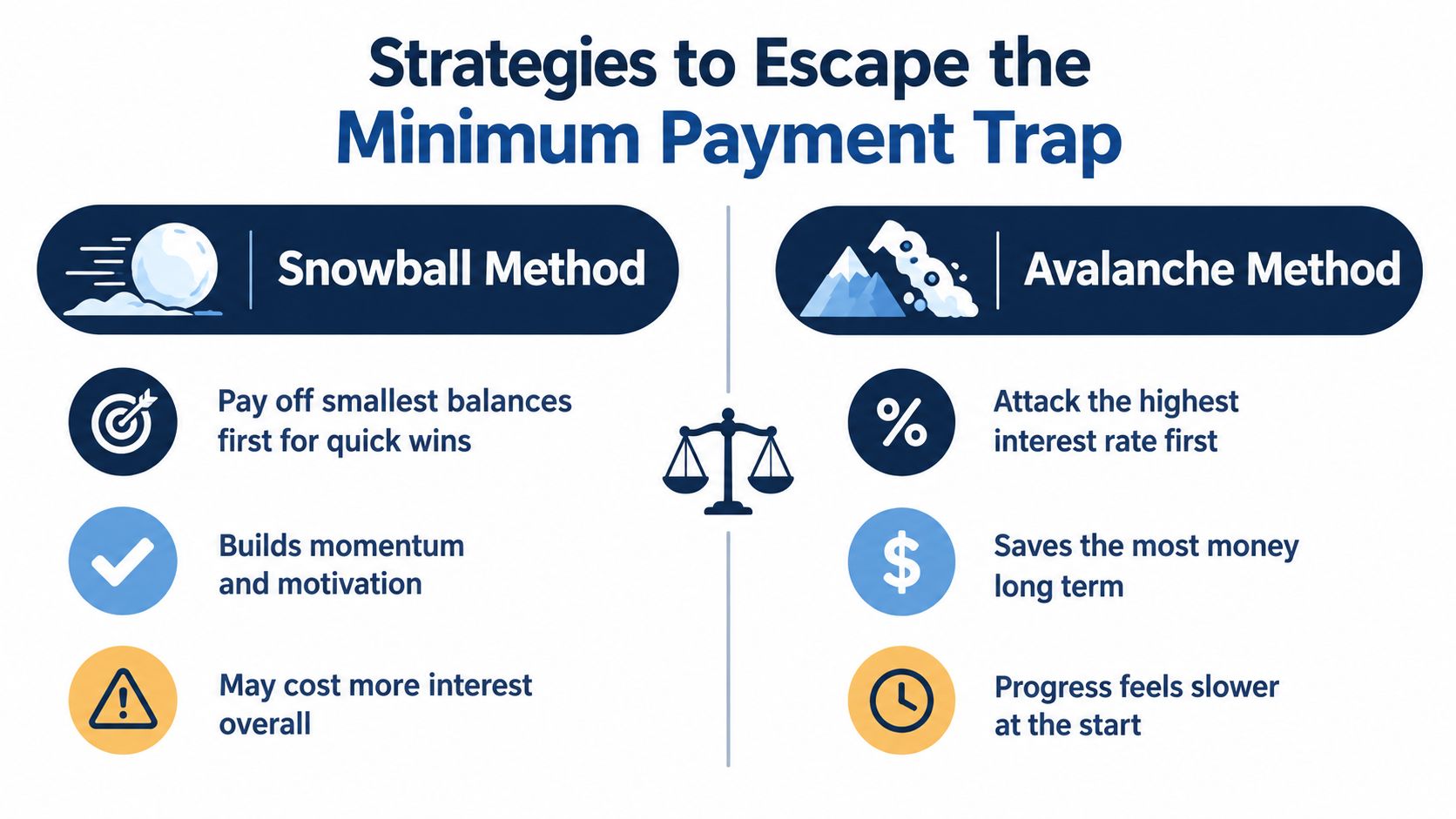
Choose a priority method. The snowball method targets the smallest balance first. It can create an early victory and simplify the number of accounts, although it may cost more interest than targeting the most expensive balance first.
Consider the avalanche method. The avalanche method directs extra money to the card with the highest APR while minimums continue on the others. It generally focuses on reducing expensive interest first, though progress can feel slower if that balance is large.
When another option deserves review
Consolidation can simplify several balances if the new terms reduce borrowing costs and the old cards don't become new sources of debt. Settlement can involve different costs, credit consequences, tax considerations, and creditor decisions. Bankruptcy has its own legal process and consequences.
A household struggling to meet even the minimums should contact issuers before missing payments and ask about hardship programs or reduced-payment arrangements. A nonprofit credit counselor or qualified attorney may also help compare options. No strategy should be chosen from the monthly payment alone. The APR, fees, timeline, credit effects, and risk of balance growth all matter.
Decision test: The right method is the one that fits both the mathematics of the debt and the household's ability to follow it every month.
Taking Control with Private Debt Calculators
A statement shows the required payment, but it may not make the payoff timeline easy to understand. A private calculator can translate the balance, APR, and planned payment into a clearer estimate, then compare what happens when the borrower adds a fixed amount or changes the repayment method.
No-login tools can be useful for people who aren't ready to share contact details. Debt Help U provides browser-based calculators for minimum payments, extra-payment scenarios, debt-to-income estimates, and multi-card payoff planning. Its minimum monthly payment calculator is designed to estimate repayment timing and interest from the card's current balance and APR.
What to enter and review
The most useful inputs come directly from the statement and card agreement:
- Current balance: Use the balance being carried, not an unrelated credit limit.
- APR: Check whether different balances have different rates.
- Minimum formula: Look for the percentage, fees, past-due treatment, and floor.
- Planned payment: Test the actual amount the household can sustain.
- New spending: Include a realistic assumption about whether purchases will continue.
Calculators produce estimates, not promises. Issuers can change balances through new transactions, fees, rate changes, and payment timing. Still, seeing the estimated interest and payoff date can make the cost of minimum-only payments concrete enough to support a better decision.
Debt Help U offers free, no-login calculators and plain-language guides for comparing minimum-only payments, extra-payment plans, snowball and avalanche strategies, and formal debt-relief options. Visit Debt Help U to model the card balance privately and choose a repayment path based on the actual timeline and cost.
Related guides
- How long will it take to pay off my credit card debt? Your minimum payment shrinks every month. Following it down is what turns a five-year balance into a thirty-five-year one.
- How to get out of credit card debt without a loan Borrowing your way out is the advice everyone gives first. Here is what works when you do not want more debt.
- Debt settlement vs. consolidation vs. bankruptcy Four paths out of unmanageable debt, what each one costs, and what each one breaks. Real numbers on a $30,000 balance, not a pitch for any of them.