Define Consumer Credit: What It Means and How It Works
The Federal Reserve defines consumer credit as credit extended to individuals for household, family, and personal spending, excluding loans secured by real estate, and it divides that credit into revolving and nonrevolving types. Who owes what after a cardholder dies depends on the state and on whether the person was a joint account holder or an authorized user.
That definition covers an ordinary grocery-store swipe, a financed laptop, a credit-card balance, and many installment loans. It also explains why a balance can affect more than a household budget. A lender may report payment behavior to credit bureaus, and that record can influence later borrowing, pricing, and available limits.
Table of Contents
- What Consumer Credit Really Means in Everyday Life
- Revolving and Nonrevolving Credit Explained
- How Consumer Credit Shapes Your Creditworthiness
- Real Examples of Consumer Credit in Action
- Common Misconceptions That Lead People Astray
- Who Owes Consumer Credit Debt After a Cardholder Dies
- A Simple Framework for Managing Consumer Credit Well
What Consumer Credit Really Means in Everyday Life
A shopper taps a credit card at the grocery store, takes the food home, and pays the card issuer later. Another household signs paperwork for a laptop and agrees to make scheduled payments. In both cases, a lender provides purchasing power before the borrower has fully paid for the purchase.
The Federal Reserve's definition of consumer credit is formal but straightforward in practice. It means credit extended to individuals for household, family, or other personal expenditures, excluding loans secured by real estate. The borrower receives access to money or purchasing power, uses it for personal needs, and promises to repay under agreed terms.
Three participants make the arrangement work:
- The lender provides the money or credit line.
- The borrower uses that credit for personal spending.
- The repayment promise sets the amount, timing, interest, and consequences of missed payments.
Interest is the price of using someone else's money. Fees may also apply, depending on the product and contract. A credit card usually lets the borrower spend repeatedly up to a limit, while an installment loan advances a set amount and collects scheduled payments.
What the narrow definition leaves out
The Federal Reserve's narrow statistical category excludes several forms of borrowing. A business loan isn't consumer credit because its purpose is commercial. A mortgage secured by real estate also falls outside this definition, even though a household may use it to buy a home. Student loans, by contrast, are included: the G.19 counts federal student loans held by the Department of Education alongside private lenders' student loans.
That distinction doesn't mean excluded debts are unimportant. It means the term has a specific boundary when policymakers and lenders measure household borrowing. A person can have substantial obligations outside the category and still use consumer credit every day.
The Fed has produced aggregate consumer-credit statistics since 1942, and its monthly G.19 release has reported the data since February 1943. The series later added terms-of-credit data in 1972, student loans in 2003, and credit flows for all categories in 2012. This history makes the definition useful for comparing household borrowing over time, not just describing a single card statement.
Revolving and Nonrevolving Credit Explained
The cleanest way to classify consumer credit is to ask whether the borrower can reuse the available credit after making payments.
A credit card is revolving credit. The issuer sets a credit limit, the borrower spends against that limit, and available credit generally returns as the balance is paid down. The borrower may pay the statement balance in full or make a minimum payment, although carrying a balance usually creates interest charges.
An auto loan is nonrevolving, or installment, credit. The lender advances a defined amount, and the borrower follows a repayment schedule. Each payment reduces principal and interest until the account reaches a zero balance. The borrower doesn't normally draw the repaid amount again.
A credit line explained in plain language follows the revolving model because it represents continuing access rather than one fixed advance.
Revolving vs Nonrevolving Credit at a Glance
| Feature | Revolving Credit | Nonrevolving (Installment) Credit |
|---|---|---|
| Borrowing mechanics | Borrower draws and repays within a credit limit | Lender advances a set amount once |
| Repayment structure | Flexible payments, often including a minimum | Scheduled payments over a defined term |
| Balance behavior | Can rise again when the borrower spends | Usually declines with each payment |
| Interest structure | APR may be variable or fixed, depending on the account | APR may be fixed or variable, depending on the loan |
| Typical example | Credit card or store card | Auto loan or personal loan |
| Credit reporting | Balance, limit, utilization, and payment history may be reported | Balance, payment history, and account status may be reported |
The same framework helps classify newer products. A store card generally behaves like a credit card. A personal loan is usually installment credit. A buy now, pay later plan may be structured as a short installment obligation, while a home equity line of credit behaves like revolving credit, although home-secured borrowing has different legal and financial risks.
The classification matters because repayment flexibility can hide cost. A borrower with a revolving balance may keep spending while making payments, whereas an installment borrower usually sees a clearer path toward the final payment.
How Consumer Credit Shapes Your Creditworthiness
A lender reviewing your application may see more than the purchase you made. Companies that provide account information, known as furnishers, can send payment and account details to credit bureaus. The three largest nationwide bureaus are Equifax, Experian, and TransUnion. Lenders and other businesses may use the resulting reports and scores when considering new applications.
The Congressional Research Service overview of credit reporting explains that bureaus collect and resell financial histories. Those records may include repayment behavior, debts in collection, bankruptcies, and account-management events. Bureaus can gather information from financial and nonfinancial entities, then use it to support credit scores.
A credit score is not a moral grade. It is a risk estimate based on reported information. Common scoring factors include:
- Payment history, including whether payments arrive on time.
- Amounts owed, especially balances compared with revolving limits.
- Length of credit history, including account ages.
- Credit mix, meaning experience with different account types.
- New credit, including recent applications and hard inquiries.
Two levers borrowers can feel
Utilization compares revolving balances with available credit. A card near its limit may suggest greater dependence on that account, even when payments are on time. For a clearer explanation of how much utilization affects your credit score, focus on the balance reported for each revolving account, not only the amount you owe across all debts.
A card balance at 90% of its limit generally appears more strained than one at 30%, all else equal. Lowering the balance can change reported utilization after the lender updates the bureau file, although the score effect varies with the report, scoring model, and other accounts. A paid-off auto loan may remain part of your positive account history, but it does not create the same revolving-limit calculation.
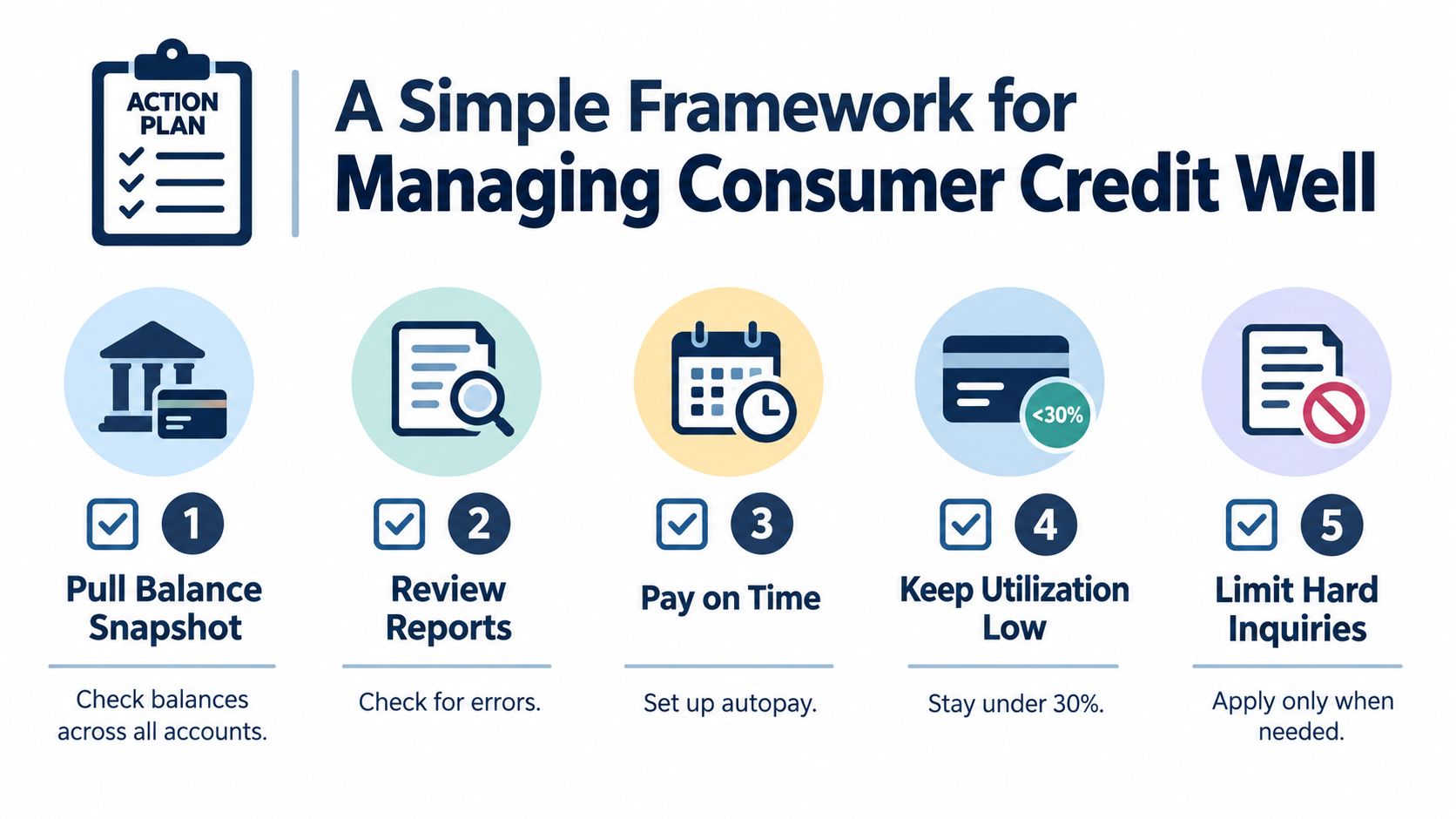
Payment history creates another practical dividing line. A missed payment can lead lenders to view delinquency as evidence that repayment capacity has weakened. Errors can also affect lenders that rely on shared bureau files, so reviewing reports and disputing inaccurate information belongs in responsible credit management.
Creditworthiness therefore reflects a continuing record, not just the original amount borrowed. The way you pay, use available revolving credit, and maintain accounts can shape how future lenders assess risk.
Real Examples of Consumer Credit in Action
Numbers make the difference between a vague warning and a usable plan. A credit card balance can stay open-ended because the borrower chooses the payment, while an auto loan or personal loan normally has a scheduled endpoint.
Consider four household situations:
- A $5,000 credit-card balance at 24% APR is revolving debt. The minimum payment may look manageable, but the balance can remain for a long time if new spending and interest continue.
- A $30,000 auto loan at 7% is installment debt. The payment schedule is established at origination, and the balance generally declines when payments arrive.
- A $200,000, 30-year mortgage at 6.5% is secured real-estate debt. It illustrates a household obligation, but it falls outside the Federal Reserve's narrow consumer-credit definition because the loan is secured by real estate.
- A $10,000 personal loan used to consolidate higher-rate card debt is usually unsecured installment credit. It can simplify payments, but the borrower still owes the new loan and must avoid rebuilding the card balances.
The final example shows why payment design matters. For a $3,000 revolving balance, a minimum-payment schedule can stretch repayment far beyond the borrower's expectation. A fixed payment of $150 per month creates a clearer endpoint, while the minimum-payment route changes as the balance changes and can keep interest costs high.
Minimum Payment vs Fixed Payment: Same Debt, Different Outcomes
| Scenario | Balance & APR | Minimum Payment Path | Higher Fixed Payment Path |
|---|---|---|---|
| Revolving card balance | $3,000 at an unspecified APR | Payment changes with the issuer's formula, and payoff may extend for years | $150 each month creates a consistent reduction plan |
| $5,000 card balance | $5,000 at 24% APR | Interest continues while the borrower pays the required minimum | A larger fixed amount reduces principal faster |
| Auto loan | $30,000 at 7% | Contractual installment payment follows the loan schedule | Extra principal can shorten the schedule if the contract permits |
| Personal consolidation loan | $10,000 at a rate set by the lender | Fixed installment payment | Additional payments may reduce the outstanding balance sooner |
Exact payoff months and total interest require the card's APR, minimum-payment formula, statement timing, and payment history. A plain-language example of unsecured debt helps separate unsecured revolving balances from installment obligations without treating every debt product as interchangeable.
The useful lesson is not that every borrower should double a payment. It's that a fixed payment exposes the timeline, while a minimum payment may conceal it. Borrowers should compare both the monthly burden and the date the balance is expected to reach zero.
Common Misconceptions That Lead People Astray
Closing an old card always improves credit. Closing an account can feel like removing temptation, but it may reduce available revolving credit and make remaining utilization look higher. It can also affect the age and composition of the credit file. A better decision weighs spending risk, annual fees, account age, and the effect on total available credit.
Carrying a small balance builds credit. A borrower doesn't need to pay interest to demonstrate responsible use. On-time payments and moderate utilization matter more than intentionally leaving debt unpaid. A card can be used, reported with a balance, and then paid according to the statement terms without treating interest as a credit-building fee.
Practical rule: Borrowing can be useful, but interest is never a required membership fee for having a credit history.
All consumer debt is bad debt. A financed treadmill that sits unused can be an expensive obligation, while a modest loan used for a necessary purchase may fit a workable budget. The product, interest rate, security, payment size, and purpose all matter. A high-rate revolving balance deserves closer scrutiny than a debt whose cost and endpoint are clearly understood.
Authorized users and joint account holders carry the same liability. They don't. A joint account holder generally shares legal responsibility for the debt. An authorized user typically receives permission to use the account but doesn't become responsible for repayment merely by receiving a card.
That distinction becomes especially important during separation, divorce, and estate administration. A family may use the words “shared card” casually while the contract treats one person as a borrower and the other as a permitted user. The account agreement, not the plastic card, determines the starting point for liability.
Who Owes Consumer Credit Debt After a Cardholder Dies
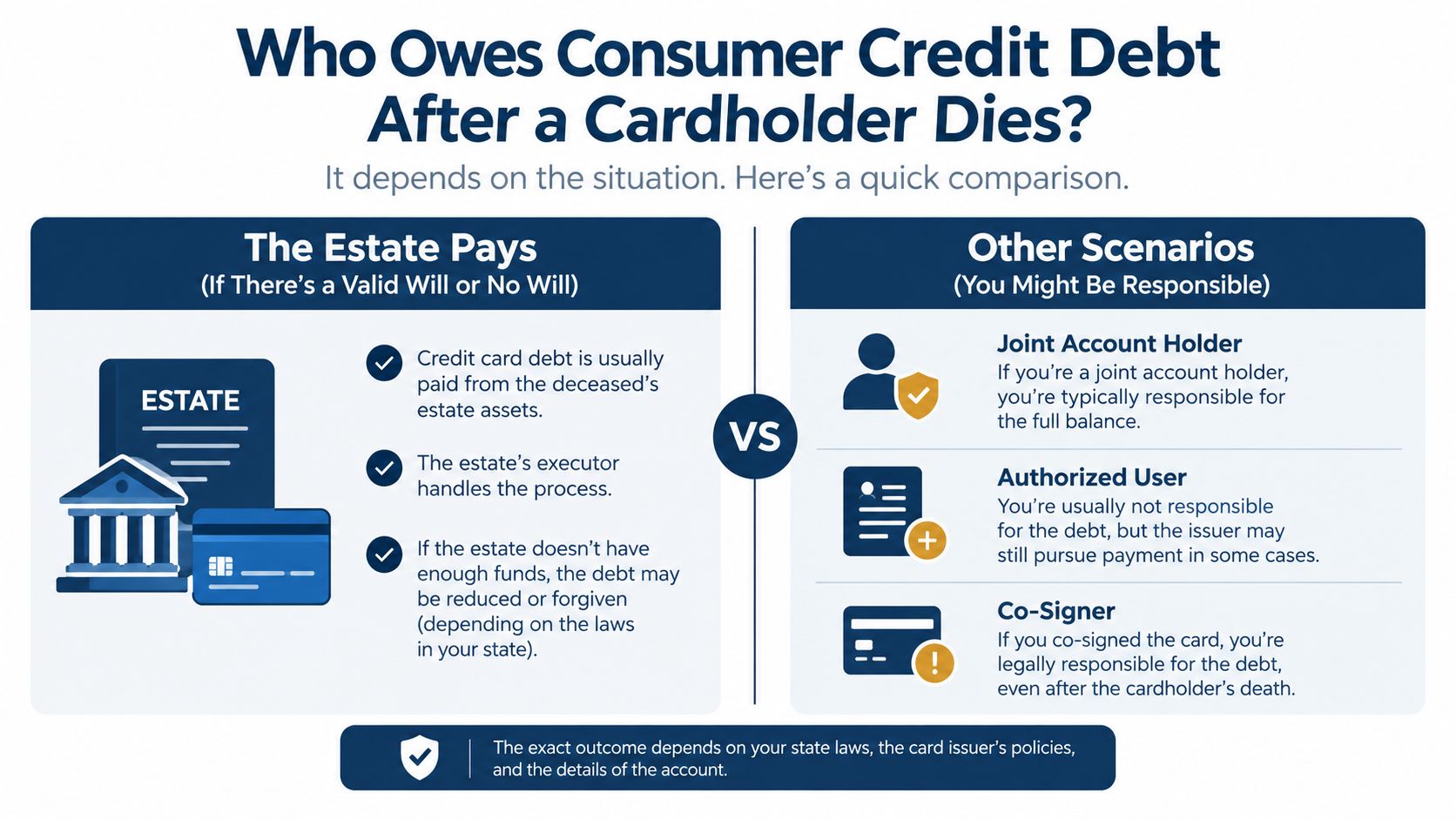
There isn't one national answer to who owes a deceased cardholder's consumer credit debt. The result depends on state law, the account structure, and the deceased person's estate. Survivors shouldn't assume that receiving a card creates liability, and they shouldn't assume that death automatically erases an unpaid balance.
The Consumer Financial Protection Bureau's guidance on debt after death identifies the main exceptions. A survivor may have responsibility if they were a co-signer or joint account holder, if a surviving-spouse rule applies, or if state law assigns duties to an estate executor or administrator.
Joint account holders and authorized users
A joint account holder shares responsibility under the account agreement. If one joint holder dies, the surviving joint holder may remain responsible for the balance. An authorized user is different. The CFPB says an authorized user generally isn't responsible merely because they were allowed to use the card.
The CFPB's guidance for surviving spouses repeats that distinction. A spouse may share responsibility through a joint account, a co-signed loan, or a state-law rule, but marriage alone doesn't create a universal national rule for every account.
Nine states have community-property rules relevant to debts incurred during marriage: Arizona, California, Idaho, Louisiana, Nevada, New Mexico, Texas, Washington, and Wisconsin. Alaska, Florida, Kentucky, South Dakota, and Tennessee let spouses choose community-property treatment for some or all of their assets. In those jurisdictions, a surviving spouse may face responsibility for certain marital debts even when the account was solely in the deceased spouse's name. The Experian explanation of credit-card debt after death describes the same joint-account, authorized-user, and community-property distinctions.
In other states, an individual card balance is generally handled through the deceased person's estate before assets pass to heirs, but state-specific exceptions still matter. The practical response is to confirm the account type, preserve estate documents, and seek local legal advice before making or refusing payment.
A Simple Framework for Managing Consumer Credit Well
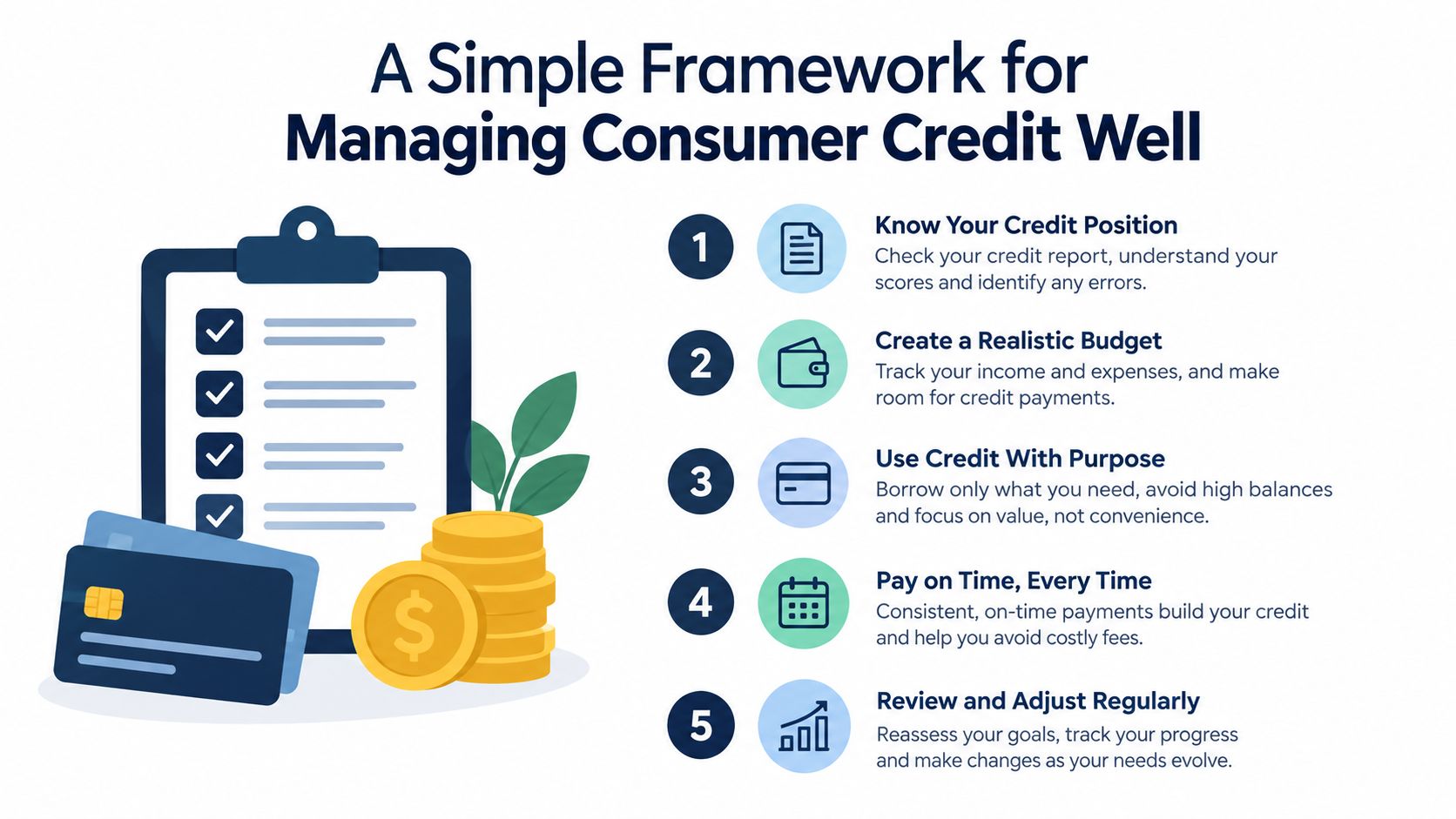
A useful review starts with a complete snapshot, not a single card. List every revolving account, installment loan, balance, interest rate, minimum payment, and due date. Then compare total revolving balances with total revolving limits to understand aggregate utilization.
A monthly statement contains four fields that deserve attention:
- Statement balance, the amount shown at the close of the billing cycle.
- Minimum payment, the smallest amount required to keep the account current.
- Due date, the deadline for avoiding a late payment.
- Interest charged, the finance cost added during the cycle.
Reading those fields prevents a common mistake: confusing the minimum payment with a payoff plan. The minimum keeps an account from becoming late under the contract, but it may not produce a quick reduction in principal.
Match the payoff method to the obstacle
The highest-interest-first method, often called the avalanche method, directs extra money toward the costliest debt while minimums continue elsewhere. It usually suits a borrower who can stay motivated by reducing interest expense.
The smallest-balance-first method, or snowball method, targets the easiest account to eliminate. It can suit a borrower who needs visible progress to maintain momentum, even when another account carries a higher rate.
A short maintenance routine can keep the plan active:
- Review reports: Check credit reports regularly and investigate inaccurate account information.
- Control utilization: Keep revolving balances comfortably below their limits, with 30% as a commonly used planning threshold reflected in the management checklist, not a guarantee of any particular score.
- Pay statements in full when possible: This can reduce interest on purchases under the account's terms.
- Recheck affordability: Compare monthly debt payments with pretax monthly income before taking on another obligation.
- Escalate early: A nonprofit credit counselor may help when balances, payment demands, or collection activity exceed the household's ability to manage them.
Debt Help U offers free, no-login calculators for payoff dates, interest comparisons, debt-to-income context, and snowball-versus-avalanche planning. It operates as an educational and referral platform rather than a lender, creditor, collector, or law firm, so consumers can use the tools to clarify options before deciding whether to seek professional help.
Debt Help U can help consumers estimate payoff timelines, compare fixed extra payments, review debt-to-income pressure, and understand options for consolidation, settlement, or bankruptcy. Visit Debt Help U to run a private, no-login calculation and make the next repayment decision with clearer numbers.
Related guides
- Debt settlement vs. consolidation vs. bankruptcy Four paths out of unmanageable debt, what each one costs, and what each one breaks. Real numbers on a $30,000 balance, not a pitch for any of them.
- How long will it take to pay off my credit card debt? Your minimum payment shrinks every month. Following it down is what turns a five-year balance into a thirty-five-year one.
- Debt snowball vs. avalanche: which one finishes faster Avalanche always pays less interest. The gap is smaller than the argument about it suggests. Run both on your own balances and see what it is worth.