How to Get Debt Relief: A Step-by-Step Guide for 2026
A card statement arrives, and the minimum payment looks almost manageable. Then the balance barely moves, interest takes most of the payment, and the question becomes uncomfortable: does “debt relief” mean a drastic legal step, or is there a practical way out?
The answer depends on the numbers. Debt relief is a spectrum, starting with repayment optimization and extra payments, moving through consolidation and nonprofit management plans, then negotiated settlement and bankruptcy. The right path is the one that fits the household's cash flow, repayment timeline, legal situation, and ability to keep making payments.
Table of Contents
- Where You Stand Right Now
- Running the Numbers Before Choosing Anything
- Trying the DIY Path First
- Comparing Consolidation, Management Plans, Settlement, and Bankruptcy
- What Debt Settlement Actually Looks Like From the Inside
- Common Mistakes and Questions Before You Commit
Where You Stand Right Now
A consumer carrying several card balances often knows the total only approximately. One statement shows a high APR, another shows a promotional rate that expires later, and the monthly minimums seem to consume income before rent, food, and utilities are covered. That uncertainty encourages rushed decisions, especially when a provider promises a quick solution.
The first step in learning how to get debt relief is to replace the label with a complete inventory. List every unsecured balance, its APR, minimum payment, due date, and current status. A person who's current on every account but paying expensive interest faces a different decision from someone already missing payments or using one card to cover another.
Debt relief has several lanes
Five paths commonly appear:
- Repayment optimization, using extra payments and a deliberate payoff order.
- Consolidation, replacing multiple balances with a new loan.
- A nonprofit debt management plan, which organizes repayment under negotiated terms.
- Debt settlement, where a company or consumer negotiates to resolve balances for less than owed.
- Bankruptcy, a court-supervised process that can address debts when repayment isn't realistic.
None of these paths is automatically responsible or irresponsible. A consolidation loan can lower interest but fail if the cards are reused. Settlement can reduce principal but usually involves missed payments, creditor discretion, and completion risk. Bankruptcy can provide legal protection, but it has serious legal and credit consequences.
The household's debt-to-income ratio is one useful starting point because it compares required debt payments with gross income. A debt-to-income formula guide can help organize that calculation, but the ratio shouldn't replace a budget that includes irregular expenses and basic living costs.
Practical rule: A debt-relief choice should solve a cash-flow problem, not merely rearrange balances.
The immediate objective is simple. Find out whether the balances can decline through ordinary repayment, whether a structured plan is needed, or whether the household's obligations exceed any credible repayment budget. That answer comes from measurement, not from a sales presentation.
Running the Numbers Before Choosing Anything
A household can earn enough to cover minimum payments and still be years from eliminating its balances. Before choosing a program, calculate three figures: each balance and APR, the payoff date and total interest under minimum payments, and the debt-to-income ratio. Those figures make a DIY plan and a formal option comparable.
Gather the balance and APR
Build one row for every account. Record the balance, APR, minimum payment, account status, and whether the rate is fixed, variable, or promotional. APR deserves close attention because a high-rate balance absorbs more cash over time, even if the borrower stops making new purchases.
The U.S. revolving credit card balance reached about $1.26 trillion in Q2 2026, and the average APR on interest-bearing balances was 22.15%, according to Forbes Advisor's average credit card debt analysis. Average consumer credit card debt was approximately $6,610 to $7,756, depending on the dataset and quarter. A balance that feels ordinary can still be expensive to carry.
Calculate the monthly amount available for repayment next. Start with take-home income. Subtract housing, utilities, food, transportation, insurance, taxes, medical needs, and minimum debt payments, then reserve money for irregular costs. If the amount disappears when a car repair or medical bill arrives, it cannot support a reliable payoff plan.
Project the minimum-payment outcome
A minimum-payment statement shows one monthly figure, not the time or interest required to reach zero. Use a no-login minimum monthly payment calculator to estimate the payoff date and total interest.
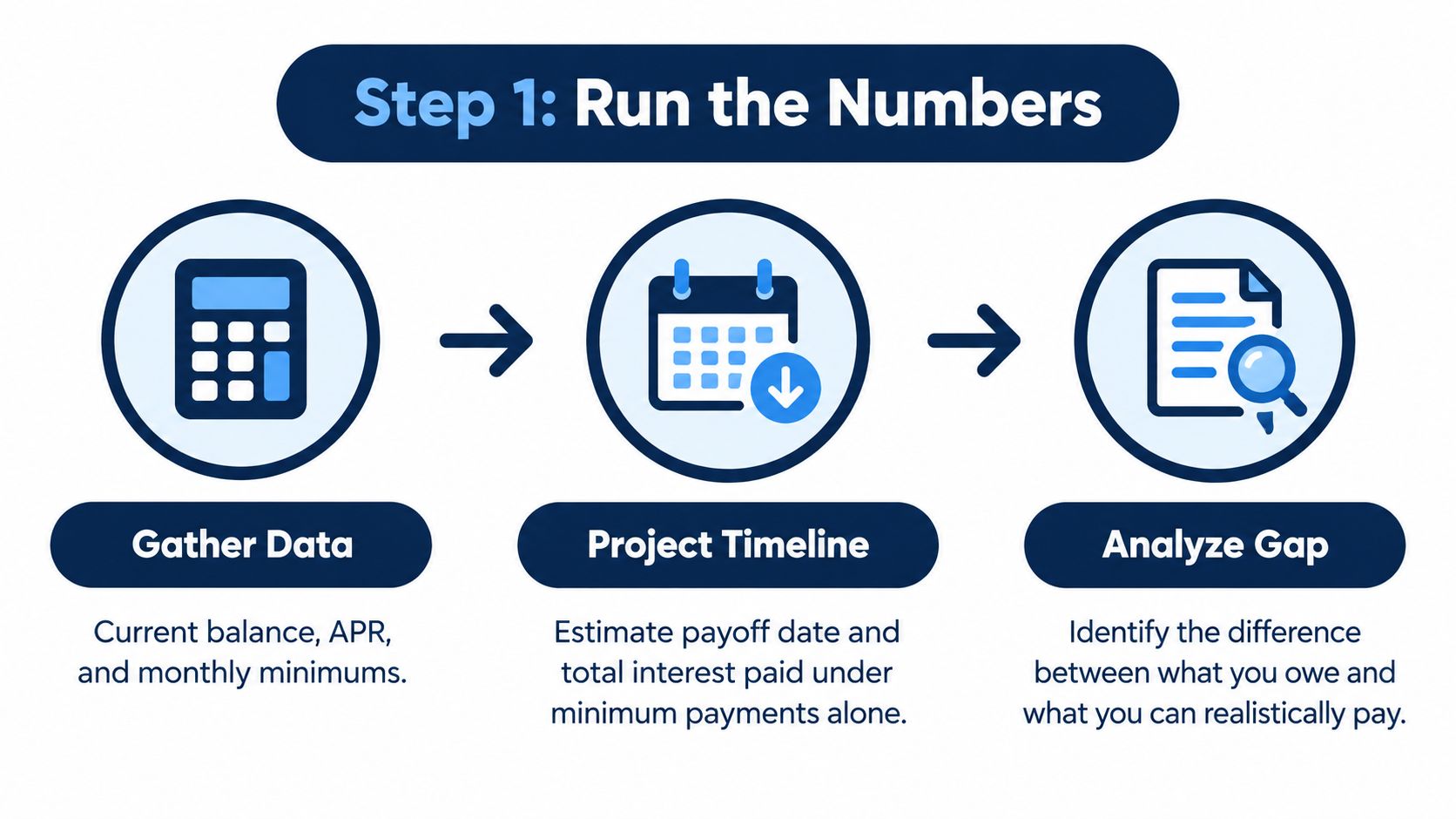
A balance near $11,149 at an APR near 23% would take almost 22 years to repay with minimum payments alone and would generate nearly $18,500 in interest, based on the example in the Forbes Advisor analysis. The result will vary by account terms, but the lesson is direct: the minimum payment is an account requirement, not a repayment strategy.
Run the same balance with an extra monthly payment. Test an amount the budget can sustain, such as $50, rather than a target likely to disappear after one difficult month. Compare the revised payoff date, interest reduction, and remaining cash for necessities.
Interpret the DTI and the gap
A manageable DTI paired with a declining balance supports a DIY plan. A high DTI, recurring credit use, or a payoff period lasting decades justifies evaluating consolidation, a management plan, settlement, or bankruptcy.
Use this decision rule:
- If minimum payments already produce a workable timeline, add an affordable amount and direct it to one account.
- If a modest extra payment sharply shortens the timeline, test DIY repayment before paying for formal relief.
- If balances do not decline, payments are unaffordable, or accounts are falling behind, compare structured and legal options promptly.
Formal debt relief is warranted when the budget cannot carry the debt. If small spending changes create a sustainable surplus and materially improve the timeline, keep the solution behavioral and avoid unnecessary enrollment, loan, or legal costs.
Trying the DIY Path First
DIY repayment isn't denial. It's a direct test of whether the household can solve the problem without enrollment fees, a new loan, negotiated settlements, or court involvement. The method works only when required payments remain affordable and the borrower can stop adding new balances.
Start by freeing a defined monthly amount. Review subscriptions, delivery spending, dining, entertainment, and nonessential shopping. The goal isn't to create a punishing budget. It's to find an amount that can be transferred to the target account every month without forcing new borrowing for groceries or utilities.
Choose the payoff order deliberately
The avalanche method sends extra money to the highest APR first while maintaining minimum payments on everything else. It minimizes interest mathematically and usually shortens the payoff period. The snowball method targets the smallest balance first, creating faster account closures and a psychological sense of progress.
The trade-off is real. A peer-reviewed analysis of the 2016 Survey of Consumer Finances found that households using the snowball approach paid an additional 1.8% to 4.3% in interest on average, with an estimated aggregate transfer of roughly $46.2 billion to $53.9 billion compared with minimizing interest accrual, as reported in the peer-reviewed repayment strategy analysis.
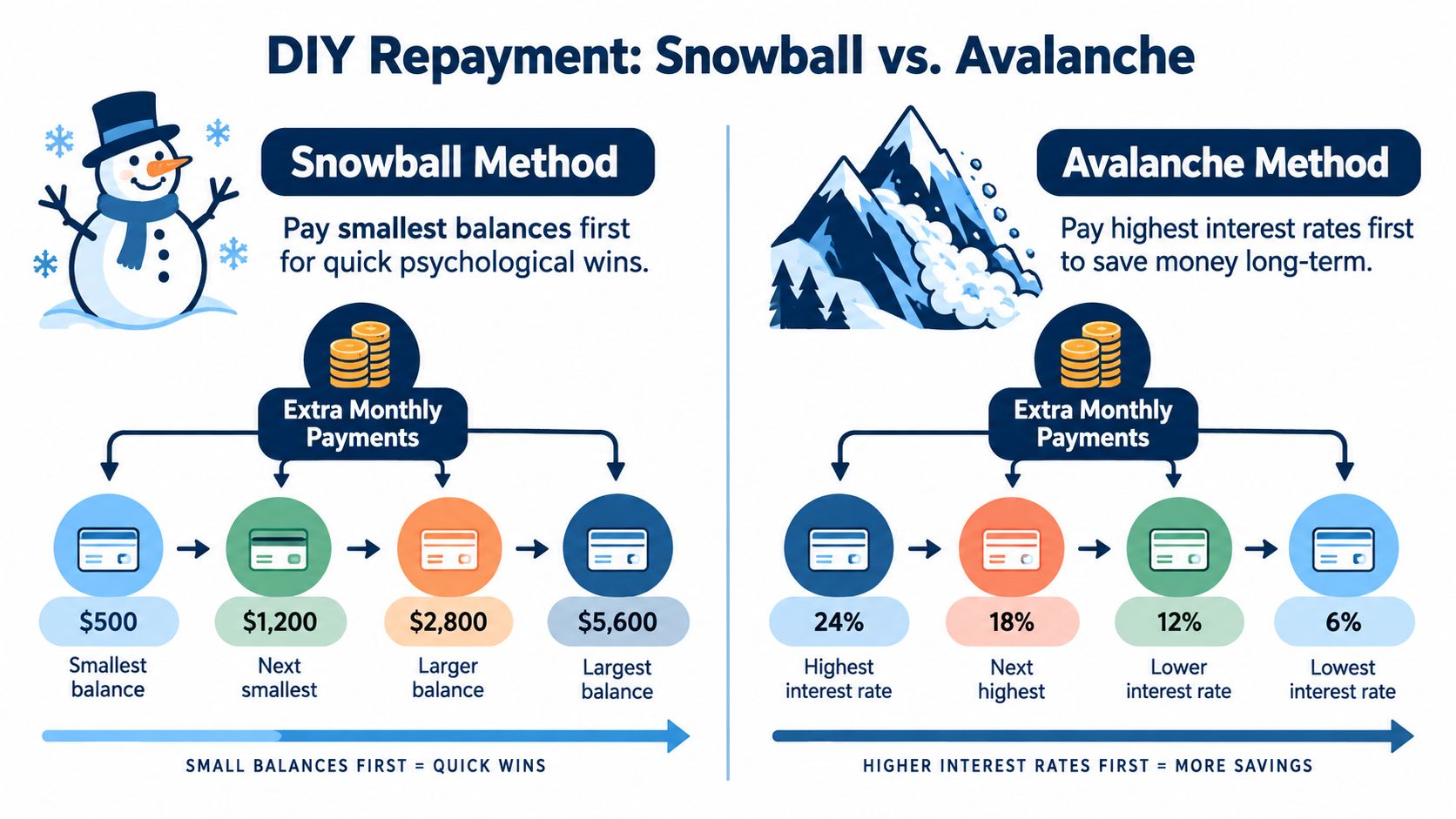
That doesn't make snowball irrational. A person who repeatedly abandons avalanche plans may finish sooner with snowball. But the choice shouldn't be described as financially neutral. In one modeled comparison, the total amount paid differed by $0 to $1,292, while one 57-month scenario showed only a $29 interest difference, according to the same repayment strategy analysis. The gap varies with the balances and APRs, yet higher-rate-first remains the cost-minimizing default.
Payoff order isn't neutral. Snowball may buy motivation, while avalanche usually buys lower interest.
Minimum-payment framing can also distort behavior. A summary from Canada's Financial Consumer Agency reported that the share using the optimal repayment strategy fell by about 11 percentage points under a minimum-payment condition, and minimum payments increased the tendency to spread repayment across more accounts, as described in its research on minimum payments and repayment strategies.
Decide whether DIY is enough
DIY repayment is a reasonable first choice when accounts are current, the budget produces a dependable extra payment, and the avalanche projection shows a credible end date. It's a poor fit when balances stay flat, minimums consume money needed for essentials, or missed payments are becoming routine.
The guide to choosing which credit card to pay off first can help organize the target order. The decision should be automated where possible, with the extra payment scheduled soon after income arrives and new card spending stopped until the balances are under control.
Comparing Consolidation, Management Plans, Settlement, and Bankruptcy
Formal debt relief changes your payment structure, creditor relationship, or legal status. Use the comparison below to screen options, not to predict an offer. Your lender, creditors, state, income, assets, debt type, and legal facts determine the actual cost and result.
| Option | Typical Cost | Credit Impact | Realistic Timeline |
|---|---|---|---|
| Consolidation loan | Interest and lender charges under a new loan. The rate may be lower or higher than existing APRs | A hard inquiry and new account can affect credit. Successful payments may help, while missed payments hurt | Set by the new loan term |
| Nonprofit debt management plan | Program fees may apply, along with interest under negotiated creditor terms | Enrollment and account changes can affect credit. Consistent repayment supports recovery over time | Structured repayment over several years |
| Debt settlement | Negotiation fees, deposits, possible interest and late charges, plus possible tax on forgiven debt | Credit commonly suffers while accounts are negotiated and may be delinquent | Settlement timing varies by program and creditor. The detailed timeline appears in the next section |
| Chapter 7 or Chapter 13 bankruptcy | Court, legal, filing, and trustee-related costs vary. Some debts may remain | A bankruptcy filing has a serious credit effect and becomes part of the public legal record | A closed consumer bankruptcy case had a median filing-to-closing time of 127 days and a mean of 499 days in 2025, according to the U.S. Courts BAPCPA report |
Consolidation replaces several balances with one new loan. Choose it only if the approved rate, fees, and repayment term reduce the total cost, and if you will stop using the old credit lines. A lower monthly payment can still cost more overall if the new term stretches repayment.
A nonprofit debt management plan leaves the underlying balances in place while coordinating payments and seeking creditor concessions. It suits a borrower with steady income who can repay principal but needs organized payments or more manageable terms. Expect a structured plan lasting several years, not an immediate reset.
Settlement seeks a negotiated reduction of principal. It requires cash to fund offers and depends on creditors accepting them. The debt settlement statistics provide context: one analysis found debts tended to settle at about 48% of the outstanding balance, while a study of participants entering programs found almost $28,000 in unsecured debt across about 6.93 accounts, with 74% settling at least one account within the first 36 months. Those figures do not equal your total cost. Add fees, growing interest, late charges, collection risk, and possible tax on forgiven debt.
Bankruptcy is a court process, not a financial product. U.S. bankruptcy courts recorded 574,314 cases in 2025, up from 517,308 in 2024 and 452,990 in 2023, according to Debt.org's bankruptcy statistics. The question is whether repayment remains feasible after protecting basic living needs and accounting for legal consequences.
Use a simple decision rule: if a modest spending cut and a dependable extra payment produce a credible payoff date, try the DIY route first. If the budget cannot cover essentials and minimums, compare formal help based on cash flow, not marketing claims.
What Debt Settlement Actually Looks Like From the Inside
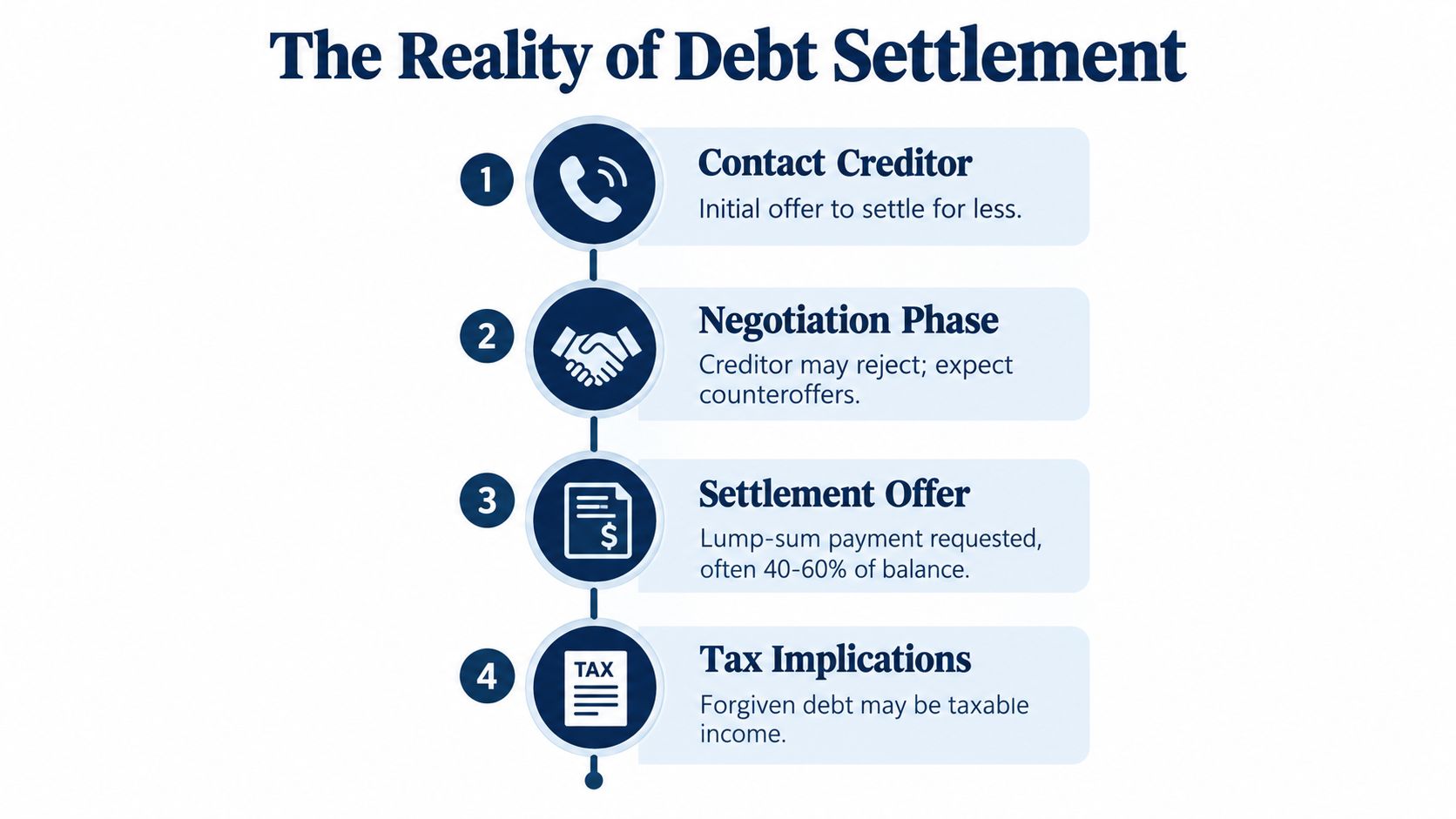
A household enters settlement with overdue accounts, a savings target, and months of uncertainty. The sales pitch focuses on paying “pennies on the dollar.” The actual process depends on building funds, waiting for creditor engagement, negotiating an offer, and making a lump-sum payment. A discount is never guaranteed.
The money moves before the settlement does
After enrollment, a consumer generally stops paying creditors directly and deposits money into a dedicated account or similar savings arrangement, depending on the program. That balance must cover a negotiated offer, program fees, and any required payment. Until it grows, creditors may add interest and fees, pursue collections, or file suit.
Industry data cited in the CFPB debt-settlement and credit-counseling report indicate that the first successful settlement often occurs in about 4 to 5 months. The average settlement arrives around 13.8 to 14.3 months after enrollment. Those timelines define the cash-flow burden. The household must keep funding the account while paying rent, utilities, food, transportation, and other ordinary bills.
Completion is the harder test. Roughly 76% of participants settled at least one account within 36 months, while only 18% settled all enrolled debt during that period. Resolving one account can leave the household with several unresolved balances, continuing collection pressure, and an unfinished funding obligation.
The two risks that sales pitches minimize
Underfunding is the first operational failure point. If the monthly deposit is too small, negotiations may be delayed, fees and interest may outpace savings, and the consumer may leave the program before meaningful progress. Before enrolling, compare the required deposit with the amount left after necessities and minimum payments. If that deposit only works in a good month, the plan is too aggressive.
Credit damage is another expected cost. Negotiation often requires accounts to become delinquent, and creditors do not have to accept an offer. Forgiven debt may also count as taxable income in some circumstances. Ask a tax professional how the rules apply before accepting a settlement.
Debt Help U offers private, no-login calculators and a six-question assessment that provides an options overview before requesting personal contact details. If a qualified user requests an introduction, the platform may refer that person to a third-party debt-relief company. Its referral revenue model is disclosed.
A useful assessment should answer six questions:
- What type of debt is involved?
- How much is owed?
- Are the accounts current, late, or in collections?
- What monthly amount can the household fund reliably?
- Is a realistic lump sum or settlement reserve available?
- Would the program leave enough cash for necessities?
A settlement offer helps only if the household can fund it without creating a new emergency.
Common Mistakes and Questions Before You Commit
The costly mistake is choosing a program before pricing the alternative. Build a side-by-side comparison of DIY repayment, monthly fees, interest, possible tax consequences, credit effects, and the risk that creditors reject proposed settlements. Compare the monthly cash-flow burden and the estimated payoff timeline, not just a provider's projected savings.
Avoid these errors:
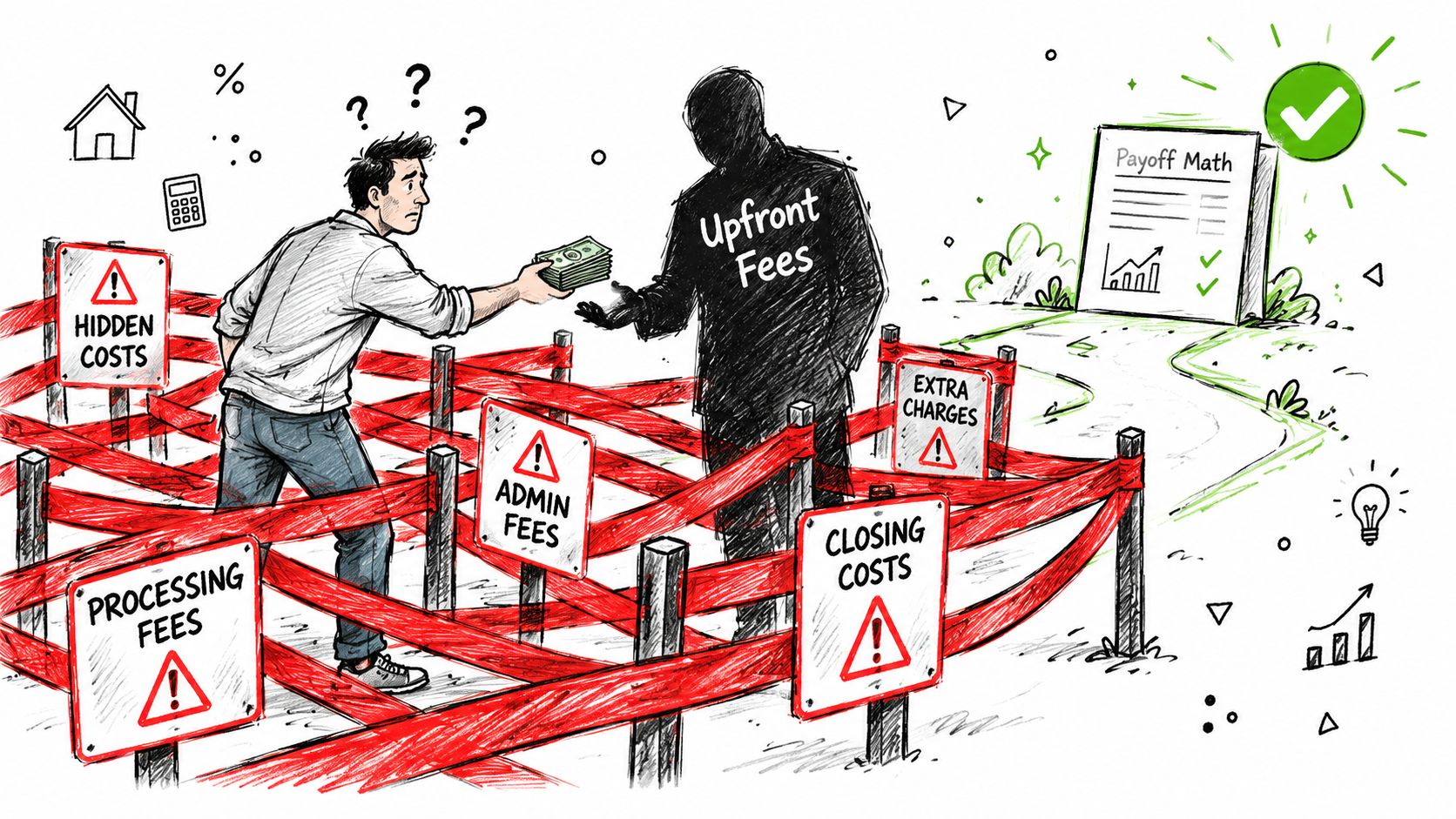
- Paying fees before results: Ask when fees are earned, what happens if an account remains unresolved, and whether any payment is due before an actual resolution.
- Ignoring account status: A delinquency-based program may be the wrong choice for someone who can clear the balance through a sustainable extra payment.
- Draining retirement accounts: Liquidating retirement savings can reduce long-term protection and create tax or penalty consequences.
- Assuming every debt qualifies: Student loans, secured loans, tax obligations, and some legal debts follow different rules from ordinary credit card balances.
- Believing a promise over a projection: Results depend on creditor cooperation, available funding, and legal eligibility. A legitimate provider cannot guarantee a specific settlement result.
Questions households ask before choosing
Can a person get debt relief while still current? Yes, sometimes. If the avalanche payoff timeline is manageable, test a fixed extra payment first. If balances remain unaffordable despite that change, compare structured options using their projected monthly burden and time to completion.
Does debt disappear when someone dies? There is no single nationwide rule. The outcome depends on state law and whether the person was a joint account holder or an authorized user. The estate is generally the first source of repayment, but responsibility can extend beyond it through co-signing, joint liability, or a surviving-spouse exception. The CFPB explanation of debt after death identifies joint account holders and spouses in community property states as important exceptions. Rules vary by state, especially across the nine community property states, so check the applicable law rather than relying on a general rule.
What should happen today? Use this checklist:
- Run every balance and APR through a payoff calculator.
- Test a sustainable fixed extra payment.
- Compare avalanche and snowball repayment.
- Complete a six-question assessment before sharing contact details.
- Speak with a provider only after reviewing the projected cash flow, timeline, and risks.
Debt Help U offers free, no-login calculators, plain-language comparisons, and a six-question assessment for households deciding between DIY repayment and formal debt relief. Visit Debt Help U to run payoff projections privately, compare trade-offs, and request an introduction to a third-party provider only if the numbers support that choice.
Related guides
- Is debt settlement a scam? How to tell a real company from a predator Federal law already bans the most common predatory practice. Knowing that one rule screens out most bad actors in a single question.
- How debt relief companies get paid Fee structures, the federal rule that bans charging you upfront, and what to demand in writing before you sign. How the industry actually makes money.
- The 1099-C: why forgiven debt can be taxed, and when it is not Settled debt can count as income. But most people who settle are insolvent when it happens, and insolvency can wipe the tax out entirely.