What Is a High APR: Credit Card Guide
A high APR is typically a credit card rate at or above current U.S. market averages of about 21% to 25%, since those are the levels where interest can start dominating monthly payments. In Q2 2026, average APR was 20.94% for all credit card accounts, 22.15% for accounts assessed interest, and 22.18% for new card offers.
Why does a rate that looks like “only” a few percentage points above average make a balance feel almost impossible to reduce? The answer is that APR isn't a static warning printed on an application. It's a living cost that can change with market conditions and accumulate every day a balance remains unpaid.
A useful definition of what is a high APR starts with comparison, not a universal cutoff. A rate near the market average may be manageable for someone who pays the statement balance in full, but expensive for someone who carries debt from month to month. The sections below translate the percentage into daily charges, payoff pressure, spending decisions, and practical next steps.
Table of Contents
- What High APR Really Means for Your Card
- Fixed Versus Variable APR and Why It Matters
- How Daily Interest Charges Grow Your Balance
- Where the Highest Credit Card APRs Live
- Real Payoff Scenarios Under High Interest Rates
- How High APR Changes Spending and Repayment Behavior
- Practical Ways to Lower Your Effective APR Cost
- Recognizing When High APR Signals a Bigger Problem
What High APR Really Means for Your Card
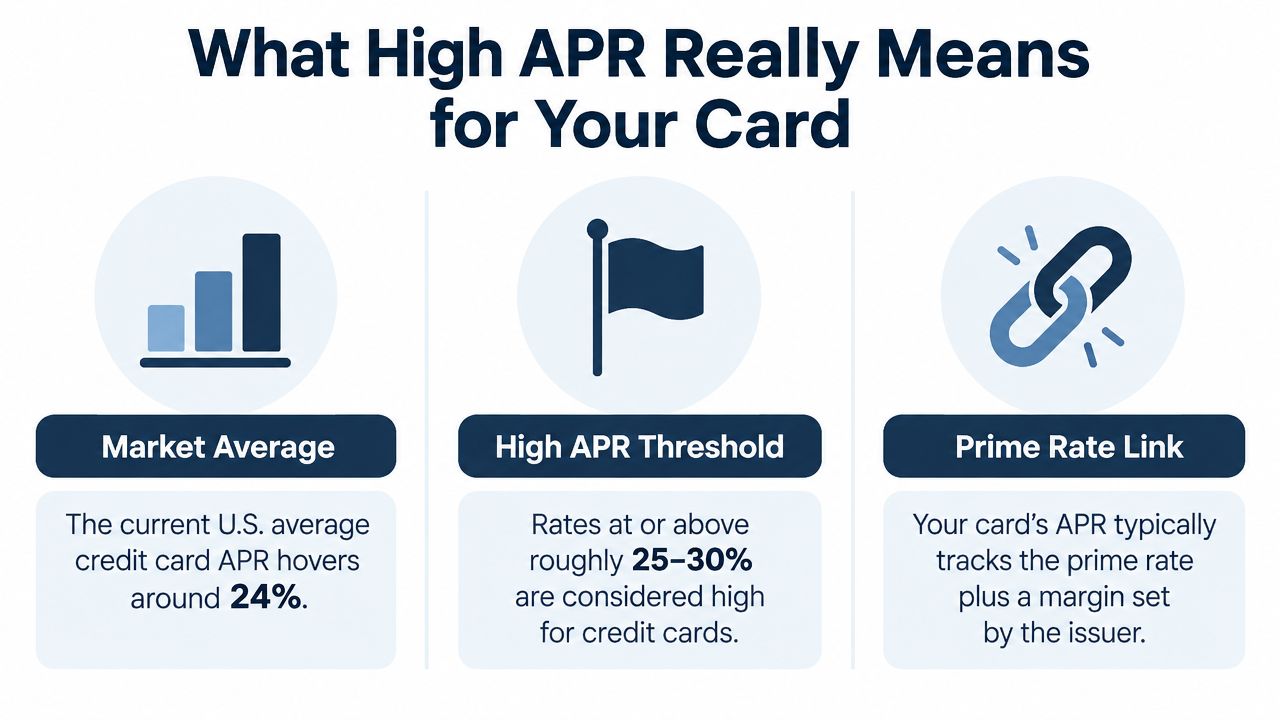
What makes a credit card APR high for your own situation? The answer depends on both the rate and the balance it acts on. A rate becomes a living cost when unpaid debt remains on the account, because interest can accrue day after day and leave less of each payment available to reduce principal.
A rate near the upper 20s is clearly high compared with the current market. Some issuers set contractual APR caps around 29.99%, though the rate on a specific account depends on its product, applicant, and agreement. The Consumer Financial Protection Bureau reported that 2024 average APRs reached 25.2% for general-purpose cards and 31.3% for private-label cards, the highest levels in that report period since at least 2015, as documented in its 2025 credit card market report.
A simple rule helps: a rate can be high because it exceeds the market, belongs to an expensive card category, or makes a carried balance unaffordable.
A rate needs context
Compare three factors:
- The market: A rate in the low to mid-20% range deserves attention in the current environment.
- The product: Retail cards can carry substantially higher rates than general-purpose cards.
- The balance: The rate matters most when debt rolls from one billing cycle into the next.
For example, a 25% APR applied to a small balance may create a manageable charge for a cardholder who pays quickly. Applied repeatedly to a larger balance, the same percentage becomes a payoff drag. Each day's interest adds cost before the next payment can meaningfully lower what is owed.
“High” also changes over time. Many credit cards use variable rates tied to benchmark rates, so broader interest-rate conditions can move the APR. A rate that was ordinary in one period may be high in another. The percentage provides the label, while the balance, payment, and rate environment determine the practical cost.
Fixed Versus Variable APR and Why It Matters
Could the APR on your statement change even if you do nothing? Yes. Many credit card rates are variable, meaning they combine a benchmark index with the issuer's margin. If that benchmark moves, the card's APR may move under the agreement.
That change connects your debt to the wider rate cycle. Market averages provide useful context, but your account agreement supplies the details that determine your cost: the index, margin, and adjustment rules. A variable APR can rise or fall without a new application, so the rate printed on one statement may not remain the rate on the next.
Different APRs can apply to one account
One card can assign different rates to different types of balances:
- Purchase APR: Applies to purchases carried beyond the grace period under the card's terms.
- Balance transfer APR: Applies to transferred debt and may be promotional for a limited period.
- Cash advance APR: Often applies under separate, generally more expensive terms, with interest treatment that can differ from purchases.
- Penalty APR: May apply after certain payment defaults if the agreement permits it.
A promotional APR can hide the regular cost temporarily. Once the offer ends, the post-promotion purchase or transfer rate controls the balance. Compare those rates rather than judging an offer by its introductory figure alone.
A card can therefore behave like separate lanes on the same road. Each balance follows its own APR, and the lane with the highest rate adds cost fastest.
Fixed doesn't mean risk-free
A fixed APR generally offers more stability, but it does not override the card agreement. That agreement explains whether the issuer can adjust the rate and under which circumstances. A variable APR adds another source of movement because benchmark changes can alter the cost of an unpaid balance.
The practical question is which balance uses which APR, when that APR can change, and whether payments are large enough to reduce principal. A single headline rate may hide several balances with different pricing. Reading the rate table and matching each rate to the balance shows how the card's cost is moving.
How Daily Interest Charges Grow Your Balance
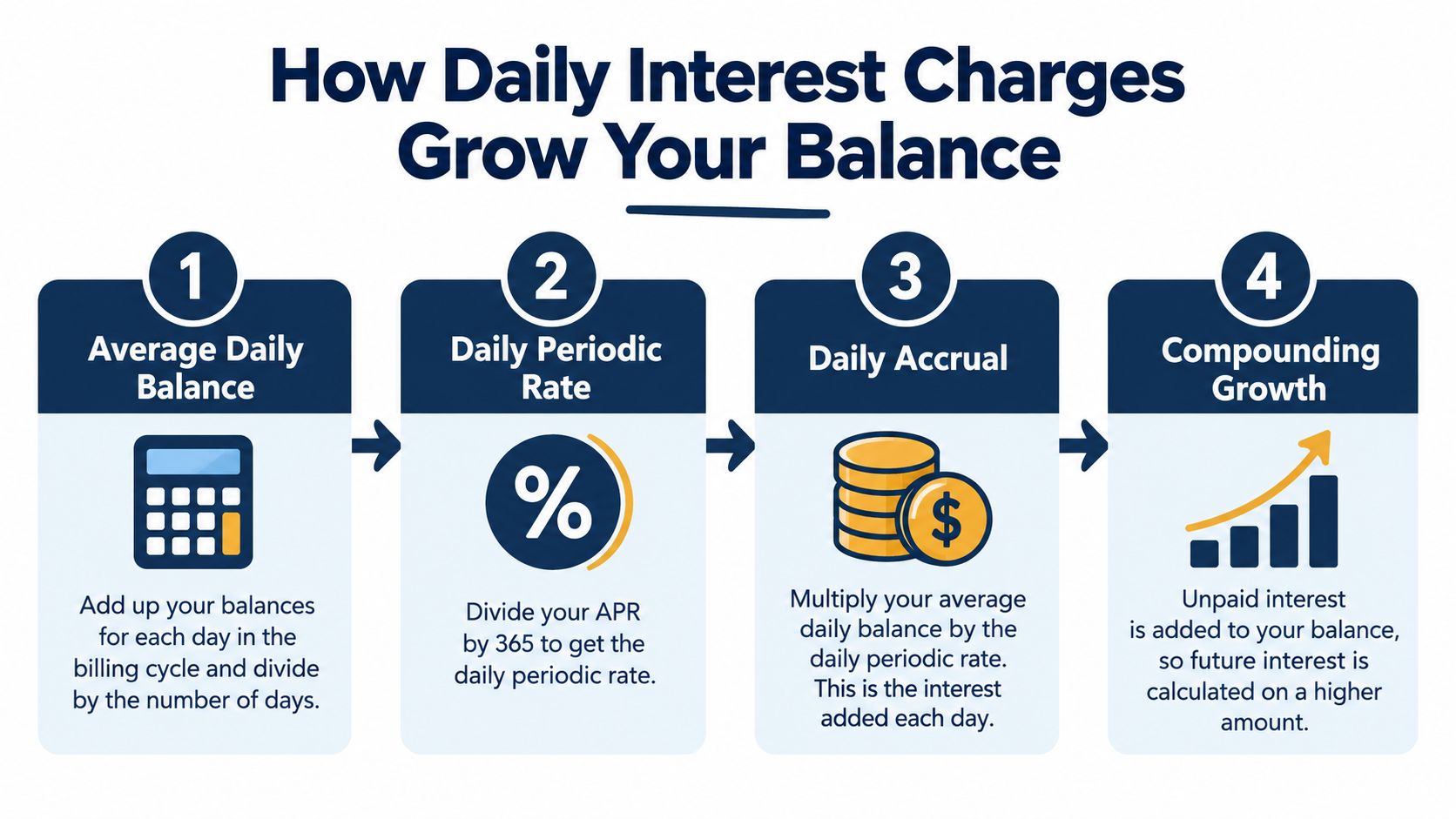
Credit card interest usually accrues daily, not just once at the end of the month. The issuer calculates a daily periodic rate by dividing the APR by 365, then applies that rate to the average daily balance. The Bank of America explanation of APR and daily periodic rates describes this process in consumer-friendly terms.
At 25% APR, the daily periodic rate is about 0.068%, calculated as 25% divided by 365. On a balance of $5,000, a simplified one-day estimate would be about $3.40 in interest before considering payment timing, new charges, fees, or the issuer's precise average-daily-balance calculation.
The calculation in plain language
The process works like this:
- The issuer tracks the balance for each day in the billing cycle.
- Those daily balances are combined and averaged.
- The issuer multiplies the average daily balance by the daily periodic rate.
- The resulting interest is added according to the account's billing terms.
A balance that remains unpaid therefore creates a moving target. If interest is added to the account and remains unpaid, the next calculation can apply to a larger balance. That's the interest-on-interest effect borrowers often describe as a debt snowball.
The percentage is annual, but the balance feels the rate one day at a time.
A cardholder who makes a payment early in the cycle may have a different average daily balance from someone who makes the same payment near the due date. New purchases can also increase the average. The exact statement charge depends on the issuer's method and account terms, so the estimate isn't a replacement for the finance-charge line on the statement.
For a deeper walkthrough of statement math, the finance charge calculation guide can help cardholders connect the APR to the amount shown on a bill. The key point is simple: a higher APR raises the daily charge applied to the balance, and unpaid charges can slow principal reduction.
Where the Highest Credit Card APRs Live
Where do high APRs appear most often? Card type matters, and private-label retail cards have generally carried higher rates than general-purpose cards.
The 2024 averages were 25.2% for general-purpose cards and 31.3% for private-label cards, according to the market report cited earlier. A private-label card is tied to one retailer or store. A general-purpose card can usually be used at many merchants.
A simple comparison
| Card category | 2024 average APR |
|---|---|
| General-purpose cards | 25.2% |
| Private-label cards | 31.3% |
That gap changes the cost of a promotional purchase. A checkout discount may reduce the price today, yet carrying the balance on a private-label card can make the purchase more expensive over time. The APR acts like a meter that keeps running while the balance remains unpaid.
Borrower profile also affects pricing. Interest-rate margins for revolving accounts reached 14.3 percentage points in 2023, which the Consumer Financial Protection Bureau described as the highest point in recent history. Federal Reserve data on New York Fed research found an average spread over the federal funds rate of 14.5 percentage points. The spread ranged from 21 percentage points for borrowers with a FICO score of 600 to 7.22 points for borrowers with a score of 850.
Those figures explain why two applicants can receive different APRs for similar cards. Credit score, revolving behavior, product risk, and market conditions all influence the rate. A high APR can therefore reflect the card's pricing structure, the borrower's credit tier, or both. For someone carrying a balance, that difference is not merely a label. It changes how much of each payment reaches the principal.
Real Payoff Scenarios Under High Interest Rates
Consider two cardholders with the same $5,000 balance and the same $150 monthly payment. The only difference is the APR. At 24% APR, a simplified payoff illustration shows roughly 56 months and about $3,322 in total interest. At 28% APR, the same balance and payment take roughly 66 months, with about $4,782 in total interest, based on the Debt Help U credit card interest calculator.
The rate difference is only four percentage points, but the payment has to cover more interest before it can reduce the balance. That is the central payoff drag: the same monthly payment does less principal work when the APR is higher.
The comparison at a glance
| Scenario | Balance | Monthly payment | APR | Approximate payoff | Approximate interest |
|---|---|---|---|---|---|
| A | $5,000 | $150 | 24% | 56 months | $3,322 |
| B | $5,000 | $150 | 28% | 66 months | $4,782 |
These are illustrative estimates, not guarantees. Actual results can differ because issuers calculate interest using average daily balances, payment dates, new purchases, fees, and account-specific terms. A cardholder should use the statement and an account-specific calculator for a precise projection.
Why small payments matter
The payment amount changes the balance trajectory in two ways. It covers the current interest charge, then directs the remainder toward principal. A larger payment leaves more of that remainder available for principal, which reduces future daily interest.
That doesn't mean every household can easily increase its payment. A realistic plan must protect essential expenses and avoid replacing one expensive balance with another. The useful question is whether the current payment is reducing the balance at a pace the household can sustain, or merely keeping the account open while interest continues to accumulate.
How High APR Changes Spending and Repayment Behavior
A high APR changes more than the interest line. It can alter how a household uses the card, how much it charges, and whether the existing repayment plan still feels workable.
Boston Fed research reported that a 1 percentage point increase in credit card APR leads to roughly a 9% drop in credit card spending the following month, or about $74 less in monthly charges on average, as reported by CNBC's coverage of the research. That finding suggests that borrowers respond to higher rates by pulling back on card use, not merely by paying more interest.
The Federal Reserve Bank of New York reported that credit card balances stood at about $1.23 trillion in the third quarter of 2025, and the CFPB report cited earlier put private-label retail card APRs above 30%. The combination creates a useful distinction: a high APR can be an expensive inconvenience for someone who pays promptly, but it can become a budget-pressure signal for someone who carries a balance and continues to rely on the card.
Signs that behavior is changing
A household may be reaching a tipping point when:
- New charges are being reduced: The card is used less because the cost has become visible.
- Minimum payments become the default: Payments cover the required amount but make little progress against principal.
- Repayment priorities change: The household starts deciding which account receives extra money.
- Borrowing shifts elsewhere: A person considers consolidation, settlement, or bankruptcy because the existing balance no longer fits the budget.
The guide to choosing which credit card to pay off first can help explain how interest rate, balance size, and repayment goals affect prioritization. A behavioral shift isn't automatically a crisis, but it deserves attention when the cardholder is cutting necessary spending, missing payments, or adding debt to cover ordinary expenses.
Practical Ways to Lower Your Effective APR Cost
Lowering the stated APR is one path, but lowering the effective cost of carrying debt can also come from reducing the balance faster, changing the payment structure, or stopping new interest-bearing charges.
A balance transfer may offer a lower introductory rate, but the agreement should be checked for the regular APR after the promotional period, transfer fees, eligibility requirements, and the consequences of missed payments. A consolidation loan can also change the rate and payment structure, but the comparison should include total repayment cost, not just the new monthly amount.
A practical review sequence
- List each balance and APR. Separate purchases, transfers, cash advances, and penalty-rate balances where the statement does so.
- Test a sustainable extra payment. Even a modest recurring increase can change the principal-reduction path, provided it doesn't cause missed essential bills.
- Ask the issuer about hardship options. A card company may have account-specific programs, though approval and terms vary.
- Compare alternatives side by side. Consolidation, settlement, and bankruptcy involve different costs, credit effects, risks, and timelines.
- Stop the balance from growing. A lower rate won't solve the problem if new charges exceed the payment.
Debt Help U provides no-login calculators that use a balance and APR to estimate payoff timing, minimum-payment outcomes, extra-payment scenarios, and consolidation comparisons. The credit card payment options guide offers plain-language context for evaluating those routes.
Before choosing a solution: Compare the total interest, fees, payment period, credit effects, and risk of falling behind. A smaller payment isn't automatically a cheaper solution.
Privacy can matter during the first evaluation. A browser-based calculator lets a person test assumptions before sharing contact details with a provider. Formal options should be reviewed carefully, and no debt-relief path guarantees a particular outcome.
Recognizing When High APR Signals a Bigger Problem
A high APR becomes a bigger financial warning when the balance keeps growing despite regular payments. Rising minimum payments, repeated new charges, and a repayment plan that never reaches principal reduction can point to an affordability problem rather than a rate problem alone.
The first check is straightforward. The cardholder can compare the current balance with the balance from earlier statements, identify how much of each payment went to interest, and determine whether new charges are replacing the amount paid down. If the account remains near its limit or grows over time, the household may need a broader review of income, essential expenses, and all unsecured debts.
Debt-after-death rules also require care. Debt doesn't automatically pass to surviving family members, but liability can remain if the survivor was a co-signer, a joint account holder, or a surviving spouse in a community property state, according to the Consumer Financial Protection Bureau's guidance on debt after death. The CFPB lists these community property states: Alaska, with a special agreement, Arizona, California, Idaho, Louisiana, Nevada, New Mexico, Texas, Washington, and Wisconsin.
A surviving spouse's responsibility depends on state law. In community property states, a spouse may be responsible for debts created during the marriage even when the account was only in the deceased spouse's name, while in non-community-property states a spouse is generally not responsible for debt held only by the deceased spouse, as explained in the CFPB's spouse-debt guidance. Authorized-user status, joint ownership, and co-signing aren't interchangeable, so legal advice may be appropriate for a specific situation.
Debt Help U offers free, no-login calculators and plain-language comparisons for credit card payoff plans, consolidation, settlement, and bankruptcy. Readers can enter a balance and APR privately, review projected timelines, and visit Debt Help U to explore next steps before choosing whether to contact a provider.
Related guides
- How long will it take to pay off my credit card debt? Your minimum payment shrinks every month. Following it down is what turns a five-year balance into a thirty-five-year one.
- How to get out of credit card debt without a loan Borrowing your way out is the advice everyone gives first. Here is what works when you do not want more debt.
- Debt settlement vs. consolidation vs. bankruptcy Four paths out of unmanageable debt, what each one costs, and what each one breaks. Real numbers on a $30,000 balance, not a pitch for any of them.