Applying for Several Credit Cards at Once: The Risks
Maya wanted three different benefits from three different cards. On Saturday, she applied for a travel rewards card, a 0% APR balance-transfer card, and a store card offering a signup discount. Within minutes, three hard inquiries appeared on her credit file.
The applications felt separate because each form was fast, familiar, and partly pre-filled. The credit report sees something different: a burst of new-credit requests that lenders can review together. Applying for several credit cards at once isn't automatically forbidden, but it often produces more risk than value.
The right question isn't whether a consumer can submit several applications. It's whether the expected rewards, financing benefit, or credit-building value justify separate inquiries, possible denials, younger accounts, and closer underwriting scrutiny.
Table of Contents
- Why So Many People Apply for Several Cards at Once
- What a Hard Inquiry Actually Does to Your Score
- Why Stacking Applications Hurts More Than a Single One
- How to Space and Time Your Applications
- When Card Applications Are and Are Not Grouped
- Scenarios Where Multiple Applications Make Sense or Not
- Your Short Checklist Before You Apply and What to Remember
Why So Many People Apply for Several Cards at Once
Maya's decision is common because card offers create urgency. A travel card may advertise a welcome bonus that appears temporary. A store card may promise an immediate discount. A balance-transfer card may look like an escape from a costly revolving balance. Each offer can seem reasonable alone, so submitting all three feels efficient.
The trouble starts when convenience replaces sequencing. Online applications make it easy to move from one issuer to another without pausing to consider what the first application has already changed. A denial can make the problem worse if the applicant immediately applies again, hoping another issuer will overlook the first result.
The usual motivations
Consumers commonly cluster applications for practical reasons:
- Chasing rewards: A large welcome offer can encourage several applications before the opportunity disappears.
- Building credit: Someone with a thin file may want more than one new tradeline quickly.
- Separating spending: Different cards may serve travel, store purchases, balance transfers, or everyday expenses.
- Seeking relief: A consumer with expensive balances may rush toward a promotional transfer offer.
- Reacting to rejection: A denied application can trigger a panic application to a different issuer.
A new credit line can help with available credit and spending organization, but consumers should first understand what a credit line is. A larger limit doesn't solve unaffordable balances, and multiple new accounts create multiple due dates, terms, and approval decisions.
Practical rule: A card application should have a specific job. If the only reason for applying is that another offer appeared, the timing is probably poor.
The safest starting point is to identify the single card with the clearest purpose and strongest fit. Then the applicant can review the credit profile, check prequalification options, and decide whether another application still makes sense after the first result arrives.
What a Hard Inquiry Actually Does to Your Score
A hard inquiry is a record created when a lender reviews a credit file to decide whether to approve a new account. It differs from a soft inquiry used for some prequalification checks, which doesn't generally affect the score.
FICO says a hard inquiry typically lowers a score by only a few points, and some consumer-finance sources describe the drop as often less than five points. The effect can matter more for a thin or newly opened file because there is less positive payment history to offset it. Experian's explanation of credit-card applications and inquiries also notes that each application can add another inquiry.
An inquiry generally remains visible on a credit report for two years, while FICO scoring models typically count inquiries from only the past 12 months, according to Experian guidance on how long hard inquiries stay on a credit report. The lasting record and the shorter scoring window aren't the same thing. The immediate scoring and approval effect deserves more attention than the eventual disappearance of the entry.
Why card inquiries aren't treated like loan shopping
Scoring models often protect consumers who compare mortgage, auto-loan, or student-loan rates within a short shopping period. Newer FICO models use a 45-day window, while VantageScore commonly uses a 14-day window, according to CNBC Select's comparison of loan and card inquiries.
Credit-card applications generally don't receive that same treatment. Three card applications can therefore create three separate hard inquiries, even when submitted on the same day. The application burst can also be visible to later issuers as a sign that the consumer is actively seeking credit.
FICO data show that people with six or more hard inquiries on their reports can be as much as eight times more likely to declare bankruptcy, as reported in Experian's discussion of multiple card applications. That doesn't mean several inquiries cause bankruptcy or that every applicant with multiple inquiries is distressed. It shows why lenders treat repeated applications as a meaningful risk signal rather than an irrelevant administrative detail.
Why Stacking Applications Hurts More Than a Single One
The single-inquiry score change is usually not the central problem. The larger concern is that several applications can alter multiple parts of the credit profile at the same time.
Each hard pull adds another recent inquiry. If cards are approved, each new account can also reduce the average age of accounts. Yahoo Finance's explanation of multiple card applications identifies the combined effect of inquiries and younger account age as a reason the damage can exceed the impact of one application.
What later underwriters see
A later issuer doesn't review the original profile in isolation. Depending on reporting timing, the issuer may see recent inquiries, newly opened accounts, new balances, and a changed average account age. The pattern can look like rapidly seeking credit, especially when applications arrive close together.
That interpretation matters even when the score remains strong. An applicant may have qualified before the first submission, then face tougher review after the file records additional activity. A denial also doesn't erase the inquiry, so immediately applying elsewhere can leave the consumer with more visible risk and no new account.
The score effect isn't a simple multiplication. Three applications don't necessarily produce exactly three times the impact of one. They combine separate inquiries with account-age changes and the lender's own view of application velocity.
| Factor Affected | 1 Application | 2 Applications in 30 Days | 3 Applications in 30 Days |
|---|---|---|---|
| Hard inquiries | One new inquiry is typically added | Two separate inquiries may be visible | Three separate inquiries may be visible |
| Account age | One new account can lower the average age | The average age can fall further if both accounts open | Several new accounts can create a pronounced age change |
| Approval review | One application receives individual review | The second issuer may see the first application activity | Later issuers may see a concentrated credit-seeking pattern |
| Account management | One new due date and set of terms | Two new accounts require coordination | Three new accounts increase payment and fee-management demands |
The balance problem
New cards can increase total available credit, but that benefit disappears if balances rise. Consumers carrying several balances should check how utilization affects a credit score before treating a new limit as a solution.
The strongest recommendation is simple: don't stack applications merely to chase a higher total limit. A new account can help only if the consumer can manage payments, keep balances controlled, and avoid adding debt that the household budget can't support.
How to Space and Time Your Applications
A disciplined sequence protects approval odds better than a weekend application spree. The goal is to gather useful information before creating another hard inquiry, then allow the profile to show whether the first decision was manageable.
Four decisions before the next application
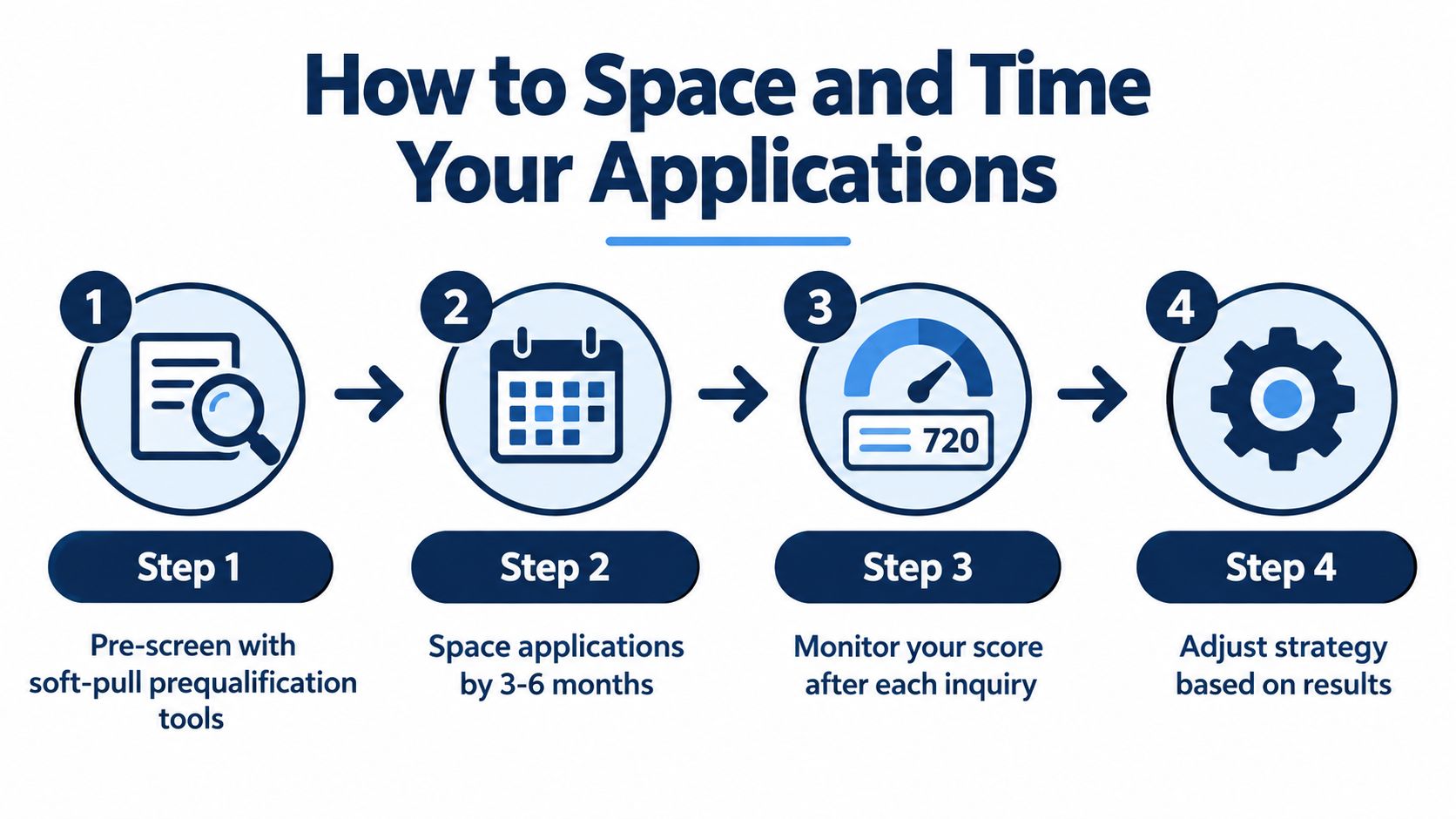
Start with soft-pull screening. Issuer and credit-bureau prequalification tools can indicate potential fit without creating the same hard inquiry associated with a full application. They aren't approvals, but they help eliminate obviously poor matches.
Choose one target card. Prioritize the card whose approval odds, terms, and purpose best match the applicant's profile. A travel card with a complicated spending requirement shouldn't outrank a balance-transfer card when reducing expensive debt is the objective.
Create separation. Waiting at least 30 days between applications gives the first decision time to register and gives the applicant a chance to review any new account terms. Some consumer-finance guidance suggests waiting about six months between card applications when possible, as discussed by CNBC Select's inquiry comparison. A longer interval is especially sensible before a major loan.
Set a hard ceiling. If multiple applications are unavoidable, limiting the burst to two applications in a 90-day window is a more controlled approach than submitting three or more together. Consumers planning a mortgage should avoid new card activity within six months of that application.
A worked example
Consider a consumer with a 710 credit score who wants a travel card, a hotel card, and a store card. The consumer applies for the travel card first, waits 45 days, reviews the result and any new account reporting, then applies for the hotel card. After another 45 days, the store card becomes the final decision.
This approach doesn't guarantee approval. It does prevent all three applications from landing as one concentrated burst and gives the consumer opportunities to stop after an approval, denial, or unexpected account term.
Timing matters most near an underwriting cutoff. A few points or one additional inquiry can affect the next decision when the profile already sits near the issuer's threshold.
Consumers should also calculate affordability before applying. A debt-to-income formula can help frame whether another required payment fits alongside existing obligations, although issuers use their own underwriting methods and definitions.
When Card Applications Are and Are Not Grouped
The popular advice to “shop around” for credit cards as if they were mortgages is incomplete. Rate-shopping protections generally apply to similar installment-loan inquiries, not to a consumer submitting unrelated credit-card applications to several banks.
Mortgage, auto-loan, and student-loan inquiries may be grouped within model-specific windows. Credit-card inquiries usually remain separate, even when the applications happen close together. Hard inquiries can stay visible for two years, while their scoring effect generally matters for about 12 months, according to Yahoo Finance's review of multiple card applications.
The issuer-policy exception
Some issuers may combine pulls in narrow circumstances, such as applications for different products through one issuer's checkout flow. Some lenders may also turn a prequalified offer into one hard pull after acceptance. Those practices aren't consistent across banks, products, locations, or applicants.
Consumers shouldn't assume that two applications will become one inquiry because the cards come from the same issuer. Even when pulls are combined, separate accounts can still open, separate new-account records can appear, and each account can affect average age and payment management.
Issuers also run internal velocity checks that sit outside FICO scoring. A bank may consider how many cards the applicant has opened recently, how much total credit the bank already extended, and whether the new request resembles urgent borrowing. The bank's internal policy can produce a denial even when the score itself looks acceptable.
| Loan Type | Grouping Window | Typical Behavior |
|---|---|---|
| Mortgage | Newer FICO models use 45 days | Similar rate-shopping inquiries may be treated as one event |
| Auto loan | Model-dependent, including 45 days for newer FICO models | Similar loan inquiries may be grouped during rate shopping |
| Student loan | Model-dependent, with VantageScore commonly using 14 days | Similar inquiries may receive rate-shopping treatment |
| Credit card | No comparable general shopping protection | Each application typically creates a separate hard inquiry |
The practical rule is to treat every card application as if it will produce its own inquiry. If an issuer later combines pulls, that's a favorable exception, not a planning assumption.
Scenarios Where Multiple Applications Make Sense or Not
Applying for several cards can make sense when the consumer has a defined objective, enough financial capacity, and no major loan decision approaching. It becomes reckless when the applications are a reaction to stress, a denial, or an inability to manage current balances.
Situations that can justify a controlled strategy
A travel-focused consumer may pursue welcome bonuses across two cards in the same issuer family during one weekend. That strategy still creates application risk, and the consumer should confirm the issuer's eligibility rules, spending requirements, annual fees, and ability to pay the balances in full.
A credit builder with a thin file may consider a secured card plus a student card to establish two tradelines. Thin files are more sensitive to inquiries because there is less positive payment history to offset them, so this is a case for careful prequalification and issuer fit, not indiscriminate submissions.
A consumer facing expensive revolving debt may prioritize a 0% APR balance-transfer offer before it expires. The transfer must solve a repayment problem rather than create permission to spend more. If the applicant can't meet the new payment schedule, the promotional offer won't fix the underlying budget.
Situations where the strategy usually backfires
- A near-term mortgage or auto-loan applicant: Recent inquiries and younger accounts can complicate approval and pricing decisions.
- A thin-file applicant reacting to rejection: Three rapid applications can turn one denial into several inquiries and additional denials.
- A borrower already near stated income or existing limits: Several requests may look like overextension or cash-flow pressure.
Major-market data show why rejection risk deserves attention. Consumers submitted over 160 million credit-card applications in 2022, while only about 44% of general-purpose card applications were approved that year, according to the CFPB's 2023 Consumer Credit Card Market Report. The CFPB's 2025 report found 67.7 million applications approved by mass-market issuers in 2024, with a 41% approval rate for general-purpose cards. A burst of applications can therefore create multiple hard pulls without producing multiple approvals.
Editorial rule: Proceed only when the card has a clear financial purpose, the score can absorb a modest dip, and no major loan is planned for the next 12 months. Otherwise, one well-chosen application is the better decision.
Your Short Checklist Before You Apply and What to Remember
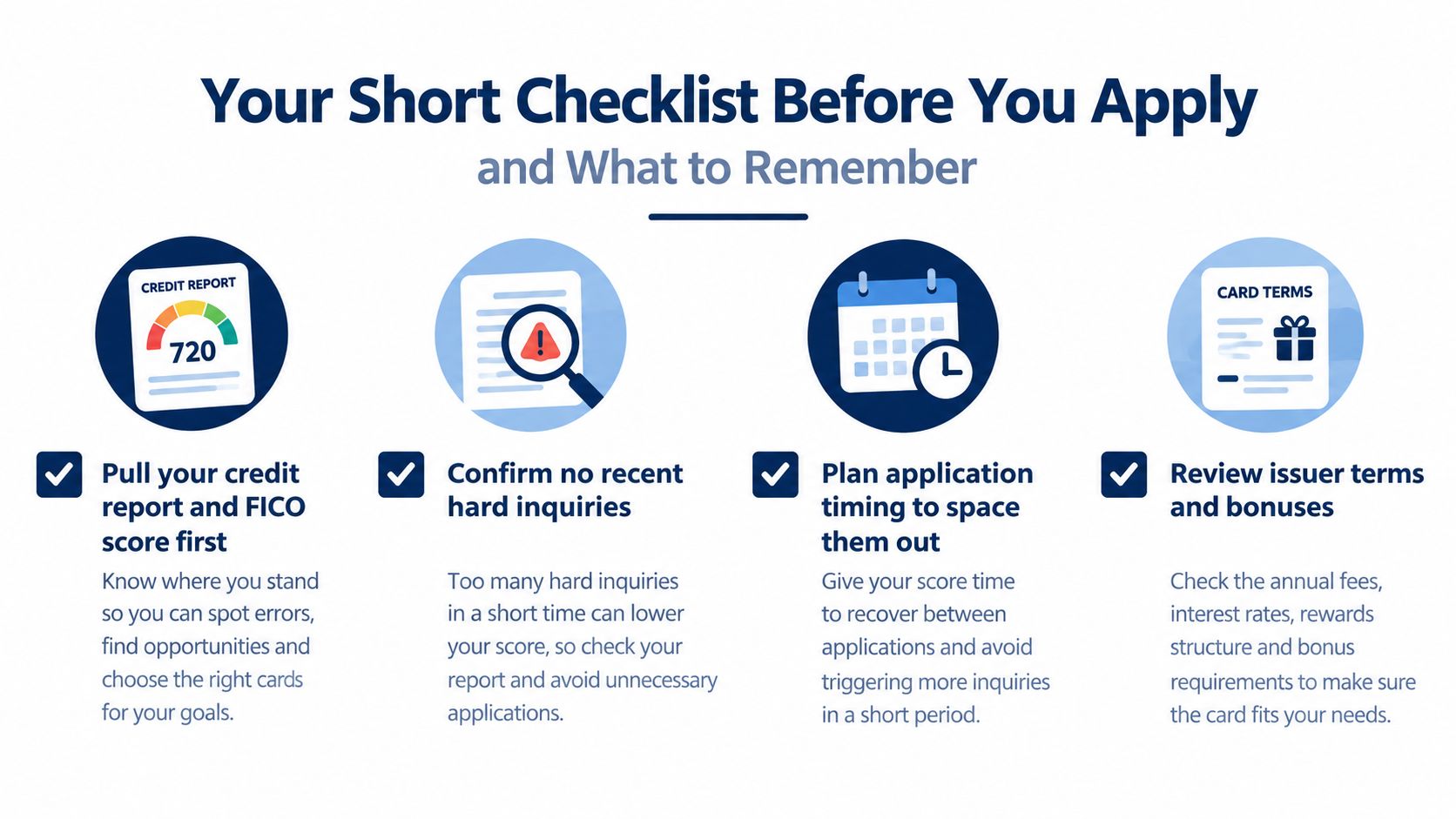
A five-minute review can prevent a weekend of unnecessary inquiries. The applicant doesn't need perfect certainty, but should know the profile, the purpose, and the timing before pressing submit.
The pre-application check
- Pull the report and score: Review the credit report and current FICO score for recent accounts, inquiries, errors, and balances.
- Check loan-shopping activity: Confirm whether mortgage, auto-loan, or student-loan inquiries are already within a model-specific 14-day to 45-day rate-shopping window, as explained in FICO's guidance on credit report inquiries.
- Prequalify first: Use soft-pull tools from two to three issuers when available. Treat the result as an indication, not a promise.
- Pick one target: Select the card that best matches the consumer's purpose, profile, and payment capacity.
- Review the terms: Check the annual fee, promotional period, transfer conditions, rewards requirements, and issuer restrictions before applying.
- Schedule the next decision: Wait at least 14 to 21 days before considering another application, and use a longer interval when the profile is thin or a major loan is approaching.
A prime borrower should generally cap new card applications at roughly two in any six-month span when protecting long-term profile stability matters. That isn't a universal underwriting rule, but it forces a useful pause between applications.
The long-term issue many applicants miss
An inquiry's scoring effect usually fades sooner than the effect of a new account's age. The average age of accounts takes time to recover because the account remains new while older accounts continue aging. That makes rapid applications a poor fit for consumers planning a mortgage, rebuilding a thin file, or struggling to control balances.
Debt-after-death rules require a separate caution. There is no single national answer about who owes what. The result depends on state law and whether the person was a joint account holder or merely an authorized user, as explained by the Consumer Financial Protection Bureau's debt-after-death guidance.
A spouse is generally not responsible solely because the other spouse died, unless the spouse was a co-signer, a joint account holder, or lives in a community property state with applicable rules. The CFPB lists these community property states: Alaska (if a special agreement is signed), Arizona, California, Idaho, Louisiana, Nevada, New Mexico, Texas, Washington, and Wisconsin. An authorized user isn't the same as a joint owner and is typically not liable for the balance, while a joint account holder can remain responsible under the account agreement, as detailed in the CFPB's spouse-debt explanation.
Check the score and report today, then mark a calendar date for the next application instead of submitting another one immediately. That small pause gives the applicant a chance to choose deliberately, protect approval odds, and avoid turning a useful card search into unnecessary credit damage.
Debt Help U offers free, no-login calculators and plain-language guides that show payoff timing, interest costs, debt-to-income context, and repayment options before a consumer shares contact details. Visit Debt Help U to compare the cost of carrying current card balances with the consequences of adding another account.
Related guides
- Debt settlement vs. consolidation vs. bankruptcy Four paths out of unmanageable debt, what each one costs, and what each one breaks. Real numbers on a $30,000 balance, not a pitch for any of them.
- How long will it take to pay off my credit card debt? Your minimum payment shrinks every month. Following it down is what turns a five-year balance into a thirty-five-year one.
- Debt snowball vs. avalanche: which one finishes faster Avalanche always pays less interest. The gap is smaller than the argument about it suggests. Run both on your own balances and see what it is worth.