8 Credit Card Payment Options for Debt
A credit card bill is due, the balance is larger than expected, and several payment choices look almost identical. A cardholder can pay the minimum, send the full statement balance, automate a fixed amount, move the balance to another card, apply for a loan, or seek formal debt relief. The lowest monthly payment isn't automatically the cheapest or safest choice.
The right path depends on cash flow, interest rates, repayment capacity, credit condition, and hardship severity. The eight options below move from ordinary payment methods to strategies for serious financial difficulty. Some change how a cardholder pays. Others change the debt structure, involve creditors, or create legal and tax consequences.
Credit cards are now a primary everyday payment rail in the United States. The Federal Reserve's 2023 Survey of Consumer Payment Choice found that credit cards represented 32% of retail payments by number, ahead of debit cards at 30% and cash at 16%. That makes repayment planning important even for households that never intended to carry a balance.
Debt-after-death rules require separate care. The answer depends on state law and whether the person was a joint account holder or an authorized user. Surviving-spouse rules can differ in the nine community property states, so anyone handling an account after a death should seek state-specific legal advice.
Table of Contents
- 1. Standard Credit Card Payments
- 2. Automatic Recurring Payments
- 3. Balance Transfer Credit Cards
- 4. Debt Consolidation Loans
- 5. Debt Settlement
- 6. Debt Management Plans and Credit Counseling
- 7. Chapter 7 and Chapter 13 Bankruptcy
- 8. Employer Payroll Deductions and Financial Wellness Programs
- 8-Point Comparison of Credit Card Payment Options
- Match the Option to Your Capacity
1. Standard Credit Card Payments
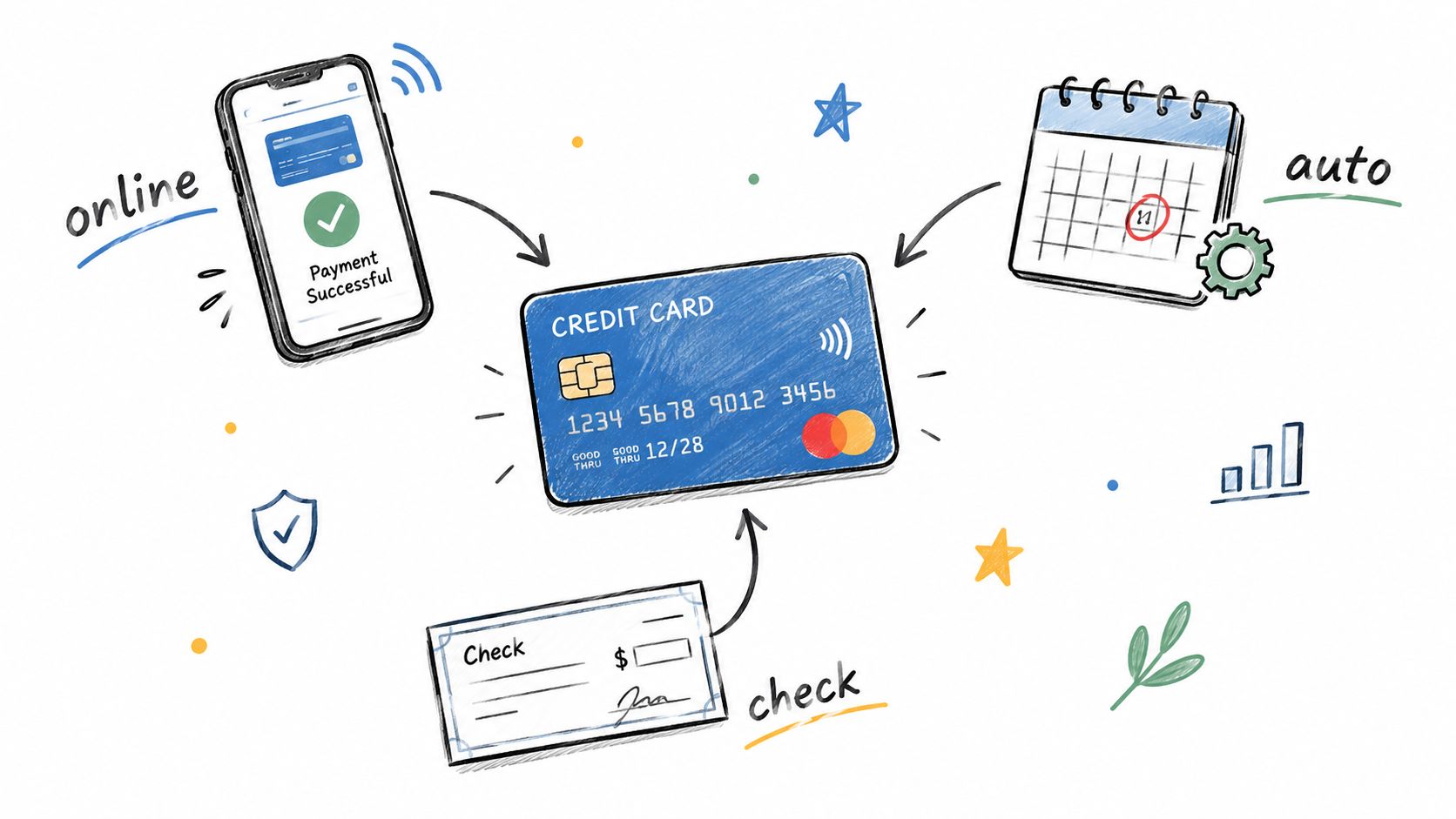
Standard payment means sending money directly to the card issuer through an online portal, bank transfer, automatic bank bill pay, or paper check. Chase, American Express, Capital One, Discover, and Bank of America all provide online payment portals where cardholders can schedule one-time or recurring payments.
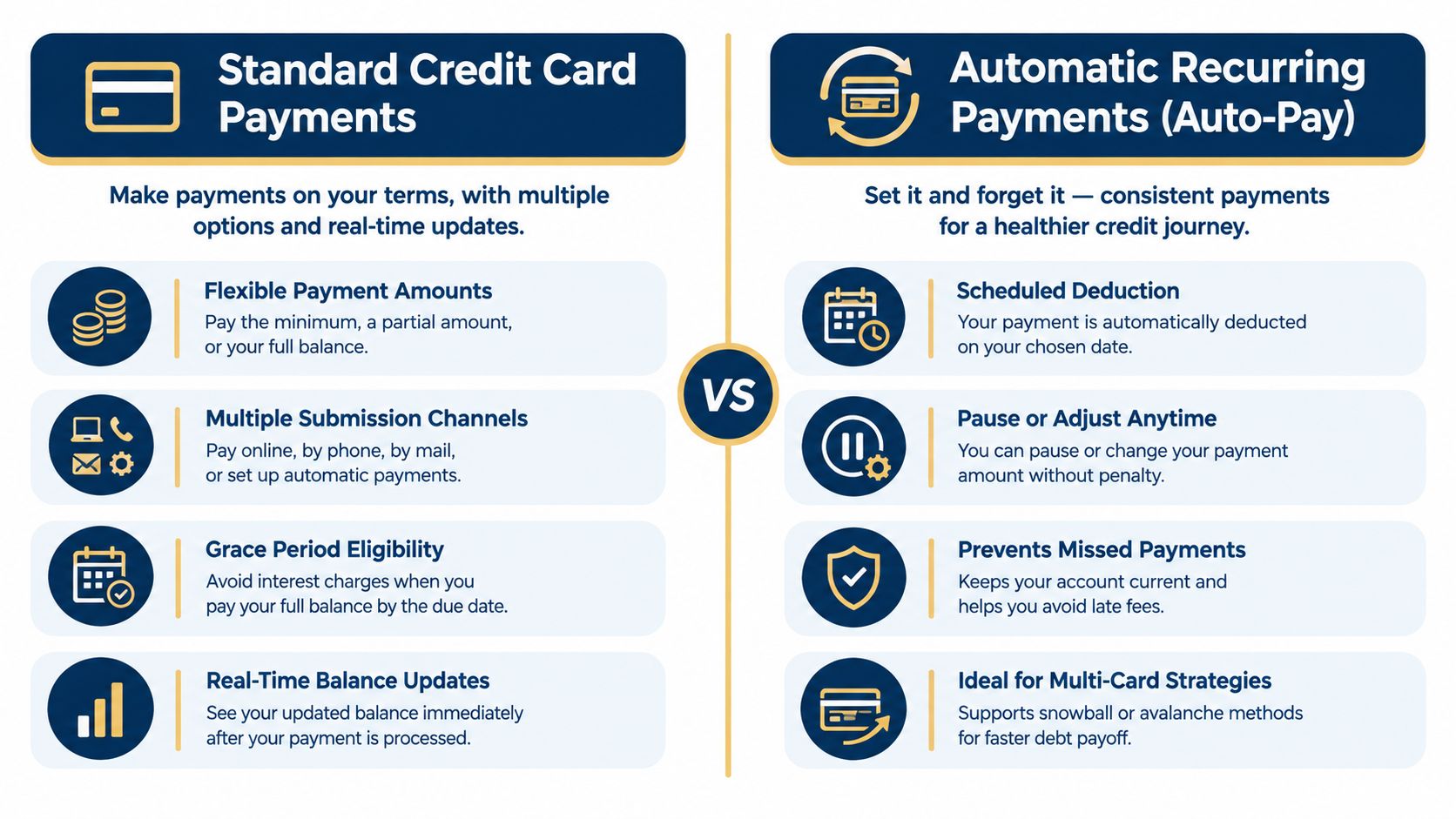
The first decision is the amount. Paying the full statement balance by the due date generally prevents interest on new purchases when the account offers a grace period and the cardholder meets its terms. Paying only the minimum keeps the account current, but it can leave revolving debt outstanding for a long time and increase the total interest cost.
The CFPB reported that 43% of cardholders paid their account balances in full each month in 2024. The same CFPB reporting found that the share making only minimum payments reached 15% for general-purpose cards and 20% for private-label cards. Those figures show why a payment choice isn't merely an administrative detail. It determines whether the balance disappears or continues revolving.
How to make the basic method work
A cardholder should automate at least the minimum, then add a fixed extra payment whenever cash flow allows. Payments scheduled around payday are easier to repeat than irregular transfers, and paperless statements can reduce missed-date risk.
Debt Help U's minimum payment calculator can show the estimated payoff date and total interest using the current balance, APR, and required payment. Its extra-payment simulator can model a fixed addition, such as $50 per month, without requiring an account.
Practical rule: The minimum protects the account. The extra amount attacks the debt.
This option makes sense when income is stable, the balance is shrinking, and the cardholder can pay more than the minimum without borrowing elsewhere. If the required payment already consumes money needed for housing, food, utilities, or other essentials, a different strategy may be necessary.
2. Automatic Recurring Payments
Auto-pay removes the calendar burden from credit card repayment. A cardholder links a checking or savings account, selects a payment amount, and chooses a recurring date. The issuer then pulls the scheduled amount each billing cycle.
The safest starting setting is usually the minimum payment on every card, because a missed due date can create fees and account problems. That setting shouldn't be treated as a payoff strategy. It prevents a missed payment while the cardholder sends additional money toward the priority balance.
A household with two cards might automate $200 toward Card A under a snowball plan, then redirect that amount to Card B after Card A is cleared. Another household might use the avalanche method, paying minimums everywhere and directing the largest affordable extra amount to the card with the highest APR.
Build an auto-pay system that survives real life
Auto-pay fails when the linked account lacks funds. A cardholder should schedule the withdrawal after pay arrives, keep a modest checking-account cushion, and review the arrangement when income or billing dates change.
Useful settings include:
- Minimum protection: Put every card on at least minimum-payment auto-pay.
- Payday alignment: Choose a date after expected income arrives, while allowing enough processing time.
- Fixed acceleration: Add an extra amount that remains affordable during ordinary months.
- Annual review: Recheck linked accounts, payment dates, and priority cards as balances change.
The minimum monthly payment calculator can help estimate what the current payment will accomplish before a cardholder chooses an automated extra amount. Debt Help U's payoff planning tools also compare snowball and avalanche priorities.
Auto-pay should create consistency, not conceal an unaffordable budget.
This option makes sense when the cardholder has predictable income and wants to prevent missed payments. It isn't enough by itself when the minimum barely reduces principal or when the account routinely causes overdrafts.
3. Balance Transfer Credit Cards
A balance transfer moves existing card debt to a new credit card, often with a temporary promotional APR. This can reduce interest during the promotional period, but it doesn't erase the balance. The cardholder still needs a payment schedule that clears the transferred amount before the standard rate applies.
The cost has two parts: the transfer fee and the risk of failing to finish on time. A transfer fee is commonly expressed as a percentage of the amount moved, and approval generally depends on the applicant's credit profile. The promotional offer also has an expiration date, so a low introductory rate shouldn't be confused with a permanent rate.
The CFPB reported that balance transfers reached $59.5 billion in 2024, showing that consumers actively use this form of debt-management move. The figure doesn't prove that every transfer is beneficial. It shows that balance transfers are a significant part of the repayment process.
Suppose a cardholder moves an $8,000 balance to a 0% offer lasting 18 months. The transfer fee could be $240 to $400, and clearing the balance during the offer would require roughly $444 per month, before considering the fee. Those amounts come from the stated scenario, not a promise that a particular issuer will approve the offer.
Run the transfer test first
A transfer makes sense only when the cardholder can make the required payments and stop adding new debt. Before applying, the cardholder should:
- Price the fee: Add the transfer fee to the payoff target.
- Divide by the deadline: Calculate the monthly amount needed before the promotional rate ends.
- Protect the deadline: Set a calendar reminder well before the offer expires.
- Control new spending: Avoid using the transfer card for routine purchases unless repayment is already planned.
A cardholder should compare the offer's fee, promotional period, post-promotion APR, and eligibility requirements. The credit utilization guide explains why moving balances and opening accounts can affect credit usage and why a transfer isn't a reason to spend more.
Use Debt Help U's extra-payment simulator to test whether the fee and deadline fit the household budget. If they don't, a consolidation loan or nonprofit counseling may provide a more workable structure.
4. Debt Consolidation Loans
A consolidation loan replaces multiple credit card balances with one personal loan. The loan may come from a bank, credit union, or online lender, and it typically has a fixed payment schedule rather than an open revolving line.
The main benefit is structure. One fixed payment can be easier to budget than several changing minimums, and a lower interest rate can reduce the cost of repayment. The loan still has to be affordable, however. A longer term can lower the monthly payment while increasing the time the debt remains outstanding.
A consumer with $20,000 across four cards might compare a five-year loan at 12% APR with existing card rates between 18% and 24%. In the stated example, the loan payment is about $445 monthly, compared with more than $500 on the cards. Actual offers depend on credit, income, debt-to-income ratio, fees, and lender terms.
Choose the loan by total cost
A lower payment isn't enough. A cardholder should compare the annual percentage rate, origination fee, monthly payment, total repayment, and payoff date. The shortest term that fits the budget usually limits interest better than stretching the loan solely to obtain a smaller payment.
Before applying, the cardholder can use Debt Help U's debt consolidation versus debt management guide to compare structure, eligibility, credit effects, and alternatives. Its DTI calculator can also provide context before applications are submitted.
A practical lender comparison should include banks, credit unions, and online platforms such as LendingClub, Prosper, or SoFi. The cardholder shouldn't accept a loan until the lender confirms how funds reach the creditors and whether any balance remains unpaid.
A consolidation loan solves the payment structure. It doesn't solve new spending.
After the cards are paid, the household needs a plan for the old accounts. Stopping use may be necessary to prevent the balance from returning. Closing accounts can have credit consequences, so account changes should be considered carefully rather than made automatically.
This option makes sense when income is dependable, the applicant qualifies for a meaningfully lower rate, and the household can keep old balances from rebuilding.
5. Debt Settlement
Debt settlement is a negotiation for a creditor to accept less than the full balance. It belongs near the serious-hardship end of the payment spectrum because creditors aren't required to agree, and the process can involve missed payments, collection activity, credit damage, fees, and tax questions.
A stated settlement scenario involves $25,000 of card debt resolved for $12,500 through a company over 36 months. The scenario also includes $3,750 in company fees, potential tax liability of about $3,000, and a possible 150-point credit-score drop lasting 7 years. Those are scenario figures, not universal outcomes. Results depend on the creditor, account status, contract, tax situation, and the person's credit file.
A household can also negotiate directly. In another stated example, a creditor accepts $6,000 on a $10,000 balance. Direct negotiation may avoid settlement-company fees, but the consumer handles the communications, funding, written agreement, and tax review.
Treat settlement as a last-resort calculation
Settlement makes sense only when the household can't realistically repay the full balances through ordinary payments, consolidation, or a DMP. Before enrollment, the consumer should calculate the complete cost, including company fees, account growth, possible tax liability, and the risk that a creditor refuses to settle.
For-profit companies may charge 15% to 25% in fees, according to the provided Debt Help U guidance. A consumer should compare that cost with direct negotiation and nonprofit credit counseling. No company should guarantee that every creditor will settle or that a specific reduction will occur.
The process requires careful documentation:
- Written terms: Obtain the settlement amount, payment deadline, and account treatment in writing.
- Tax review: Ask a tax professional about Form 1099-C and possible income-tax treatment.
- Credit reporting: Check how the creditor reports the account after payment.
- Alternative review: Compare bankruptcy before committing funds to a settlement program.
Settlement can be appropriate during severe hardship, but it isn't a cheaper version of ordinary repayment. It trades repayment relief for significant uncertainty and long-term consequences.
6. Debt Management Plans and Credit Counseling
A debt management plan, or DMP, organizes repayment through a nonprofit credit counseling agency. The consumer generally repays the full enrolled balance while the agency requests creditor concessions, such as lower interest rates or revised payment arrangements. The plan addresses high-cost revolving debt through structured repayment, not balance reduction.
The consumer makes one program payment, and the agency distributes funds to participating creditors. A DMP does not require approval for a consolidation loan and does not involve a court filing. It is also separate from debt settlement, where creditors may accept less than the full balance.
Provided guidance describes DMP commitments commonly lasting 3 to 5 years, with monthly service fees often between $25 and $50. Include those fees in the payoff calculation. Before enrolling, ask which creditors participate, whether accounts must close, how payments are allocated, and what happens after a missed payment.
Verify the counselor before enrolling
Start with a free initial counseling session from a nonprofit agency affiliated with the National Foundation for Credit Counseling or a member of AICCCA. Check accreditation, fee disclosures, creditor participation, and written terms. A sales promise is not a substitute for documentation.
A DMP makes sense when income is stable and high APRs make direct repayment unmanageable. It fails the fit test if the household cannot sustain the program payment or is still adding balances to other cards.
Use this checklist:
- Request rate terms: Get expected creditor rate reductions in writing.
- Confirm the timeline: Test the payment against a realistic multi-year budget and calculate the total paid, including fees.
- Stop new borrowing: Avoid replacing enrolled balances with new card debt.
- Compare alternatives: Review the Debt Help U comparison guide before signing.
Credit counseling can clarify options even if the consumer rejects a DMP. The initial conversation should produce documented costs, payment obligations, and exit terms, without pressure to enroll immediately. This is educational information, not legal, tax, or individualized financial advice.
7. Chapter 7 and Chapter 13 Bankruptcy
Bankruptcy is a legal debt-relief process for consumers who cannot manage unsecured debt through ordinary repayment. Chapter 7 may discharge qualifying unsecured debts, while Chapter 13 creates a court-approved repayment plan. Eligibility, exemptions, asset protection, and discharge treatment depend on the person's facts and applicable law.
Chapter 7 cases may resolve within 3 to 6 months. Chapter 13 plans generally run 3 to 5 years. Bankruptcy can trigger an automatic stay that generally halts collection activity, while creating lasting credit and legal consequences. Bankruptcy information can remain on credit reports for 7 to 10 years, depending on the chapter and reporting rules.
A consumer with substantial card debt and limited assets may investigate Chapter 7. A homeowner seeking to protect property while repaying through court supervision may investigate Chapter 13. These examples do not determine eligibility. An attorney must review income, expenses, assets, recent transactions, liens, and household circumstances.
Get legal advice before choosing a chapter
Chapter 7 eligibility includes a means test based on income and expenses. Chapter 13 requires a workable plan and ongoing payments. Required pre-filing credit counseling must come from an agency approved by the U.S. Trustee.
Bankruptcy fits when debt is unmanageable and other options offer no credible repayment path. It should not be a casual response to temporary strain. Recent charges may receive different treatment, and major financial moves before filing can create legal problems.
Practical rule: Bankruptcy can protect you from collectors, but it does not erase every debt. Consult an attorney before filing.
A consumer should ask the attorney to explain eligibility, exemptions, filing costs, discharge risks, and post-filing responsibilities. After filing, rebuilding typically depends on accurate reports, on-time payments, and carefully managed new credit. The Debt Help U Chapter 7 vs. Chapter 13 guide offers educational background, not legal, tax, or individualized financial advice.
8. Employer Payroll Deductions and Financial Wellness Programs
Employer benefits can turn repayment into a payroll routine. Some workplaces let employees direct part of each paycheck into a debt-repayment account or savings account. Others provide financial wellness tools, budgeting support, credit counseling, or contributions connected to debt reduction.
The arrangement works because the money leaves before ordinary spending begins. A worker might schedule deductions alongside each paycheck and then apply the accumulated funds to a priority card under a snowball or avalanche plan. The employer's program documents should determine whether funds go directly to a creditor, into savings, or through another arrangement.
The stated examples include a Fidelity financial wellness program with employee contributions of 3% to 5% of a paycheck, a matching contribution of 50% up to $100 per month, and savings of $300 to $500 monthly toward payoff. Another example describes a large employer partnering with a nonprofit counselor and offering payroll deduction. These examples illustrate possible program designs, not benefits available at every workplace.
Check the benefit details
An employee should review the financial wellness program and employee assistance program before assuming payroll deduction is available. The employer should explain eligibility, matching rules, tax treatment, account ownership, withdrawal rules, and what happens after a job change.
- Set a sustainable amount: Use an extra-payment simulator before selecting the deduction.
- Capture available matching: Follow the program rules for any employer contribution.
- Keep a priority order: Direct extra funds to the highest-interest card or smallest balance, according to the chosen strategy.
- Plan for interruption: Arrange manual payments or auto-pay if employment changes.
This option makes sense when payroll is reliable and the deduction leaves enough money for essential expenses. It works best as a funding method paired with standard payments, auto-pay, a transfer, consolidation, or counseling. It doesn't reduce an APR by itself, settle a balance, or replace legal advice.
8-Point Comparison of Credit Card Payment Options
| Option | 🔄 Implementation Complexity | ⚡ Resource Requirements | 📊 Expected Outcomes | ⭐ Key Advantages | 💡 Ideal Use Cases |
|---|---|---|---|---|---|
| Standard Credit Card Payments | Low, simple online/phone/mail setup, can automate | Low, issuer account, time and discipline | Pay off if full paid (avoid interest); minimums → long timelines and high interest | Widely accepted; no direct fees; builds payment history | Regular managers who can pay in full or want simple direct control |
| Automatic Recurring Payments (Auto‑Pay) | Low, one-time setup, occasional adjustments | Medium, linked bank account, maintain buffer to avoid overdraft | Consistent on‑time payments; reduces late fees; accelerates when extras automated | Eliminates missed payments; supports snowball/avalanche strategies | Multi‑card holders or forgetful payers; align with payroll dates |
| Balance Transfer Credit Cards | Medium, apply, request transfers, monitor promo expiry | Medium–High, good credit required, pay transfer fee (3–5%) | Large interest savings during 0% promo if paid before expiry; risk of high APR after | 0% APR window for aggressive payoff; consolidate multiple balances | Borrowers with good credit who can repay within promotional period |
| Debt Consolidation Loans | Medium, lender application and underwriting | Medium, credit/income required, possible origination fee | Predictable fixed payments and payoff timeline; potential interest savings vs cards | Simplifies budgeting; fixed rate avoids surprise APR increases | Those needing structure and a single payment with lower APR than cards |
| Debt Settlement (Lump‑Sum Negotiation) | High, creditor negotiation or use of settlement company; escrow | Medium, lump sum or months of savings; fees; tax planning | Large principal reduction (30–60%) but severe credit damage and possible taxable forgiven income | Significant debt reduction when repayment is otherwise impossible | Last‑resort for serious hardship after exploring consolidation and DMP |
| Debt Management Plans (DMP) & Credit Counseling | Medium, enroll with nonprofit agency; agency negotiates with creditors | Low–Medium, monthly service fee ($25–$50), stable income required | Full repayment in 3–5 years often with reduced interest; less credit harm than settlement | Structured plan + counseling; no forgiven debt tax liability | Consumers with steady income preferring nonprofit negotiation and education |
| Chapter 7 & Chapter 13 Bankruptcy | High, legal filings, means test (7), court‑supervised plan (13) | High, filing/attorney fees, required counseling, time in process | Chapter 7: discharge of many unsecured debts; Chapter 13: 3–5 year court plan; major credit impact 7–10 yrs | Immediate automatic stay (legal protection); enforceable discharge or restructuring | When debts are unmanageable and other options are exhausted; legal relief needed |
| Employer Payroll Deductions & Wellness Programs | Low, opt‑in to employer program; employer integrates payroll | Low, payroll participation; may require employer program and enrollment | Consistent, payroll‑aligned payments; faster payoff with employer match/incentives | Removes friction; employer match and counseling accelerate progress | Employees with access to employer benefits who want automatic, payroll‑based paydown |
Match the Option to Your Capacity
The safest decision path starts with account protection. A cardholder should put every account on at least the required minimum payment if the household can do so without sacrificing essentials. The CFPB reported that the most common minimum-payment floor in U.S. card agreements rose to $40 in 2025, while average required minimums in 2024 were $129 for general-purpose cards and $81 for private-label cards. Deep-subprime cardholders saw required minimums grow by nearly 45% from 2022 to 2024, according to the CFPB's 2025 credit card market report. Separately, the share of active card accounts making only the minimum payment reached 10.75% in the third quarter of 2024, a high for the 12-year series, according to the Philadelphia Fed's large bank credit card data.
Next, model the full statement balance and a fixed extra payment. The minimum-payment calculator estimates payoff time and interest under current terms. The extra-payment simulator shows how a chosen addition changes the schedule. A cardholder should select an amount that remains affordable in an ordinary month, then automate it.
If the balance is expensive but the household can repay it before a promotional deadline, compare a balance transfer. Include the transfer fee, required monthly amount, post-promotion APR, and approval conditions. If several cards create payment confusion and a qualified borrower can secure a lower fixed rate, compare a consolidation loan by total repayment rather than monthly payment alone.
A nonprofit DMP belongs next in the sequence for a household with stable income but unaffordable interest rates. The full debt is generally repaid, and the plan requires discipline over several years. The consumer should verify nonprofit status, fees, creditor participation, account rules, and written rate concessions before enrolling.
Settlement and bankruptcy should remain options for serious hardship, not casual shortcuts. Settlement requires review of creditor discretion, fees, credit reporting, possible tax liability, and funding risk. Bankruptcy requires legal advice about eligibility, assets, exemptions, discharge, and the automatic stay. Debt-after-death questions also require state-specific advice. The answer varies by state and account status, especially where community property rules apply. A joint account holder may have responsibility, while an authorized user generally doesn't, but the exact result depends on the governing law and account relationship. The CFPB explains this distinction in its guidance on debts after death.
Debt Help U offers free, no-login calculators and plain-language comparison guides for repayment, consolidation, settlement, and bankruptcy. It operates as an educational and referral platform, not a lender, creditor, collector, settlement firm, credit-repair service, or law practice. Availability varies by state, and no outcome is guaranteed. Calculators are designed for education, not individualized financial, tax, or legal advice.
Debt Help U provides no-login tools to estimate payoff dates, interest, extra-payment effects, debt-to-income context, and differences among relief options. Visit Debt Help U to model the available credit card payment options privately before deciding whether to contact a provider.
Related guides
- Debt settlement vs. consolidation vs. bankruptcy Four paths out of unmanageable debt, what each one costs, and what each one breaks. Real numbers on a $30,000 balance, not a pitch for any of them.
- How long will it take to pay off my credit card debt? Your minimum payment shrinks every month. Following it down is what turns a five-year balance into a thirty-five-year one.
- Debt snowball vs. avalanche: which one finishes faster Avalanche always pays less interest. The gap is smaller than the argument about it suggests. Run both on your own balances and see what it is worth.