What Happens When You Stop Paying Credit Cards Explained
A lot of people search this right after a due date passes. One payment was missed. Then another bill arrives. The minimum feels impossible, and stopping payment starts to look less like a choice and more like a pause button.
That's usually the moment when fear rushes in. Will the card be closed? When do calls start? Does the debt disappear after charge-off? Can a collector sue? The hard part is that what happens when you stop paying credit cards isn't one event. It's a sequence that unfolds over months.
Someone might start with a single missed payment because rent, groceries, or a car repair came first. Another person might be considering stopping payments on purpose while looking into settlement or bankruptcy. Those are different situations, but the timeline that follows often overlaps.
Table of Contents
- Introduction to What Happens When You Stop Paying Credit Cards
- How Credit Card Delinquency Turns Into Default Over Time
- Late Fees Interest and Credit Score Damage Explained
- Why Serious Delinquency Risk Remains Elevated Today
- Collections Charge Offs Lawsuits and What Changes by Market Cycle
- Practical Steps to Limit Damage After You Stop Paying
- Choosing Relief Options and Planning Your Next Move
Introduction to What Happens When You Stop Paying Credit Cards
You miss one card payment because rent cleared first. A week later, another due date is coming, the minimum still does not fit, and the account that felt manageable starts to feel like it is sliding downhill.
That slide usually happens in stages, not all at once.
A credit card account often follows a fairly predictable path after payments stop. A late payment may reach your credit report after about 30 days. Collection pressure often increases as the account becomes more delinquent. Many issuers charge off unpaid credit card accounts after several months, with 180 days a common benchmark for major issuers, according to American Express's explanation of credit card default.
The helpful way to look at this is like a weather forecast, not a lightning strike. One missed payment matters. What changes the situation more is how long the account stays unpaid, who still owns the debt, and how aggressively the lender is handling delinquent accounts at that point in the credit cycle.
That last part matters more now than many articles admit. From 2024 through 2026, credit card delinquency and collection trends have stayed under close watch across the industry. Lenders have been balancing higher serious delinquency rates with tighter underwriting, changing recovery efforts, and closer attention to which accounts may still be cured early. For a borrower, that means the timeline is still familiar, but the pressure points can shift.
Why the process feels hard to read
Some of the terms sound more final than they are.
Charge-off is the clearest example. It usually means the lender moved the account into an accounting loss category. It does not usually mean the balance vanished. Collection can still continue through the original issuer, a collection agency, or a debt buyer.
People also tend to focus on single moments. The missed due date. The first collection call. The notice that the account was closed. Creditors usually work from a sequence instead. As the account ages, the consequences change. Reporting changes. Internal collections may change. Settlement room may change too.
That is why timing affects your options. Early in the process, the main question is often whether the account can still be brought current or placed into hardship assistance. Later, the question often shifts to damage control, documentation, and who has the right to collect.
A simple way to frame it
If you stop paying, you are not stepping into one problem. You are stepping onto a timeline.
A useful first pass is to sort the situation into four checkpoints:
- Just missed: the issue is still mainly cash flow.
- A month or two behind: credit reporting and account restrictions become more likely.
- Several months behind: collection activity and charge-off risk rise.
- After charge-off: ownership, settlement, and legal exposure matter more.
This step-by-step view lowers panic because it replaces one blurry fear with a map. Once you know roughly where the account sits on that map, the next decision gets clearer too.
How Credit Card Delinquency Turns Into Default Over Time
Missing a credit card payment usually starts subtly. One due date passes. Then the account begins moving through a system that gets less flexible as time goes on.
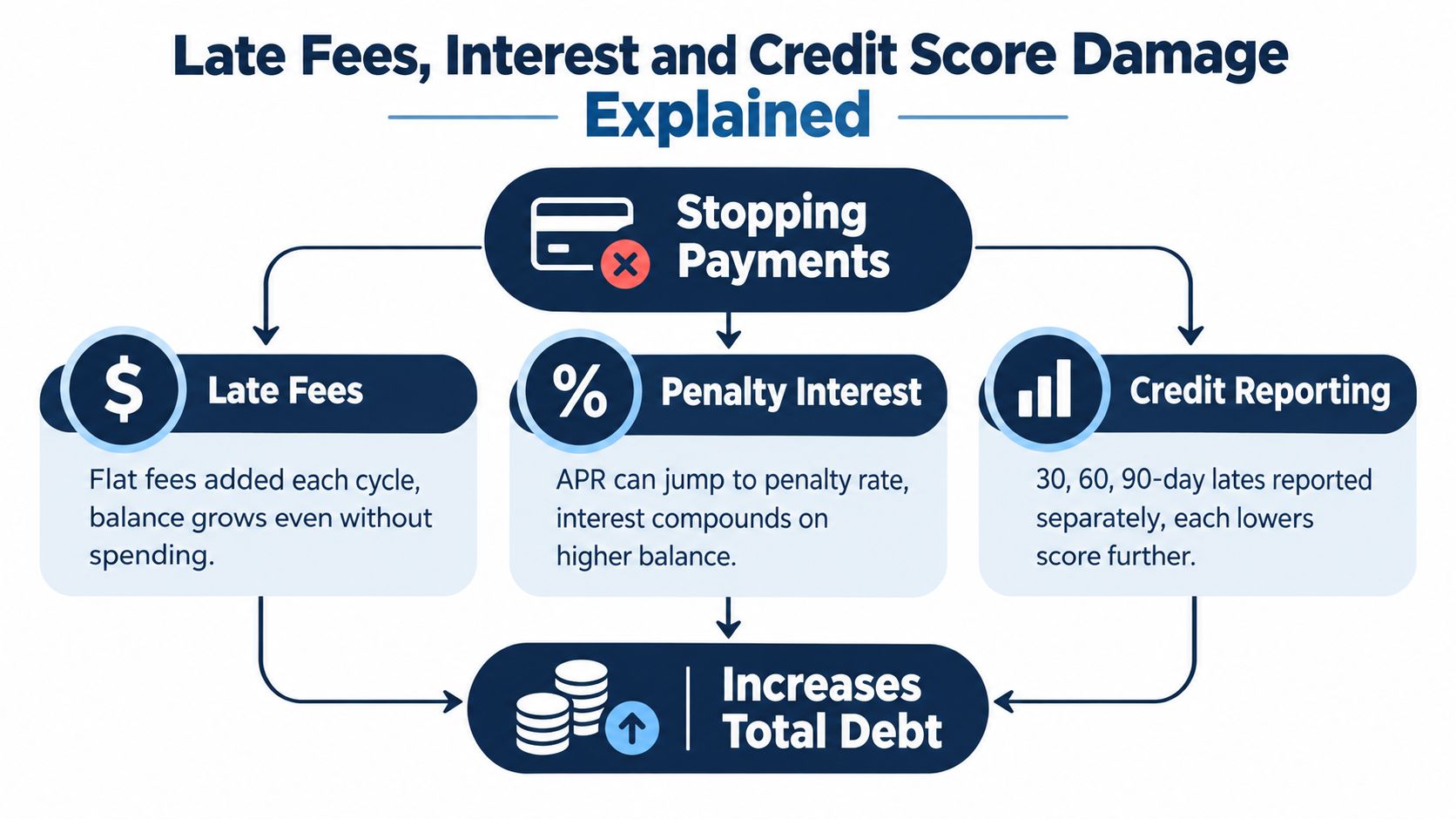
The easiest way to understand default is to treat it like a timeline, not a single event. An account can slide from early delinquency into default over several billing cycles, and each point on that path changes what the issuer is trying to do.
The usual sequence
A common path looks like this:
- About 30 days late. The missed payment may start showing up in credit reporting, and the issuer is often still trying to pull the account back into normal status.
- Around 60 to 90 days late. The account is aging deeper into delinquency. Calls, notices, or hardship discussions may become more urgent.
- Around 120 to 180 days late. Many issuers move seriously delinquent accounts toward charge-off, often after several missed billing cycles.
- After charge-off. Collection can continue through the original issuer, an outside agency, or a debt buyer.
That sequence is the backbone. The meaning of each stage is what matters.
What each stage usually means
At the 30-day stage, the account is damaged, but it is still in the early part of the process. In plain terms, the lender is often asking, "Can this account be saved?" That is why this is often the best window for hardship requests, payment arrangements, or other ways to stop the slide.
By 60 to 90 days late, the account starts looking less like a temporary slip and more like a pattern. Issuers may tighten account access, step up collection contact, or move the file to a different internal team. From the borrower's side, this is often the point where the problem feels more real because the account is no longer being treated as a small delay.
Then comes charge-off, usually after months of nonpayment. Charge-off is an accounting decision. The lender moves the account into a loss category on its books. The debt usually still exists.
A short version helps: charge-off changes how the lender records the account, not whether collection can continue.
Why timing matters more than many people expect
The same unpaid balance can be handled differently depending on its age. Early on, an issuer may still prefer a cure. Later, the focus often shifts to recovery.
That shift matters more in the current market cycle. Card delinquency and serious delinquency rates rose during 2024 and remained a concern heading into 2025 and 2026, which means many issuers are watching unpaid accounts closely and adjusting how quickly they intervene. In a softer consumer credit environment, some lenders may push outreach harder in early delinquency, while others may move faster toward recovery channels once an account looks unlikely to catch up.
That does not mean every bank follows the same script. It means the broad direction has changed. As stress in card portfolios rises, account age can matter even more because issuer behavior is shaped by both your timeline and the wider credit market.
What can happen after charge-off
After charge-off, the account usually follows one of three paths:
- The original creditor keeps the debt and collects on it
- A collection agency works the account for the creditor
- The debt is sold to a debt buyer
Each path can lead to letters, calls, settlement offers, or, in some cases, a lawsuit.
The key point is simple. "Written off" does not usually mean "forgiven." It usually means the account has moved into a later stage of the collection timeline, where different players may now be involved.
Late Fees Interest and Credit Score Damage Explained
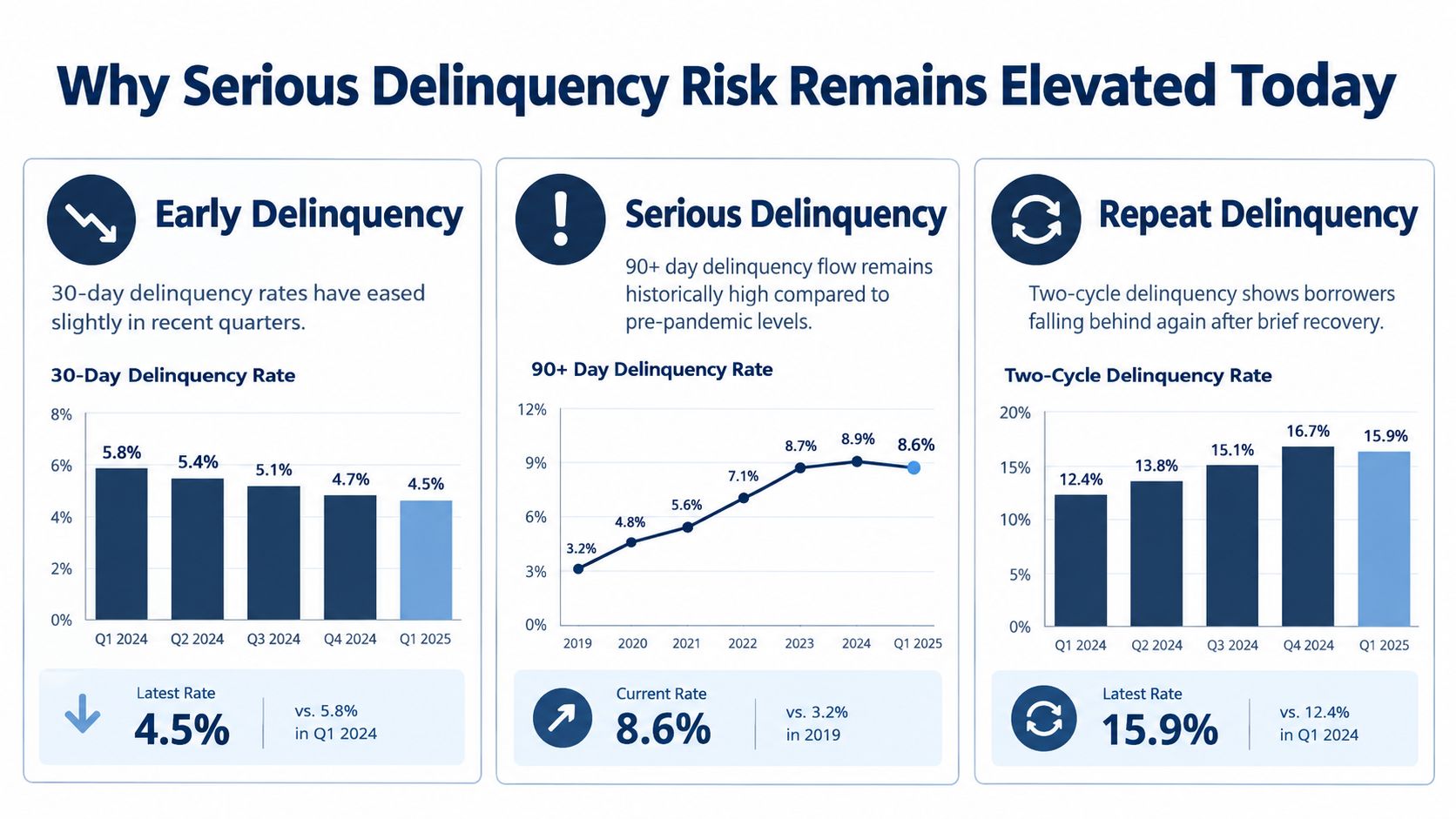
A missed credit card payment usually hurts in three lanes at the same time. The bill can grow. The credit report can get worse month by month. New borrowing can become harder because future lenders may see a pattern, not a one-time slip.
Why the balance often gets worse even without new spending
A common point of confusion is simple: if you stop using the card, why does the balance still rise?
Because the account meter usually keeps running. Late fees may be added. Interest can keep accruing on the unpaid amount. Some card agreements also allow a higher penalty APR after missed payments, which can make the balance climb faster.
The result feels a bit like missing a train and then finding out the station clock did not stop for you. Even if no new purchases hit the account, the old balance can keep getting more expensive.
A simple example shows the pattern. You miss one payment. Then you miss the next one. You buy nothing else. Your following statement can still be higher because the issuer added interest and fees to what was already there.
How credit reporting gets worse in steps
Credit reporting usually changes in stages, not all at once.
Once a payment is late enough to be reported, the account can move from current to 30 days late. If nothing brings it current, the reporting can later show 60 days late, then 90 days late, and beyond. Each step tells future lenders the problem lasted longer and became harder to fix.
That distinction matters. A high balance shows strain. A late-payment string shows strain plus missed obligations. For readers sorting out the difference, this guide on how much utilization affects a credit score explains how balance usage and payment history affect scores in different ways.
A card can be maxed out, late, or both. When both show up together, the account usually looks riskier to the next lender reviewing it.
Why 90-plus days late changes the picture
By the time an account reaches 90 days late, the issue is no longer just a missed due date. It starts to look more like a breakdown in the account relationship.
That helps explain why this stage gets so much attention from card issuers and credit scoring models. It signals that the borrower has not caught up after several billing cycles, and that often changes how the account is treated internally.
Recent credit card data show a split between early and late stages of trouble. The share of outstanding card balances that were at least 30 days past due was 2.85% in Q2 2026, while the share that was 90 or more days delinquent was 12.92%, according to LendingTree's summary of New York Fed credit card debt statistics. That gap matters.
It suggests a pattern many borrowers miss. Some accounts recover early. Others keep rolling down the timeline into the more serious buckets, where score damage is usually heavier and the path toward charge-off becomes more likely.
In other words, the stop-payment timeline is not just about being late once. It is about how long the account stays unresolved. That has become more important as card issuers watch delinquency trends from 2024 through 2026 and adjust how quickly they react to accounts that do not self-correct.
Why Serious Delinquency Risk Remains Elevated Today
Stopping payment on a card can feel quiet at first. A missed due date may look like a small slip. What often matters more is whether that slip turns into a pattern over the next few billing cycles.
What the recent pattern shows
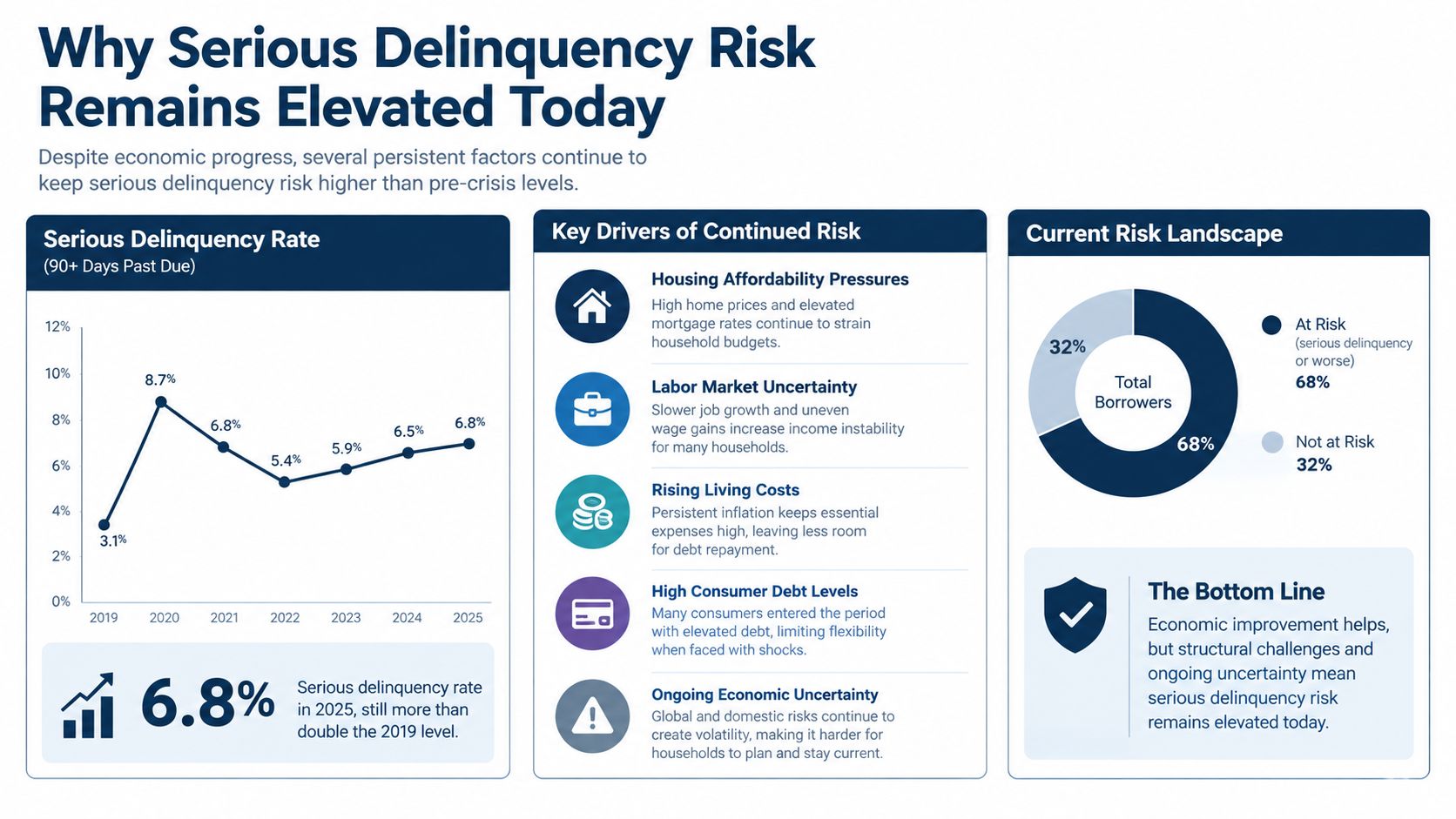
Recent card data suggest the later stages of trouble are still showing up at a high rate, even after some broader conditions cooled. The New York Fed reported that the flow of U.S. credit card balances into serious 90-plus-day delinquency reached 6.97% in Q2 2026, and a market summary of that release noted this was the 10th straight quarter above the level seen at the start of the Great Recession. It also cited FICO data showing two-cycle delinquency rising from 1.1% in January 2022 to 2.1% in January 2026, according to this market report on serious delinquency flow and repeat delinquency trends.
That combination matters.
A card account usually does not jump from current to charge-off overnight. It moves more like a car sliding downhill. First comes one missed payment. Then another. Then a point where catching up gets harder because the balance is growing while the account is falling further behind.
Why this part of the timeline deserves attention
Earlier sections covered what happens inside one account as it moves from 30 days late toward default. The broader market adds another layer. From 2024 through 2026, issuers have been watching not just first misses, but repeat misses and serious roll rates.
That changes behavior behind the scenes. If more accounts are reaching the 90-plus-day bucket, lenders have a reason to watch unresolved accounts more closely, even if early-stage delinquency is not rising at the same pace.
A brief catch-up can also give a false sense of safety. Some borrowers pay enough to steady the account for a month, then fall behind again. Repeated slips matter because they suggest the problem is no longer timing. It is affordability.
Serious delinquency usually grows out of several strained billing cycles, not one rough week.
What this means if you stop paying now
The practical point is simple. The risk does not end with the first late notice, and it does not stay fixed.
As an account moves down the stop-payment timeline, the borrower's room to negotiate often changes, and issuer behavior can change with it. In a period where serious delinquency has stayed high and repeat delinquency has risen, some creditors may be quicker to treat a missed-payment pattern as a likely default rather than a short-term hiccup.
That does not mean every unpaid card ends in the same place. It means waiting for things to sort themselves out is a weaker plan than many people assume. The pressure often builds later, after the account has had several chances to recover and did not.
Collections Charge Offs Lawsuits and What Changes by Market Cycle
After charge-off, the account usually stops behaving like a normal credit card relationship and starts behaving like a recovery file. Who contacts the borrower, how often they reach out, and whether the account is sued on can depend on the creditor, the balance, the state, and the broader market cycle.
What has changed recently
A useful wrinkle in the current environment is that conditions have shifted somewhat at the system level. The Consumer Financial Protection Bureau reported that credit card delinquencies and charge-offs peaked in early 2024 and then moved back toward pre-pandemic levels by year-end 2025, while Q3 to Q4 2025 showed only tiny quarter-to-quarter changes and third-party collections stayed near historic lows at about 4.6% to 4.9% of consumers, according to the CFPB consumer credit card market report for 2025.
That doesn't erase individual risk. It does suggest that some creditors and collectors may be operating in a softer environment than the most heated period before.
How contact behavior is changing
The pre-charge-off collection process has also changed in practice. The 2025 CARD Act reporting highlighted lower cure and liquidation rates, and all surveyed issuers capped daily calls per account at one to four calls, down from one to 11 in the prior report, while actual average attempts stayed around 1 to 2.8 per day, based on Orrick's summary of the 2025 Credit CARD Act Report.
That matters because many people picture nonstop ringing from dawn to dusk. In reality, collection pressure can still be stressful without matching the old stereotype. Lower call caps don't remove the problem. They just change how it shows up.
What happens after charge off by path
| Path After Charge Off | Who Contacts You | Typical Timing and Risk |
|---|---|---|
| Creditor keeps the account | The original issuer or its recovery department | Contact may continue after charge-off. Settlement options may exist, but policies vary. |
| Account placed with a collection agency | A third-party collector working for the creditor | Communication may become more formal. The collector seeks payment, but ownership stays with the creditor. |
| Debt sold to a buyer | A debt buyer or the law firm it hires | Collection can restart with a new company. In some cases, this path can lead to a lawsuit if the debt remains unpaid. |
For readers who want a more detailed look at legal exposure, this guide explains whether a debt collector can sue.
A key takeaway is that negotiating power shifts over time. Before charge-off, lenders may focus on curing the account. After charge-off, the conversation may shift toward settlement, recovery, or legal action. The exact path often depends less on one universal rule and more on who owns the account and how that company is handling distressed debt at that moment.
Practical Steps to Limit Damage After You Stop Paying
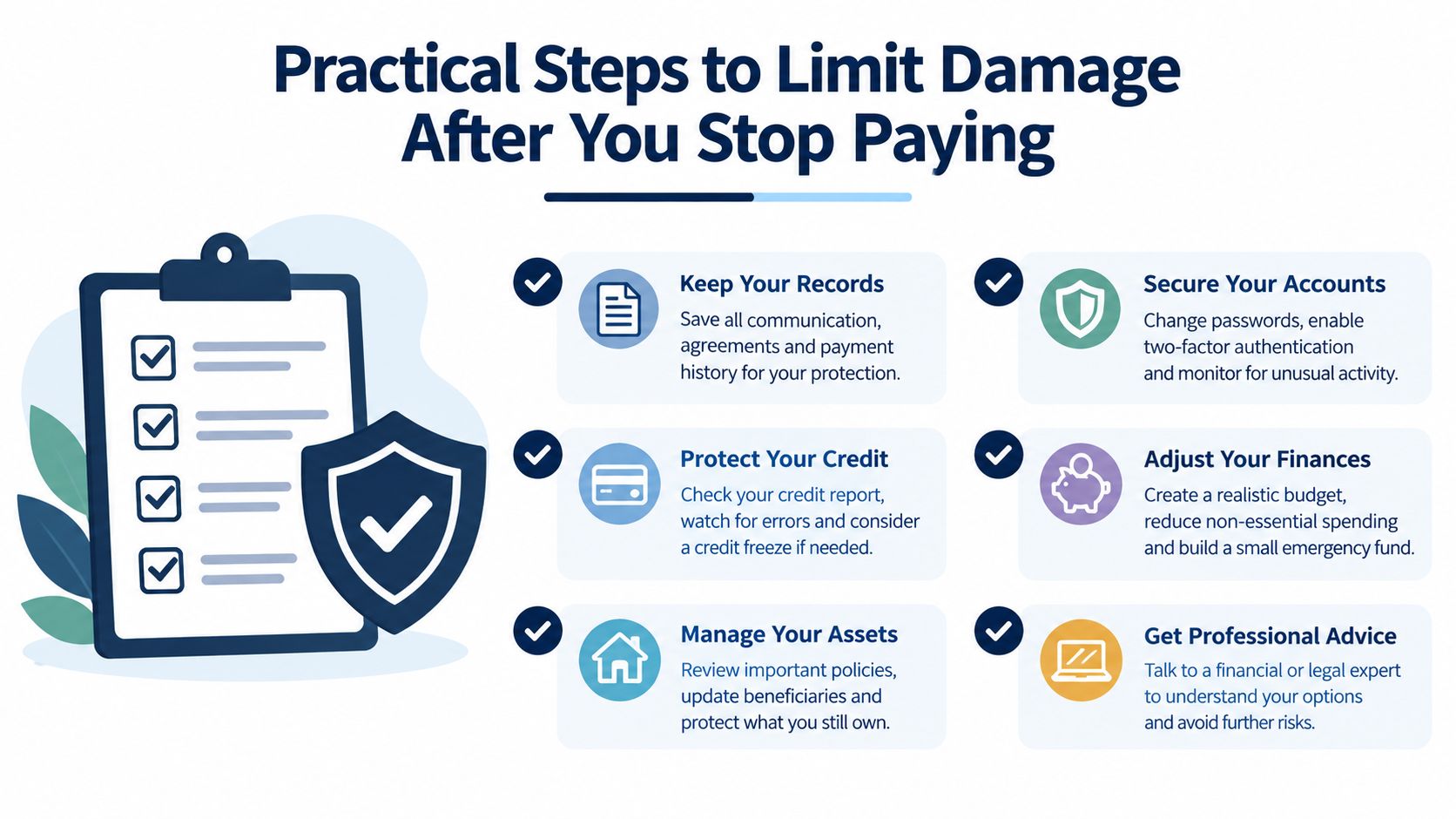
The most useful moves are usually the least dramatic ones. Good notes, quick calls, and clear priorities often preserve more options than silence does.
First priorities in the first weeks
A person who has stopped paying or is about to stop paying usually needs an order of operations.
- Protect essentials first. Housing, utilities, food, medicine, and work transportation usually come before unsecured credit card debt when money is short.
- Call the issuer early. Ask whether a hardship program, reduced payment, or temporary accommodation is available. Those options are often easier to discuss before the account gets deeper into delinquency.
- Stop adding new charges. Continued use can make the balance harder to manage and may complicate later relief choices.
- Document everything. Keep notes of dates, names, and what each representative said.
What to do once the account is already behind
Once the account has slipped, the goal changes from prevention to damage control.
A borrower can review statements, save letters, and watch for status changes such as account closure, recovery transfer, or charge-off. Credit reports should also be checked for accuracy. If something is reported incorrectly, that's worth disputing.
Keep a simple log with the date, company name, phone number, and summary of each contact. That record can become useful if the account is sold or escalates.
People should also pay attention to communication patterns. As noted earlier, issuers now often limit daily call attempts, but contact can still feel intense. Knowing that some issuers cap daily calls can help people prepare without assuming every ring means a lawsuit is imminent.
What usually makes things worse
Some choices reduce flexibility.
- Ignoring mail: Important notices often arrive by letter, not just by phone.
- Paying randomly without a plan: Small, irregular payments can sometimes delay decisions without solving the problem.
- Using another card to cover basics without a budget change: This can move distress from one account to several.
- Assuming charge-off ends the matter: It usually doesn't.
A nonprofit credit counselor may help when someone still has some ability to repay but needs structure. Legal advice may make sense when court papers arrive, when a collector's claims seem questionable, or when state-specific rights need review.
Choosing Relief Options and Planning Your Next Move
By the time someone is researching what happens when you stop paying credit cards, the question usually isn't just “what happens next.” It's “which path causes the least damage from here.”
A practical decision frame
The options usually fall into a few buckets.
Staying current works best when the hardship is temporary and the budget can recover quickly.
Hardship programs may help if the issuer is willing to reduce pressure before the account gets too far behind.
Debt management through nonprofit counseling can fit people who have income but need lower rates and one organized payment.
Settlement may become part of the conversation when full repayment isn't realistic. It carries tradeoffs, including credit damage and uncertainty because creditor participation is discretionary. This overview of the pros and cons of debt settlement can help frame that choice.
Bankruptcy may be appropriate when unsecured debt is overwhelming and there's no credible path to catch up.
Matching the option to the problem
A short-term cash crunch and a long-term insolvency problem aren't the same. Someone who can resume payments soon may need a bridge. Someone who can't cover minimums across multiple cards may need a formal relief strategy instead of repeated short-term fixes.
Tools can help make that difference visible. Debt Help U offers no-login calculators and guides that let consumers estimate minimum-payment payoff time, model extra payments, compare snowball versus avalanche planning, check debt-to-income context, and review relief options privately in the browser before deciding whether to seek outside help.
One area where people often get tripped up
Debt after death is one of the most misunderstood parts of credit card liability. The answer depends on the state and on whether the person was a joint account holder or an authorized user. It's especially important to be careful in the nine community property states.
The CFPB says debt usually isn't owed by survivors, but responsibility can shift if the survivor is a co-signer, a joint credit-card account holder, or a spouse covered by state law. It also says an authorized user is different from a joint account holder and isn't the same as being liable for the debt, according to the CFPB's explanation of debt after death. For credit cards specifically, the CFPB also states that a joint account holder may still share responsibility with the estate, while an authorized user is not responsible for the debt, as explained in the CFPB resource for families dealing with debt collectors after a death.
The simplest next move is usually to identify which stage the account is in right now, then choose a response that matches that stage rather than reacting to the worst-case outcome first.
Debt Help U provides plain-language guides, private no-login calculators, and side-by-side explanations of repayment, settlement, and bankruptcy so people can see the timeline and tradeoffs before making a move. For anyone weighing whether to keep paying, seek hardship help, or compare formal relief paths, Debt Help U is a practical place to start.
Related guides
- Debt settlement vs. consolidation vs. bankruptcy Four paths out of unmanageable debt, what each one costs, and what each one breaks. Real numbers on a $30,000 balance, not a pitch for any of them.
- How long will it take to pay off my credit card debt? Your minimum payment shrinks every month. Following it down is what turns a five-year balance into a thirty-five-year one.
- Debt snowball vs. avalanche: which one finishes faster Avalanche always pays less interest. The gap is smaller than the argument about it suggests. Run both on your own balances and see what it is worth.