Chapter 13 Payment Plan Explained with Examples
Bills are stacked on the table. A credit card is behind. A car payment is current, but only barely. Tax debt may be mixed in with medical balances or old collection accounts. In that kind of moment, many people search for one simple answer: what does a Chapter 13 payment plan look like month by month?
Chapter 13 is often easier to understand when it's treated like a court-supervised household budget, not like a new loan. The person filing proposes a plan, sends one regular payment to a trustee, and the trustee sends money out according to legal rules. That sounds simple at first. The confusion starts when people ask what sets the payment amount, which debts must be paid first, and how long the plan really lasts.
A lot of readers reach this point after comparing bankruptcy chapters and trying to decide whether repayment or liquidation fits better. A side-by-side overview like this explanation of bankruptcy chapter differences can help place Chapter 13 in context before looking at the payment mechanics.
Table of Contents
- Introduction to Chapter 13 Payment Plans
- How a Chapter 13 Plan Is Structured
- How Your Monthly Payment Is Calculated
- How Long Plans Last and How the Trustee Handles Payments
- Modifications Hardship Options and What Happens If You Miss Payments
- Real World Examples of Chapter 13 Payment Schedules
- Key Takeaways and Next Steps for Your Repayment Path
Introduction to Chapter 13 Payment Plans
A Chapter 13 case usually starts with a problem that isn't just about total debt. It's about cash flow.
A household may have enough income to pay something each month, but not enough to catch up on everything at once. That's where Chapter 13 can become relevant. Instead of every creditor pulling in a different direction, the court process creates one structured plan.
A simple way to think about the plan
The easiest analogy is a kitchen table budget with a referee.
The filer writes out income, living expenses, and debts. Then the court reviews whether the proposed budget follows the law. If it does, the plan becomes the rulebook for how monthly payments are handled.
That's why a Chapter 13 payment plan isn't a private arrangement with a credit card company. It's a formal case with oversight.
Practical rule: In Chapter 13, the important question usually isn't “How much debt exists?” It's “What can the budget support every month under court rules?”
Why the details matter early
Many people assume the payment starts after everything is approved. That's not how Chapter 13 works. Payment obligations begin early, and the structure of the plan affects whether the case stays on track.
Confusion also comes from the fact that not every debt gets treated the same way. Some debts sit near the front of the line. Others wait and share what remains. That order changes the size of the monthly payment and the length of the case.
A clear explanation matters because completing a Chapter 13 plan is not guaranteed. Of the 192,616 chapter 13 consumer cases closed by dismissal or plan completion in 2021, 81,120 were dismissed, while 111,496 (58 percent) ended with the debtor receiving a discharge after completing the repayment plan. Failure to make plan payments was cited in 59 percent of those dismissals (2021 federal court bankruptcy reporting on chapter 13 case outcomes).
How a Chapter 13 Plan Is Structured
A Chapter 13 plan works like one paycheck being split into labeled envelopes. The difference is that the envelopes are controlled by bankruptcy law.
One payment goes in and several categories come out
The filer usually sends one plan payment to the Chapter 13 trustee. The trustee then distributes money according to the confirmed plan.
The main categories are easier to understand when treated as buckets:
- Secured claims: These are debts tied to property. If the plan deals with keeping a car or curing certain arrears, those claims may receive payment ahead of general unsecured debt.
- Priority claims: These commonly include debts that bankruptcy law gives special treatment. Many taxes fall into this group and are commonly paid in full through the plan.
- Administrative claims: These are case-related amounts allowed under the process.
- General unsecured claims: Credit cards, medical bills, and similar debts often sit here and may receive whatever remains on a pro rata basis after higher-ranked claims are addressed.
Why court approval matters
A proposed plan isn't final just because it's filed.
The court has to confirm it. Until that happens, the plan is a proposal under review. The written plan matters because it tells the trustee who gets paid, in what order, and under what terms. It also tells creditors how the filer plans to deal with arrears, priority obligations, and unsecured balances.
The written plan is the map. The trustee follows that map only after the court approves it.
The payment waterfall in plain language
This is the basic flow:
- Income is reviewed to see what the budget can support.
- A plan is proposed that groups debts by legal priority.
- Payments begin while the case moves toward confirmation.
- The trustee distributes funds once the plan is confirmed.
- Lower-priority creditors share what's left after higher-priority amounts are handled.
The reason this structure feels different from ordinary debt repayment is that the filer doesn't choose freely which bill gets paid first. Bankruptcy law sets much of the order. According to Chapter 13 bankruptcy basics from the U.S. Courts, a confirmed plan must satisfy the Chapter 7 liquidation test for unsecured creditors and, for many debtors, the disposable-income test over the applicable commitment period. The same source explains that unsecured claims are often paid pro rata after secured, priority, and administrative claims, and that many priority claims such as taxes are commonly paid in full through the plan.
How Your Monthly Payment Is Calculated
The monthly payment starts with a budget, but it doesn't end there. A Chapter 13 payment plan is shaped by both math and legal minimums.
The basic formula
In simple terms, the starting point is:
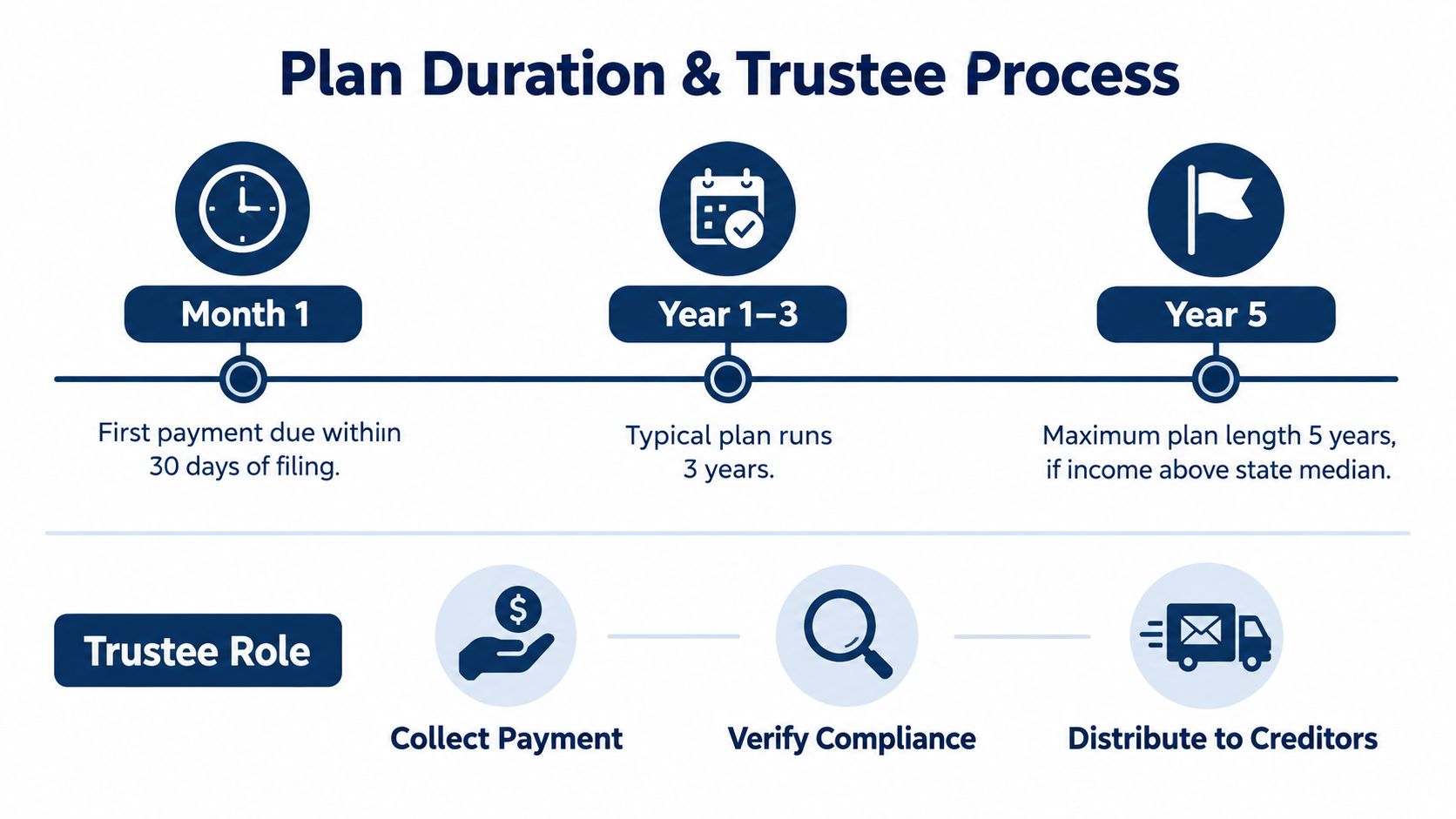
income minus allowed expenses = disposable income
That number matters because it shows what may be available for plan payments after necessary living costs are accounted for. Wages, self-employment income, and benefits can all affect the top line. Housing, food, medical costs, taxes, and other allowed expenses affect the bottom line.
But the monthly payment isn't always just whatever disposable income says.
Two legal floors shape the result
A workable estimate usually has to account for at least these two floors:
- Disposable-income floor: For many filers, the plan must commit disposable income over the required period.
- Liquidation floor: Unsecured creditors generally must receive at least what they would have received if non-exempt assets had been liquidated in a Chapter 7 case.
That's why two households with similar credit card balances can end up with very different Chapter 13 payments. One household may have more disposable income. Another may have assets that raise the liquidation floor.
Priority claims change the picture fast
Many readers get tripped up here. They assume all debts share the same monthly payment evenly.
That's not how the waterfall works.
If the case includes priority claims, such as many taxes, those claims commonly need to be paid in full through the plan. Secured and administrative claims also affect what's left over. Only after those pieces are handled does the remaining pool move to unsecured creditors on a pro rata basis.
A simple example helps. If two people each have the same unsecured debt, but one person also has priority tax debt, that second person may need a larger plan payment or a longer plan term because more of each month's payment is spoken for before unsecured creditors see anything.
A Chapter 13 budget doesn't ask only, “What can this household pay?” It also asks, “What must this household pay first?”
A practical way to estimate the payment
A rough planning process often looks like this:
- List all income sources and check whether they're stable.
- List realistic allowed expenses instead of wishful numbers.
- Separate debts by category because priority, secured, and unsecured claims aren't treated alike.
- Check the legal floors that may increase the minimum payment.
- Test affordability against the actual monthly budget.
For people trying to estimate disposable income and possible plan length before speaking with counsel, a tool such as the Chapter 13 means test calculator can help organize the inputs. It's still only a planning aid. The confirmed number comes from the case itself and the court-approved plan.
How Long Plans Last and How the Trustee Handles Payments
The question many ask next is simple. How long does this go on?
For most filers, the short answer is years, not months.
The usual range
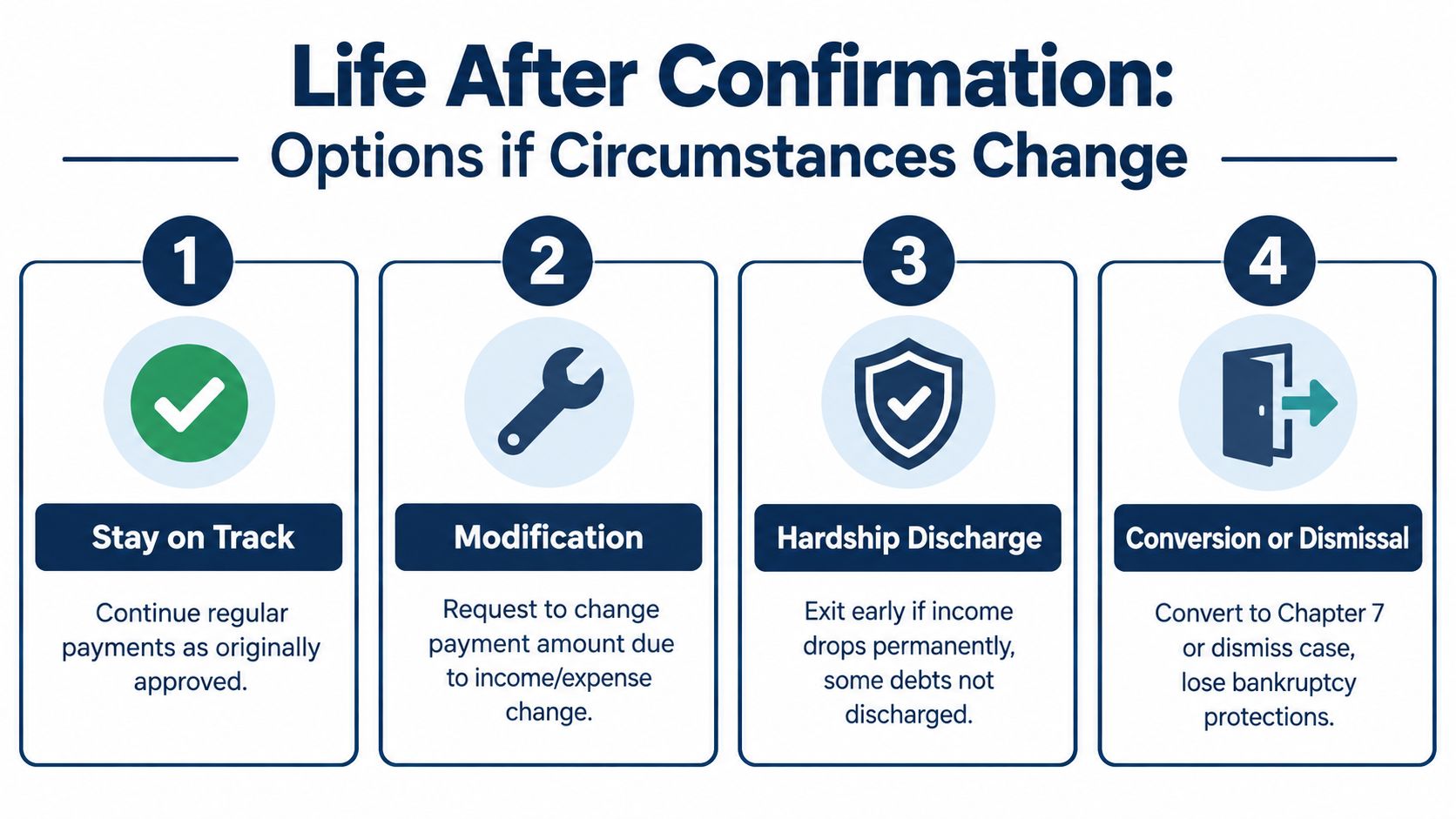
Chapter 13 plans are commonly structured to last three to five years. Federal court reporting also shows how long these cases can remain open in practice. In 2024, there were 194,055 chapter 13 consumer cases closed, with a mean time from filing to closing of 1,173 days and a median of 1,274 days. The same report warns that these closing times are only proxies because cases that end through plan completion usually take much longer than cases dismissed earlier, which reinforces that the repayment timeline often stretches over multiple years (2024 federal court bankruptcy reporting).
Payments begin early
Many people expect a waiting period before money has to start moving. Chapter 13 doesn't work that way.
Under the bankruptcy code, plan payments generally must begin within 30 days after filing. Once the court confirms the plan, the trustee distributes those payments according to the plan. If the plan isn't confirmed, the trustee returns the payments after deducting allowed administrative expenses under the Chapter 13 provisions in the U.S. Code.
That timing creates real pressure at the start of the case. A plan may still be under review, but the cash-flow discipline begins almost immediately.
What the trustee actually does
The trustee is often misunderstood. The trustee isn't just holding a mailbox open for payments.
The trustee generally handles several operational tasks:
- Collects plan payments: The filer sends the regular payment to the trustee.
- Reviews compliance: Income records, tax returns, and case requirements may be checked.
- Distributes money: After confirmation, the trustee sends funds according to the plan's ranking and terms.
- Returns certain funds if confirmation fails: That return is subject to allowed administrative deductions.
Missing early payments can create trouble before the case even reaches a stable routine.
Why plan length differs from household to household
The same debt amount doesn't produce the same timeline for everyone.
Plan length is shaped by income, debt structure, and the legal tests that apply. Some households can fit the required payment into a shorter window. Others need a longer commitment because priority claims, arrears, or disposable-income requirements stretch the schedule.
The practical takeaway is that a Chapter 13 payment plan is less like a one-time settlement and more like a long-distance budget the court supervises over time.
Modifications Hardship Options and What Happens If You Miss Payments
A confirmed plan isn't frozen in real life. Jobs change. Hours get cut. Cars break down. Medical costs rise.
The problem isn't that budgets change. The problem is waiting too long to respond.
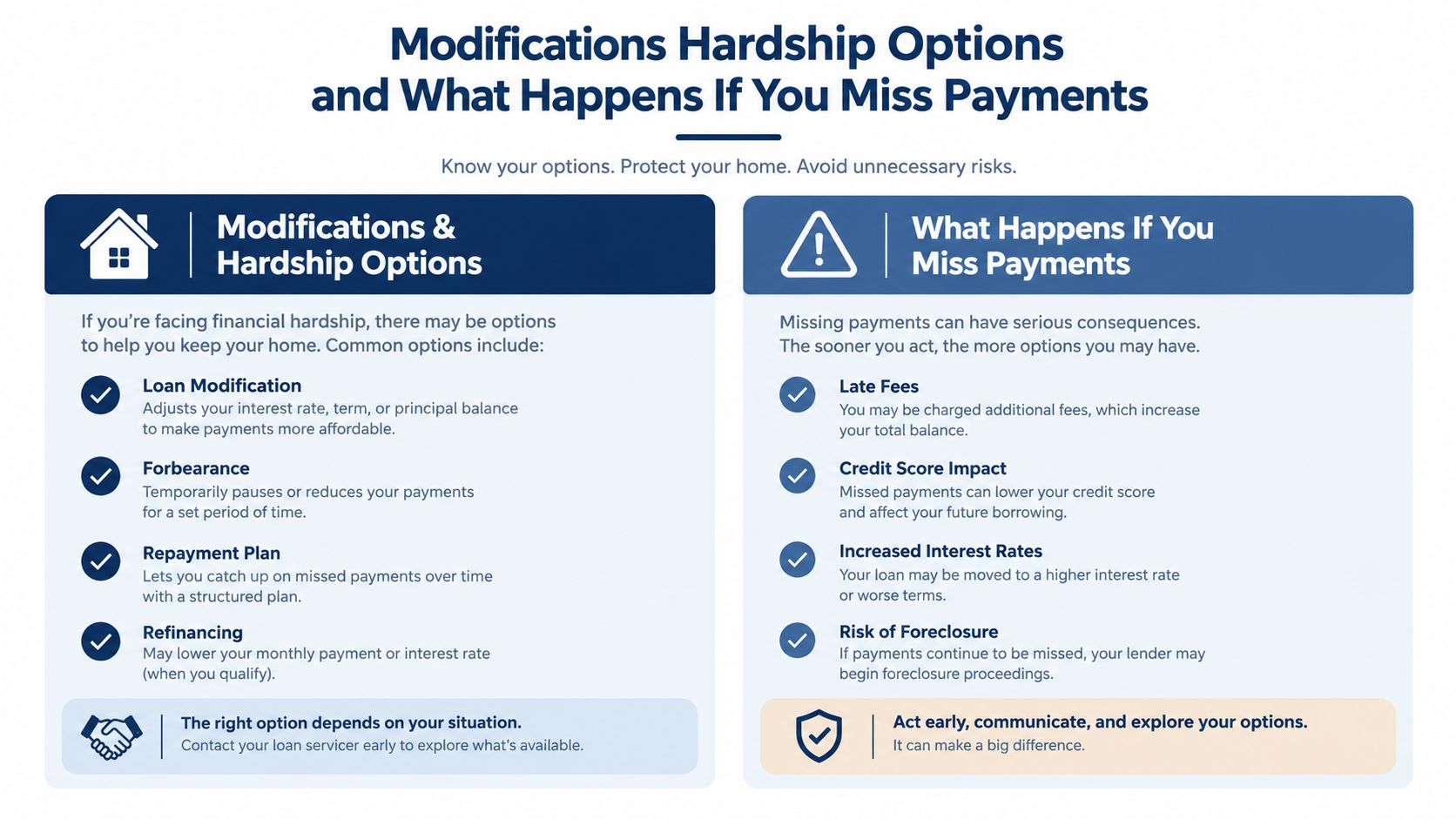
Four common paths when circumstances shift
A filer who runs into trouble usually faces one of several paths rather than one universal outcome.
| Situation | What it usually means |
|---|---|
| Stay on track | Payments continue under the confirmed plan if income and expenses remain workable |
| Modification | The filer may ask to change plan terms when income or necessary expenses change |
| Hardship relief | In limited situations, early relief may be sought if the setback is serious and lasting |
| Conversion or dismissal | The case may shift to another chapter or end, which can also change the protections the filer has |
Missing early payments is especially risky
The first stretch of a case is fragile because payment duties start before confirmation. If those first payments are missed, confirmation can be delayed or the case can lose momentum quickly.
That's one reason communication matters. If income drops, documents usually become important fast. Pay stubs, medical bills, repair invoices, and proof of job loss often help show whether the budget changed in a way that supports a revised plan.
Decision point: If the household can't make the next payment as proposed, it's time to talk with bankruptcy counsel promptly instead of hoping the problem resolves on its own.
Realism matters
Chapter 13 can work, but it isn't automatic. The earlier completion figures already mentioned show why a realistic budget matters at the start.
Sometimes the right move is to pursue a plan modification. Sometimes the numbers show the case no longer fits the household. Wage pressure can also overlap with collection concerns outside bankruptcy, which is why some readers compare Chapter 13 with tools like guidance on when a creditor can garnish wages when they're weighing options.
The key is to treat missed payments as a legal problem, not just a budgeting problem.
Real World Examples of Chapter 13 Payment Schedules
A Chapter 13 plan works like a court-supervised household budget. You send in one monthly payment. The trustee then pours that payment into different buckets in a set order.
That order matters.
Two households can owe the same amount of credit card debt and still have very different results because taxes, car arrears, attorney fees, and trustee fees may take the first dollars each month. The examples below are hypothetical only. They show how the payment waterfall can work in plain numbers.
Example A with a shorter plan feel
Household A has steady income and $1,900 a month in disposable income after allowed living expenses. The plan lasts 36 months.
Debts paid through the plan include:
- $3,600 in attorney fees
- $9,600 in priority tax debt
- $10,800 in mortgage arrears
- $18,000 in general unsecured debt such as credit cards and medical bills
The household pays $1,900 each month to the trustee.
Example B with a longer plan feel
Household B has more disposable income, but also more debt that must be paid ahead of unsecured creditors. The plan lasts 60 months and the monthly payment is $2,600.
Debts paid through the plan include:
- $4,800 in attorney fees
- $18,000 in priority tax debt
- $36,000 in car and mortgage arrears
- $40,000 in general unsecured debt
The household pays $2,600 each month to the trustee.
Example Chapter 13 Payment Waterfall
| Payment Component | Example A 3 Year Plan | Example B 5 Year Plan |
|---|---|---|
| Monthly plan payment | $1,900 | $2,600 |
| Attorney fees through plan | $300 per month for first 12 months | $250 per month for first 19 months, then $50 in month 20 |
| Priority tax claim | $800 per month for first 12 months | $300 per month for 60 months |
| Secured arrears | $600 per month for 18 months | $600 per month for 60 months |
| General unsecured claims | $200 per month for first 12 months, then $500 per month for months 13 to 18, then $1,300 per month for months 19 to 36 | $1,450 per month for first 19 months, $1,650 in month 20, then $1,700 per month for months 21 to 60 |
| Overall schedule effect | Early plan dollars are tied up by taxes and arrears. Unsecured creditors get more only after some higher-ranked claims finish. | The payment is larger, but higher-ranked claims stay in the picture much longer, so the unsecured pool grows more slowly over time. |
Month by month walkthrough for Example A
Here is what the first part of Example A can look like if the plan follows the schedule above.
Months 1 through 12
Each month, the trustee receives $1,900.
The plan sends:
- $300 to attorney fees
- $800 to priority taxes
- $600 to mortgage arrears
- $200 to general unsecured creditors
That means the first year looks like this:
- Attorney fees paid after 12 months: $3,600
- Priority taxes paid after 12 months: $9,600
- Mortgage arrears paid after 12 months: $7,200
- General unsecured creditors paid after 12 months: $2,400
At that point, the attorney fee balance and tax balance are fully paid under this example. The mortgage arrears still have $3,600 left.
Months 13 through 18
The same $1,900 comes in each month, but the buckets change because two earlier claims are done.
Now the plan sends:
- $600 to mortgage arrears
- $1,300 to general unsecured creditors
Over these 6 months:
- Mortgage arrears receive $3,600
- General unsecured creditors receive $7,800
The mortgage arrears are now fully caught up.
Months 19 through 36
The higher-ranked claims in this example are finished, so the remaining monthly payment can go to unsecured creditors.
Now the full $1,900 payment can be used for that remaining pool, subject to plan terms and trustee administration in a real case. For this simplified example, that leaves $1,900 per month available, and we show $1,300 per month going to unsecured creditors to keep the total example aligned with the debt amounts listed above.
Over 18 months, unsecured creditors receive another $23,400 under this illustration.
What these examples show
Example A and Example B show why the monthly payment alone does not explain the case.
A larger payment does not automatically mean credit card creditors get much more each month. In Example B, more money is coming in, but taxes and secured arrears keep absorbing a large share for a much longer stretch.
The useful question is narrower. Out of each monthly payment, how much goes first to priority claims, how much cures arrears, and how much is left for unsecured creditors after that? Once you see the plan as a waterfall instead of one lump sum, the schedule becomes easier to read.
Key Takeaways and Next Steps for Your Repayment Path
A Chapter 13 payment plan makes the most sense when it's treated as a disciplined long-term budget under court supervision.
The key checkpoints are straightforward. First, estimate disposable income. Second, understand that debt category matters because priority, secured, and unsecured claims don't sit in the same place in line. Third, expect trustee oversight and plan for payment discipline from the beginning of the case, not after confirmation.
Questions worth checking before filing
- Is the monthly budget real: A plan only works if regular living costs are listed.
- Does the debt mix change the payment waterfall: Taxes, arrears, and other higher-ranked claims can reshape the whole plan.
- Can the household handle a multi-year commitment: Chapter 13 is usually a long process, not a short reset.
Some households also compare bankruptcy with other forms of debt relief, including consolidation or settlement, before deciding. Debt Help U publishes calculators and plain-language comparisons for unsecured debt options, including bankruptcy context, which can help organize that decision without replacing legal advice.
A related confusion that matters
Debt questions often overlap. One common misunderstanding involves debts after someone dies.
There isn't one national rule for that. Debt-after-death rules vary by state, especially in the nine community property states. The answer depends on the state and on whether the survivor was a joint account holder or merely an authorized user. The CFPB explains that living in a community property state can make a surviving spouse responsible for certain debts created during the marriage (CFPB guidance on spouse debt after death), and Experian identifies those states as Arizona, California, Idaho, Louisiana, Nevada, New Mexico, Texas, Washington, and Wisconsin, with Alaska counting only where spouses choose to make their property community. Separate CFPB guidance also explains that survivors generally don't have to pay a deceased relative's debt unless they were a co-signer, joint account holder, or a spouse made liable by state law, and it distinguishes a joint account holder from an authorized user (CFPB guidance for survivors and debt collectors). Independent consumer guidance confirms the same practical difference between joint account holders and authorized users (Experian explanation of spouse credit card use after death).
For Chapter 13, the practical next step is usually to gather pay information, recurring expenses, and a list of debts by category. From there, bankruptcy counsel can test whether the proposed payment is feasible and whether Chapter 13 fits better than the available alternatives.
Debt Help U offers free calculators, guides, and side-by-side explanations that help consumers estimate debt timelines and compare options such as consolidation, settlement, and bankruptcy. For someone trying to understand whether a Chapter 13 budget is realistic before taking the next step, Debt Help U can be a useful starting point for organizing the numbers and narrowing the questions to bring to legal counsel.
Related guides
- Chapter 7 vs. Chapter 13 bankruptcy: which one applies to you One wipes qualifying debt in a few months. The other reorganizes it over three to five years. Your income and what you own decide which is even available.
- Debt settlement vs. consolidation vs. bankruptcy Four paths out of unmanageable debt, what each one costs, and what each one breaks. Real numbers on a $30,000 balance, not a pitch for any of them.
- How long will it take to pay off my credit card debt? Your minimum payment shrinks every month. Following it down is what turns a five-year balance into a thirty-five-year one.