Credit Card Debt Consolidation Reddit: A 2026 Guide
Reddit can surface the right questions about credit card debt consolidation. It can't answer them safely on its own. Anonymous posts often mix real experience with outdated card terms, missing disclosures, referral pitches, and advice that may not fit a borrower's state, budget, or credit profile.
That matters more now because revolving balances are large and still rising. The CFPB reported that consumer credit card debt at the end of 2022 surpassed $1 trillion for the first time in its data, and later market data shows balances reaching about $1.26 trillion in Q2 2026 and an all-time high of $1.28 trillion in Q4 2025 in the historical series summarized in this Reddit discussion citing CFPB and Fed-linked data. Reddit threads reflect that pressure, but they don't replace disclosures, creditor rules, or legal advice.
This guide treats credit card debt consolidation Reddit discussions as a source of warning signs, recurring questions, and lived experience. Then it compares those themes with nonprofit counseling, debt management plans, consolidation loans, and educational tools that show costs and timelines before a person hands over personal details.
One rule needs to stay firm from the start. Debt after death doesn't have one national answer. The answer depends on the state, especially in the nine community property states, and on whether the survivor was a joint account holder or only an authorized user. The CFPB says liability typically depends on account status and state law, and it identifies Alaska (only with a special agreement), Arizona, California, Idaho, Louisiana, Nevada, New Mexico, Texas, Washington, and Wisconsin in its guidance on a spouse's debts after death.
Table of Contents
- 1. Debt Help U
- 2. Money Management International
- 3. GreenPath Financial Wellness
- 4. InCharge Debt Solutions
- 5. American Consumer Credit Counseling
- 6. Discover Personal Loans
- 7. SoFi
- 8. LightStream by Truist
- 9. Happy Money Payoff Loan
- 10. PenFed Credit Union
- Reddit-Discussed Credit Card Debt Consolidation: Top 10 Comparison
- Turn Reddit Research Into a Safer Decision
1. Debt Help U
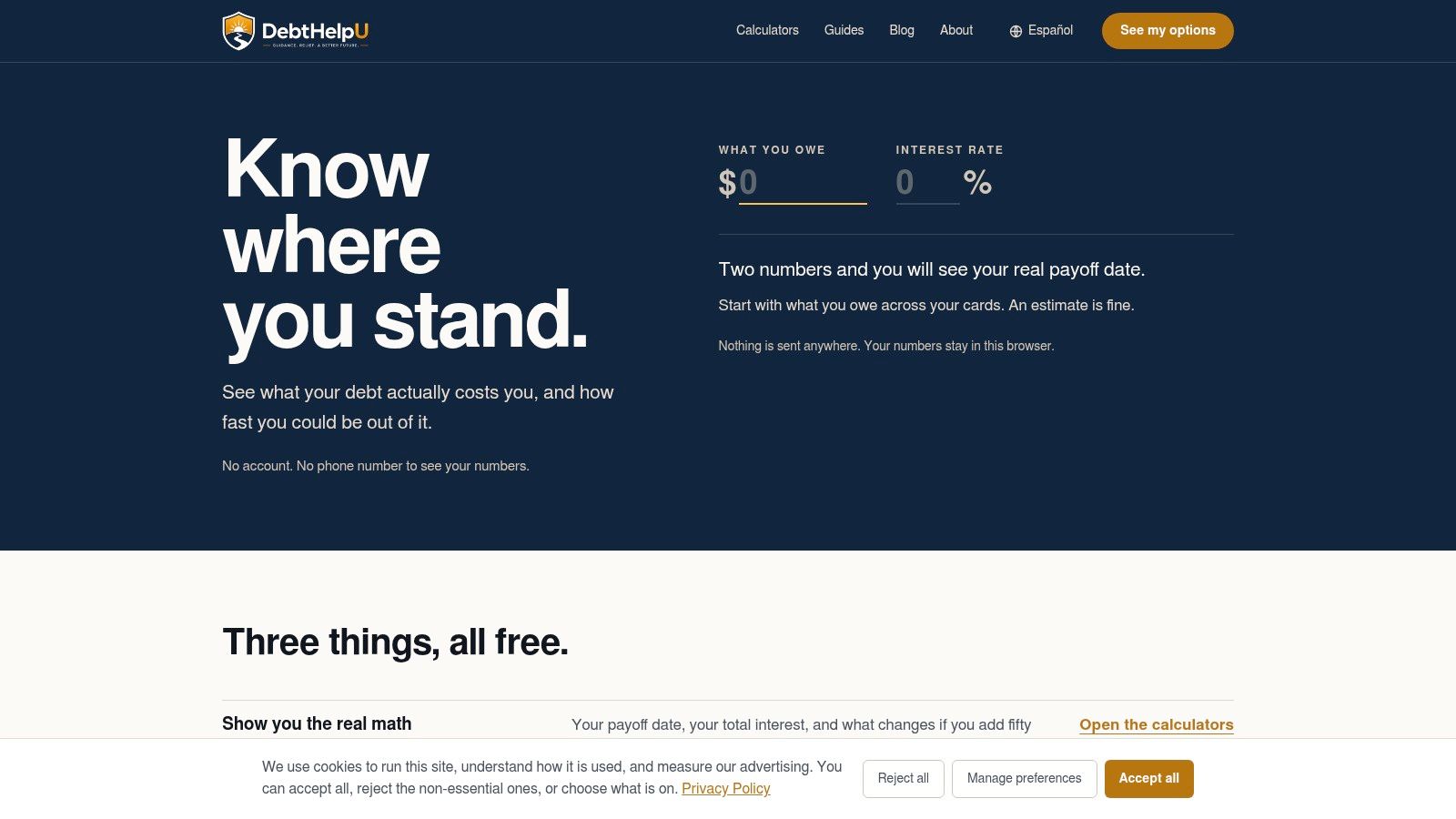
Reddit users often ask the right first question and then get shaky answers. Before anyone compares a debt management plan with a personal loan or debt settlement, they usually need to know what their current cards are already set to cost them. Debt Help U is built around that earlier stage.
Its tools run in a browser and, based on the company's own description, do not require an account or phone number to start. That matters for readers who want estimates before they hand over contact details. In Reddit threads about consolidation, privacy concerns and unwanted sales calls come up almost as often as interest rates.
What Debt Help U actually does
Debt Help U is an educational and referral platform. It is not presented as a lender, debt collector, law firm, or debt negotiator. The site focuses on calculators, basic debt education, and a short assessment that sorts users toward possible options.
That narrower role is a strength for some people and a limitation for others.
A reader can use the tools to compare minimum-payment timelines, test the effect of adding a fixed monthly amount, and review plain-language explanations of consolidation, settlement, and bankruptcy. That makes the site more useful as a screening tool than as a final answer.
Practical rule: If a calculator shows only a lower monthly payment and not the total repayment time or estimated interest cost, it is leaving out part of the decision.
Where it may help, and where caution makes sense
Debt Help U fits the Reddit pattern of "I need to understand my options before I talk to anyone." Its English and Spanish content also broadens access for households that want basic debt information without starting with a sales call.
The trade-off is incentives. The company says its tools are free and that it earns referral compensation only when a user asks for an introduction to a partner program and appears to qualify. Readers should treat that disclosure as useful context, not a reason to dismiss the site outright. Referral-based businesses can still publish helpful tools, but the incentive should stay visible while you compare recommendations.
A few checks matter before acting on any result:
- Confirm whether the recommendation is education, a referral, or a firm offer from a provider.
- Check whether the option is available in your state.
- Ask which creditors participate if the suggested path is a debt management plan.
- Review fees before sharing detailed financial information.
- Keep privacy in mind if you decide to move from calculator use to a contact form.
- If family liability is part of the concern, verify debt-after-death rules under your state law rather than relying on forum comments.
Debt Help U works best as an optional first-pass research tool. The company information on the Debt Help U website can help readers frame better questions, but any actual debt solution still depends on provider disclosures, creditor participation, state availability, and, in some cases, legal or nonprofit counseling guidance.
2. Money Management International
Money Management International, usually called MMI, comes up often when Reddit users want a nonprofit alternative to for-profit debt relief. That distinction matters. A debt management plan isn't a new loan. It's a structured repayment program run through a counseling agency, with one monthly payment distributed to participating creditors.
MMI's appeal is its education-first posture. It offers counseling before enrollment and publishes fee information instead of making people dig through a sales funnel. For someone overwhelmed by several cards and rising minimums, that sequence is often safer than chasing a promotional offer first.
Where MMI fits
A debt management plan can work well when card issuers participate and the borrower wants structure. It can work poorly when a person needs open revolving credit, won't tolerate account closures, or expects every creditor to join automatically. MMI at least puts that tradeoff in plain view.
Reddit often treats “consolidation” as one thing. In practice, a debt management plan, a balance transfer, and a personal loan solve different problems.
Readers comparing a debt management plan with a consolidation loan can use this plain-language breakdown of debt consolidation vs. debt management before talking to any agency. MMI's own Money Management International debt management page is the direct provider page to review for current terms and state-specific details.
The main caution is operational, not ideological. Not every creditor participates, and accounts included in a plan are commonly closed. That can reduce available credit and affect utilization or account age even while the plan simplifies repayment.
3. GreenPath Financial Wellness

Reddit threads about credit card debt consolidation often surface a useful question before they surface a useful answer: does the person need a new loan, or a structured plan and a counselor who can review the whole budget? GreenPath Financial Wellness sits in that second category. It is a nonprofit that leads with counseling and education, then discusses debt management plans if the budget and creditor mix make that route realistic.
That distinction matters because Reddit anecdotes can blur very different forms of relief. A debt management plan is not the same as debt settlement, and it is not the same as a consolidation loan. The Consumer Financial Protection Bureau's research on the debt settlement market shows why borrowers compare categories so aggressively in the first place. Outcomes, timelines, and risks differ, especially once accounts are delinquent or charged off. GreenPath's role is less about validating a forum consensus and more about slowing the process down enough to sort those options clearly. The CFPB's report on debt settlement practices and outcomes provides broader context for that comparison.
Where GreenPath can be useful
GreenPath stands out for readers who want plain-language education before they agree to anything. Its materials explain how counseling works, what a debt management plan may change, and what it cannot guarantee. That makes it a practical checkpoint for someone whose Reddit research has produced more warnings than answers.
There are trade-offs. If a debt management plan is recommended, enrolled credit card accounts are often closed, and concessions still depend on creditor participation. GreenPath does not control which issuers join or what terms each creditor will accept.
Its public information is also more useful as a verification tool than as a promise. Readers can check whether services are available in their state, what kind of counseling is offered, how privacy is handled, and whether any referrals or affiliated services create incentives worth asking about. GreenPath's financial counseling page is the direct provider page for current program details, access, and disclosures.
For borrowers trying to separate crowd-sourced warnings from provider facts, that is the value here. Reddit can point to red flags. GreenPath can help test whether a debt management plan fits the debts, the creditors, and the household budget before someone commits.
4. InCharge Debt Solutions
InCharge Debt Solutions is built for readers who want specifics. Its public materials focus on counseling, debt management plans, and state-by-state fee disclosures, which is a practical contrast to vague “one payment” advertising common in this category.
That transparency matters because credit card debt consolidation Reddit posts often skip the mechanical details. A debt management plan may lower the effective interest burden and simplify payments, but inclusion is creditor-dependent and card use usually has to stop on enrolled accounts. Those aren't side notes. They shape whether the plan is workable.
Why detail matters here
InCharge publishes guidance on how the process works, what it costs, and how proposals go to creditors when a debt management plan appears appropriate. That can help borrowers compare a structured nonprofit program against the looser promise of “debt relief” more effectively than comment threads do.
- Clearer pricing context: The agency publishes fee ranges and state caps, which helps readers compare before a counseling call.
- Counseling first: The process starts with a review of budget and debts instead of immediate enrollment pressure.
- Real limitation: Some accounts won't qualify, and creditor participation isn't automatic.
A debt management plan also asks for behavior change. LendingTree's 2025 survey found that half of Americans took on some form of debt in 2025, 49% were actively trying to pay down debt, and 43% of that group said they were doing so only fairly or poorly in this financial outlook survey. InCharge's credit counseling cost and process page is useful precisely because it frames the plan as a discipline tool, not a magic reset.
5. American Consumer Credit Counseling
American Consumer Credit Counseling, usually shortened to ACCC, serves a familiar nonprofit niche. It offers free credit counseling and debt management plans, then explains the basics through FAQs rather than assuming visitors already know the difference between counseling, consolidation, and settlement.
That matters for first-time researchers. A surprising amount of confusion in credit card debt consolidation Reddit threads comes from people using “consolidation” to mean any kind of debt help. ACCC's format can be easier for those readers because the starting point is orientation, not rate shopping.
What to watch with ACCC
ACCC is most useful for borrowers who want a counselor to help translate options into a monthly plan. Its FAQ-driven presentation lowers the learning curve, but readers still need to verify current fees, account treatment, and creditor participation before enrolling.
A nonprofit label is helpful, not sufficient. The borrower still needs the written fee schedule, account-closing rules, and creditor list.
One caution applies here as it does with other debt management providers. Monthly maintenance fees may vary by state and debt amount, and cards included in the plan are typically closed. ACCC's about and FAQ page is the direct place to confirm how the agency explains those details today.
6. Discover Personal Loans
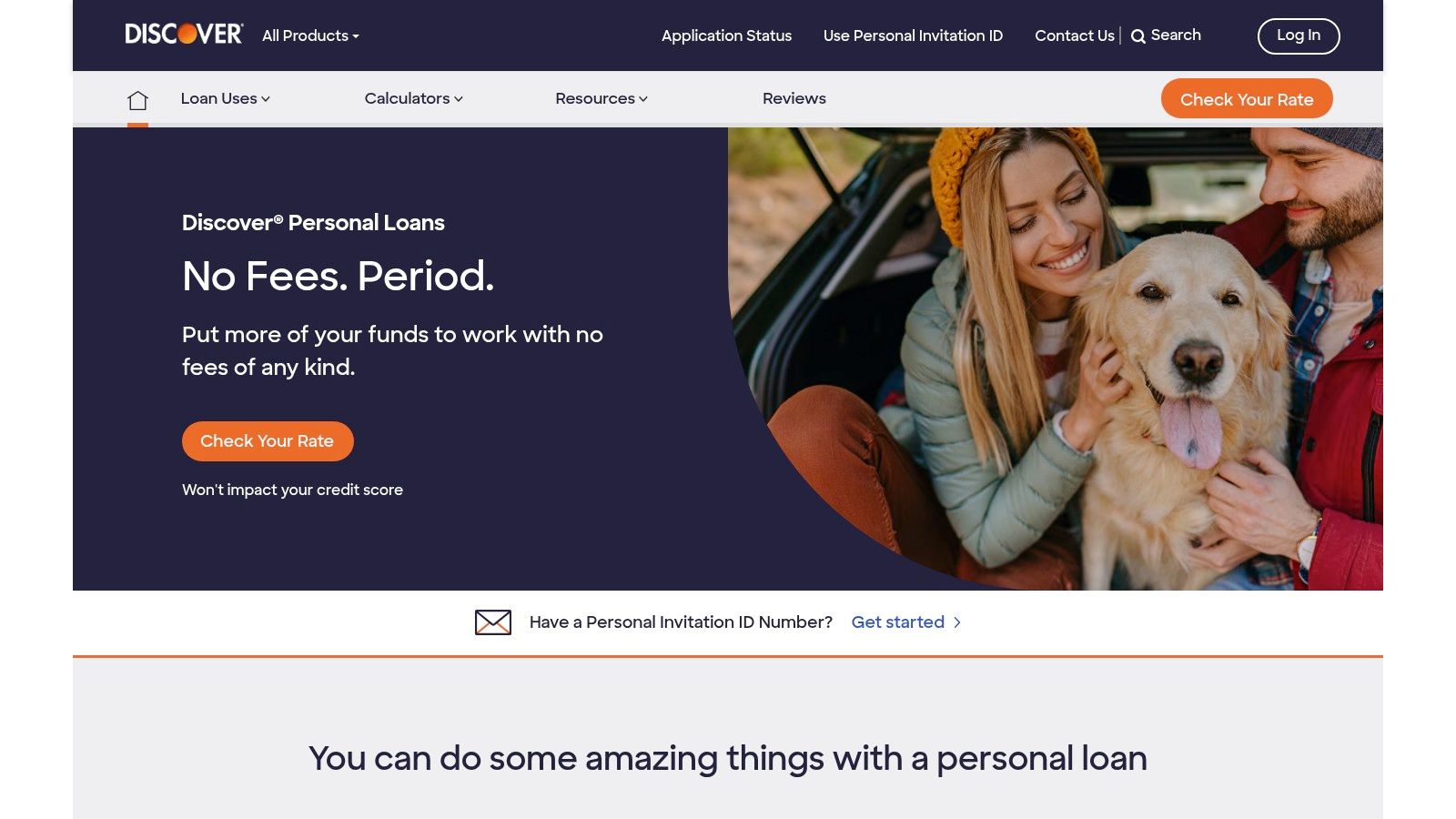
Some Reddit advice is blunt. If the borrower still has decent credit, skip the programs and get a lower-rate loan. Discover Personal Loans is one of the cleaner examples in that lane because it presents debt consolidation as a standard unsecured personal loan product rather than a mysterious rescue package.
Discover publishes a public rate band and states that it charges no origination, closing, or prepayment fees on this product. It also offers direct payment to creditors, which reduces the chance that loan proceeds sit in a checking account while old balances remain open and tempting.
Good fit for borrowers with credit access
The attraction here is straightforward. A personal loan creates a fixed payment and fixed term. That can be easier to budget than revolving card minimums that shift as balances move. Readers trying to test the math before applying can use this consolidation loan calculator to compare the current card path with a loan term and rate scenario.
The caution is just as straightforward. Lower monthly payment doesn't necessarily mean lower total cost, especially if the term is stretched. Discover's personal loans website is best for people who want direct lender terms and no-fee positioning, but approval and final pricing still depend heavily on credit profile and income.
7. SoFi
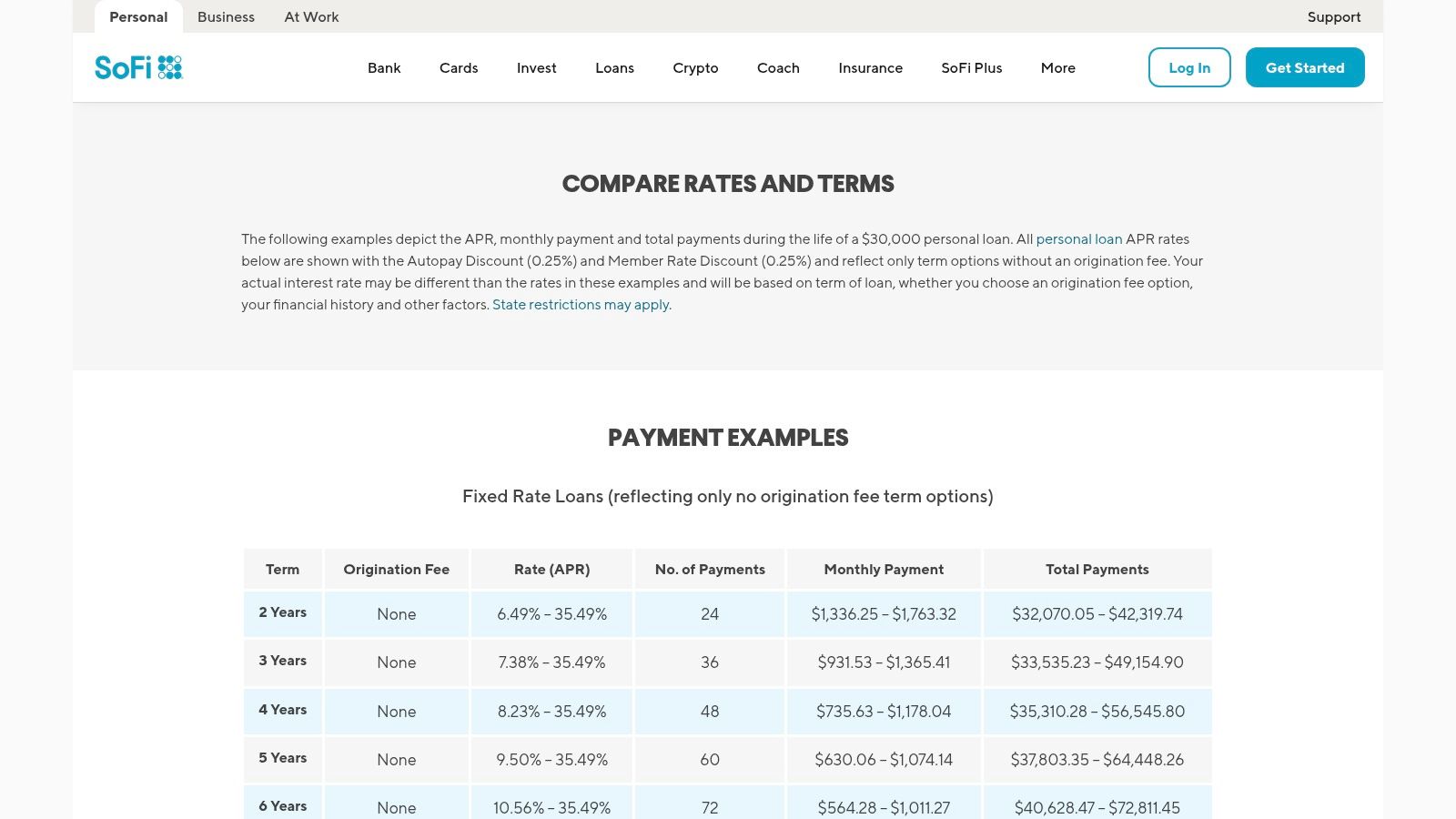
SoFi sits in a different corner of the market than nonprofit counseling. It appeals to borrowers who want a large unsecured loan, online rate shopping, and a soft-pull prequalification step before committing to a hard inquiry. For many Reddit users, that alone makes it worth checking.
Its broad loan sizing can matter for borrowers trying to clear several cards at once. It also positions itself as a member-focused platform rather than just a loan page, which some shoppers prefer when comparing lenders side by side.
The appeal and the risk
The strongest case for SoFi is flexibility. A borrower can preview a possible rate without immediately taking a hard credit hit, then compare term scenarios with a Debt Help U consolidation loan calculator. That's especially useful when a person is deciding whether a lower required payment is worth the added time.
TransUnion found that consumers who used unsecured personal loans to consolidate credit card debt saw their card balances fall by 57% on average after consolidation, while many balances returned close to prior levels 18 months later. In that same study, median utilization fell from 59% before origination to 14% immediately after origination, then rose to 42% 18 months later, and average credit scores increased by 18 points, as summarized in this Reddit discussion referencing the TransUnion findings. That pattern is a warning for SoFi and every similar lender. The loan can help, but it doesn't close old habits.
SoFi's direct product page is its personal loan rates page. Borrowers should read rate bands and discount conditions carefully.
8. LightStream by Truist
LightStream is often the lender people mention when someone on Reddit says they have excellent credit and want a no-fee loan. That reputation comes from its clean pricing posture, unsecured loan structure, and borrower-friendly details such as no prepayment penalty.
Its product can be attractive for one simple reason. It doesn't ask the borrower to trade a lower rate for a visible origination charge. For shoppers who dislike fee layering, that's a real differentiator.
Best for strong credit profiles
LightStream is not built around broad approval. It's better thought of as a lender for stronger applicants who want potentially competitive pricing and may value fast funding. The challenge is that public APR details can be harder to pin down in advance because terms vary by purpose and borrower profile.
- Why borrowers like it: No-fee structure and no prepayment penalty.
- Why some borrowers bounce off: Underwriting is less forgiving, and the best offers go to top-tier credit profiles.
- What to verify: Whether the loan purpose category and term presented online match the actual consolidation use case.
Its LightStream debt consolidation page is the right place to confirm live terms, funding conditions, and any rate-match style features before relying on Reddit impressions.
9. Happy Money Payoff Loan
Happy Money's Payoff Loan is more narrowly framed than many personal loans. It speaks directly to credit card payoff, which can make it easier for borrowers to compare against what they're carrying now instead of treating the loan as general-purpose cash.
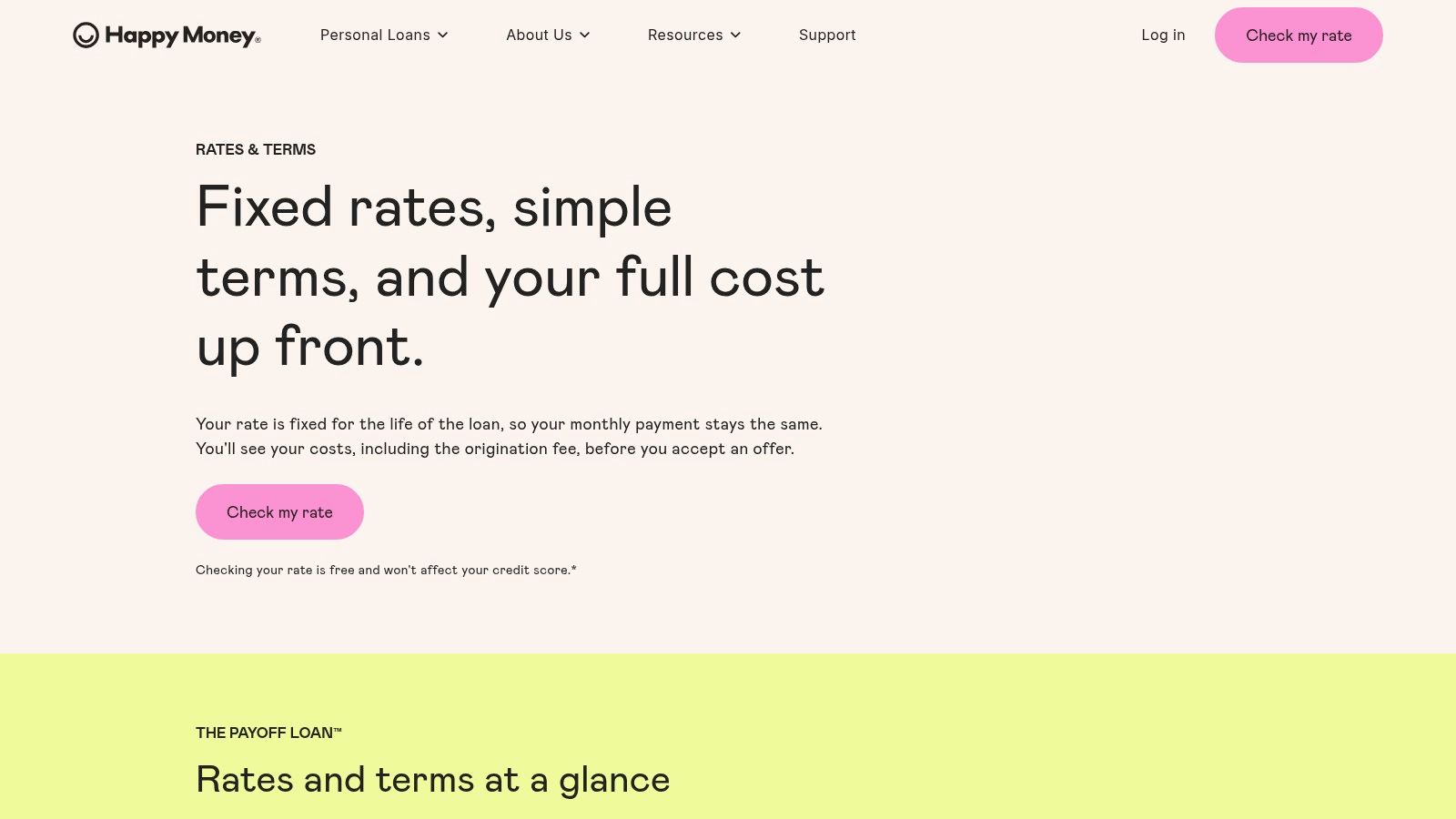
That specialization helps on the messaging side. It can also sharpen the math because Happy Money publicly discloses that origination fees may apply. That's a material issue in consolidation, and too many comparisons hide it until late in the process.
Fee drag matters
A fee can erase part of the rate advantage that made the loan attractive in the first place. That's the same reason balance-transfer offers need full modeling. CFPB reporting shows total balance transfers among the largest 25 card issuers reached $59.5 billion in 2024, and the average balance-transfer fee in the second half of 2024 was 4.3% of the transferred balance. A $10,000 transfer therefore typically costs about $430 up front, according to this balance transfer statistics summary. The principle carries over to origination-fee loans. Fee drag should be measured, not hand-waved.
Happy Money's rates and terms page is useful because it puts APR and origination-fee ranges in public view. The key question isn't whether the product is “for consolidation.” It's whether the all-in cost and term beat the card payoff path without creating a fresh excuse to keep spending.
10. PenFed Credit Union
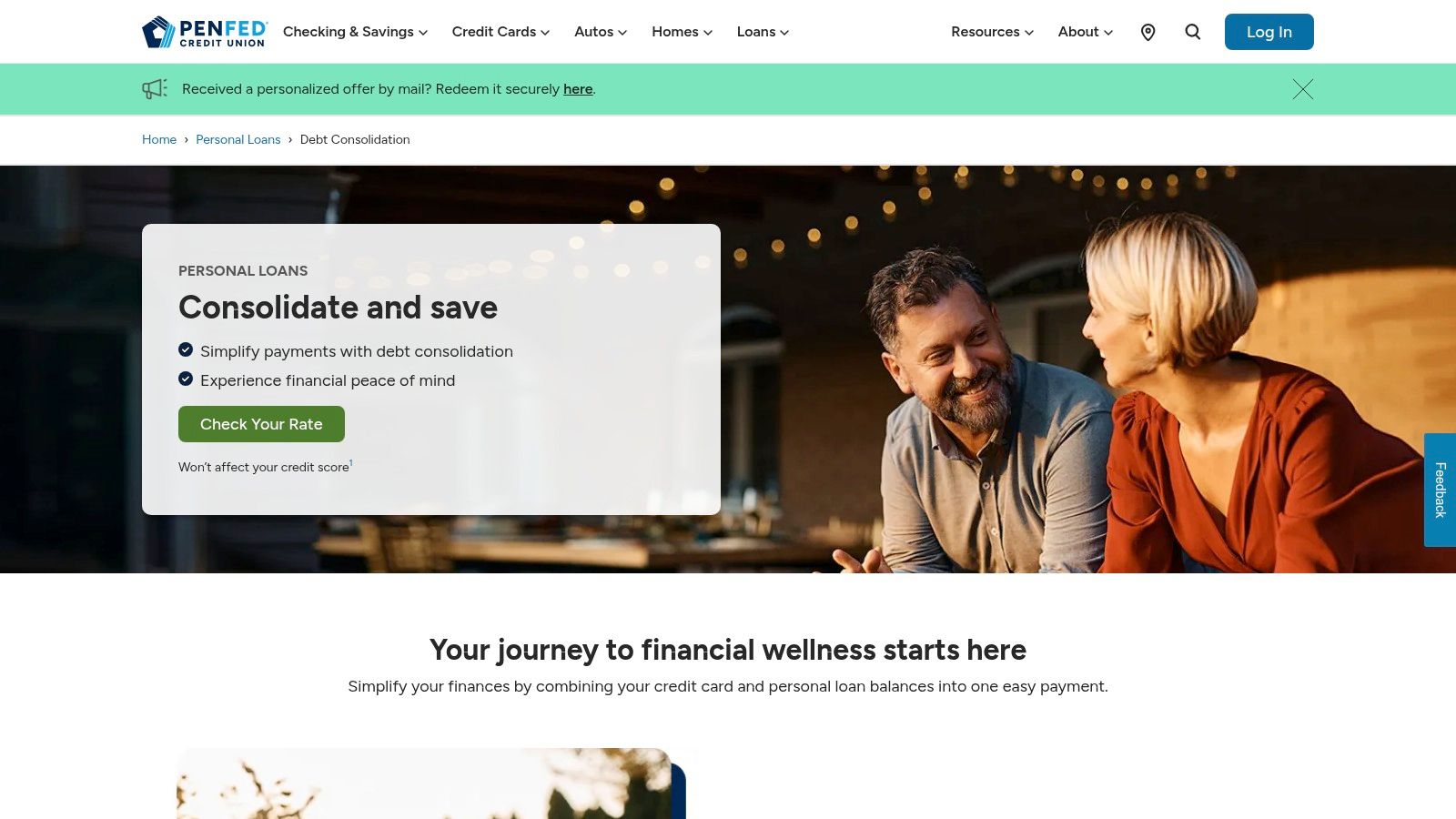
PenFed Credit Union is the option for readers who want credit-union-style lending without already being members. It allows non-members to apply, then handles membership as part of the process if approved. That makes it more accessible than some credit union products that effectively start with a gate.
Its draw is familiar. No origination fee, no early-payment penalties, and a soft-pull rate check create a cleaner shopping experience than some marketplace lenders offer. For borrowers who dislike hidden costs, that's appealing.
Where PenFed belongs in the comparison
PenFed is best thought of as a direct-lender alternative in the same broad bucket as Discover and SoFi, but with a credit union structure. The borrower still has to watch the usual consolidation traps: term length, final APR, and the temptation to run card balances back up after payoff.
Recent survey data also suggests that awareness and action don't always line up. Only 8% of Americans said they consolidated or refinanced debt in the past six months, even though 42% were concerned about their payments, according to this Happy Money article on credit conditions in 2025. PenFed's debt consolidation loan page is worth a look for borrowers who want credit-union pricing, but the product still needs to be judged on total repayment certainty, not branding.
Reddit-Discussed Credit Card Debt Consolidation: Top 10 Comparison
| Product | Core features | UX (★) | Price / Value (💰) | Target (👥) | Unique / USP (✨) |
|---|---|---|---|---|---|
| Debt Help U 🏆 | No-login in‑browser calculators (payoff, extra‑pay, multi‑card, DTI), 6‑question assessment, guides, opt‑in vetted referrals | ★★★★ | 💰 Free tools; referral fee disclosed only on enrollment | 👥 DIY borrowers, privacy‑focused users comparing options | ✨ Privacy‑first, bilingual, transparent revenue & plain‑numbers guidance |
| Money Management International (MMI) | Free counseling, Debt Management Plans (DMPs), published fee ranges, national reach | ★★★★ | 💰 Setup ~$37–$75; monthly ~$26–$69 (state dependent) | 👥 Those preferring nonprofit DMPs and negotiated APRs | ✨ Nonprofit with fee caps and broad recognition |
| GreenPath Financial Wellness | Free NFCC/HUD‑certified counseling, DMPs, bilingual guides, fee transparency | ★★★★ | 💰 Avg setup ~$35; monthly ~$31 (state dependent) | 👥 Borrowers wanting education‑first DMP guidance | ✨ Strong borrower education; published averages |
| InCharge Debt Solutions | Free counseling, tailored creditor proposals, state‑by‑state fee disclosure | ★★★★ | 💰 Avg setup ~$52; monthly ~$34; state caps vary | 👥 People seeking clear, state‑level fee detail & tailored plans | ✨ Detailed state fee disclosures; NFCC‑accredited |
| American Consumer Credit Counseling (ACCC) | Free counseling, FAQs, published enrollment fee examples | ★★★ | 💰 Enrollment example ~$39; monthly varies by state | 👥 First‑time counseling seekers needing predictable costs | ✨ Clear enrollment fee examples and longstanding nonprofit presence |
| Discover Personal Loans | Fixed‑rate unsecured loans $2.5k–$40k, $0 origination/prepay, direct‑to‑creditor payoff | ★★★★ | 💰 APR ~7.99%–24.99%; $0 origination/prepay fees | 👥 Fair‑to‑good credit borrowers wanting simple consolidation | ✨ No fees; bank reliability and direct payoff option |
| SoFi | Unsecured loans $5k–$100k, soft‑pull prequal, member benefits, autopay discounts | ★★★★ | 💰 APR ~6.99%–35.49%; discounts for autopay/members | 👥 Mid‑to‑high credit borrowers seeking perks & large loans | ✨ Soft‑pull prequalification; member resources/benefits |
| LightStream (by Truist) | No fees, possible same‑day funding, very long terms for some purposes, Rate‑Beat | ★★★★★ | 💰 Purpose/term‑dependent APR; $0 fees on eligible loans | 👥 Excellent‑credit borrowers chasing top rates | ✨ Rate‑Beat program; competitive no‑fee structure |
| Happy Money (Payoff Loan) | Loans $5k–$50k for card payoff, published APR & origination fee ranges | ★★★ | 💰 APR ~8.95%–35.99%; origination fee ~2%–12% | 👥 Borrowers wanting a loan purpose‑built to pay off cards | ✨ Consolidation‑focused product with clear fee disclosure |
| PenFed Credit Union | Personal loans up to $50k, $0 origination, soft‑pull rate check, autopay discount | ★★★★ | 💰 $0 origination; APR varies by applicant; autopay ≈0.25% discount | 👥 Borrowers seeking credit‑union pricing; non‑members welcome | ✨ No origination fee and simple membership path on approval |
Turn Reddit Research Into a Safer Decision
The safest way to use credit card debt consolidation Reddit threads is to treat them like field notes. They show what confused people, what surprised them, and what went wrong. They shouldn't be treated as the final authority on lender terms, nonprofit program rules, or state liability.
A practical sequence starts with the current facts, not with a provider. Gather each card balance, APR, and minimum payment, then add the borrower's state. The state matters for program availability, fee rules, and any question about estate liability or spousal responsibility later. Debt after death still doesn't have one national answer. It depends on state law, especially in the nine community property states, and on whether the person was a joint account holder or only an authorized user. Experian's consumer guidance also draws that same line, explaining that authorized users usually aren't liable while co-signers or joint account holders may be, and that creditors generally look first to the estate in its overview of what happens to credit card debt when someone dies.
Next, model the current payoff path before comparing alternatives. That step keeps a borrower from accepting a lower monthly payment that extends repayment for years. Then compare nonprofit debt management plans, personal-loan offers, and, where relevant, more serious options such as settlement or bankruptcy. The point isn't to force one answer. The point is to identify which path is survivable.
Check before sharing data: privacy policy, referral model, fee disclosures, state availability, creditor participation, account-closing rules, and whether the next step triggers a hard inquiry.
For balance transfers, readers should focus on timing as much as teaser rates. CFPB-linked market data shows average intro APR periods around 16.5 months and top offers up to 21 months, while external market studies report that only about 48% of transferred balances are paid off within the promo period and about 35% of users transfer again when the first promo expires, according to the CFPB consumer credit card market report. That's why many community discussions emphasize a 12 to 18 month payoff target on promotional balances. If the balance won't be gone in time, the comparison changes.
Readers should also verify whether a nonprofit's creditors participate, whether enrolled cards must close, whether a lender pays creditors directly, what fees apply up front, and whether any cancellation or withdrawal rights exist. No one should send money to an unverified intermediary or rely on one persuasive comment in a thread.
For estate or liability questions, a qualified attorney in the relevant state is the right next step, especially where joint-account status or community-property rules may matter. For payoff math and option comparisons, Debt Help U works best as an optional educational starting point for private calculations and scenario testing. It isn't a lender, creditor, collector, law firm, negotiator, or guaranteed solution.
Debt Help U gives borrowers a private way to test the numbers before they talk to a lender or counseling agency. Its free calculators, plain-language guides, and side-by-side explanations can help readers sort through the confusion that often shows up in credit card debt consolidation Reddit threads. Readers who want a no-login starting point can visit Debt Help U to model payoff timelines and compare options.
Related guides
- Is a debt consolidation loan worth it? Sometimes it saves thousands. Sometimes it costs more than doing nothing at all. The rate and the term decide, and one of them is where people get caught.
- Debt settlement vs. consolidation vs. bankruptcy Four paths out of unmanageable debt, what each one costs, and what each one breaks. Real numbers on a $30,000 balance, not a pitch for any of them.
- How long will it take to pay off my credit card debt? Your minimum payment shrinks every month. Following it down is what turns a five-year balance into a thirty-five-year one.