$20,000 Credit Card Debt Payoff Plans That Work
A cardholder can open a statement and feel trapped by the same cycle: the balance is $20,000, the minimum payment is technically affordable, yet the principal barely moves. Rent, groceries, and irregular expenses compete with every extra dollar, while interest keeps charging for the privilege of carrying yesterday's spending into another month.
That balance needs more than a generic budgeting tip. It needs a clear view of cash flow, payoff time, interest cost, credit utilization, and available relief options. The following guide turns those moving parts into practical decisions, while keeping the focus on a realistic question: what payment and strategy can a household sustain without creating another emergency?
Table of Contents
- What $20,000 Credit Card Debt Really Means Right Now
- Why a $20,000 Balance Costs More Than You Expect
- How Long Will $20,000 Take to Pay Off
- Smart Payoff Strategies for Multiple Cards
- Consolidation Settlement and Bankruptcy Compared
- Check Your Budget and DTI Before You Choose
- Your Next Steps to Tackle $20,000 Credit Card Debt
What $20,000 Credit Card Debt Really Means Right Now
A household with a $20,000 credit card balance is carrying far more than a typical cardholder. The average bankcard balance per borrower was $6,519 in Q1 2026, according to TransUnion's Q1 2026 Credit Industry Insights Report, while the average monthly credit card balance per cardholder was about $5,300 in 2024, as reported in the CFPB's 2025 consumer credit card market report. Those comparisons show why this debt can reshape a monthly budget. Payments may take priority over savings, irregular bills, and the cash reserve needed for a household surprise.
The balance creates a cash-flow decision, not a test of discipline. A cardholder must identify how much income remains after housing, food, utilities, transportation, and other required costs, then decide what payment can be sustained without creating new debt.
Three problems travel together
Interest means part of each payment goes to the cost of borrowing before it reduces principal. A high balance can also use a large share of available revolving credit, which may affect credit health and future borrowing power. Minimum payments can feel manageable now while keeping the account open for a much longer repayment period.
The CFPB's credit card guidance explains that card issuers must disclose how long repayment may take when a cardholder makes only minimum payments. It also explains that interest continues accumulating as the balance is carried. That timeline turns an unclear problem into a concrete tradeoff: a smaller payment preserves more cash today, while a larger payment can shorten the period of repayment.
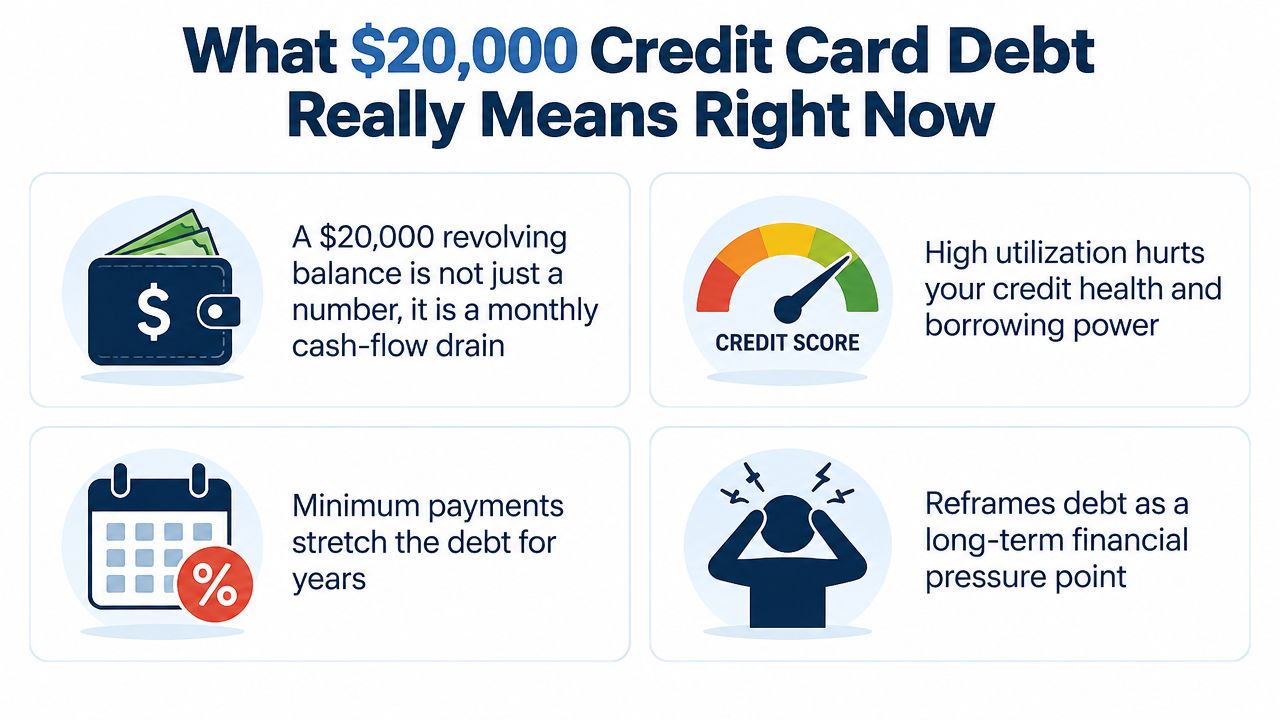
Start with a simple inventory: each balance, APR, minimum payment, and credit limit. The guide to how utilization affects a credit score explains the credit impact of those balances, while the payoff decision depends on household cash flow. The practical question is how much can go toward principal each month while leaving room for essentials and unexpected costs. That number helps compare extra payments, consolidation, settlement, or other relief options later.
Why a $20,000 Balance Costs More Than You Expect
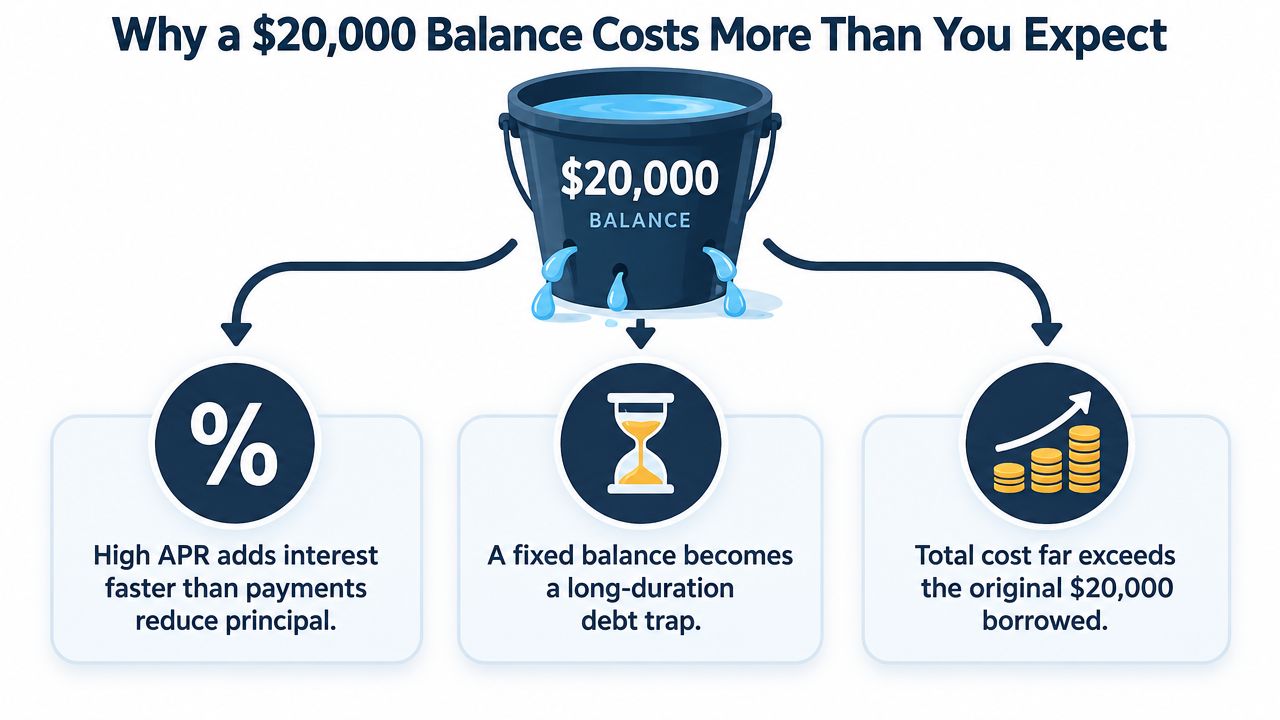
A household with a $20,000 card balance can make every required payment and still see little progress. The balance works like a bucket with a leak: each payment adds money, while interest drains part of it before the principal, the amount owed, falls. A higher APR makes the leak wider, so more of each monthly payment goes to interest and less reduces the balance.
Recent U.S. data shows why this matters. Credit card balances reached about $1.28 trillion in Q4 2025, according to the Federal Reserve Bank of New York's Household Debt and Credit Report, while accounts assessed interest averaged roughly 22.3% APR across 2025, according to the Federal Reserve's G.19 consumer credit release. The Consumer Financial Protection Bureau's 2025 credit card market report separately found about $160 billion in total U.S. credit card interest charges in 2024. These are market-wide figures, not a forecast for one household. They illustrate how revolving debt can become a long-running cash-flow problem.
Utilization adds pressure before a missed payment
Credit utilization compares revolving balances with revolving credit limits. The CFPB advises keeping total utilization at or below 30%, as described in its credit-building guidance. For a $20,000 balance, that guideline would require combined limits of about $66,667, calculated by dividing the balance by 0.30.
A larger limit is not automatically the answer. Applying for more credit can create additional inquiries and may make further borrowing easier. The calculation is mainly diagnostic: if your combined limits are far below that level, the balance may place substantial pressure on your credit profile even while payments remain current.
Minimum-payment comfort can conceal a worsening household budget. The share of outstanding balances more than 90 days past due rose from 7.6% in mid-2022 to 12.8% in early 2026, levels described as not seen since the Great Recession, according to CNBC's coverage of the New York Fed data. In the same reporting cycle, 2.85% of outstanding balances were at least 30 days delinquent.
You do not need to wait for a missed payment to review your choices. Rising minimums, using cards for necessities, or making payments without reducing principal can signal that the current arrangement no longer fits your cash flow.
Practical rule: Judge a payment plan by how much principal it removes, not only by whether it covers this month's minimum.
How Long Will $20,000 Take to Pay Off
A household carrying $20,000 credit card debt may see very different payoff dates depending on the balance, APR, payment amount, and new charges. The payment schedule works like a clock with two hands: interest adds to the balance, while each payment removes part of it. If new purchases continue, the clock can keep running even when payments are made on time.
Paying only the minimum allows interest to remain active month after month. Card statements usually provide an estimated minimum-only payoff period, so start there instead of guessing. Treat that estimate as a warning light, not a complete plan.
A simple calculator method
Use the statement and work through these steps:
- Enter the current balance, rather than an older estimate.
- Enter the APR for each card. Separate cards may require separate calculations.
- Enter the required minimum payment, noting whether it is a percentage, a fixed amount, or a combination.
- Run a minimum-only estimate, then run another estimate with a fixed extra payment.
- Compare the payoff date and total interest, not only the payment due this month.
A fixed extra amount helps reduce principal after required payments are covered. In practical terms, the minimum keeps the account current, while the extra amount shortens the distance to zero. If several rates apply, direct additional money according to the card terms and confirm how the issuer applies payments.
| Payment Scenario | Estimated Payoff Time | Total Interest Paid |
|---|---|---|
| Minimum payment only | Use the issuer's statement disclosure | Use the issuer's statement disclosure |
| Minimum payment plus a fixed extra amount | Recalculate with the added payment | Recalculate after the added payment |
| Fixed payment maintained each month | Recalculate using the same payment every month | Recalculate using the same payment every month |
This table is a planning framework, not a universal answer. The result can change with APR, fees, daily interest calculations, issuer formulas, minimum-payment rules, and new charges. Enter the exact terms from each statement before relying on a projected date.
Why a small extra payment can change the picture
Suppose the household can pay the minimum plus $50 per month. The exact timeline still depends on the APR and issuer formula, but a calculator can show whether that amount removes months or years from the schedule. The same test works for any repeatable amount, including money freed by reducing a recurring expense or receiving overtime.
Use a minimum monthly payment calculator to turn the statement into a target date and compare payment choices. A sustainable payment is more useful than an aggressive target that leads to new borrowing when an ordinary expense arrives. Recheck the plan whenever the balance, interest rate, or household cash flow changes.
Smart Payoff Strategies for Multiple Cards
A household with $20,000 credit card debt may be paying several cards at once. Each account still needs its required payment to protect payment history. The extra money is the part that needs an order. Directing it across every card can feel fair, but it often slows visible progress.
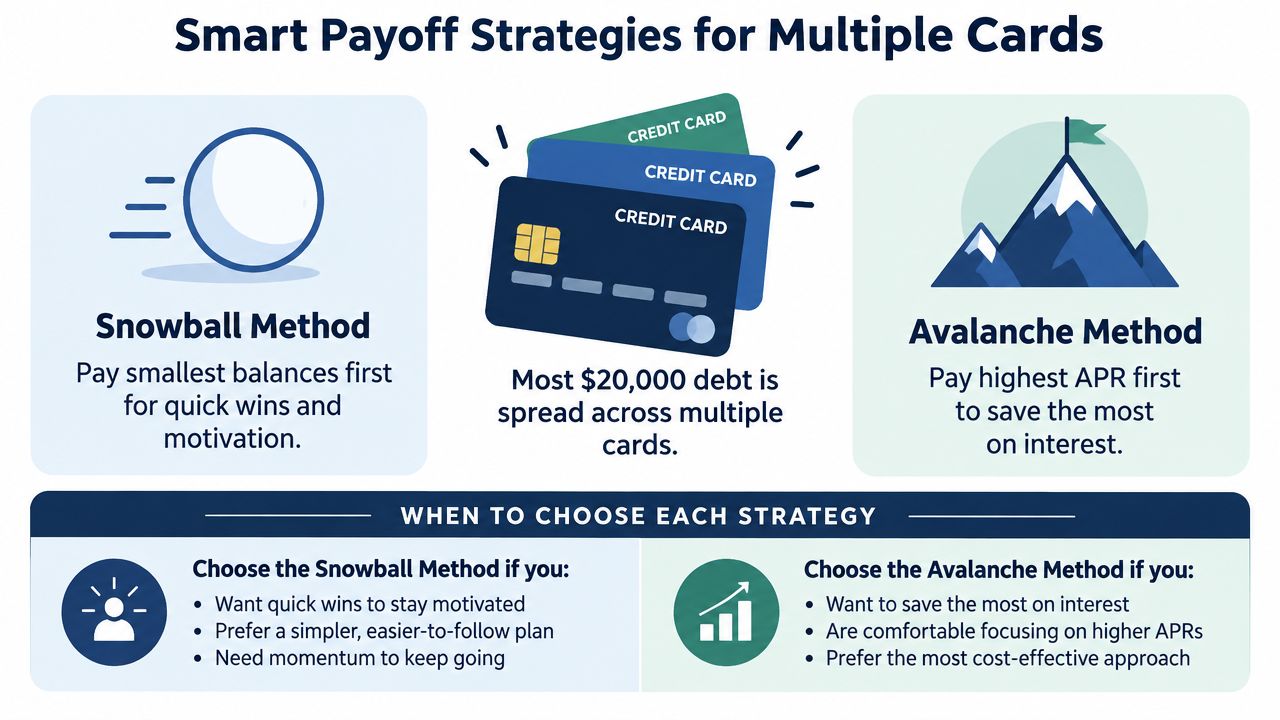
The avalanche method sends extra money to the card with the highest APR first. Like stopping the fastest leak, this usually limits interest because the most expensive balance receives attention first. The snowball method targets the smallest balance. Closing one account sooner can simplify the monthly routine and build confidence, even if another card has a higher rate.
Choosing between motivation and math
Avalanche suits a household that can follow an interest-first order without needing a quick account closure. Snowball may be easier when several balances make the plan confusing or when an early payoff provides useful momentum. The better method is the one the household can keep funding through ordinary and difficult months.
| Method | First target | Main advantage | Main tradeoff |
|---|---|---|---|
| Avalanche | Highest APR | Usually reduces interest cost | The first account may take longer to disappear |
| Snowball | Smallest balance | Creates an early psychological win | May cost more interest when rates differ |
This guide to choosing which credit card to pay off first can help set the order. Keep minimum payments on autopay, send the extra amount to one target card, and add that card's former payment to the next target after the balance reaches zero.
Freeing up payment capacity
The monthly target should come from money the household can repeat, not from an unusually good month. Review subscriptions, insurance premiums, delivery spending, and services no longer being used. Irregular income can go toward principal while a small cash buffer remains available for immediate needs.
Write the extra amount as a monthly commitment. If income falls, reduce that extra payment temporarily while preserving every minimum payment, then raise it when cash flow improves. A plan that bends during disruption is stronger than one that forces new borrowing after an ordinary expense.
A reliable strategy is the one that survives an uneven income month without sending the balance upward again.
Consolidation Settlement and Bankruptcy Compared
A household with $20,000 in card debt may reach a point where interest and required payments leave too little for ordinary bills. At that stage, the choice concerns consolidation, settlement, and bankruptcy, not personal discipline alone. Each option changes monthly cash flow, total repayment, and the household's credit profile in a different way.
Consolidation combines several debts into one account, often through a personal loan with a structured payment. One bill can make the plan easier to follow, and the rate may be lower. Approval and pricing depend on credit history, income, and existing obligations. A smaller monthly payment can still cost more overall if a longer term or substantial fees extends repayment.
Settlement means negotiating to repay less than the full amount owed. The balance may fall, yet creditors do not have to accept an offer. Fees may apply, missed payments can hurt credit, and forgiven debt can raise tax questions. Many settlement programs require the household to save money before negotiations begin, so the balance and delinquency risk may change during that period.
Bankruptcy is a legal process that may discharge or restructure qualifying unsecured debt. Eligibility, exemptions, filing requirements, and outcomes depend on the state and the person's circumstances. A qualified bankruptcy attorney should review those facts before a decision. Bankruptcy may provide legal protection in severe cases, while its effects on future borrowing and credit can last.
A decision matrix for household fit
| Option | Cash-flow effect | Credit and risk considerations | Often considered when |
|---|---|---|---|
| Consolidation | One structured payment may make monthly planning easier | Qualification is required, and the new loan's rate, term, and fees matter | Income can support a defined payment |
| Settlement | The amount repaid may be lower, but savings are needed to fund offers | Delinquency, creditor discretion, fees, and possible tax consequences matter | Full repayment is not realistic |
| Bankruptcy | A legal process may restructure or discharge qualifying debt | Legal and credit consequences require professional review | Debt is severe and other plans cannot create a sustainable path |
Use the household budget as the starting point, rather than a sales promise. Compare the required payment, projected total cost, fees, timeline, credit effects, and the result if income falls. As noted earlier, high APRs make the timeline and cash-flow tradeoff important, but no general market report can decide which legal or financial option fits one household. The right comparison is the plan that leaves enough cash for regular needs without depending on new card borrowing.
Check Your Budget and DTI Before You Choose
A debt-relief option must fit the household's cash flow after it begins. Debt-to-income ratio, or DTI, compares recurring monthly debt payments with gross monthly income:
Monthly debt payments ÷ gross monthly income × 100 = DTI
DTI is a screening tool, not a complete affordability answer. Two households can have the same ratio yet face different pressure because rent, childcare, medical bills, transportation, and irregular income vary. A ratio is like a dashboard warning light. It signals pressure, but it does not show every cost under the hood.
Test the payment before applying
List housing costs, car payments, student loans, personal loans, minimum card payments, and other recurring debt obligations. Then subtract essential expenses from income. The proposed consolidation payment, settlement contribution, or bankruptcy-related cost should fit within the remaining cash flow without forcing new card use.
Run more than one scenario. Test the required payment, a higher payment that shortens the timeline, and a lower payment that might be easier to maintain. A payment that works only in a good month is not a workable plan. A private DTI calculator can organize these comparisons, but its result is not an approval guarantee. Lenders use their own standards, while settlement and bankruptcy reviews consider facts beyond a ratio.
Review utilization separately
DTI measures pressure on income. Utilization measures pressure on available credit. As noted earlier, a $20,000 balance exceeds the 30% guideline unless combined limits are well above $60,000. This affects credit use, but paying down balances does not automatically make a strained budget affordable.
Before choosing a path, check:
- Payment capacity: Can the proposed payment continue after essential bills?
- Interest exposure: Does the plan lower the APR, or merely rearrange the balance?
- Credit status: Are payments current, late, or seriously delinquent?
- Fee exposure: Are origination, transfer, settlement, legal, or monthly fees included?
- Behavioral fit: Can paid-off cards remain unused during repayment?
- Backup plan: What happens if income drops or an urgent bill appears?
If the budget fails, the household should reconsider the option rather than fill the gap with more borrowing. The best choice is the one that leaves room for ordinary bills and an imperfect month, not merely the option with the lowest advertised payment.
Your Next Steps to Tackle $20,000 Credit Card Debt
A household facing $20,000 credit card debt needs a clear map before choosing a solution. Gather each statement, balance, APR, credit limit, minimum payment, and due date. Then calculate the payment needed for a chosen payoff date. A minimum-payment estimate shows how slowly the balance may fall, while an extra-payment comparison shows what a repeatable increase can change.
Choose one target for the extra payment. The avalanche method sends it to the highest APR, which usually reduces interest. The snowball method targets the smallest balance, creating an earlier payoff milestone. Keep every account current, then direct the extra amount to one card instead of spreading it so widely that no balance changes clearly.
A practical sequence
- This week: Build the debt list and run minimum-payment, extra-payment, and DTI scenarios.
- This month: Set a fixed payment that fits ordinary bills and automate minimums.
- During repayment: Check balances, APR changes, utilization, and available cash each month.
- If the plan fails: Compare consolidation, settlement, and bankruptcy by total cost, timeline, fees, credit effects, and legal consequences.
- Before sharing information: Use private, no-login calculators for estimates, then seek qualified advice if a formal option requires personal or legal review.
Debt Help U provides browser-based tools for payoff estimates, extra-payment comparisons, DTI planning, and side-by-side information about debt relief. Its materials state that it is not a lender, creditor, collector, settlement firm, credit-repair service, or law practice, and that availability can vary by state.
A payment plan must survive an imperfect month. If the proposed amount leaves no room for food, housing, utilities, or an urgent bill, reduce the target and reconsider the method before missed payments narrow the available choices.
Debt Help U can help households estimate payoff dates, compare extra payments, and review consolidation, settlement, and bankruptcy considerations in plain language. Visit Debt Help U to run an initial calculation privately, then decide whether independent counseling or a requested referral makes sense.
Related guides
- How long will it take to pay off my credit card debt? Your minimum payment shrinks every month. Following it down is what turns a five-year balance into a thirty-five-year one.
- How to get out of credit card debt without a loan Borrowing your way out is the advice everyone gives first. Here is what works when you do not want more debt.
- Debt settlement vs. consolidation vs. bankruptcy Four paths out of unmanageable debt, what each one costs, and what each one breaks. Real numbers on a $30,000 balance, not a pitch for any of them.