Debt to Income Formula Explained with Examples

The debt to income formula is monthly debt payments divided by gross monthly income, multiplied by 100. For many mortgage borrowers, 43% is still a common lender cutoff for total monthly debt payments to total monthly income, though it is no longer a federal Qualified Mortgage limit.
A paycheck lands, bills stack up, and the core question is simple. Is there enough room left for a mortgage, car payment, or student loan without stretching too far? That's exactly where DTI helps, because it turns a messy budget into one lender-ready number that can be compared across incomes and markets.
Table of Contents
- Introduction to the Debt to Income Formula and Why It Matters
- The Core Debt to Income Formula Explained Simply
- What Counts as Income in the DTI Formula
- What Counts as Debt in the DTI Formula
- Debt to Income Formula Examples With Step by Step Math
- Front End vs Back End DTI and How They Differ
- How Lenders Use Your DTI Ratio to Assess Risk
- Quick Reference Toolkit for Debt to Income Calculations
Introduction to the Debt to Income Formula and Why It Matters
A household can earn a solid income and still feel squeezed when recurring payments keep stacking up. The debt to income formula helps make that pressure visible. It gives consumers, lenders, and regulators a shared way to compare debt against income, which matters for a mortgage, a car loan, or a simple affordability check.
For mortgage reviews, the Consumer Financial Protection Bureau explains how to calculate DTI and notes that different loan products and lenders set different DTI limits Consumer Financial Protection Bureau. The 43% DTI limit that once applied to General Qualified Mortgages was removed and replaced with price-based thresholds CFPB General QM final rule. That makes DTI more than a budgeting shortcut. It becomes a lender-ready reference point that can affect approval odds, rate conversations, and repayment choices.
Why the ratio is useful
DTI works because it turns a full debt picture into one percentage. A lender can compare two borrowers with very different incomes using the same yardstick, and a consumer can see whether a new payment would crowd out breathing room.
Practical rule: a lower DTI usually means more room to absorb everyday costs, because less of each dollar is already committed to debt.
The ratio also appears in broader policy and research. Eurostat uses a similar household debt-to-income measure by comparing debt at year-end with gross disposable income earned during the year. The math may be presented differently, but the affordability idea is the same.
That makes DTI a quick-lookup tool, not just a single number on a form. It is useful for everyday borrowing and for major mortgage decisions, and it helps readers spot errors before an application goes out.
The Core Debt to Income Formula Explained Simply
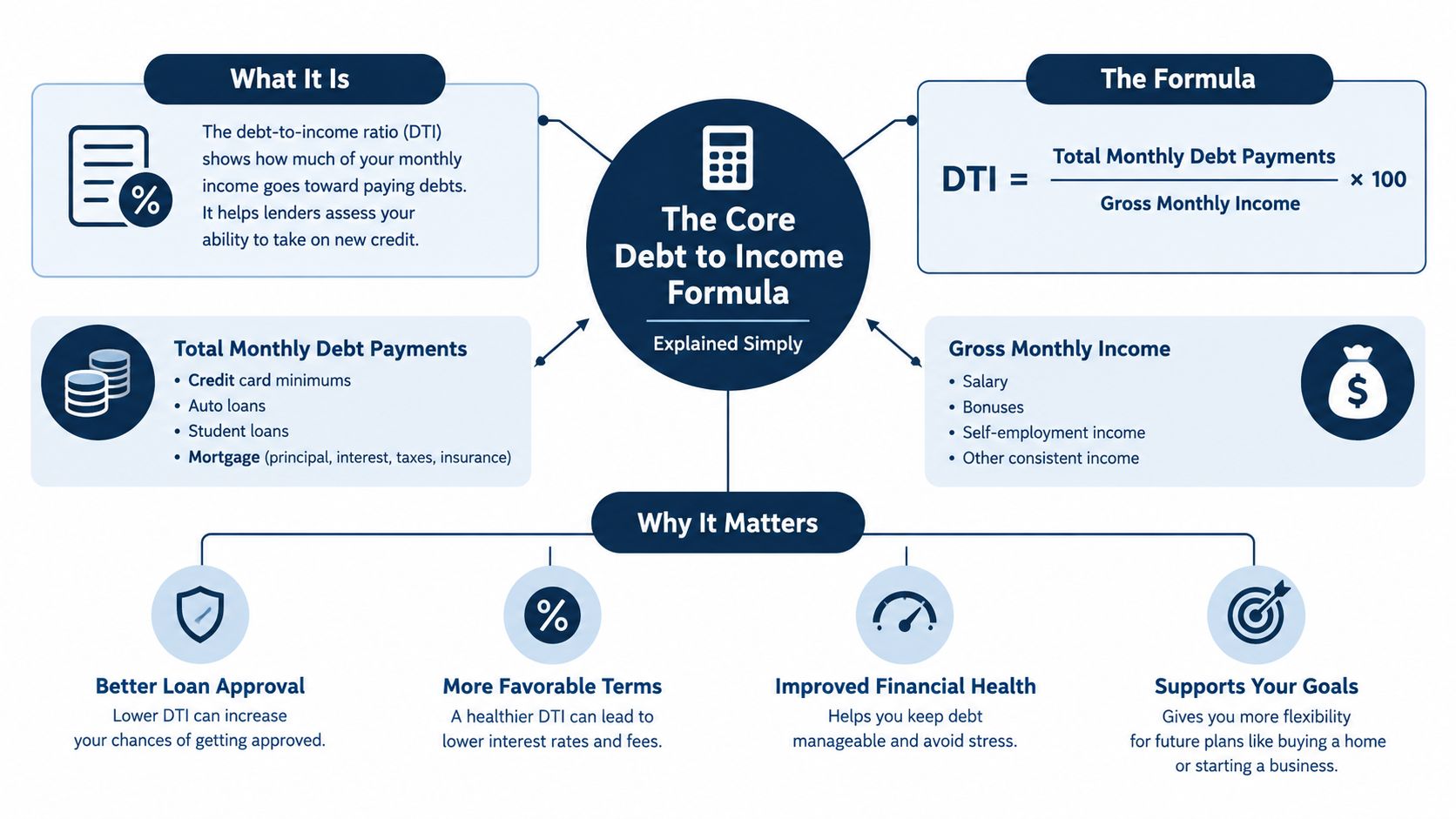
The formula itself is plain math. DTI = monthly debt payments ÷ gross monthly income × 100. Gross monthly income means income before deductions, not the take-home amount that lands in a bank account.
The three parts that matter
The formula has only three moving pieces.
- Monthly debt payments. Add the recurring payments that count, such as loans and minimums on revolving debt.
- Gross monthly income. Use income before taxes and other deductions.
- Multiply by 100. That turns the decimal into a percentage lenders can compare quickly.
A tiny example makes the structure easier to see. If monthly debt payments are 1,000 and gross monthly income is 4,000, the division gives 0.25. Multiply by 100, and the DTI is 25%.
That simple conversion is why the formula shows up in lending. It standardizes different budgets into one comparable number, so one borrower's 25% can be discussed beside another borrower's 40% without confusion.
Gross income, not take-home pay
Many readers get stuck here. Net pay feels more intuitive because it reflects what's available to spend, but DTI usually starts with gross income. That means the number should be built from earnings before deductions, which is why later sections separate income inputs from debt inputs so the calculation stays clean.
If the income figure is wrong, the ratio will be wrong even if the debt total is perfect. That's why the next step is to sort income into the categories lenders can verify.
What Counts as Income in the DTI Formula
Income in DTI needs to be gross and verifiable. That means a salary worker, an hourly worker, and a self-employed borrower can all have usable income, but the supporting documents and monthly conversion may look different.
The easiest way to think about it is this. Lenders want recurring income they can document, not a best guess about what might come in later. That's why pay stubs, tax returns, and other proof matter more than a household's informal budget.
Common income categories
- Wages and salary. Use gross pay before taxes, insurance, and retirement deductions.
- Hourly earnings. Convert the expected gross pay into a monthly amount using consistent recent earnings.
- Self-employment income. Use income that can be verified from tax documents and business records.
- Other recurring income. Include only amounts that are regular and documentable enough for the lender's review.
Annual pay can be converted to monthly pay by dividing the annual gross amount by 12. A biweekly paycheck can also be translated into monthly terms, but the key is consistency, because lenders want the same monthly standard across the whole file.
Gross income is the anchor. If the borrower starts with take-home pay, the ratio will look too high or too low depending on deductions.
What to leave out
Do not use net pay. Do not add one-time windfalls, and do not double-count income that isn't stable enough to support repayment. The point is not to maximize the number on paper. The point is to show what can realistically support monthly debt service.
For people comparing broader debt rules and repayment screening, a means test calculator can feel similar in structure, but DTI is a separate affordability measure and should be kept distinct.
If the income side is only half understood, the debt side is where the next round of errors usually shows up. A clean DTI calculation needs both sides to be equally disciplined.
What Counts as Debt in the DTI Formula
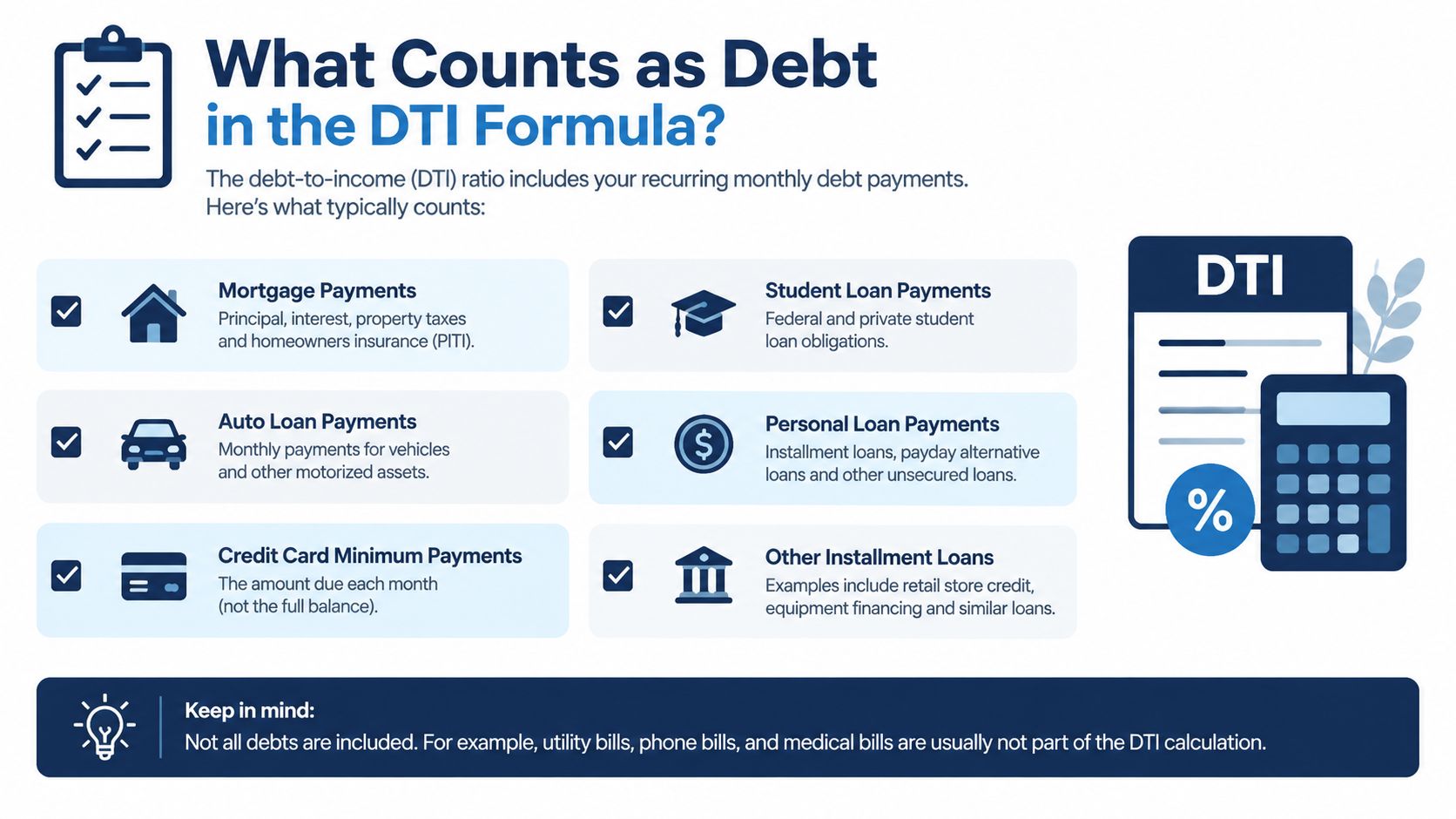
DTI counts recurring monthly debt obligations, not every bill in a household budget. That difference matters, because many people try to include groceries, utilities, or insurance premiums that don't belong in the standard ratio.
The core idea is simple. If it is a scheduled debt payment that repeats each month, it belongs on the list. If it is a normal living expense, it usually doesn't.
Typical debts to include
- Housing payment. This can include mortgage-related payments when the lender is evaluating housing affordability.
- Auto loans. Use the required monthly loan payment.
- Student loans. Include the required payment that is due.
- Credit card minimums. Revolving balances matter because lenders look at the minimum payment, not the full balance.
- Personal loans and other installment loans. Count any recurring required monthly debt payment.
Joint debts can be confusing. If a borrower is legally responsible for the payment, it belongs in the debt total. If another person pays part of the bill but the borrower is still obligated, that payment still matters for underwriting.
What to leave out
Normal living costs usually stay out of DTI. That includes utilities, groceries, and income taxes. The ratio is trying to measure debt burden, not the full cost of living.
A good checklist before calculating is straightforward. Gather every recurring loan statement, note the minimum required payment on revolving accounts, and separate debt from non-debt spending. That keeps the ratio from being inflated by expenses lenders are not counting.
The same discipline applies in reverse for income. If the payment belongs on one side, the corresponding income must be on the other side, and each item should be counted only once.
Debt to Income Formula Examples With Step by Step Math
A worked example makes the formula feel far less abstract. The mechanics stay the same every time, but the result changes based on the mix of income and debt.
Example one, a renter with a few debts
Suppose monthly debt payments are 900 and gross monthly income is 3,000. Divide 900 by 3,000, which gives 0.30. Multiply by 100, and the DTI is 30%.
That result means 30 cents of every gross dollar is already committed to debt service. For many borrowers, that's easier to manage than a number that climbs much higher, because there's still room for future obligations.
Example two, a homeowner with more housing cost
Suppose monthly debt payments are 2,400 and gross monthly income is 5,000. Divide 2,400 by 5,000, which gives 0.48. Multiply by 100, and the DTI is 48%.
That ratio is close to the level where mortgage underwriting becomes more sensitive. The borrower may still qualify in some settings, but the lender will usually look more closely at the overall file.
Example three, multiple debts making the picture tighter
If debt payments rise while income stays the same, DTI rises quickly. That's why households with several loans need to total every required payment before deciding whether a new loan is realistic. Even a manageable-looking payment can push the ratio higher once it's added to existing obligations.
| Household Scenario | Monthly Debts / Gross Income | DTI Result |
|---|---|---|
| Renter with one car loan and credit card minimums | 900 / 3,000 | 30% |
| Homeowner with larger housing payment | 2,400 / 5,000 | 48% |
| Household carrying multiple recurring debts | 2,100 / 4,200 | 50% |
The math itself is always the same. The hard part is getting the inputs right before the division starts. If the debt total or income total is off, the percentage will be off too.
Front End vs Back End DTI and How They Differ
Mortgage lenders often separate DTI into two views because one number doesn't always tell the whole story. Front-end DTI looks at housing costs only. Back-end DTI looks at all recurring monthly debts.
The two ratios side by side
| Ratio Type | What It Includes | What It Helps Show |
|---|---|---|
| Front-end DTI | Housing costs only | Whether the home payment itself looks affordable |
| Back-end DTI | Housing plus all recurring debts | Whether the borrower can carry the full monthly debt load |
The same income can produce two very different ratios. A borrower may have a housing payment that seems manageable on its own, but once car loans, student loans, and credit card minimums are added, the broader debt picture can look much tighter.
Mortgage guidance often emphasizes the broader total monthly debt ratio because that number reflects the full obligation stack. That's why a borrower shouldn't stop after checking only housing affordability. The overall payment load still matters for approval and for day-to-day breathing room.
Useful distinction: front-end DTI answers whether the house payment fits, back-end DTI answers whether the whole debt picture fits.
A homeowner comparing these two ratios should keep them separate, not averaged together. If the housing number is low but the back-end number is high, that usually means other monthly debts are doing the damage. If both are high, the issue is broader and may require reducing obligations before applying.
How Lenders Use Your DTI Ratio to Assess Risk
A lender reads DTI like a quick risk profile. It shows how much of your gross income is already spoken for by debt, so the lender can judge whether one more payment would leave enough room for ordinary life and unexpected expenses.
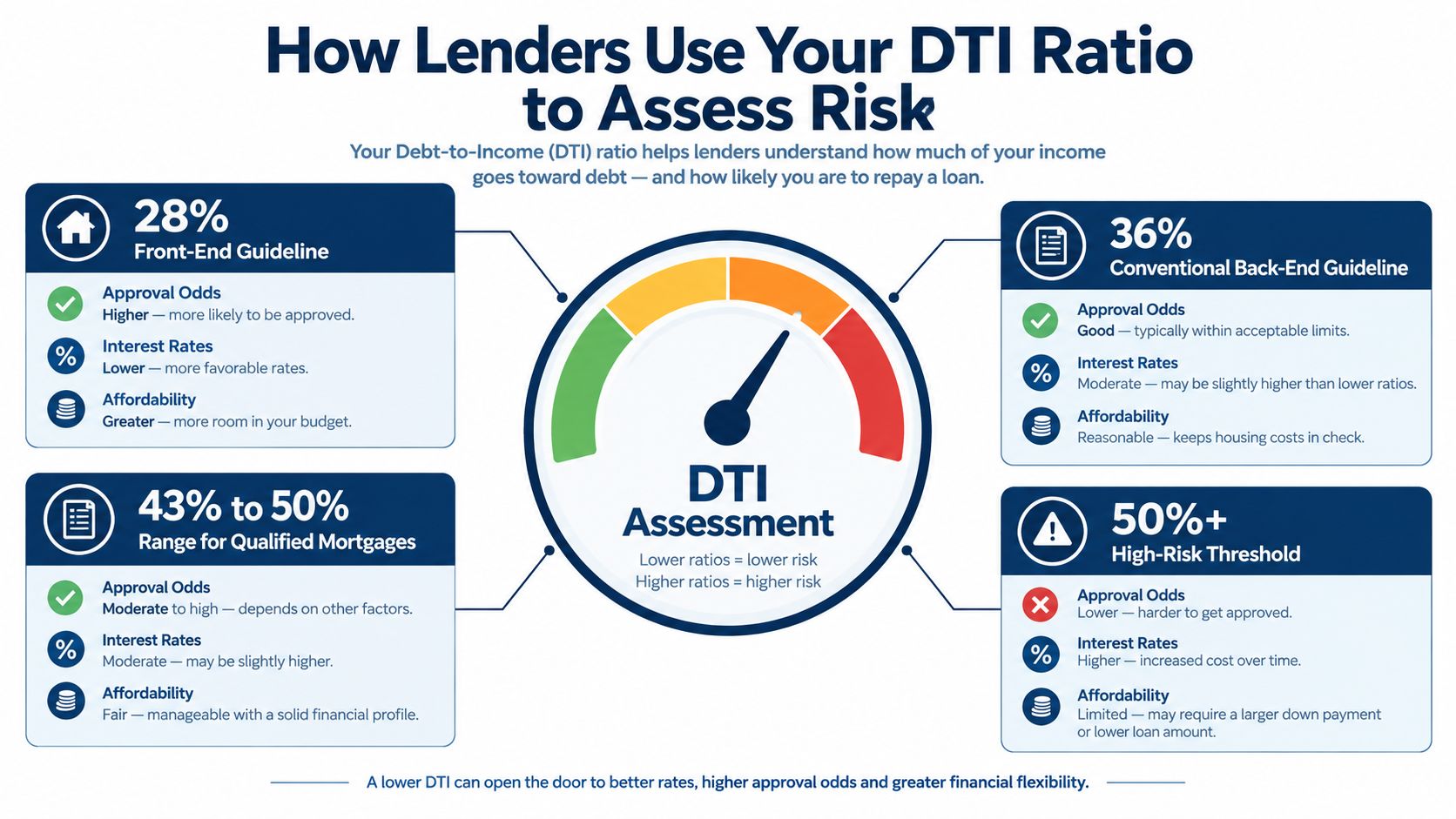
Borrowers often hear about common mortgage benchmarks early in the process. Debt Help U treats under 36% as healthy and 36% to 43% as manageable but tight, and many lenders still use 43% as a cutoff, but the Qualified Mortgage rule no longer sets a 43% DTI limit. Those figures work best as reference points, not as a single pass-or-fail test. A lender may be comfortable with a higher ratio if the rest of the file is strong, or cautious with a lower one if other parts look weak.
What the ratio tells underwriters
Underwriters look at DTI the way a mechanic looks at several warning lights at once. One light can point to a small issue. Several lights together can point to a system that needs attention.
A lower DTI usually means more breathing room if costs rise or income changes. A higher DTI suggests less margin for a rate reset, a temporary pay cut, or a new household expense. Lenders use that reading alongside credit history, employment verification, and cash reserves, because the ratio alone does not show the full picture.
The Federal Reserve's household debt dashboard shows why lenders and analysts keep DTI in view Federal Reserve household debt dashboard. It tracks debt-to-income measures across states, metros, and counties and gives a broader sense of how debt burdens move over time. That makes DTI useful as both a loan-by-loan check and a wider market signal.
How to improve the number
The cleanest ways to improve DTI are straightforward. Pay down recurring obligations, raise verified gross income, or do both before you apply. If a borrower has credit card minimums, a car loan, and a mortgage payment in the mix, reducing one recurring balance can change the ratio more than hoping for a larger loan approval.
For a plain-language way to judge where you stand, a good debt-to-income ratio guide can help you compare your number with what lenders often consider manageable. DTI works best as a lender-ready reference, one that sorts debts into categories and shows whether the full monthly load looks stable enough to support new credit.
Quick Reference Toolkit for Debt to Income Calculations
A borrower preparing for a mortgage often needs a fast way to sort the numbers before a lender does. DTI works best as a lender-ready reference, with each monthly item placed in the right bucket so the result is easy to check.
Quick lookup list
- Formula: monthly debt payments ÷ gross monthly income × 100.
- Income side: use gross, documentable income.
- Debt side: include recurring loan payments and minimums on revolving debt.
- Housing view: front-end DTI looks only at housing costs.
- Full view: back-end DTI looks at all recurring debt payments.
Benchmark reminders
See the mortgage benchmarks noted above if you need a frame of reference for what lenders often review. The useful part here is not the benchmark itself, but knowing which version of DTI you are checking before you submit an application.
Common mistakes to avoid
- Using net pay instead of gross pay. That makes the ratio harder to compare.
- Counting living expenses as debt. Utilities and groceries are not the same as loan payments.
- Ignoring minimum credit card payments. Revolving debt still affects DTI.
- Mixing front-end and back-end ratios. They answer different questions.
- Forgetting to verify the totals. A clean ratio still needs clean inputs.
A free debt-to-income calculator can handle the arithmetic once the categories are sorted. Debt Help U offers one that uses monthly income and debt payments to calculate the ratio.
Use it as a quick check, not a shortcut around the math. First separate gross income from recurring debt, then confirm whether you are reviewing the housing slice or the full monthly picture. That way the number you get is ready to compare with the benchmarks noted above, and it is less likely to trip up when a lender reviews the file.
For a final self-check, make sure each debt item is recurring, each income item is gross and verifiable, and the final percentage matches the formula exactly.
Related guides
- What is a good debt-to-income ratio? The number lenders and relief programs use to size up your situation, what each range signals, and how to work out yours in about a minute.
- Debt settlement vs. consolidation vs. bankruptcy Four paths out of unmanageable debt, what each one costs, and what each one breaks. Real numbers on a $30,000 balance, not a pitch for any of them.
- How long will it take to pay off my credit card debt? Your minimum payment shrinks every month. Following it down is what turns a five-year balance into a thirty-five-year one.