Bankruptcy Chapter Differences Explained Simply
A household can reach the same uncomfortable point in several ways. Credit card balances keep growing, a medical bill has gone to collections, a car payment is overdue, or mortgage arrears are threatening the family home. The person knows that relief may be available, but the labels, Chapter 7, Chapter 13, and sometimes Chapter 11, make the decision feel like a legal puzzle.
The choice matters because bankruptcy isn't one single process. One chapter may focus on a relatively quick discharge of qualifying unsecured debt. Another may require years of court-supervised payments but provide a way to catch up on secured debts while protecting property. The right comparison isn't only, “Which chapter eliminates debt?” It also asks, “How predictable is the timeline, what must be paid along the way, and what does the filer need to preserve?”
Table of Contents
- Introduction to Bankruptcy Chapter Differences
- What Each Bankruptcy Chapter Actually Does
- Eligibility and What Debts Each Chapter Handles
- Timelines Costs and Credit Impact Compared
- Success Rates and Real World Filing Trends
- Which Chapter Fits Common Financial Situations
- How to Choose Your Next Step Wisely
Introduction to Bankruptcy Chapter Differences
A person with mostly credit card and medical debt, modest income, and few assets may need a relatively quick way to address qualifying obligations. Another person may have regular income, a stable home, and overdue mortgage or vehicle payments. That household may need time and a court-approved structure to catch up while protecting important property. The same word, bankruptcy, can describe very different practical paths.
Bankruptcy chapter differences shape how the court handles income, assets, secured and unsecured debts, repayment duties, and discharge. They also affect how long a case follows a filer through the credit-reporting system. ProPublica's comparison of Chapter 7 and Chapter 13 describes Chapter 7 as generally faster, while Chapter 13 uses a longer repayment arrangement.
For consumer cases, Chapter 7 and Chapter 13 are the main choices. Chapter 7 is the dominant filing route in court data, while Chapter 13 represents a substantial share of consumer cases. Chapter 11 also exists, but it generally serves businesses or individuals with unusually complex financial structures.
The filing distribution matters because it provides context, not a recommendation. A chapter used more often may be familiar in consumer practice, but frequency does not determine eligibility or suitability. Timeline certainty matters too. A Chapter 7 case may offer a shorter path to discharge, while a Chapter 13 case is built around a multi-year plan. Comparing only the average can hide unusual cases, so later discussions distinguish a typical or median experience from a mean that may be pulled upward by longer matters.
| Question | Chapter 7 | Chapter 13 | Chapter 11 |
|---|---|---|---|
| Basic purpose | Liquidation and discharge | Court-approved repayment and reorganization | Complex reorganization |
| Typical consumer fit | Qualifying individuals with limited disposable income | Individuals with regular income who need a repayment plan | Businesses and some individuals with complex debts |
| Main timeline | Often about 3 to 5 months to discharge | Usually a 3 to 5 year repayment plan | Varies considerably |
| Main trade-off | Faster relief, with asset and eligibility questions | Longer supervision, with tools for catching up on certain debts | More complex process and administration |
| Credit reporting | Generally 10 years from filing | Generally 7 years from filing | Depends on the case and reporting history |
This table is an orientation, not an eligibility test. State exemptions, prior filings, disputed debts, household income, and repayment capacity can change the analysis. The following comparisons examine those practical differences without treating any single chapter as automatically right for every filer.
What Each Bankruptcy Chapter Actually Does
A family facing rising bills may need to choose between a shorter case with possible property questions and a longer plan built around steady income. The word “chapter” identifies the part of the U.S. Bankruptcy Code used for that case. It does not measure the amount of debt. Each chapter sets a different process for the court, filer, trustee, and creditors.
Chapter 7 focuses on liquidation
Chapter 7 is a liquidation process. A trustee reviews the filer's financial information and property. Assets not protected by applicable exemptions may be used to pay creditors, while qualifying debts are generally discharged at the end of the case. In many consumer cases, the filer receives a discharge without surrendering property, but that result depends on the facts and available exemptions.
The practical trade-off is speed versus the need to examine eligibility and property. Chapter 7 is often associated with a relatively short path to discharge and a clean break from qualifying unsecured obligations. It does not create a long payment plan from future income.
Chapter 13 reorganizes future income
Chapter 13 is a wage-earner reorganization. It uses a court-approved repayment plan funded by the debtor's future income, rather than focusing primarily on selling non-exempt property. The plan generally lasts 3 to 5 years, and debtors generally begin plan payments within 30 days of filing, according to the U.S. Courts' Chapter 13 Bankruptcy Basics.
Chapter 13 may suit someone with regular income who needs time to catch up on certain secured or priority obligations. Court supervision supplies a structure for repayment, but the filer must make consistent payments over the plan period. In practical terms, Chapter 13 trades a more predictable payment framework for a longer commitment.
Core distinction: Chapter 7 is designed for liquidation and a relatively quick discharge. Chapter 13 reorganizes obligations through a supervised repayment plan funded by future income.
Chapter 11 handles complex reorganizations
Chapter 11 is primarily a reorganization chapter for businesses, although individuals with complex debts or substantial financial arrangements may sometimes use it. It is not normally the first framework for a consumer whose difficulties involve ordinary household bills, credit cards, or medical debt.
A plain-language comparison of Chapter 7 and Chapter 13 bankruptcy clarifies the basic contrast, but definitions do not establish eligibility. The relevant questions include whether the filer meets the applicable requirements, whether property needs protection, and whether income can support a plan.
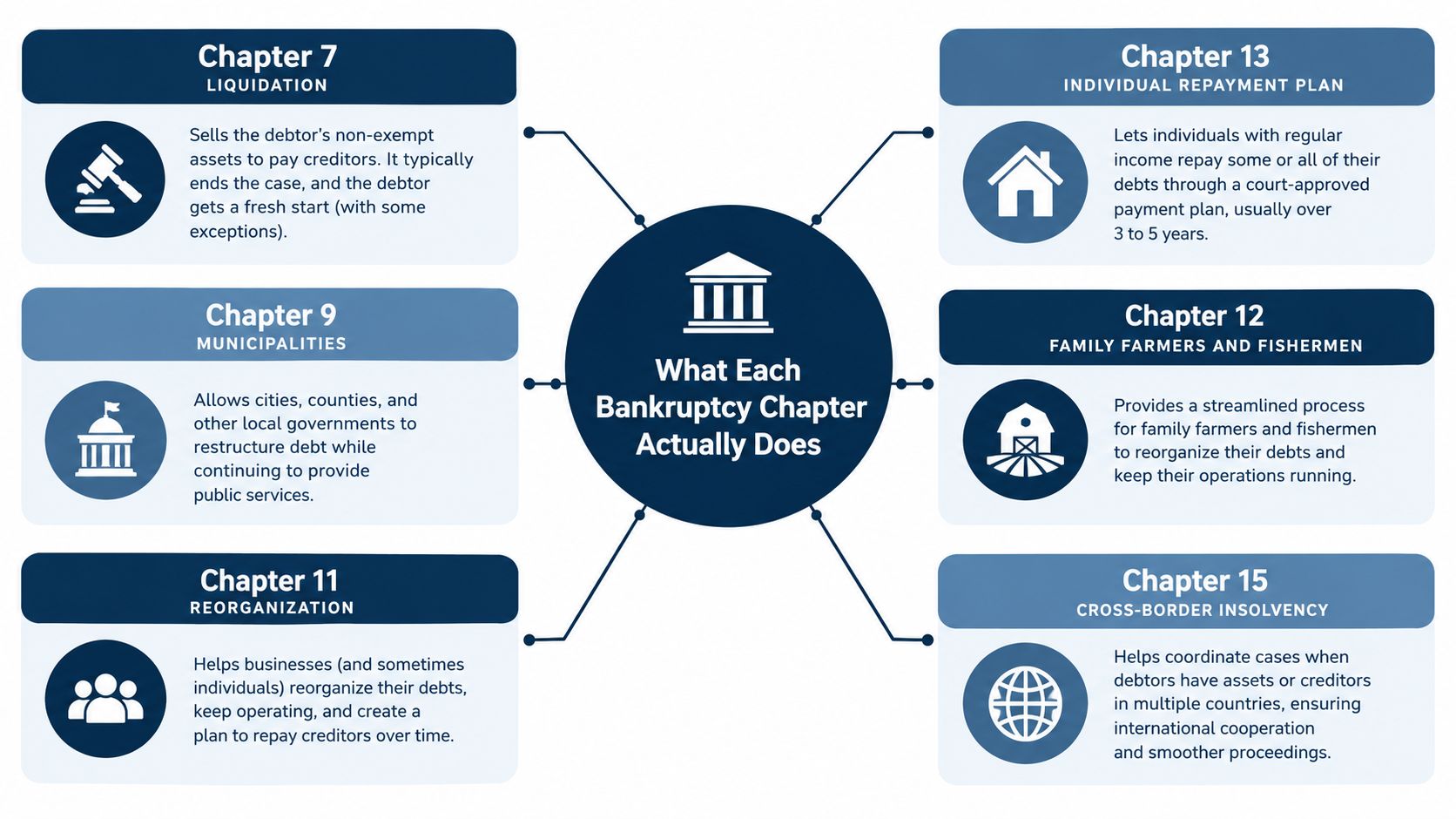
The chapters are different tools for different financial problems. Chapter 7 is not automatically better because it can be faster, and Chapter 13 is not automatically worse because it lasts longer. The useful comparison is whether the chapter's process matches the filer's property, income, and need for timeline certainty.
Eligibility and What Debts Each Chapter Handles
A household can prefer Chapter 7 for its shorter timeline and still find that eligibility points toward another chapter. Chapter 7 uses a means test to examine whether the filer's income and expenses leave enough disposable income to repay creditors. The U.S. Trustee Program's means-testing information explains this screening process. Passing the test is not the only requirement, so a complete eligibility review still matters.
Chapter 13 is built for an individual with regular income who can make payments under a court-supervised plan. The filer must also stay below the applicable statutory debt threshold. That threshold can change and depends on the type of debt, so an online summary cannot confirm whether a particular household qualifies.
Chapter 11 generally involves a broader, more complex reorganization. It may be considered when the filer's debt structure, assets, business operations, or income arrangements do not fit comfortably within Chapter 7 or Chapter 13. The practical question is not only which chapter sounds preferable, but which process can address the filer's debts and provide a workable timeline.
Debt treatment depends on classification
Bankruptcy does not treat every bill alike. Classifying each obligation is similar to sorting papers into separate folders, because the category often determines what the bankruptcy process can change.
- Unsecured debt: Credit cards, medical bills, and many personal loans generally have no collateral attached. Qualifying unsecured debt is often a main target of a Chapter 7 discharge. Chapter 13 addresses these balances through the repayment plan and may discharge eligible amounts after successful completion.
- Secured debt: A mortgage or vehicle loan is tied to collateral. Bankruptcy may address personal liability, but it does not automatically let a filer keep the property without meeting the loan's ongoing requirements.
- Priority or non-dischargeable obligations: Certain support debts, recent taxes, and many student loans may not be eliminated through an ordinary discharge. Their treatment requires a debt-by-debt review.
The difference between discharge and repayment causes frequent confusion. A discharge removes personal liability for qualifying obligations. It does not necessarily erase a lien against a house or car, and it does not turn every surviving obligation into a dischargeable debt.
Eligibility and debt treatment by chapter
| Criteria | Chapter 7 | Chapter 13 | Chapter 11 |
|---|---|---|---|
| Income requirement | Must pass the means test or otherwise satisfy applicable requirements | Requires regular income to support a plan | Uses a more complex reorganization framework |
| Debt limit | No Chapter 13-style threshold is the central feature | Secured and unsecured debts must remain below the applicable statutory threshold | Broader and more complex eligibility considerations |
| Unsecured debt | Qualifying debts may be discharged relatively quickly | Addressed through the repayment plan, with eligible balances potentially discharged after completion | Addressed under a negotiated or court-approved reorganization |
| Secured debt | Filer generally must address the collateral and ongoing payments | Can provide a structured way to address arrears while retaining property, if the plan and other requirements work | May restructure obligations under a broader reorganization |
| Property | Non-exempt assets can create risk | Property is generally retained, but asset values can affect plan requirements | Treatment depends on the reorganization and the court process |
A filer comparing Chapter 13 eligibility can use a Chapter 13 means test calculator as an educational starting point. It cannot replace a review of income, household expenses, debts, assets, exemptions, and prior bankruptcy history. These details also affect how much timeline certainty a filer can reasonably expect from a chapter choice.
Timelines Costs and Credit Impact Compared
For a household under collection pressure, the key question may be how predictable the path to relief will be. A case that may conclude within months creates a different planning problem from a case requiring years of payments, court oversight, and income stability. Chapter choice therefore involves timeline certainty as well as debt treatment.
Chapter 7 generally moves toward discharge in about 3 to 5 months. A reported median duration of about 3.5 months shows why this route is often associated with faster finality, although an individual case can take longer. Chapter 13 uses a longer schedule. Its repayment plan generally lasts 3 to 5 years, with payments generally beginning within 30 days after filing.
That extra time can help a filer address certain secured-debt arrears while keeping property, if the plan and other requirements work. It also gives income changes, missed payments, and unexpected expenses more chances to interfere with completion.
A quick view of the practical trade-offs
| Practical issue | Chapter 7 | Chapter 13 |
|---|---|---|
| Discharge timeline | About 3 to 5 months | After successful completion of a 3 to 5 year plan |
| Payment structure | No long-term repayment plan for discharged unsecured debt | Court-supervised plan funded by future income |
| Start of plan payments | No Chapter 13 plan payment | Generally within 30 days of filing |
| Credit-report period | Generally 10 years from filing | Generally 7 years from filing |
| Main timeline advantage | Faster and more final for qualifying debt | Provides time to reorganize and catch up |
| Main timeline risk | Asset and eligibility issues must be addressed early | The filer must sustain the plan over several years |
Credit reporting adds another part to the comparison. Chapter 7 generally remains on a credit report for 10 years, while Chapter 13 generally remains for 7 years. The shorter Chapter 13 reporting period does not make its process shorter, since the repayment plan itself can continue for years. Conversely, Chapter 7's faster discharge does not remove the need to address eligibility and property questions before filing.
Costs require individualized estimates
Filing and attorney costs differ by jurisdiction, attorney, case complexity, payment arrangement, and the need for disputes or additional court work. A single quoted fee cannot serve as a universal national estimate.
A filer can request a written breakdown of court costs, attorney fees, required education courses, payment timing, and possible additional charges. The chapter with the lower initial quote may still create greater practical strain if it does not address essential property concerns or arrears.
The practical distinction is straightforward. Chapter 7 offers a shorter route for a qualifying filer whose property analysis is acceptable. Chapter 13 offers a longer, more structured route when time is needed to reorganize debts or catch up on obligations. The better comparison is not fast versus slow. It is a question of which timeline a household can realistically complete.
Success Rates and Real World Filing Trends
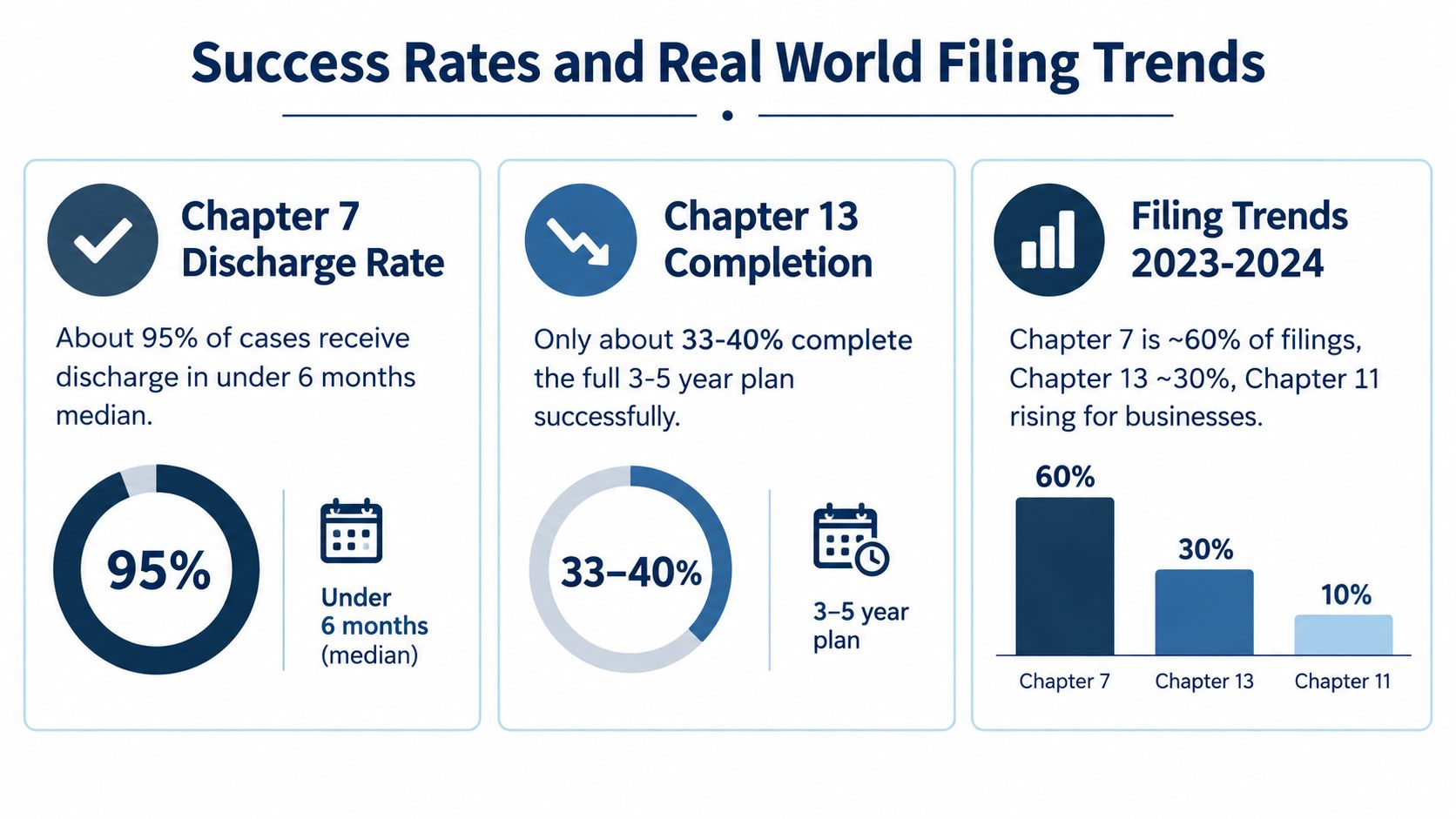
Outcome data helps translate legal definitions into practical expectations. A typical Chapter 7 case may reach discharge relatively quickly, while Chapter 13 generally runs for 3 to 5 years because the filer must maintain payments under an approved plan. The difference is a choice between greater timeline certainty and a longer process that may provide room to reorganize debts or address arrears.
Filing volume adds another useful frame. The Administrative Office of the U.S. Courts reported 356,724 Chapter 7 filings and 207,889 Chapter 13 filings in 2025. Chapter 7 therefore represents the more common route in the reported consumer filing distribution. That pattern can shape public advice, but filing totals cannot determine which chapter fits one household.
Chapter 7 remains more common
The court data show that Chapter 7 was the larger consumer pathway in 2025. The reported distribution also identified Chapter 13 as 38% of filings, leaving Chapter 7 as the majority pathway.
A high filing share does not make Chapter 7 appropriate for every filer. It only describes what happened across the system. A renter with limited property and qualifying unsecured debt may face different questions from a homeowner seeking time to address mortgage arrears. Real-world frequency is useful context, not a personal recommendation.
Mean and median tell different stories
The U.S. court data report a mean time to close consumer cases of 499 days and a median of 127 days for the period covered by the 2025 BAPCPA report. These figures answer different questions. The median identifies the midpoint of reported cases, while the mean can rise when a smaller group of unusually long cases remains open.
That distinction matters when a filer asks how long bankruptcy takes. A median may better describe the middle case, but the mean shows how extended matters affect the system as a whole. Chapter 7 may offer a shorter path for a qualifying filer, while Chapter 13 cases can remain active for years because payments continue under the plan.
Practical reading rule: Use the median to understand the typical midpoint, and the mean to see the effect of long-running cases.
The trend also changes over time. Chapter 7 remains more common, while Chapter 13 still represents a substantial consumer option. The practical lesson is to separate two questions: how frequently a chapter is filed, and how reliably a particular household can complete its required process.
A chapter with a shorter expected route may offer more timeline certainty. A longer chapter may fit a filer who needs structured time, but completion depends on sustained income and plan payments.
Which Chapter Fits Common Financial Situations
A chapter usually fits because of the interaction among income stability, debt type, property goals, and timeline needs. The same level of debt can lead to different considerations for a renter with no significant assets and a homeowner trying to prevent the loss of a house.
Mostly unsecured debt and limited income
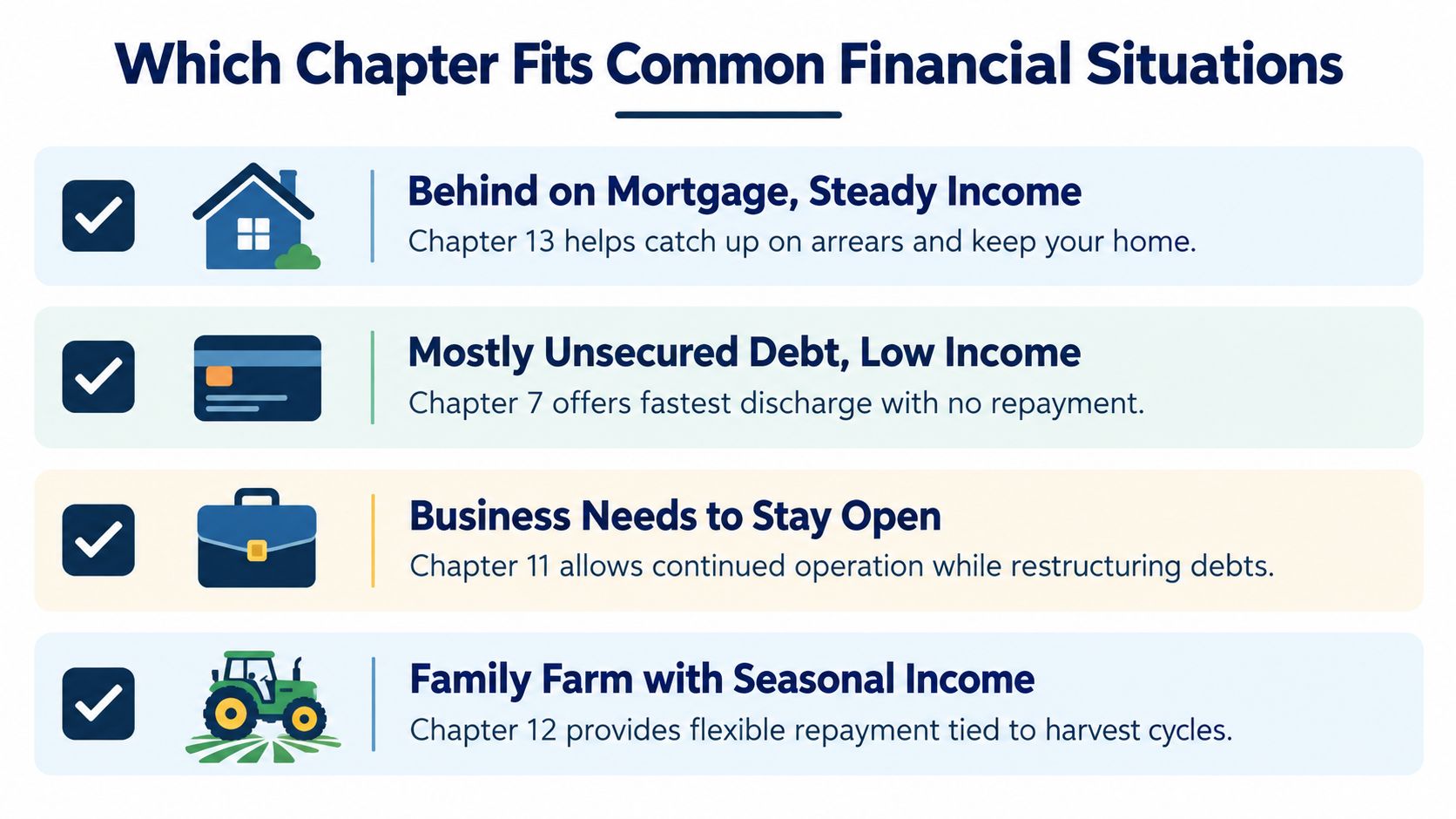
A household with mostly credit cards, medical bills, and personal loans may focus on Chapter 7 if its income satisfies the means-test requirements and its property is adequately protected. The central question is whether the filer needs a repayment plan or whether a faster discharge of qualifying unsecured debt would address the main problem.
A person who doesn't have regular income may struggle to sustain Chapter 13 payments. That doesn't decide the case by itself, but it makes the payment-plan requirement an important practical concern.
Regular income and mortgage or vehicle arrears
Someone with reliable income who is behind on a mortgage or vehicle loan may examine Chapter 13 more closely. The chapter's repayment structure can provide a way to address arrears over time while the filer resumes ongoing payments, subject to the plan, court approval, and applicable requirements.
Chapter 13 may also be relevant when a filer has priority or non-dischargeable obligations that need organized repayment. The plan doesn't make those debts disappear, but it may create a supervised path for addressing them while other eligible debts receive different treatment.
Assets that need protection
A filer with meaningful equity in a home, vehicle, or other property should examine exemptions before assuming Chapter 7 is safe. Chapter 13 may offer a way to retain property, but non-exempt value can affect the required plan payments.
An individual with a business or unusually complex personal finances may need to discuss Chapter 11, rather than treating it as an ordinary consumer alternative. Chapter 12 may also apply to qualifying family farmers with seasonal income, although the available facts don't establish eligibility for any individual situation.
A self-sorting checklist
- Debt mix: Is the burden mainly unsecured, secured, priority, or non-dischargeable?
- Income: Is there regular income that can support payments over several years?
- Property: Does the household need to protect home equity, a vehicle, or business assets?
- Urgency: Is the priority a quick discharge, stopping collection activity, or catching up on arrears?
- Complexity: Does the person operate a business or have financial arrangements that exceed a typical consumer case?
This checklist can organize questions before a professional consultation, but it can't select a chapter. State exemption rules, household income, asset values, debt limits, and prior filings can change the analysis.
How to Choose Your Next Step Wisely
A careful decision starts with records, not a rushed filing. The household should gather income documentation, account statements, loan information, collection notices, tax records, property values, and a list of monthly expenses. The more complete the information, the easier it is to compare a possible Chapter 7 case with a realistic Chapter 13 plan.
A practical sequence looks like this:
- Map the debts. Separate secured debts, unsecured debts, priority obligations, and debts that may not be dischargeable.
- Review income and expenses. A budget should show whether a repayment plan is sustainable after ordinary household costs.
- Check the means-test basics. Educational tools can help explain the screening process, but only a qualified professional can confirm how the rules apply.
- Compare alternatives. Consolidation, settlement, and bankruptcy have different timelines, costs, risks, and credit consequences. Debt Help U's comparison of settlement, consolidation, and bankruptcy can help frame those questions.
- Seek legal confirmation. A qualified bankruptcy attorney can review state-specific exemptions, eligibility, prior filings, creditor actions, and the treatment of individual debts.
Debt Help U is an educational and referral platform, not a law firm, lender, creditor, collector, settlement firm, or credit-repair service. Its calculators and guides can support preliminary comparison, but no tool guarantees eligibility, discharge, plan confirmation, or a particular financial outcome. Availability and legal rules vary by state.
The clearest takeaway is that Chapter 7 and Chapter 13 solve different problems. Chapter 7 generally offers a faster path for qualifying filers, while Chapter 13 demands longer supervision but can help a filer reorganize obligations and protect important assets. A person should confirm the facts before choosing a chapter.
Debt Help U provides plain-language guides and no-login calculators for reviewing payoff timelines, debt-to-income context, and debt-relief alternatives before any referral decision. Visit Debt Help U to compare the available paths privately and organize the questions a qualified professional should answer.
Related guides
- Chapter 7 vs. Chapter 13 bankruptcy: which one applies to you One wipes qualifying debt in a few months. The other reorganizes it over three to five years. Your income and what you own decide which is even available.
- Debt settlement vs. consolidation vs. bankruptcy Four paths out of unmanageable debt, what each one costs, and what each one breaks. Real numbers on a $30,000 balance, not a pitch for any of them.
- How long will it take to pay off my credit card debt? Your minimum payment shrinks every month. Following it down is what turns a five-year balance into a thirty-five-year one.