Credit Card Payment Plan: Build a Workable Repayment Path
A credit card payment plan can be a self-made repayment schedule, a formal arrangement with the issuer, or a negotiated settlement. The right choice depends on the balance, income stability, and tolerance for credit impact.
A reader may be facing the same quiet problem today: the statement shows a manageable minimum due, the payment gets made, and the balance barely seems to move. That pattern can continue for months or years without creating a clear path to zero. A workable plan replaces that uncertainty with a target payment, an expected timeline, and a realistic view of total cost.
Table of Contents
- Why a Credit Card Payment Plan Matters
- What Is a Credit Card Payment Plan
- How Minimum Payments Shape Your Payoff Timeline
- Types of Credit Card Payment Plans Compared
- How to Model Your Credit Card Payoff with Debt Help U
- When to Choose a Payment Plan Over Other Relief Options
- Next Steps to Build Your Credit Card Payment Plan
Why a Credit Card Payment Plan Matters
A household may pay every required minimum on time yet watch its balance barely change. The account stays current, but the payment can cover interest and fees before reducing much principal. A payment plan matters because it turns that vague pattern into a defined route from the current balance to zero.
Minimum payments have also changed over time. Research on U.S. consumer credit markets documents a decline in typical requirements from about 5% of the outstanding balance in the 1970s to about 2% by the 2000s. Lower required payments extended payoff timelines and increased total interest. The same research found that 29% of accounts regularly paid at or near the minimum, so this is a common feature of credit card repayment, not an unusual mistake by one household (research on minimum payments and consumer credit markets).
The statement is not a strategy
A statement answers one narrow question: what must be paid by the due date to keep the account from becoming late? It usually does not answer how much to pay each month to clear the balance within a chosen period. Treat the minimum as a floor, not as a payoff schedule.
Suppose a household can pay slightly more than required but has never calculated the effect. Each extra dollar reduces principal sooner. Future interest is then calculated on a smaller balance, much like removing weight from a backpack before a long walk. Consumer finance analysis found that raising a payment by only $5 per month cut a sample payoff period from about 5 years 10 months to 4 years 3 months and saved more than $200 in interest (consumer finance analysis of minimum payments and extra payments).
A plan can cover the full range of choices, from a self-managed fixed payment to an issuer installment option or negotiated settlement. Each option changes the payment, timeline, total cost, account status, or credit consequences differently. Modeling those details before enrolling helps separate an affordable arrangement from one that only makes the next bill look smaller.
Practical rule: A payment plan should state the monthly payment, the expected date the balance reaches zero, and the interest paid along the way.
It should also test whether new charges are pushing the balance higher than payments can reduce. That check keeps the plan connected to the household's actual cash flow.
What Is a Credit Card Payment Plan
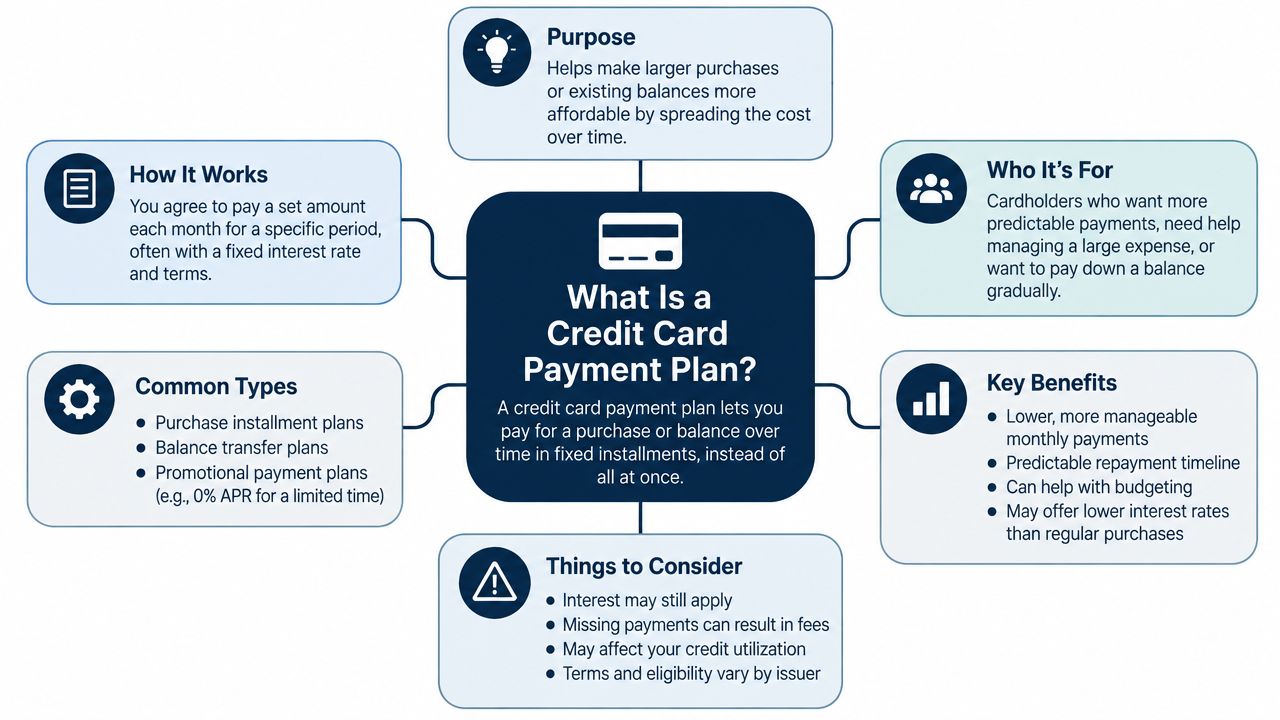
A credit card payment plan is any structured method for repaying revolving debt. The phrase can describe a personal schedule created by the cardholder, an installment feature offered by an issuer, a counseling-based arrangement, or a settlement negotiated with creditors.
The four categories below use different terms and create different consequences.
Self-managed repayment schedule
The cardholder keeps the existing account terms and chooses a fixed payment above the minimum. The issuer still controls the APR, fees, due date, and minimum-payment formula, while the cardholder controls the extra amount and repayment priority.
This approach suits someone with stable income who can cover essential expenses and make consistent overpayments. It usually preserves normal account use and avoids enrolling in a third-party program, but the debt remains subject to the card's interest rate.
Issuer-created installment program
Some issuers let cardholders convert eligible purchases into fixed installment plans. The purchase is repaid over a stated period, often with a monthly fee or another disclosed cost. That installment amount is commonly added to the card's minimum payment, so the cardholder may owe the installment amount while also carrying revolving balances.
This option can make a particular purchase more predictable, but it doesn't automatically reduce the overall debt burden. The cardholder should compare the plan's total cost with the cost of leaving the purchase in the revolving balance.
Formal debt management plan
A credit counseling agency may arrange a debt management plan under which the consumer makes a payment to the agency, which then distributes funds to participating creditors. The agency may seek concessions from creditors, but acceptance, account treatment, fees, and eligibility depend on the specific arrangement.
This path can help when several unsecured accounts need one coordinated payment. It requires regular cash flow and careful review of how accounts will be handled.
Settlement plan
A settlement company or attorney may negotiate with creditors to accept less than the full balance. The consumer may be asked to stop paying creditors and build funds for negotiated settlements, which can lead to added fees, collection activity, credit damage, and uncertain outcomes.
Settlement is not just a cheaper payment plan. It changes the objective from repaying the full balance over time to resolving accounts for negotiated amounts, with significant risks that must be understood before enrollment.
How Minimum Payments Shape Your Payoff Timeline
A minimum payment is produced by an issuer-specific formula. It may combine a percentage of the balance with accrued interest and fees, so the repayment schedule depends on the account agreement as well as the APR. U.S. regulation requires issuers to use the account's applicable formula when presenting repayment estimates under the Regulation Z minimum-payment rules.
Consider a $1,500 balance. An independent consumer example shows that a 4% minimum payment can take more than 8 years to repay and cost over $889 in interest. A 2.5% minimum can extend repayment beyond a decade. These figures are illustrations, not a promise about every account. The actual outcome depends on the APR, fees, payment formula, and whether new purchases continue. As the balance falls, the required payment may fall too, leaving less money directed toward principal.
Why the first payment isn't mostly principal
Interest accrues on the outstanding balance. If a payment barely covers the interest and fees added during the billing period, only a small portion reduces principal. The following interest calculation then begins with a balance that has changed very little.
For example, at a 20.99% APR, a $2,000 balance paid only at the minimum can take more than 11 years to repay and cost $4,456 total, including $2,456 in interest. This illustrative scenario shows the central tradeoff: a low required payment may fit the current month while making the account expensive over time. Modeling the same balance with a fixed payment can reveal how much faster principal falls and how the total cost changes.
For a plain-language explanation of the amount due, see this guide to what minimum payment due means on a credit card.
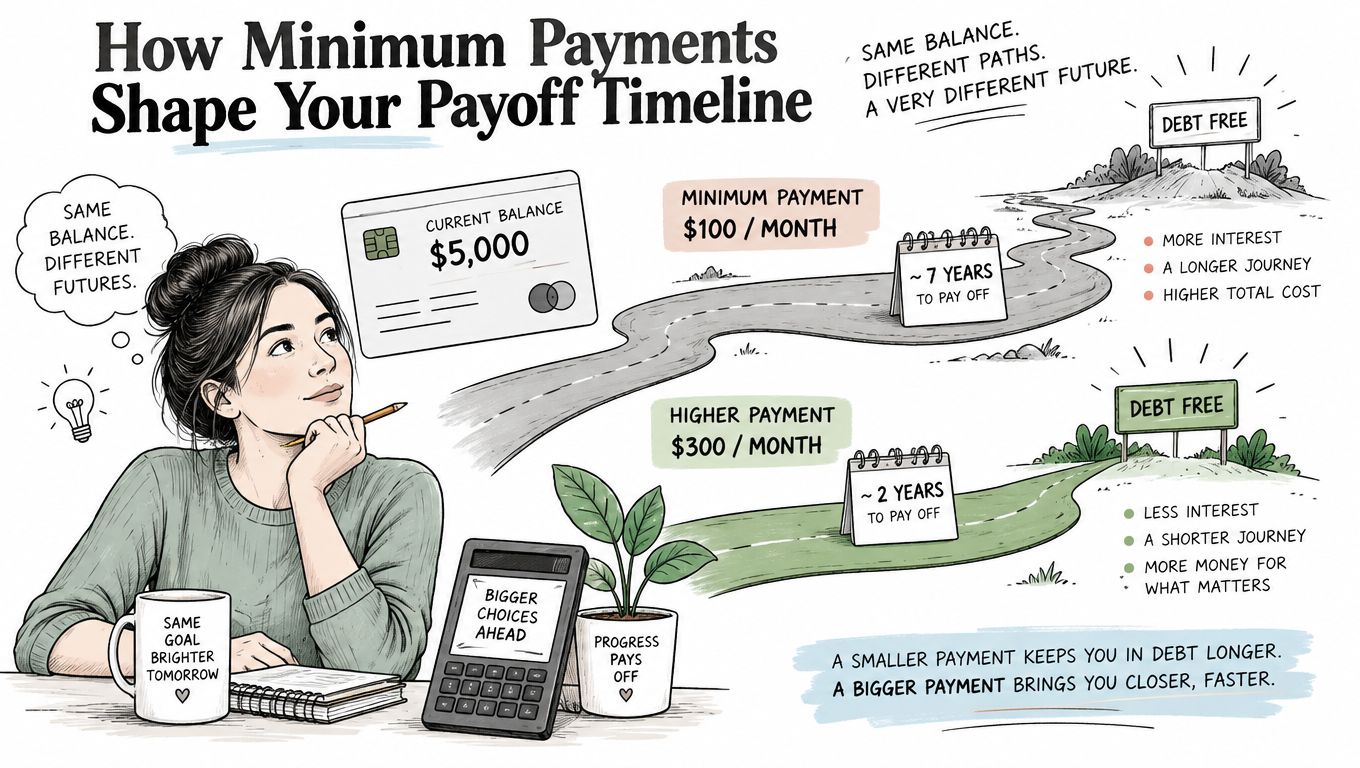
The practical lesson is clear: the minimum keeps the account current, but it does not set a borrower's preferred payoff date. A deliberate payment plan chooses a fixed amount, applies it consistently, and shows how each option affects principal, interest, and time before enrollment in any issuer program, management plan, or settlement arrangement.
Types of Credit Card Payment Plans Compared
The right repayment path depends on what the cardholder can sustain, how quickly the balance must be resolved, and how much credit disruption is acceptable. A fixed DIY schedule is usually the least complicated option, while settlement carries the greatest uncertainty because creditors don't have to accept a negotiated offer.
| Plan Type | Typical Timeline | Total Cost Impact | Credit Effect | Best Fit |
|---|---|---|---|---|
| DIY fixed-payment plan | Set by the cardholder's payment and account terms | Interest continues under existing terms | Usually limited if payments remain current | Stable income and capacity for extra payments |
| Issuer installment program | Fixed period stated by the issuer | Includes disclosed fees or financing costs | Account treatment varies by issuer | A defined purchase needing predictable payments |
| Debt management plan | Set by agency and creditor arrangements | May reduce interest or fees, with possible agency costs | Accounts may be closed or restricted | Several debts and need for one coordinated payment |
| Settlement plan | Negotiated account by account | May reduce balances, but fees and tax consequences can apply | Often significant credit damage | Severe hardship and inability to repay in full |
| Consolidation loan | Fixed loan term if approved | New interest and fees replace card costs | New inquiry and account changes may affect credit | Qualifying borrower with stable repayment ability |
| Bankruptcy | Governed by legal process and eligibility | Legal costs and court requirements apply | Major, lasting credit consequences | Debts exceed realistic repayment capacity |
DIY plans
A DIY plan works best when the cardholder can keep every account current and direct extra money toward one target. The avalanche method prioritizes the highest APR, while the snowball method prioritizes the smallest balance. Both require minimum payments on other accounts and a reliable monthly amount for the target.
Issuer and counseling plans
Issuer installments may organize one purchase without addressing the rest of the card balance. A debt management plan can coordinate several accounts, but the consumer should review account closures, fees, creditor participation, and the required monthly contribution before agreeing.
Settlement and consolidation
Consolidation can simplify payments, but a lower monthly payment isn't automatically a lower total cost. Settlement can be appropriate for serious hardship, yet missed payments and negotiations create risks that don't apply to a current DIY plan.
A lower payment can improve monthly breathing room while increasing the time and total cost of repayment. The comparison must include both.
How to Model Your Credit Card Payoff with Debt Help U
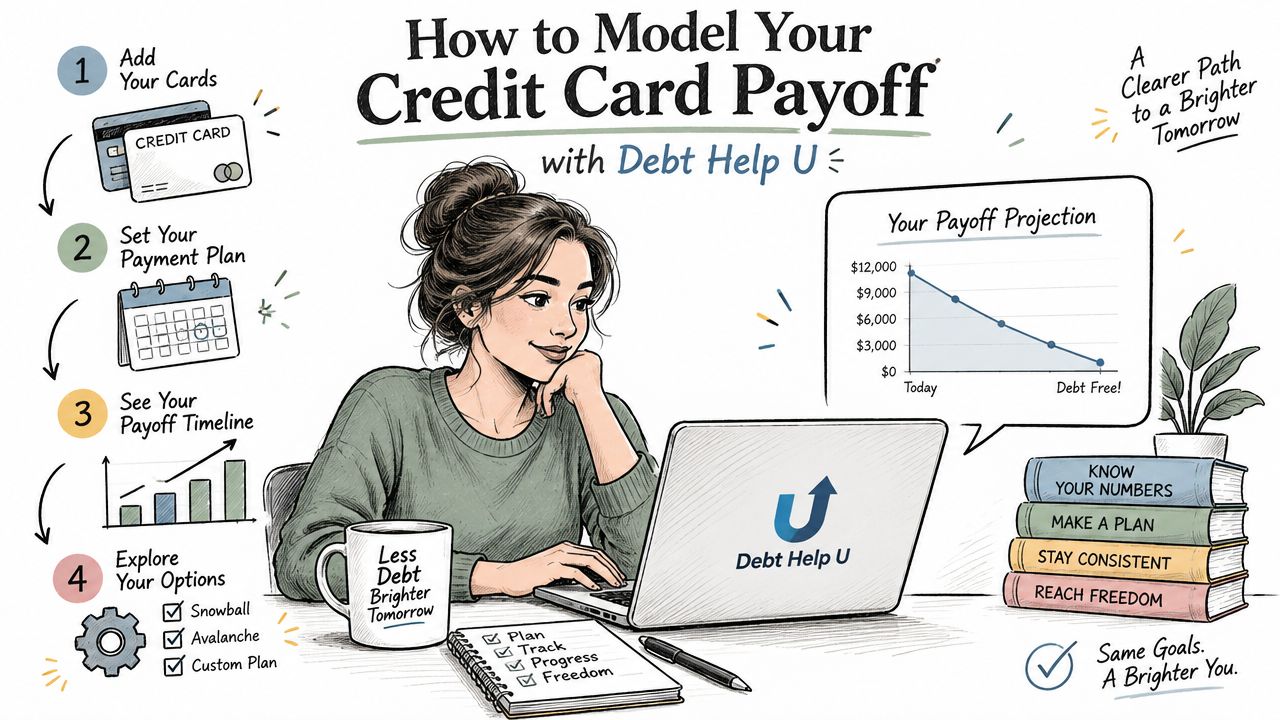
A cardholder facing a large balance can test several paths before changing accounts or contacting a provider. Debt Help U offers browser-based tools for estimating payoff dates, interest, payment increases, priorities across multiple cards, and debt-to-income context. The calculators work without an account, and the inputs remain in the browser during use.
Start with the baseline
Begin with the current balance, APR, and required payment shown on the statement. The minimum payment calculator uses those details to estimate a payoff date and total interest. This first result is a measuring point, not advice. It shows the likely direction of the account if the existing payment pattern continues.
A payoff plan needs a clear starting line. Without a baseline, a lower monthly payment can look attractive even when it extends repayment or increases total interest.
Test one controlled change
The extra-payment simulator shows what happens when a fixed amount is added each month. A reader might test an additional $50 or another amount the budget can sustain. The result is an estimate, because APR, balance, fees, and issuer rules affect the actual outcome.
Use the tools in a consistent order:
- Record the baseline: Enter the current balance, APR, and required payment.
- Add a sustainable amount: Choose an extra payment that does not displace rent, food, utilities, insurance, or emergency needs.
- Compare outputs: Review the projected payoff date and total interest, rather than focusing only on the new monthly amount.
- Check multiple cards: Compare snowball and avalanche priorities. Direct extra funds to one account while paying at least the required amount on the others.
- Review affordability: Use the debt-to-income calculator to see how the proposed payment fits within the household budget.
These steps model a self-managed amortization plan. The same disciplined comparison can clarify issuer installment offers, consolidation, settlement, or bankruptcy information. Each option changes the balance, timing, cost, or credit treatment differently, so the household should model the available figures before committing.
Use the model before choosing relief
If the extra-payment result remains unworkable, the numbers provide a practical basis for questions about outside help. Browser-based exploration lets the household begin privately and compare cost, timing, and account effects before making contact.
When to Choose a Payment Plan Over Other Relief Options
A self-managed payment plan is usually the strongest first option when income is dependable, the balance stops growing, and the household can make consistent overpayments after covering essential expenses. The cardholder keeps control of the account and can see exactly how a higher payment changes the projected payoff path.
The decision changes when the budget cannot support even a stable minimum-payment pattern. Recent data shows that 15% of general-purpose cardholders and 20% of store-branded cardholders made only minimum payments in 2024, while average required minimum payments reached $129 for general-purpose cards and $81 for private-label cards (recent minimum-payment market data). Those figures don't determine an individual's solution, but they show why a rising required payment deserves close attention.
Warning signs that a DIY plan may be insufficient
A structured payment schedule may not be enough when:
- Balances keep increasing: New charges exceed the amount paid each month.
- Income is unstable: The proposed payment depends on overtime, irregular work, or money needed for essentials.
- Interest dominates repayment: The payment barely reduces principal under the issuer's formula.
- Several accounts are distressed: Coordinating separate due dates and creditors has become unmanageable.
- Legal or collection pressure exists: The household needs qualified advice about available formal options.
Debt Help U's guide to how to get debt relief compares consolidation, settlement, and bankruptcy by cost, credit effects, and expected timelines. Consolidation generally replaces several balances with a new loan if the borrower qualifies. Settlement seeks negotiated reductions but can involve missed payments and credit harm. Bankruptcy is a legal process with serious consequences and should be evaluated with qualified legal advice.
The safest plan is the one that remains payable after ordinary household costs, not the one that looks fastest in an ideal month.
Next Steps to Build Your Credit Card Payment Plan
A workable plan starts with accurate inputs rather than a guess based on the minimum due. The following checklist keeps the early work low risk and makes later conversations with issuers or providers more informed.
- Gather account details: List every balance, APR, minimum payment, due date, annual fee, and promotional rate.
- Run a baseline projection: Calculate the expected payoff date and total interest if the current payment pattern continues.
- Test small increases: Compare fixed extra amounts, beginning with a payment the household can sustain without sacrificing essential expenses.
- Choose a priority method: For multiple cards, compare avalanche and snowball approaches while keeping every account current.
- Review issuer programs: Ask whether eligible purchases can be converted into installments, then check the full cost, monthly fee, account treatment, and interaction with existing balances.
- Compare third-party options last: If self-managed repayment remains unaffordable, examine consolidation, counseling, settlement, and bankruptcy with attention to fees, credit effects, eligibility, and legal consequences.
The assessment should also account for debt after death. There isn't one national answer about who owes what. The CFPB explains that survivors are generally not responsible unless they were a co-signer, a joint account holder, or a surviving spouse in a state with applicable community-property rules, and it identifies nine community property states: Arizona, California, Idaho, Louisiana, Nevada, New Mexico, Texas, Washington, and Wisconsin (CFPB guidance on debt after death). The answer depends on the state and on whether the person was a joint account holder or merely an authorized user.
Debt Help U provides free calculators and a six-question assessment that produces an options overview before personal contact details are requested. The platform can introduce qualified users to vetted debt-relief programs only when they explicitly ask, so the household can model repayment before deciding whether outside assistance is appropriate.
A credit card payment plan works best when it matches both the mathematics and the person's ability to keep paying over time. The most useful next action is to collect the account terms, run a baseline, and test a sustainable fixed payment before accepting a new arrangement.
Debt Help U offers free, no-login calculators for payoff timelines, extra payments, multiple-card prioritization, and debt-to-income context, plus plain-language comparisons of repayment and relief options. Visit Debt Help U to model the numbers privately and identify a payment path that fits the household budget.
Related guides
- Debt settlement vs. consolidation vs. bankruptcy Four paths out of unmanageable debt, what each one costs, and what each one breaks. Real numbers on a $30,000 balance, not a pitch for any of them.
- How long will it take to pay off my credit card debt? Your minimum payment shrinks every month. Following it down is what turns a five-year balance into a thirty-five-year one.
- Debt snowball vs. avalanche: which one finishes faster Avalanche always pays less interest. The gap is smaller than the argument about it suggests. Run both on your own balances and see what it is worth.