What Is a Letter of Hardship and How It Works

A letter of hardship is a formal written request to a lender or creditor explaining a qualifying financial setback and asking for specific relief, such as reduced payments, a lower interest rate, fee waivers, or a loan modification. Debt-after-death questions have no single national answer, especially in the nine community property states, because responsibility depends on state law and on whether the survivor was a joint account holder or only an authorized user.
A job loss, serious illness, divorce, or death in the household can make a familiar monthly payment impossible. The borrower may sit at the kitchen table with overdue notices nearby, unsure whether to call the bank, send an email, or wait for a better month. A hardship letter gives that crisis a clear written form that a lender, servicer, or creditor can review.
The document doesn't guarantee approval, erase a balance, or replace legal advice. It does create a structured explanation of what happened, when it happened, how the household's budget changed, and what solution could make repayment realistic.
Table of Contents
- When a Hardship Letter Becomes Your First Real Move
- What a Letter of Hardship Actually Is
- Who You Send a Hardship Letter To and When
- What to Include in a Strong Hardship Letter
- Sample Hardship Letter Sections for Common Situations
- Myths That Lead Borrowers Astray
- How a Hardship Letter Fits Into Your Debt Options
- Practical Next Steps and a Quick Checklist
When a Hardship Letter Becomes Your First Real Move
After losing a job, a borrower may spend the first few days calling creditors, promising to catch up, and hoping new work begins quickly. A sudden medical bill can create the same pattern. The borrower knows the account is in trouble, but a vague plan to “call the bank” doesn't tell the creditor what caused the problem or what assistance could actually work.
A written hardship request turns that uncertainty into a reviewable case. It records the financial setback, connects the setback to the missed or threatened payment, and identifies a practical remedy. Lenders and creditors can then route the request toward a repayment plan, temporary payment relief, fee waiver, loan modification, or another workout option.
Why a written request matters
Phone calls can help a borrower find the correct department, but a conversation may not preserve the full explanation. An informal email may describe distress without identifying the account, documenting the timeline, or stating the exact relief requested. A hardship letter gives the recipient a document that can sit with the rest of the borrower's assistance application.
A mortgage assistance review may require a detailed hardship letter and proof of hardship before the servicer evaluates possible options. The Consumer Financial Protection Bureau homeowner guide explains that borrowers may need a hardship letter as part of that evaluation.
Practical rule: The earlier a borrower documents the problem, the more useful the letter becomes. Waiting until several notices have arrived can leave fewer workable options and less time to assemble proof.
The letter as a bridge
The strongest letter doesn't read like a personal grievance. It presents a short, honest explanation followed by evidence and a defined request. A borrower who lost employment might explain the last working date, attach termination documentation, show current household income, and request a temporary payment arrangement while searching for work.
The letter is therefore a first real move, not merely a record of failure. It tells the creditor that the borrower recognizes the problem, understands the account, and is asking for a solution based on actual cash flow.
What a Letter of Hardship Actually Is
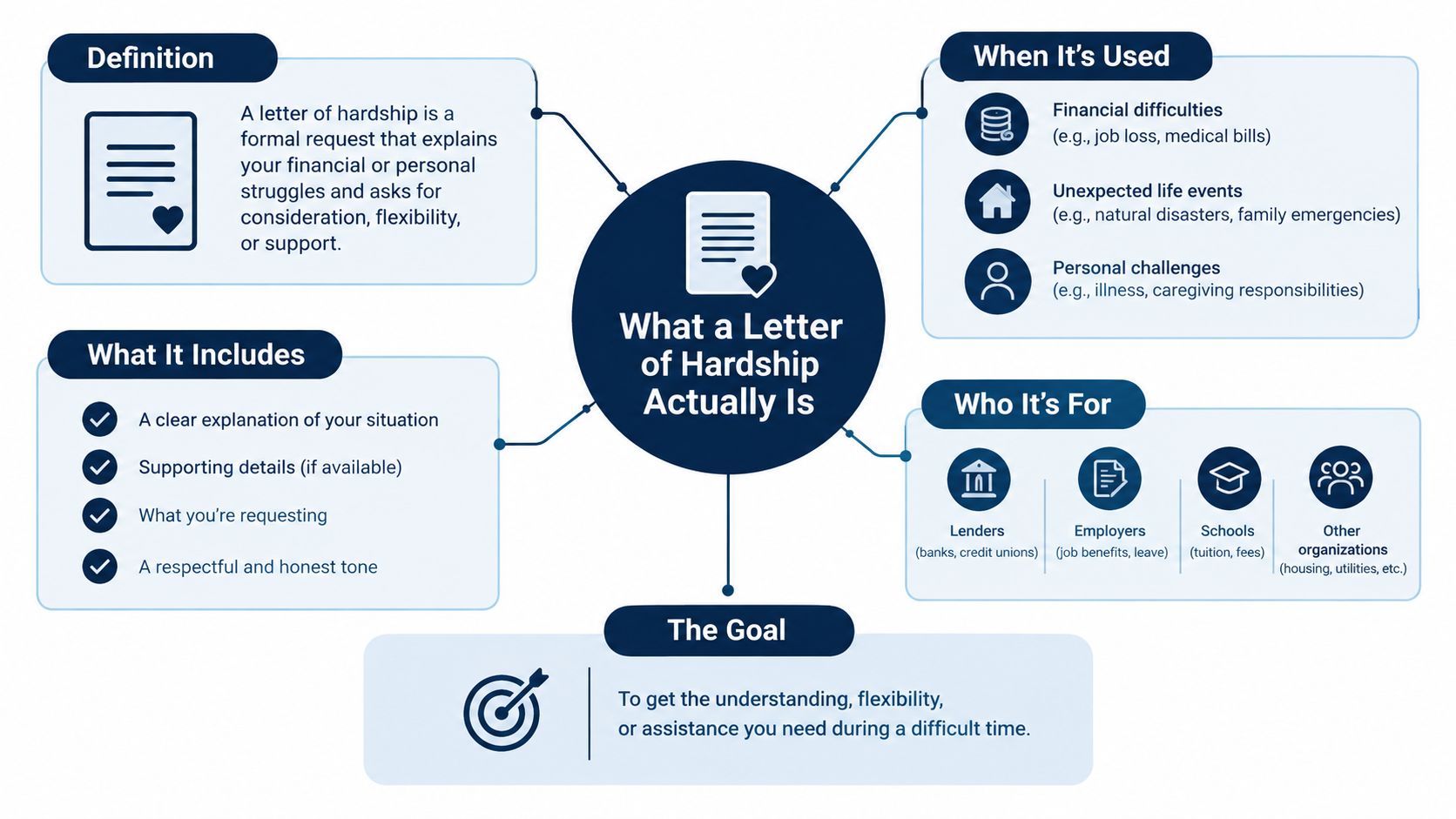
A letter of hardship is a formal written request sent to a lender, mortgage servicer, creditor, or collection agency. It explains why the borrower can't make the normal payment because of a qualifying financial setback and asks for a defined form of relief.
The document may request reduced payments, a lower interest rate, waived late fees, forbearance, a payment plan, a settlement discussion, or a loan modification. A Cambridge Dictionary definition of letter of hardship reflects the long-standing idea of writing to a bank or lender to explain why a payment can't be made or to ask to pay less than usual.
Four elements creditors need
A useful letter normally answers four questions:
Which account and borrower are involved? The opening should identify the borrower, account number, property address when relevant, mailing address, phone number, and email address.
What happened? The explanation should name the event, such as job loss, illness, divorce, reduced income, hospitalization, or overextended credit use. The facts should be truthful and specific, without turning the letter into a long personal history.
How did the event affect the budget? Income, essential expenses, available funds, and the resulting shortfall should align with pay stubs, bank statements, medical records, or other supporting material.
What relief is requested? The creditor needs a clear remedy to evaluate. A request might involve a temporary payment reduction, interest-rate relief, a fee waiver, a repayment plan, or a modification of the loan terms.
A generic complaint email says that the payment is unaffordable. A hardship letter explains why, shows when, and asks what should happen next. Honest, organized writing usually gives the reviewer more usable information than an emotional letter filled with accusations or unsupported promises.
Who You Send a Hardship Letter To and When
The original lender isn't always the correct recipient. A mortgage may be owned by one institution but serviced by another company. A credit card account may have moved to a financial assistance department or a collection agency. Sending the letter to the wrong address can delay review, so the borrower should call the number on the statement and confirm the department, mailing address, upload portal, and required forms.
Mortgage requests generally go to loss mitigation, mortgage assistance, or workout teams. Credit card issuers may use a financial assistance or hardship-program department. Personal loans can be handled by the current servicer, while an account in collections may require communication with the named collection agency. The recipient should match the account statement and the creditor's current instructions.
Situations that commonly trigger a request
A qualifying setback can take many forms:
- Employment disruption: Job loss, reduced hours, or an unexpected income reduction.
- Health crisis: Illness, hospitalization, ongoing treatment, or major medical costs.
- Household change: Divorce, separation, or the death of a co-borrower.
- Property or community event: Natural-disaster damage that interrupts income or creates necessary expenses.
- Service obligations: Military deployment or another change that affects household finances.
- Business trouble: A failed contract, closure, or severe revenue loss for a self-employed borrower.
The timing matters because a creditor needs time to review documents and determine whether a program fits. A borrower shouldn't assume that sending a letter automatically pauses collection activity or eliminates the need to make payments.
| Debt Type | Typical Recipient | Best Trigger to Send |
|---|---|---|
| Mortgage | Loss mitigation or mortgage assistance team | Income loss, illness, divorce, disaster, or another event threatening future payments |
| Credit card | Card issuer's hardship or financial assistance department | A minimum payment no longer fits the verified household budget |
| Personal loan | Current servicer or lender's workout department | A documented income interruption or unavoidable expense increase |
| Debt in collection | Named collection agency or creditor identified in the notice | A request for a payment arrangement, fee relief, or settlement review |
For questions about collection communications and consumer protections, a borrower can review Debt Help U's guide to rights when a debt collector calls. A secured portal upload can create a digital record, while certified mail can provide delivery evidence. Copies of the letter, attachments, delivery confirmation, and follow-up notes should remain together.
What to Include in a Strong Hardship Letter
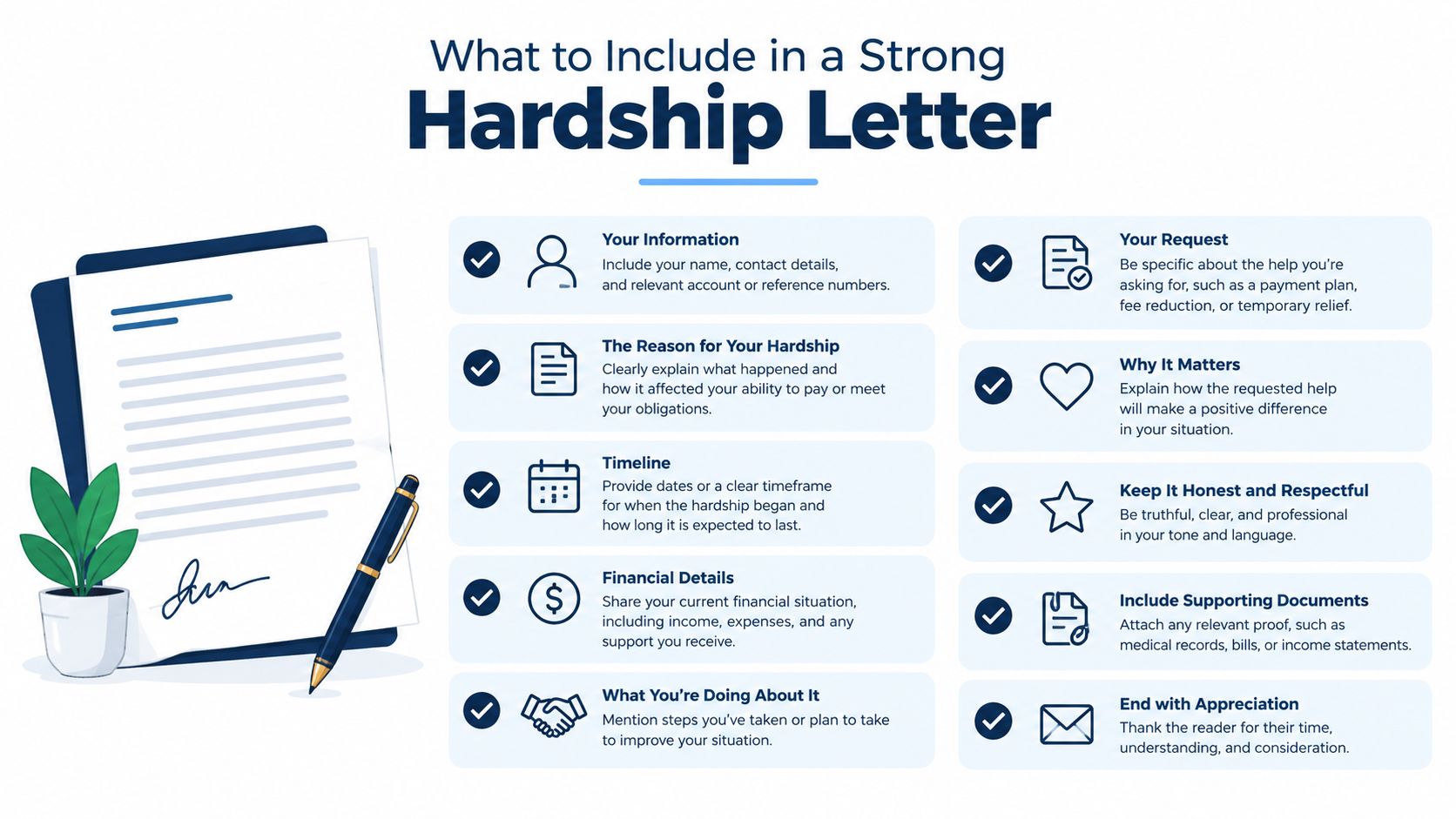
A creditor reviewing a hardship request is trying to understand whether the proposed relief matches the borrower's actual situation. The letter should therefore move in a logical order, from the event that caused the problem to the remedy that could address it.
Start with the trigger event
The first building block is a plain description of the setback. “Income has declined” is less useful than “Employment ended on [date] after [brief reason].” A borrower facing medical hardship can identify the diagnosis or treatment period without disclosing more private information than the creditor needs.
Supporting evidence should connect directly to the explanation. Depending on the situation, that could include a termination letter, recent pay records, medical documentation, court filings related to divorce, insurance information, or records showing a household death. The evidence doesn't need dramatic language. It needs to be relevant and consistent.
Establish the timeline
The reviewer needs to know when the hardship began and whether it is temporary, ongoing, or uncertain. A letter can explain that income stopped on [date], that a return to work is expected around [month and year] if known, or that the household is still adapting to a long-term medical condition.
A realistic timeline is more credible than an optimistic promise. Mortgage assistance materials commonly ask borrowers to explain how long the hardship may last because the expected duration can affect the type of assistance considered.
Show the budget honestly
The budget section should list current monthly income, essential expenses, and the remaining shortfall. Housing, utilities, food, transportation, insurance, medical costs, and other necessary obligations should be separated from discretionary spending where possible.
The figures must match the attached pay stubs, bank statements, and other records. A budget that claims no available income while showing unexplained deposits can weaken the request. The purpose isn't to produce a perfect financial plan. It is to show what payment the household can realistically sustain.
Make one specific request
The final building block is a defined remedy. Depending on the account, the borrower might request a temporary forbearance, reduced payment arrangement, interest-rate reduction, loan-term extension, waived late fees, or modified payment plan.
The Experian guidance on writing a hardship letter to creditors identifies the start date, cause, expected duration, and requested relief as important information for creditors. A dated header, account number, complete contact details, polite closing, and a list of attachments make the letter easier to process.
The borrower should keep the original records and a complete copy of everything submitted. Personal details should be sent through the creditor's verified portal or mailing channel, not through an unconfirmed address.
Sample Hardship Letter Sections for Common Situations
The same four-part structure can serve different debts, but the requested remedy should fit the creditor's program. Each sample below is a short framework, not a promise that the recipient will approve the request.
Mortgage hardship
Account and event: “Borrower [full name], loan account [number], requests mortgage assistance. Employment income ended on [date], and household income has fallen from [amount] to [amount]. The attached employment record and budget show the resulting payment shortfall.”
Request: “The borrower requests review for [temporary forbearance, repayment plan, or loan modification] and asks the servicer to provide the documents required for the applicable loss-mitigation program.”
Credit card hardship
Account and event: “Borrower [full name], account ending in [digits], experienced [job loss, illness, divorce, or other event] beginning [date]. The current minimum payment no longer fits the attached income and essential-expense budget.”
Request: “The borrower requests consideration for a reduced interest rate, fixed payment plan, waived fees, or another available hardship arrangement, with written terms before enrollment.”
Medical debt
Account and event: “Patient [full name], account [number], incurred treatment costs connected to [condition or treatment period]. Insurance coverage changed or did not cover the full balance beginning [date]. Supporting insurance and billing records are attached.”
Request: “The patient requests review for the provider's charity-care, financial-assistance, hardship write-off, or settlement process and asks for the application requirements in writing.”
| Debt Type | Trigger Event to Cite | Specific Relief to Request | Supporting Documents |
|---|---|---|---|
| Mortgage | Income interruption or household change | Forbearance, repayment plan, or loan modification | Income records, hardship proof, budget, account information |
| Credit card | Reduced income or unaffordable minimum payment | Lower rate, fixed plan, or fee waiver | Pay records, bank statements, budget, account statement |
| Medical debt | Treatment costs or insurance gap | Charity-care review, write-off, or settlement review | Bills, insurance explanation, medical records where relevant |
| Personal loan | Job loss or unavoidable expense growth | Payment adjustment or settlement discussion | Income proof, expense records, budget, loan statement |
A borrower considering a final balance resolution can also review Debt Help U's payment-in-full letter guide, while keeping in mind that a payment-in-full proposal differs from a request for temporary hardship relief.
Myths That Lead Borrowers Astray
A hardship letter helps a creditor evaluate a request, but it doesn't force a particular result. Approval can depend on the account status, the borrower's documented ability to pay, the creditor's program rules, and the requested remedy. A sincere story without supporting facts may still fail to establish a workable plan.
Myth one says hardship guarantees approval
Creditors don't approve assistance merely because a borrower experienced a painful event. They may assess whether the borrower can resume payments, whether the proposed arrangement addresses the shortfall, and whether the account qualifies for a program. A request becomes stronger when the borrower supplies consistent records and asks for relief connected to the budget.
Myth two says every hardship program damages credit
Sending a letter by itself doesn't automatically damage a credit score. However, a forbearance, modification, settlement, or other arrangement may affect how the account is reported, depending on the creditor and the agreement. Before signing, the borrower should ask how the account will be coded, whether interest continues, what happens to fees, and whether payments are reported as current or delinquent.
Myth three says survivors always inherit debt
Debt generally doesn't disappear at death, but it is usually addressed through the deceased person's estate. The Consumer Financial Protection Bureau explains in its guidance on debt after a person's death that the result depends on state law and on whether the survivor was a co-signer, joint account holder, or covered by another exception.
The distinction between roles is important. A joint account holder may share responsibility for the balance, while an authorized user generally isn't responsible solely because that person was allowed to use the account, as explained in Equifax's guidance on credit accounts after death.
The nine community property states deserve particular caution because marital-property rules can affect responsibility differently from rules in other states. No family member should assume that a collector's demand is automatically valid or that an estate automatically eliminates every obligation. A state-specific review may be necessary before signing an agreement or transferring funds.
How a Hardship Letter Fits Into Your Debt Options
A hardship letter is usually an entry point into a creditor's workout process, not the final solution. The same document can lead to different discussions depending on whether the debt is secured, unsecured, medical, or already in collection.
| Debt Type | Common Programs Triggered | Typical Relief Asked For |
|---|---|---|
| Home loan | Forbearance, repayment plan, or loan modification | Lower payment, lower rate, longer term, fee relief, or principal-related assistance |
| Credit card | Issuer hardship program or fixed payment arrangement | Reduced interest, waived fees, or a manageable payment |
| Medical debt | Charity-care review, financial assistance, or settlement discussion | Write-off, reduced balance, or structured payments |
| Personal loan | Workout arrangement or settlement review | Payment adjustment, term change, or negotiated resolution |
| Multiple unsecured debts | Counseling, settlement evaluation, or bankruptcy consultation | A coordinated repayment or legal strategy |
For a mortgage, the requested remedy should reflect whether the income interruption is temporary or ongoing. A temporary interruption may point toward a repayment arrangement or payment pause, while a lasting reduction in income may require a modification that changes the payment structure. The servicer's evaluation determines what is available.
For credit cards, a borrower may request a lower interest rate, waived fees, or a fixed payment arrangement. For medical accounts, the appropriate route may be the provider's financial-assistance process rather than a general debt negotiation. An unsecured personal loan may call for a payment adjustment or a settlement conversation, but the creditor can reject any proposal.
The Debt Help U guide to debt relief options can help a consumer compare repayment, consolidation, settlement, and bankruptcy at a high level. Debt Help U also provides no-login calculators for estimating payoff timing and comparing repayment strategies, plus an optional introduction to a third-party provider when a qualified user requests it. It isn't a lender, creditor, collector, law firm, or negotiator, and it doesn't guarantee an outcome.
Bankruptcy may become part of the discussion when negotiated options don't resolve the problem. A hardship letter can show good-faith efforts to communicate, but it isn't a bankruptcy filing and shouldn't be treated as a substitute for advice from a licensed attorney.
Practical Next Steps and a Quick Checklist
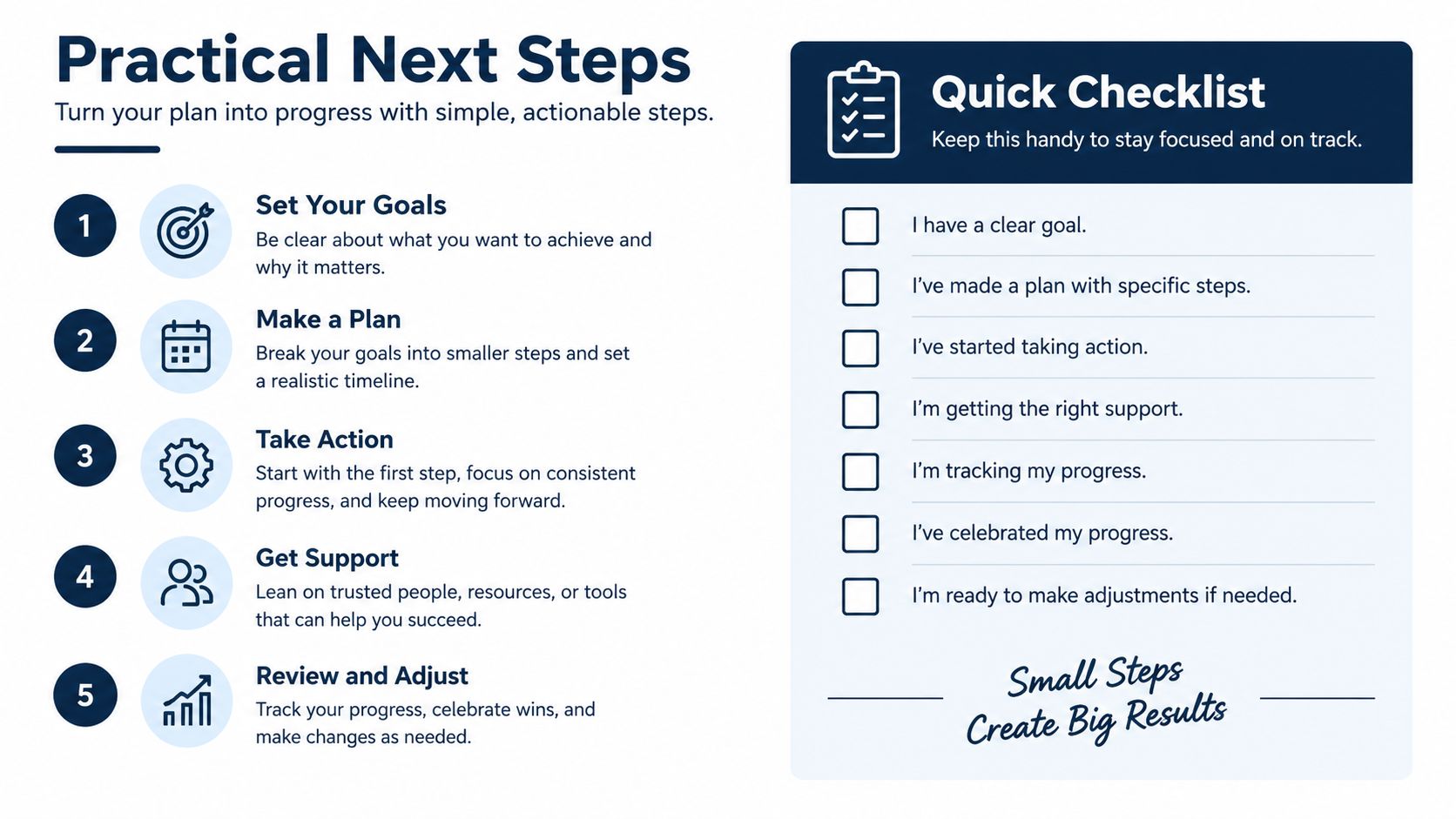
A borrower can prepare a useful first draft in one sitting by gathering the account statement, a recent credit report, and a household budget covering current income and essential expenses. The letter should then connect the hardship event to the shortfall and request a remedy that matches the creditor's process.
Before sending
- Confirm the recipient: Call the servicer or creditor and verify the correct hardship, loss-mitigation, or financial-assistance department.
- Collect proof: Attach relevant income records, termination documents, medical evidence, court filings, bills, or other records supporting the event.
- Check consistency: Make sure the letter, budget, pay records, and bank statements tell the same story.
- State the request: Identify the desired payment arrangement, fee relief, rate reduction, forbearance, modification, or review.
- Create a record: Upload through the verified portal or send by certified mail, then save the confirmation and a complete copy.
- Follow up in writing: If no response arrives, document each contact and send a written follow-up every 10 to 14 days.
A borrower shouldn't exaggerate the hardship, promise a payment that the budget can't support, or stop paying without asking whether a grace period or temporary arrangement applies. State law, investor requirements, creditor policy, and account status can all change the answer.
A nonprofit housing counselor or consumer credit counseling agency may review the letter before submission. A licensed attorney in the relevant state should review any proposed settlement, foreclosure strategy, bankruptcy path, or question involving responsibility for a deceased person's debt.
Debt Help U offers plain-language guides and no-login calculators that help consumers compare repayment strategies and understand the possible cost and timeline of unsecured debt. Visit Debt Help U to review debt options privately before deciding whether a hardship request, counseling conversation, or professional consultation fits the household's situation.
Related guides
- Debt settlement vs. consolidation vs. bankruptcy Four paths out of unmanageable debt, what each one costs, and what each one breaks. Real numbers on a $30,000 balance, not a pitch for any of them.
- How long will it take to pay off my credit card debt? Your minimum payment shrinks every month. Following it down is what turns a five-year balance into a thirty-five-year one.
- Debt snowball vs. avalanche: which one finishes faster Avalanche always pays less interest. The gap is smaller than the argument about it suggests. Run both on your own balances and see what it is worth.