Debt Relief Referral Program for Insurance Agents Guide
A client arrives for an annual policy review worried about a premium increase. Before the conversation reaches coverage, the client mentions that credit-card minimums are consuming the cash that used to fund insurance and retirement contributions. The agent wants to help, but a casual recommendation to “try debt settlement” could expose the agency to privacy complaints, misleading-advertising allegations, licensing questions, and reputational damage.
A debt relief referral program for insurance agents should therefore be treated as a controlled client-service process, not a side hustle. The agency needs vetted partners, documented disclosures, careful triage, secure handoffs, and clear boundaries around advice. A referral can add genuine value, but only when the client understands what happens next and why the agency is involved.
Table of Contents
- Why Insurance Agents Need a Structured Referral Path
- Vetting Debt Relief Partners for Compliance and Quality
- Navigating Regulatory Disclosures and Fiduciary Boundaries
- Scripting the Client Conversation and Triage Process
- Using Privacy-Preserving Tools for Secure Client Handoffs
- Managing Compensation Tracking and Debt-After-Death Rules
Why Insurance Agents Need a Structured Referral Path
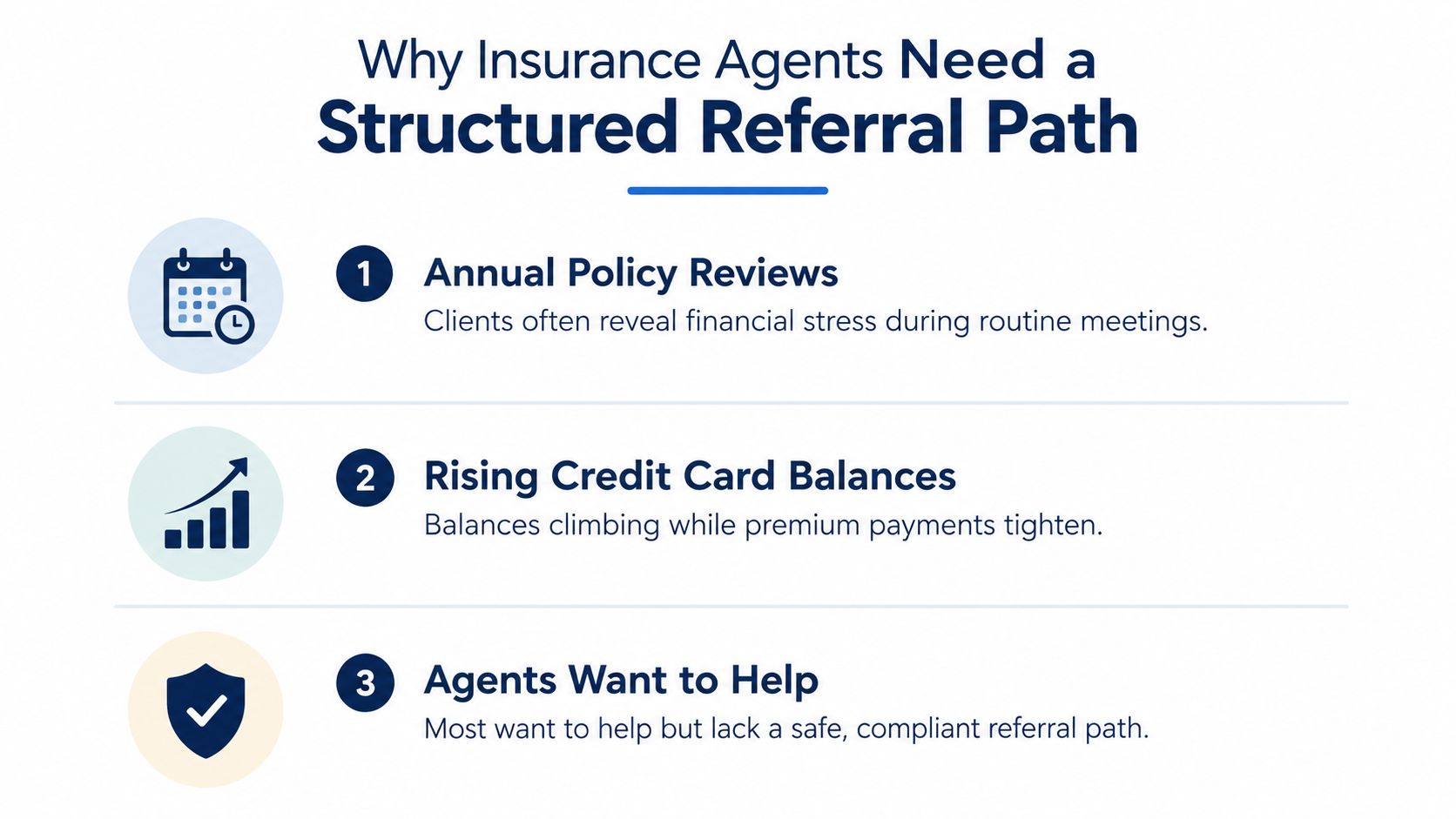
Debt stress often surfaces indirectly. A client may say that premiums feel harder to manage, that a spouse's card balances have grown, or that a planned retirement contribution needs to be postponed. The agent doesn't need to diagnose the household's finances to recognize a service need. The agent does need a safe way to respond.
Credit-card pressure is substantial. Bankrate's 2026 credit-card debt report states that 61% of cardholders with balances had been in debt for at least a year, up from 53% in late 2024. The same report cited U.S. credit-card debt at a record $1.233 trillion in Q3 2025, an average balance of $6,523 per borrower in late 2025, and an average revolving interest rate of 24.04%. Those figures explain why a policy review can become a financial-wellness conversation, even when debt isn't the reason for the appointment.
The risk lies in improvisation. Sending a client to an unfamiliar company, forwarding personal details by email, or repeating a provider's promise without checking it can make the agent part of a problematic marketing chain. A structured path keeps the agent in an appropriate role: identify concern, offer neutral education, obtain permission, and make a transparent introduction only when the client wants one.
A referral is a service, not a sales pitch
Agents should position debt education alongside budgeting, emergency planning, and retirement readiness. The conversation isn't an invitation to sell a settlement program. It is an opportunity to help a client understand options before a financial problem disrupts coverage or long-term planning.
A useful first screen can include the client's debt type, payment burden, cash flow, and immediate hardship. A debt-to-income formula guide can help explain the calculation without requiring the agent to make an eligibility determination. The agent should avoid collecting full account numbers, login credentials, or detailed creditor records during an insurance meeting.
The market requires realistic expectations
Debt settlement is not a quick fix. Industry summaries describe professional settlement as a 24–48 month process, with the first settled account often occurring within about 4–9 months after enrollment once enough money has accumulated for an offer, as summarized in USA Today's comparison of debt consolidation, settlement, and bankruptcy. Chapter 13 bankruptcy typically involves a 3–5 year repayment plan, while Chapter 7 often concludes in about 4–6 months, also according to that comparison.
That range makes education essential. A client who needs immediate payment relief may not be suitable for a program that requires sustained deposits and may involve serious credit consequences. The agency's referral process should help the client compare consolidation, counseling, settlement, and bankruptcy without presenting one route as universally appropriate.
Practical rule: If the agency can't explain what the client will be asked to do, how long the process may take, and what risks may arise, the agency isn't ready to make the referral.
Vetting Debt Relief Partners for Compliance and Quality
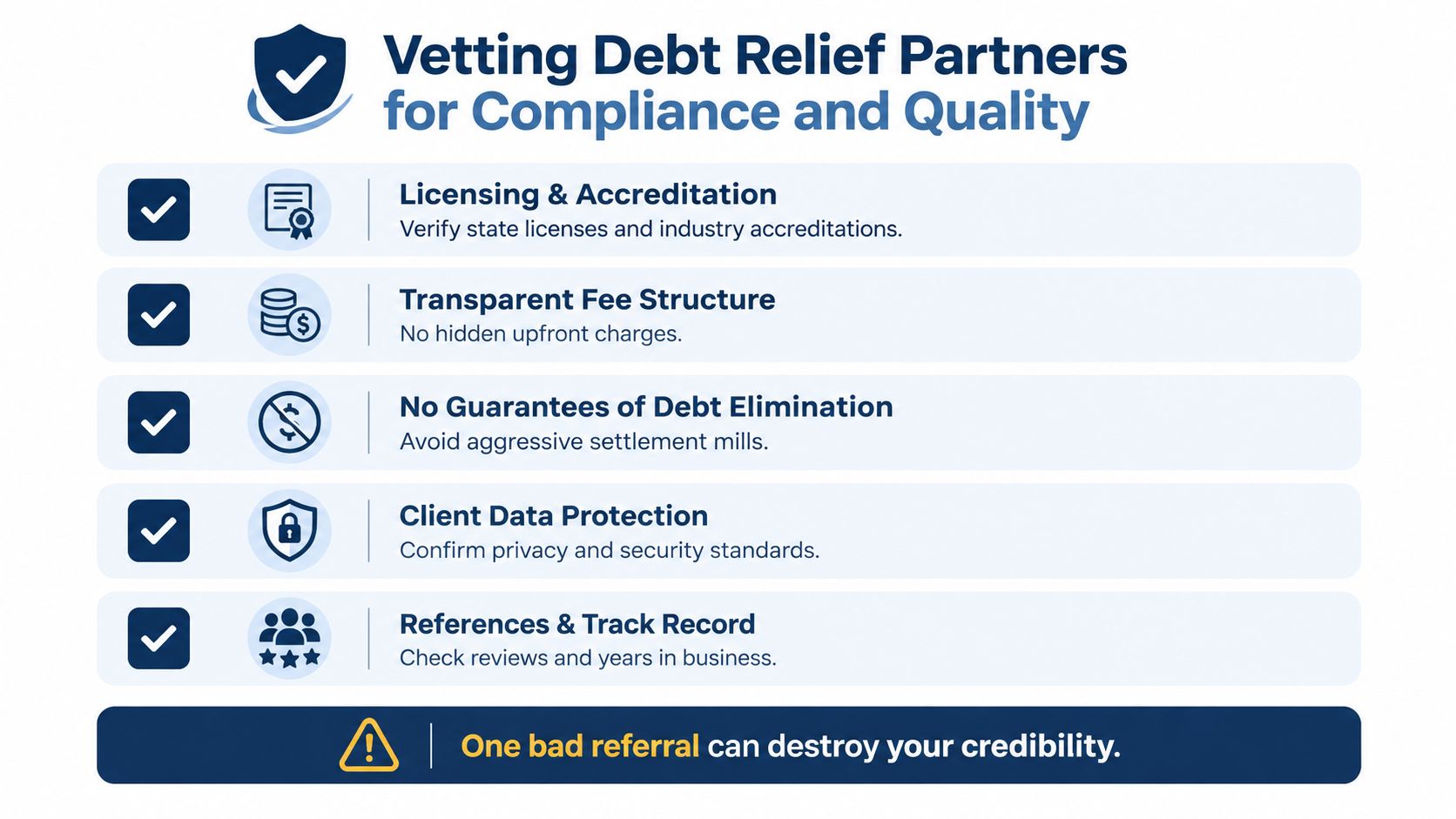
Partner selection determines whether the program protects the agency or creates a recurring liability. A polished website isn't enough. The agency should review the provider as carefully as it would review a carrier, technology vendor, or outsourced service that touches client information.
The first question is whether the partner's business model aligns with consumer protection rules. The Consumer Financial Services Outlook 2026 highlights lead generation, affiliate marketing, and third-party relationships as areas of regulatory and litigation exposure in debt relief. Recent FTC guidance reinforces that legitimate debt-relief assistance must avoid upfront fees and must not promise guaranteed or fast outcomes.
Start with the provider's operating evidence
A serious review should produce documents, not impressions. The agency should ask for the provider's state availability, licensing information where applicable, consumer agreements, fee disclosures, complaint process, privacy notice, and sample advertising. The provider should explain which services it performs and which services it doesn't perform.
Use this checklist before any referral link goes live:
- State availability: Confirm that the provider can lawfully serve the client's state and explain any state-specific restrictions.
- Fee timing: Reject partners that demand prohibited upfront fees or obscure when compensation becomes payable.
- Outcome language: Remove claims promising guaranteed savings, guaranteed enrollment, rapid resolution, or elimination of every debt.
- Program mechanics: Require plain-language explanations of deposits, creditor contact, settlement authority, possible late fees, charge-offs, and credit-score effects.
- Data practices: Determine what information the partner collects, when it collects it, where it stores it, and which parties receive it.
- Escalation procedures: Identify who handles complaints, withdrawal requests, privacy inquiries, and suspected misconduct.
- Compensation disclosure: Obtain the exact language describing the agency's financial interest.
The provider should also explain how it screens consumers. A referral partner that accepts every lead may create high cancellation rates and expose clients to unsuitable programs. Stable cash flow and the ability to sustain deposits matter because settlement commonly depends on building funds over time while creditor payments may stop.
Compare completion evidence carefully
Completion data varies sharply by definition and methodology. A government and state-investigation summary reported by WorldMetrics notes that FTC and state reviews often found less than 10% of consumers successfully completed settlement programs, while a TASC survey cited in the same hearing reported 34.4% completion at a 75% debt-settled threshold. The difference is a warning against accepting a single headline metric without asking what “completion” means.
Credit counseling presents a different profile. An FDIC-hosted paper reports one provider's 68.4% completion rate across 14,670 enrollments, with 28.1% canceled and 3.5% still active. The same underlying academic research found that only 4.8% to 6.12% of free-counseling clients converted to a debt-management plan after counseling sessions, showing that affordability and initial conversion can be the main bottlenecks.
An agency doesn't need to choose a provider based on the highest advertised number. It should choose a partner that explains its methodology, discloses limitations, and helps unsuitable consumers find a more appropriate resource.
Navigating Regulatory Disclosures and Fiduciary Boundaries
The agent's role must remain narrow and explicit. Insurance agents can identify a concern and provide access to educational resources, but a referral doesn't authorize them to negotiate debts, recommend bankruptcy, assess legal liability, or determine that a settlement program is suitable for a particular household.
The agency should disclose three things before the handoff. First, the agency may receive compensation if the client enrolls through the referral. Second, the referred company is a separate third party. Third, the client can decline the referral and can seek other options, including nonprofit counseling, legal advice, direct creditor contact, or no action.
Put the disclosure where the decision occurs
A disclosure buried in a website footer won't address a conversation in which an agent recommends a provider. The notice should appear in the referral page, consent screen, email confirmation, and any material that describes the partner.
A practical agency disclosure can read:
“The agency may receive compensation if a client chooses to enroll with a third-party debt-relief provider introduced through this referral. The provider is independent from the agency. The agency doesn't provide debt settlement, legal, bankruptcy, credit-repair, or financial-planning advice through this referral. The client may compare other resources and is not required to proceed.”
Compliance counsel should adapt that language to the agency's states, licenses, business model, and privacy obligations. The exact wording matters less than accuracy, visibility, and consistency across channels.
Agents should also review scripts for prohibited claims. They shouldn't say a program will “erase debt,” “stop collection calls,” “save everyone money,” or “fix credit quickly.” They shouldn't predict acceptance, settlement amounts, completion dates, or creditor behavior. The FTC's consumer-protection principles concerning no upfront fees and no guaranteed or fast outcomes should guide every landing page, email, social post, and spoken explanation.
Separate insurance advice from debt advice
A debt conversation can affect insurance recommendations. A client under cash pressure may consider reducing coverage, surrendering a policy, borrowing against cash value, or stopping premiums. Those decisions belong in the insurance discussion, but they should not be used to pressure the client into a debt referral.
The agent should document the distinction:
- The insurance file records the coverage discussion and any client-directed changes.
- The referral record shows the client's permission, disclosure acknowledgment, and destination.
- The agency avoids storing unnecessary debt details in the insurance-management system.
- The partner receives only information the client expressly authorizes.
This structure helps prevent a referral arrangement from looking like an undisclosed financial recommendation or a disguised cross-sell.
Scripting the Client Conversation and Triage Process
The safest transition sounds ordinary and gives the client control. During a policy review, an agent might say:
“The premium concern sounds connected to broader monthly cash flow. The agency doesn't provide debt advice, but there are neutral tools that can help show payoff timelines and compare general options. Would the client like that resource, or would it be better to keep today's meeting focused on coverage?”
That question avoids assumptions. It also gives the client a graceful way to decline.

Use triage before referral
The agent's job is not to select a debt program. It is to determine whether a referral conversation is appropriate and whether the client needs a different resource first.
A simple triage sequence works well:
- Identify the immediate issue. Is the client struggling with a one-time expense, a recurring cash-flow gap, rising minimum payments, or several types of debt?
- Ask about stability. Could the client sustain a monthly payment or deposit after essential living costs and insurance premiums?
- Separate debt categories. Credit cards and other unsecured debts may be treated differently from secured debts, tax obligations, student loans, or court-ordered obligations.
- Check readiness. A client who is distressed but unwilling to share information or consider options shouldn't be pushed toward enrollment.
- Offer education first. A payoff calculator, debt-to-income explanation, nonprofit counseling resource, or legal referral may be more appropriate than a settlement introduction.
- Obtain affirmative consent. The client should request the introduction rather than being transferred without being asked.
The letter of hardship guide can be offered as general educational material when a client is communicating financial difficulty to a creditor. It shouldn't be presented as a guarantee that a creditor will modify terms or accept a settlement.
A client example without a sales pitch
Suppose a client says that several card minimums now compete with a life-insurance premium. The agent can acknowledge the pressure, explain that the agency isn't a debt counselor, and ask whether the client wants an educational resource. If the client says yes, the agent can provide a neutral link and leave the client to review it privately.
If the client later requests an introduction, the agent can confirm the disclosure: “The company is independent, and the agency may receive compensation if enrollment occurs. The company will explain eligibility, costs, risks, and alternatives. Does the client authorize the agency to share contact information?”
That final question matters. It prevents a casual disclosure during an insurance meeting from becoming an unsolicited lead.
Settlement suitability deserves particular caution. The FDIC-hosted research supports using affordability screening because low cash flow can lead to cancellations, while properly screened consumers are more likely to complete structured repayment. An agent shouldn't refer a client whose budget clearly cannot support the program's requirements.
The best script gives the client information, time, and a clear exit. Pressure is a compliance failure, not a conversion strategy.
Using Privacy-Preserving Tools for Secure Client Handoffs
Traditional lead generation asks for a phone number before the consumer understands the product. That approach creates friction and increases privacy risk, especially when the consumer is discussing financial hardship. It also gives the agent little control over how many vendors will contact the client or what information will circulate.
A privacy-preserving path reverses the order. The client first receives education, uses a calculator, compares options, and decides whether a formal introduction is necessary. No partner should receive contact information merely because a client explored a debt article.
Compare the two handoff models
| Traditional lead handoff | Privacy-preserving educational path |
|---|---|
| Contact details are requested early | The client can begin without creating an account |
| A vendor may call before the client understands the options | The client reviews repayment and relief choices first |
| The agent may not know which data was collected | The agency can direct the client to a defined tool and disclosure |
| The referral can feel like a sales transfer | The client requests an introduction after reviewing information |
| Debt details may travel through email or spreadsheets | The initial assessment can remain private until consent is given |
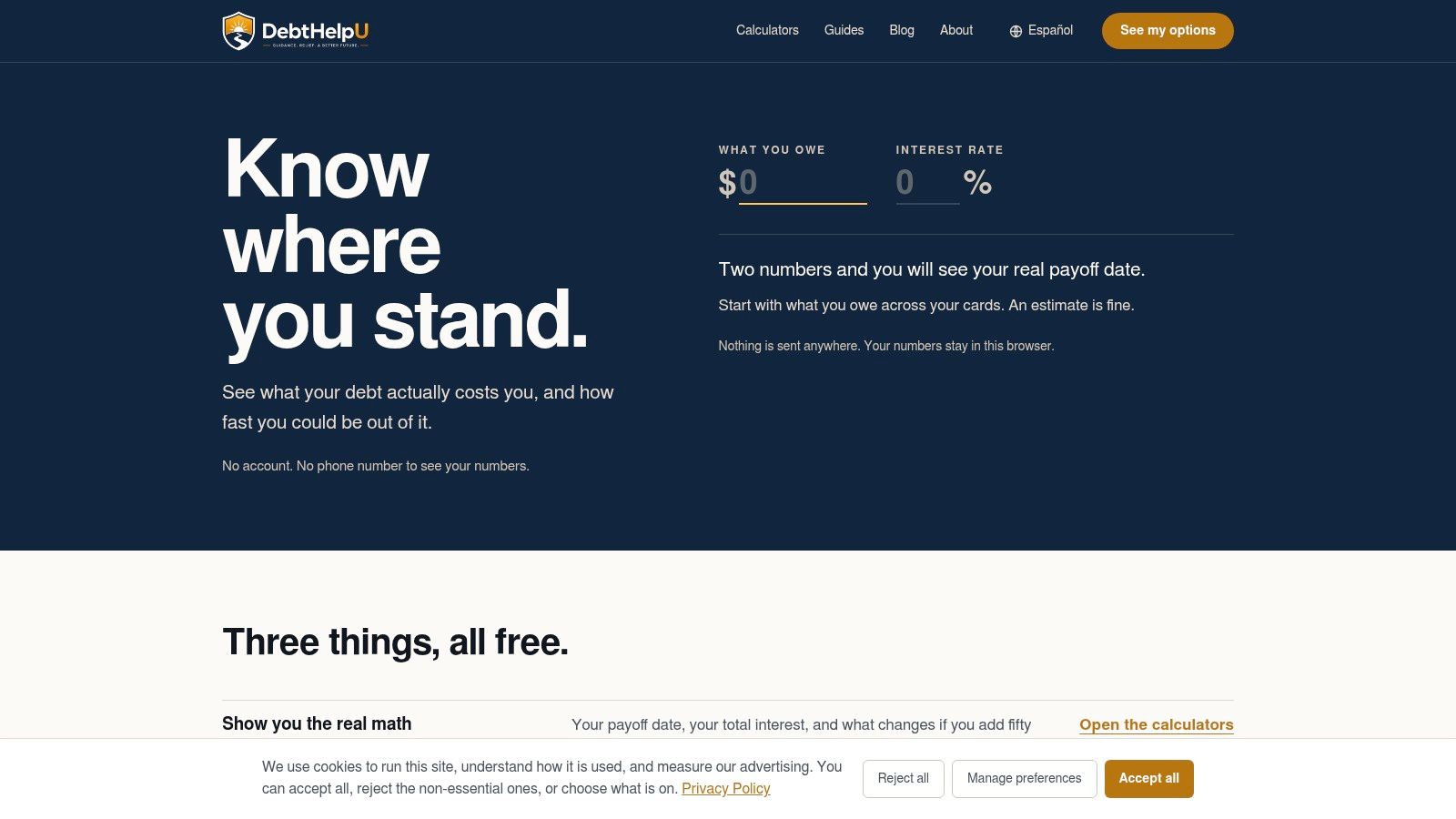
In-browser tools can show minimum payments, payoff dates, extra-payment effects, and debt-to-income context without requiring a phone number. They also let the consumer compare consolidation, settlement, and bankruptcy at a general educational level before speaking with a provider.
Debt Help U offers no-login calculators, plain-language guides, a six-question assessment, English and Spanish core resources, and an optional introduction to a third-party provider when a user requests it and appears to qualify. Its stated model keeps calculator inputs in the browser and discloses that the platform earns a referral fee when an introduced consumer enrolls.
Make privacy part of the workflow
An agency should never paste a client's debt list into a shared spreadsheet, send account information through ordinary email, or forward a client's phone number without permission. The agent can instead provide the approved educational resource directly and record only that the resource was offered, whether consent was given, and which disclosure was presented.
The platform still needs review. Agents should verify its privacy notice, scope, state availability, referral disclosures, and data practices before recommending it. Privacy-preserving design lowers exposure, but it doesn't eliminate the agency's responsibility to choose a suitable resource.
The handoff should end with control returning to the client. If the client wants a provider introduction, the client should submit the request or authorize the agency through a documented consent process. If the client doesn't request contact, the agency should not treat calculator use as permission to market.
Managing Compensation Tracking and Debt-After-Death Rules
A referral program needs an operating ledger. Each referral should have a unique tracking method, a consent record, the disclosure version presented, the date of the introduction, and the compensation status. The agency should reconcile partner reports against its own records and investigate unexplained discrepancies.
Compensation must never influence the triage outcome. The client who needs nonprofit counseling or legal advice should receive that direction even if it produces no revenue. The agency's written policy should prohibit staff from ranking providers by payout, withholding alternatives, or describing a paid partner as independent without disclosing the financial relationship.
A compensation agreement should specify what event creates payment, how reversals are handled, what information the partner may return, and how complaints are escalated. This guide to how debt-relief companies get paid can help agents understand why fee timing and revenue disclosures must be explained plainly to clients.
Keep estate conversations legally accurate
Debt-after-death discussions require even tighter discipline. The answer depends on the state and on the account relationship. The estate generally pays the deceased person's debts, but a surviving spouse or another survivor may have responsibility when a co-signer, joint account holder, community-property rule, or another legal exception applies.
The FTC's guidance on debts and deceased relatives states that debts generally don't disappear at death and are paid from the estate. The CFPB's consumer guidance explains that, without a co-signer, joint account holder, or similar exception, the estate generally owes the debt. Agents should not give a single national answer about who owes what.
The distinction between account roles matters:
- Joint account holder: A joint owner may share responsibility, subject to the agreement and applicable law.
- Authorized user: An authorized user generally isn't responsible for the credit-card debt merely because the person used the card, as explained by CFPB guidance for survivors dealing with debt collectors.
- Surviving spouse: Responsibility can change in community-property states, including Alaska only when a special agreement is signed, Arizona, California, Idaho, Louisiana, Nevada, New Mexico, Texas, Washington, and Wisconsin.
- Estate representative: The representative should verify the state law, account documents, and estate assets before responding to a creditor.
The agent should say, “This depends on the state and whether the survivor was a joint account holder or only an authorized user. An estate attorney or qualified consumer-law professional should review the facts.” That sentence protects accuracy without pretending to provide legal advice.
Operationally, the agency should route estate questions away from the referral workflow unless the partner has confirmed legal expertise and proper licensing. Insurance agents can identify the issue, document the client's concern, and make a qualified legal referral. They shouldn't decide liability from a credit-card statement or a family member's description.
Debt Help U provides no-login debt calculators, plain-language comparisons, and an optional, consent-based introduction to a third-party debt-relief provider, making it a practical educational step for agencies building a privacy-conscious referral process. Insurance agents can review the tools and disclosures at Debt Help U before adding any debt-relief handoff to their client-service workflow.
Related guides
- Is debt settlement a scam? How to tell a real company from a predator Federal law already bans the most common predatory practice. Knowing that one rule screens out most bad actors in a single question.
- How debt relief companies get paid Fee structures, the federal rule that bans charging you upfront, and what to demand in writing before you sign. How the industry actually makes money.
- The 1099-C: why forgiven debt can be taxed, and when it is not Settled debt can count as income. But most people who settle are insolvent when it happens, and insolvency can wipe the tax out entirely.